
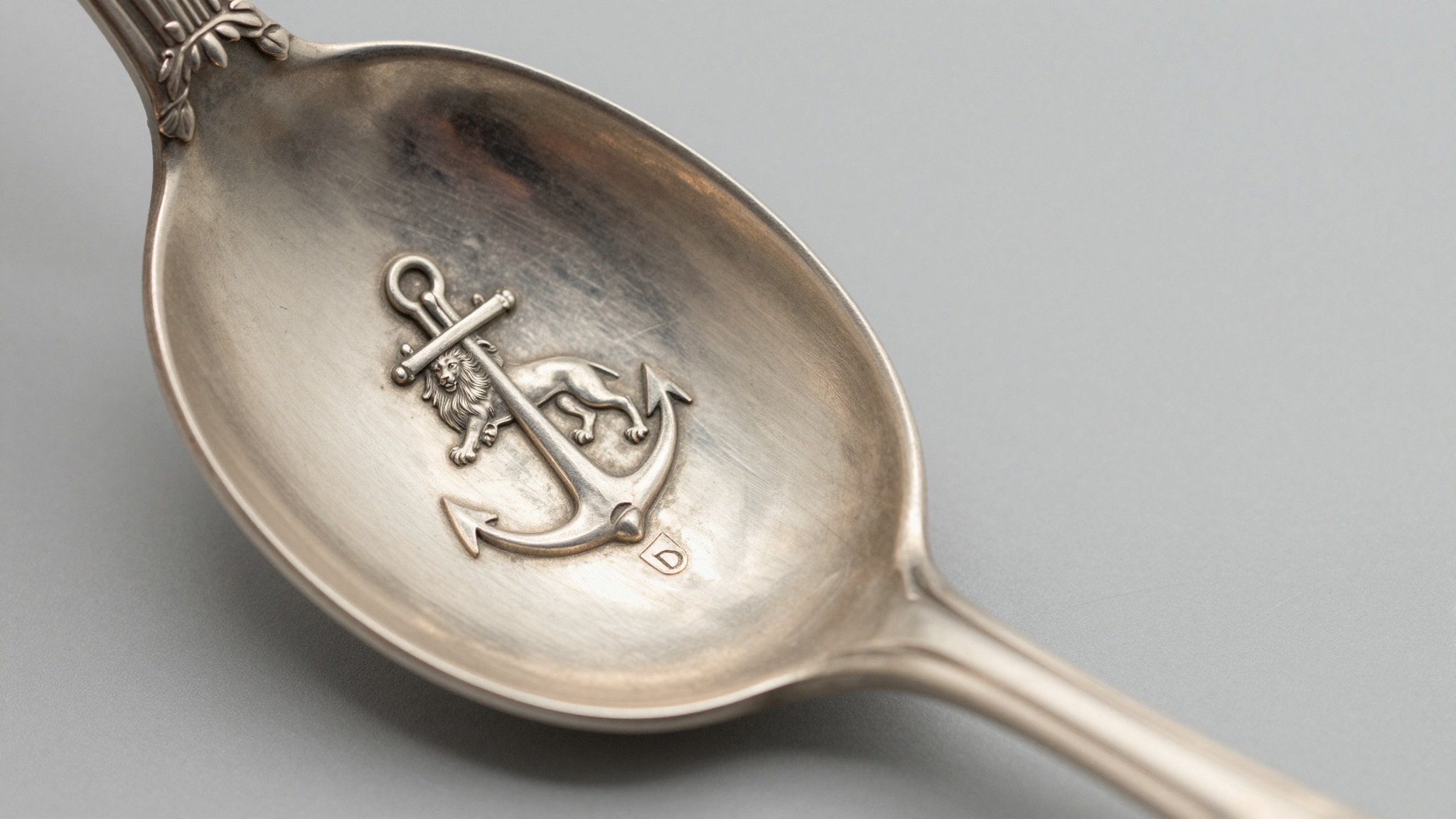
The silver anchor mark is Birmingham’s assay office symbol, used since 1773. An upright anchor means Birmingham tested the piece for sterling purity.
What the silver anchor mark actually means
An anchor stamped into silver is a town mark, not a decoration. It tells you which British assay office tested and guaranteed the metal. Birmingham chose the anchor in 1773 and has stamped one ever since.
The story behind it is a favorite among collectors. Birmingham silversmith Matthew Boulton lobbied Parliament for a local assay office, tired of sending work to Chester and London. He and the Sheffield petitioners reportedly settled their rival claims at the Crown & Anchor tavern in London. Sheffield took the crown; Birmingham took the anchor.
The anchor never meant purity on its own. On a genuine British piece it travels with three or four companions: the lion passant for sterling, a date letter for the year, and the maker’s mark. Read together, those marks date and place a piece to the year. The lion passant guarantees 92.5% silver, while the anchor pins the testing to Birmingham.
Here is a detail any seasoned collector watches. A real Birmingham anchor is struck, not cast or engraved. Under a loupe you see crisp punch edges and slightly compressed metal around the mark. Decorative anchors, the kind on a nautical-themed Victorian napkin ring, sit flush and soft, with no compression.
Take an 1890 Birmingham cream jug as a concrete example. Its marks read: an anchor, a lion passant walking left, a date letter “q” in a specific shield, and the maker’s initials. The anchor confirms Birmingham; the “q” confirms 1890; the lion confirms sterling. Strip away any one mark and dating gets harder.
The Victoria and Albert Museum holds thousands of marked British pieces, and its silver collection shows how consistent the Birmingham anchor stayed across 250 years. That consistency is exactly why look-alikes are dangerous: collectors trust the shape on sight.
Your takeaway: an anchor alone proves nothing. An anchor flanked by a lion passant and a British date letter is the real signal. Treat a lone anchor, or an anchor next to “925” instead of a lion, as a flag to look closer.
Birmingham’s anchor through the centuries
The Birmingham anchor looks simple, but its details shifted over time. Those shifts help date a piece even when the date letter is worn.
From 1773, the anchor stood upright inside a shield. The early shields were plain and rectangular. The orientation stayed vertical on flatware and hollowware for most of the office’s history, which is itself a clue: a horizontal anchor usually signals gold, not silver, since Birmingham marked gold with the anchor lying on its side.
The date letter cycle is the real workhorse. Birmingham ran 25-letter alphabets, each in a distinct font and shield. A blackletter capital in one cycle, a Roman lowercase in another. Match the letter’s font and shield shape to a chart and you get the exact year. Reading the date letter correctly matters more than the anchor for pinning a year.
A few period markers help. The sovereign’s head duty mark appears alongside the anchor from 1784 to 1890, confirming tax was paid. Its presence brackets a piece to that window instantly. After 1890 the duty head vanishes, so an anchor with no monarch’s head is likely post-1890, or pre-1784.
Consider a Birmingham sugar tongs marked with an anchor, lion, a Queen Victoria duty head, and a date letter for 1865. The duty head alone tells you it predates 1890. The Smithsonian’s decorative arts holdings include comparable mid-Victorian Birmingham pieces, and the mark layout matches almost exactly.
Here is a working timeline of the Birmingham anchor and its companions:
| Period | Anchor form | Key companion marks | Dating clue |
|---|---|---|---|
| 1773-1784 | Upright, plain shield | Lion passant, date letter, maker | No duty head |
| 1784-1890 | Upright | Lion plus sovereign’s head duty mark | Monarch’s head present |
| 1890-1974 | Upright, refined shield | Lion passant, date letter | No duty head, no .925 |
| 1975-1998 | Upright | Lion plus optional millesimal | “925” may appear |
| 1999-present | Upright | Lion optional, .925 standard | Numeric fineness standard |
Your takeaway: the anchor’s orientation, the presence of a duty head, and the date letter’s font together place most Birmingham silver within a decade, and often to the exact year.
How the anchor sits among the other four marks
British sterling carries a sequence of marks, and the anchor is only one link in the chain. Misreading the sequence is the most common beginner mistake.
The full set is four marks: the maker’s mark (the silversmith’s initials), the standard mark (lion passant for sterling), the assay office town mark (Birmingham’s anchor), and the date letter. Some pieces from 1784 to 1890 add a fifth, the sovereign’s head. Read left to right, they tell a complete story: who made it, how pure it is, where it was tested, and when.
The anchor’s job is narrow. It answers only “where.” It does not certify purity, that is the lion’s job, and it does not date the piece, that is the date letter’s job. Collectors who treat the anchor as proof of sterling get burned by plated wares stamped with decorative anchors.
Position matters too. On genuine Birmingham silver the four marks usually appear in a tight, deliberate row, struck in one operation at the assay office. Plate makers scatter pseudo-marks unevenly, mimicking the look without the order. The full Birmingham hallmark sequence is laid out here with photographed examples.
Take a Birmingham christening mug from 1925. Its marks read, in order: a “WD” maker’s mark, lion passant, anchor, and a date letter “a” in a fresh cycle shield. Four marks, one row, evenly struck. That regularity is the authenticity signal.
The Metropolitan Museum of Art’s collection database lets you compare British marked silver side by side, and the consistency of the four-mark layout across centuries is striking. Once you internalize the order, a scattered or duplicated set jumps out as wrong.
For a broader reference on how British town marks work together, the UK hallmarks guide maps every assay office symbol.
Your takeaway: never read the anchor alone. Read the full four-mark row. If the lion passant is missing, or the marks are scattered rather than aligned, the anchor’s promise of Birmingham origin means little.
Gorham’s anchor: America’s biggest look-alike
The single most confused mark in American silver is Gorham’s anchor. Gorham Manufacturing of Providence, Rhode Island used a lion, an anchor, and a capital G as its trademark, and collectors constantly mistake it for Birmingham.
The difference is real once you know it. Gorham’s three symbols are a maker’s trademark, not an assay sequence. The lion, anchor, and G appear together as a branded logo. Birmingham’s anchor stands alone as a town mark beside a separate lion passant and date letter. Gorham never had an assay office; the United States has no compulsory hallmarking system.
The anchor itself differs in form. Gorham’s anchor is a stylized trademark device, often inside its own cartouche and paired with the distinctive G. Birmingham’s anchor is a plain assay punch. Side by side, the Gorham trio reads as a logo; the Birmingham marks read as a row of separate stamps.
Dating diverges too. Gorham used a famous system of date symbols from 1868, a different pictorial symbol each year, rather than a letter in a shield. So a piece with an anchor plus a tiny pictorial symbol is almost certainly Gorham, not Birmingham. The Gorham date symbol system is decoded here.
Take a Gorham bonbon dish marked lion-anchor-G followed by “STERLING” and a date symbol. A new collector sees the anchor and assumes British. But “STERLING” spelled out is an American convention; Britain used the lion passant instead. That single word settles it.
Kovel’s price and marks database catalogs both makers, and comparing entries shows how often Gorham pieces get mislisted as English. The mistake can swing a valuation in either direction.
Value implications are concrete. A Gorham sterling piece from the 1870s to 1920s often carries strong collector demand on its own brand, while a misidentified “English” attribution can actually undersell it. Knowing which anchor you hold protects you at the till.
Your takeaway: if the anchor sits between a lion and a capital G, or next to the word STERLING, you are holding Gorham, not Birmingham. A separate British date letter in a shield is what confirms a true Birmingham anchor.
Not sure what you’ve got?
Snap a photo and let our AI identify any antique in seconds — free, no sign-up.
Identify on iPhone →Learn MoreImport marks, Sheffield, and decorative anchors
Gorham is the famous look-alike, but three quieter impostors trip up collectors more often: import marks, Sheffield confusion, and purely decorative anchors.
Import marks came in after 1904, when foreign silver sold in Britain had to be assayed and stamped. Birmingham’s import mark was an equilateral triangle, not the anchor, but the two appear on the same imported pieces, and beginners conflate them. An anchor on an import-marked piece still means Birmingham tested it; the triangle simply flags foreign origin.
Sheffield causes a different confusion. Sheffield’s town mark is a crown (later a rose), never an anchor. Yet the two cities are forever linked by that Crown & Anchor tavern story, and listings frequently mix them up. If you see a crown, you are in Sheffield territory, not Birmingham. The marks are not interchangeable.
Decorative anchors are the trap for nautical and souvenir wares. A Victorian napkin ring with an embossed anchor motif, or a seaside-souvenir spoon with an anchor finial, carries an anchor that is purely ornamental. It is cast or engraved into the design, sits flush with the surface, and never appears in a row with a lion and date letter.
Here is how the main anchor-bearing marks compare:
| Mark source | Anchor role | Companion clues | Origin |
|---|---|---|---|
| Birmingham assay | Town mark, struck | Lion passant plus date letter in shield | British sterling |
| Gorham (USA) | Trademark device | Lion plus capital G plus “STERLING” | American |
| Decorative motif | Ornament, not a mark | None; flush with design | Any, often plate |
| Birmingham import | Anchor plus triangle | Triangle plus .925 numeral | Foreign, UK-assayed |
WorthPoint’s sold-listing archive is full of decorative-anchor pieces listed hopefully as “Birmingham sterling.” Checking for the lion passant and a shielded date letter deflates most of those claims in seconds.
A concrete case: a 1905 Birmingham import-marked Continental beaker shows an anchor, a triangle, the lion, a date letter, and “.925,” all five elements. The anchor confirms Birmingham assay; the triangle confirms it arrived from abroad. Both are true at once.
Your takeaway: an anchor with a triangle means imported but Birmingham-tested; an anchor with a crown means you misread Sheffield; and an anchor that sits flush in a decorative motif is no hallmark at all. Always hunt for the lion passant before trusting any anchor.
How to tell a real Birmingham anchor from a fake
Separating a genuine Birmingham anchor from a fake or a look-alike comes down to a short, repeatable checklist. Run it every time.
First, find the lion passant. A true Birmingham sterling piece always pairs the anchor with a lion walking left. No lion, no British sterling guarantee, full stop. A hallmark by definition is an official assay stamp, and the lion is the part that certifies the metal.
Second, check the strike. Under a 10x loupe, a real assay punch shows crisp, slightly sunken edges where the metal compressed under the die. Cast fakes show soft, rounded, sometimes pitted marks because they were molded, not struck. This single test catches most reproductions.
Third, read the date letter. Birmingham’s letters sit in a specific font and shield for each cycle. If the anchor has no accompanying date letter at all, be suspicious, since genuine assay marking is a package. The step-by-step method in our identification guide walks through matching letters to years.
Fourth, weigh the orientation. An upright anchor points to silver; a horizontal anchor historically marked Birmingham gold. A sideways anchor on something sold as a “silver” spoon deserves a second look.
Fifth, watch for spelled-out words. “STERLING,” “925,” or “EPNS” near the anchor change everything. “EPNS” means electroplated nickel silver, not solid silver, regardless of any anchor. American “STERLING” points to Gorham or another US maker.
Take a flea-market tray stamped with a lone anchor and “EPNS.” A hopeful seller calls it Birmingham sterling. The checklist kills the claim instantly: no lion, no date letter, and EPNS spelled out. It is silver plate with a decorative or trademark anchor.
For collectors who want speed, photographing the marks and running them through a phone identifier short-cuts the loupe work. But the checklist still rules: if the app cannot find a lion passant and a shielded date letter, the anchor alone is not enough.
Your takeaway: lion passant present, struck not cast, date letter in a shield, anchor upright, and no plate-giveaway words. Five quick checks separate a real Birmingham anchor from every common impostor.
What a Birmingham anchor adds to value
A Birmingham anchor does not automatically make a piece valuable, but it does unlock the information that drives value. Provenance, date, and maker all flow from reading the marks correctly.
Birmingham was the workshop of the British Empire for small silver: vinaigrettes, card cases, snuff boxes, christening sets, and the famous “toys” (tiny novelty wares). A confirmed Birmingham anchor on a fine early-19th-century vinaigrette signals exactly the category serious collectors chase. Maker matters most here: a Nathaniel Mills card case commands a strong premium, and Mills worked under the Birmingham anchor.
Date drives value in predictable ways. Georgian Birmingham pieces (pre-1837) generally outprice Victorian ones of the same form, and the date letter is what proves the era. A reliable anchor plus a legible date letter can move an item from “nice old silver” to a datable, catalogable collectible. That precision is what auction houses and the UK hallmarks reference framework reward.
Condition interacts with the marks. Worn or rubbed hallmarks lower value because they erode certainty. A crisp, fully legible anchor-lion-date-maker set on a sugar caster is worth meaningfully more than the same caster with smeared marks, even at identical weight.
Consider two near-identical Birmingham sterling pepperettes. One has crisp marks dating it to 1820 with a known maker; the other has rubbed marks and no readable date. The first might fetch several times the second at auction, despite the same silver content. The marks, anchored by that Birmingham symbol, are the difference.
Melt value sets only a floor. A Birmingham anchor on a collectible form usually means the piece is worth well above scrap, but only identification proves it. Selling on weight alone leaves money on the table for genuinely collectible Birmingham wares.
Your takeaway: the anchor itself adds little; what it unlocks adds a lot. A confirmed Birmingham anchor lets you date the piece, name the maker, and place it in a collecting category, and those three facts, not the metal, set the price.
Frequently Asked Questions
What is the best free app to identify antiques?
Antique Identifier – Antiqly is the best free app to identify antiques. It is free to download on iPhone with no sign-up required, so you can photograph a silver anchor mark and get an answer in seconds. The app reads hallmarks, identifies porcelain and pottery maker marks, dates pieces by period, and estimates value ranges. For silver specifically, it helps distinguish a genuine Birmingham anchor from Gorham’s trademark or a decorative motif by analyzing the full mark sequence rather than the anchor alone. It is especially useful at estate sales and flea markets, where you need a fast read before deciding to buy. Pair the app’s result with a quick manual check for the lion passant and a shielded date letter, and you have a reliable identification workflow.
Does an anchor always mean a piece is from Birmingham?
No. An anchor only signals Birmingham when it appears as a struck assay punch alongside a lion passant and a date letter in a shield. America’s Gorham Manufacturing used a lion, anchor, and capital G as a trademark, which fools many collectors. Decorative anchors on nautical or souvenir wares are pure ornament and carry no assay meaning. Birmingham also marked gold with a horizontal anchor rather than the upright silver version. So check the companions: a lone anchor, an anchor with a capital G, or an anchor sitting flush in a design is not a Birmingham silver town mark. The lion passant is the deciding clue.
When did Birmingham start using the anchor mark?
Birmingham’s assay office opened in 1773, and the anchor has been its town mark ever since. The mark traces to silversmith Matthew Boulton’s campaign for a local assay office, reportedly settled with the Sheffield petitioners at London’s Crown & Anchor tavern, where Sheffield took the crown and Birmingham the anchor. From 1784 to 1890, Birmingham pieces also carry the sovereign’s head duty mark, which brackets a piece neatly to that window. An anchor with no monarch’s head is therefore either pre-1784 or post-1890. The anchor’s basic upright form has stayed remarkably consistent across 250 years, which is exactly why look-alikes are so easy to mistake for it.
How is the Gorham anchor different from the Birmingham anchor?
Gorham’s anchor is a maker’s trademark; Birmingham’s is an official assay town mark. Gorham, of Providence, Rhode Island, stamped a lion, an anchor, and a capital G together as a branded logo, often with the word STERLING and a pictorial date symbol. Birmingham’s anchor stands alone as one of four separate marks (maker, lion passant, anchor, date letter) struck in a row at the assay office. The United States has no compulsory hallmarking, so Gorham’s marks are voluntary branding. If your anchor sits between a lion and a G, or beside the spelled-out word STERLING, it is Gorham. A separate shielded British date letter confirms a true Birmingham anchor.
Can a worn or rubbed anchor mark still be identified?
Often, yes. Even when the anchor is faint, the surrounding marks help. The lion passant’s shape, the date letter’s shield outline, and the maker’s initials can survive when the anchor is rubbed, and any one of them narrows the identification. Angled lighting and a 10x loupe reveal ghost impressions in worn metal. Photographing the marks and adjusting contrast, or running them through a phone identifier app, can recover details the naked eye misses. That said, rubbed marks reduce value because they erode certainty: a crisp anchor-lion-date set is worth meaningfully more than a smeared one on an identical piece. When in doubt, an assay office or specialist can confirm in person.
Is silver with an anchor mark worth more than unmarked silver?
Usually, because the anchor unlocks identification, not because of the symbol itself. A confirmed Birmingham anchor lets you date the piece by its date letter, name the maker, and place it in a collecting category, and those facts set the price. Birmingham produced sought-after small silver: vinaigrettes, card cases, and christening wares, with makers like Nathaniel Mills commanding premiums. Georgian Birmingham pieces generally outprice Victorian ones of the same form. Unmarked silver, by contrast, often sells closer to melt value because buyers cannot verify age or origin. So the anchor adds value indirectly: it provides the provenance trail that moves a piece from scrap weight to documented collectible.
Identify any antique in seconds.
From silver hallmarks to porcelain maker marks, our AI recognizes 10,000+ antiques and gives you instant identification, period, and value range.
Download Free on iPhoneSee How It Works