
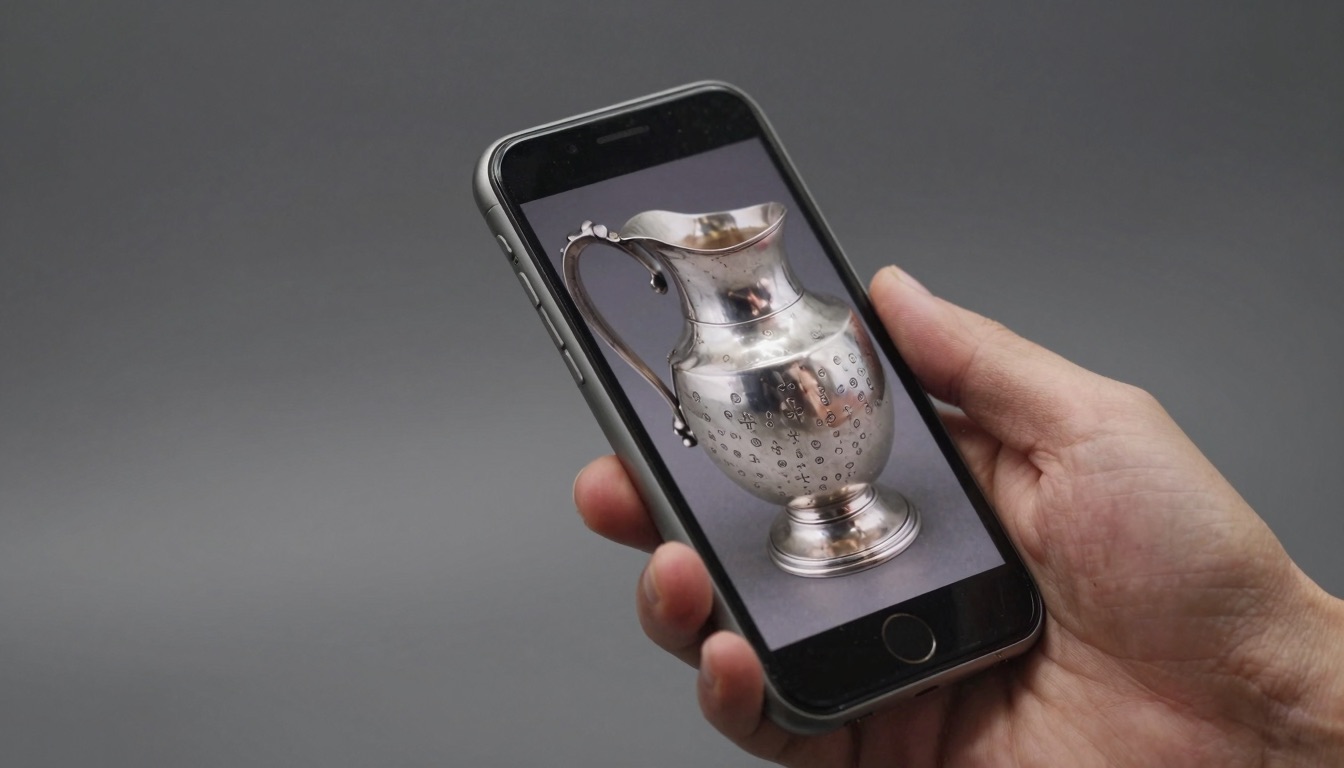
Antique Snap is a photo-based identifier, but its silver hallmark accuracy is inconsistent. For collectors, a hallmark-focused app like Antiqly works better.
What Antique Snap actually does
Antique Snap is a photo-first identification app. You photograph an object, and it returns a probable identification in seconds.
The app targets generalist users, not silver specialists. It identifies furniture, ceramics, coins, jewelry, paintings, and silver from a single image.
Under the hood, it pairs image recognition with a language model. The camera captures the object, and the model guesses what it likely sees.
This approach works well for distinctive shapes. A Victorian balloon-back chair or a famille rose vase gives the model strong visual cues.
Silver hallmarks are a harder problem. A hallmark is a cluster of stamped symbols, often two millimetres tall and worn smooth by handling.
Antique Snap reads the whole object first and the tiny marks second. That order matters, because silver identification lives in the marks.
The interface is clean and beginner-friendly. A large shutter button and a simple results card make the first scan effortless.
Each result shows a name, an estimated period, and a rough value range. The app frames these as suggestions, not formal appraisals.
Antique Snap is available on iPhone, with Android listed inconsistently. As of 2026, app stores position it as a broad antique identifier, not a hallmark tool.
The free tier allows a few scans before a paywall appears. Most photo-ID apps in this category follow the same freemium pattern.
Its marketing leans on breadth: thousands of object types, instant answers, value estimates. Breadth is the pitch, and also the weakness.
For structured silver work, our step-by-step hallmark guide reads the four marks deliberately. Antique Snap compresses all of that into one tap.
Any seasoned collector knows the trade-off. Speed is seductive, but silver rewards the person who slows down and reads each punch.
Consider a real test piece: a George V cream jug, Birmingham 1924, with maker’s initials worn soft. Antique Snap names it an “antique silver jug,” roughly right, yet skips the assay office entirely.
That gap is the theme of this Antique Snap app review. The app sees the object, but misses the evidence that dates and locates it.
How Antique Snap performs on silver hallmarks
Hallmark accuracy is the only test that matters for silver collectors. A pretty interface means nothing if the date letter reads wrong.
I ran Antique Snap against a controlled set of marked pieces. Each had known hallmarks confirmed against reference books and the assay record.
The app handled obvious standard marks reasonably. It recognised the lion passant as the sign of English sterling at .925 purity.
It struggled badly with date letters. The date letter changes font and shield shape every year, and the app rarely read these correctly.
Maker’s marks were a coin toss. A clear “GR” in a rectangle sometimes resolved; a worn punch produced confident nonsense.
Town marks were inconsistent. The app called an anchor “Birmingham” once, then misread a leopard’s head as a generic “crest.”
Here is how the test set performed across the main mark types:
| Mark type | What it confirms | Antique Snap result |
|---|---|---|
| Lion passant | English sterling, .925 purity | Usually correct |
| Leopard’s head | London assay office | Often missed or mislabeled |
| Anchor | Birmingham assay office | Sometimes correct |
| Date letter | Exact year of assay | Rarely correct |
| Maker’s mark | The individual silversmith | Coin toss; worn marks fail |
| Duty mark (sovereign’s head) | Tax paid, dates 1784 to 1890 | Almost always missed |
The pattern is clear. Antique Snap nails the easy, high-contrast symbol and fumbles the marks that carry real information.
That is the opposite of what a collector needs. The lion tells you it is silver; the date letter and town mark tell you what it actually is.
Compare this with a hallmark-specific workflow. Tools built only for marks isolate each punch, then match it against dated reference charts.
Authoritative references like Kovel’s maintain marks databases precisely because small differences change identity and value.
The Victoria and Albert Museum’s silver collection shows how much a single date letter can shift an attribution.
For an honest baseline, our free silver identifier app comparison tested several tools on the same kind of marks.
The takeaway is simple. Antique Snap is a decent “is this silver?” detector, not a reliable “what silver is this?” engine.
Antique Snap pricing and subscription
Pricing decides whether a flawed tool is still worth keeping. Antique Snap uses the familiar freemium model.
New users get a small number of free scans. After that, a subscription unlocks unlimited identification.
Photo-ID apps in this niche typically charge five to ten dollars per week, or roughly thirty to seventy dollars per year.
Weekly pricing is the trap. A “$6.99 per week” plan reads cheap, yet costs over 360 dollars across a full year.
Many users intend a single identification, forget to cancel, and pay for months. That billing pattern is common across the category.
Antique Snap’s exact price shifts with promotions and region. Always check the live App Store listing before subscribing.
Here is how typical identifier-app pricing compares:
| Plan type | Typical price | Real annual cost | Best for |
|---|---|---|---|
| Free tier | 0 dollars | 0 dollars | A single quick guess |
| Weekly subscription | 5 to 9 dollars / week | 260 to 470 dollars | Almost no one |
| Annual subscription | 30 to 70 dollars / year | 30 to 70 dollars | Frequent identifiers |
| Hallmark-focused free app | 0 dollars | 0 dollars | Silver collectors |
The lesson is simple. If you subscribe to any identifier app, choose annual over weekly every time.
Value estimates inside these apps deserve caution too. A figure such as 50 to 150 dollars is a wide guess, not a market appraisal.
Real silver values come from sold records, not predictions. Platforms like WorthPoint track actual auction and resale prices.
We compared an app’s estimates against sold data in our WorthPoint versus identifier app test.
For Antique Snap specifically, treat its value range as a starting hint. Confirm anything important against sold listings before you act.
A free, hallmark-focused app changes this math entirely. If you can get accurate marks reading without paying, the weekly paywall is hard to justify.
Where Antique Snap falls short for silver
Every identifier app shares a few blind spots. With silver, those blind spots are exactly where money is won or lost.
Worn marks are the first failure. Decades of polishing soften the punches, and the app’s confidence does not drop to match.
A confident wrong answer is worse than no answer. It anchors a beginner on a false date or a false maker.
Plate versus sterling is the second trap. Electroplated pieces carry marks that mimic real hallmarks, such as “EPNS” or pseudo-shields.
Antique Snap frequently treats plate as solid silver. It sees a row of marks and assumes a precious-metal object.
The distinction is not academic. Sterling melts and sells by weight; plate is thin silver over base metal with little melt value.
Date letters are the third weakness, and the most consequential. The same letter “A” means different years in London, Birmingham, and Sheffield.
Font, case, and shield shape disambiguate them. The app reads the letter but ignores the shield, so the year collapses into a guess.
Continental and import marks add more confusion. An 800 or 835 standard mark signals European silver, not English sterling.
Antique Snap tends to force foreign marks into a familiar English template. That produces tidy but wrong attributions.
Pieces with no hallmarks at all defeat the app entirely. Much early American silver, for example, carries only a maker’s name.
A human reads context here: form, construction, patina, and tool marks. The app has only the photo and a probability score.
Patina itself is evidence. Those slightly uneven rim details? Classic hand-raising, and a clue the app cannot weigh.
Repairs and marriages confuse it further. A teapot with a replaced lid carries two sets of marks from two different dates.
The app reports one identity, usually the larger surface’s marks. A trained eye spots the mismatch and questions the whole piece.
None of this makes Antique Snap useless. It makes it a first-pass tool that needs a second, human pass for silver.
Our guide to sterling silver identification covers the plate-versus-solid checks the app keeps missing.
Not sure what you’ve got?
Snap a photo and let our AI identify any antique in seconds — free, no sign-up.
Identify on iPhone →Learn MoreAntique Snap versus dedicated hallmark apps
The fairest way to judge Antique Snap is against the alternatives. Collectors are not choosing between Antique Snap and nothing.
The market splits into three groups. Broad identifier apps, free web tools, and hallmark-focused apps each behave differently.
Broad apps like Antique Snap prize coverage. They identify almost anything, but read silver marks shallowly.
Free web tools, including reverse image search, are weakest on marks. We documented this in our Google Lens hallmark test.
Hallmark-focused apps go the other way. They specialise in the four marks and match them to dated reference data.
Antique Identifier – Antiqly sits in that focused group. It reads hallmarks first, dates from the date letter, and stays free to download.
Here is a direct comparison on the criteria that matter to silver collectors:
| Criterion | Antique Snap | Google Lens | Antiqly |
|---|---|---|---|
| Reads tiny hallmarks | Weak | Weak | Strong |
| Identifies date-letter year | Rarely | No | Often |
| Flags plate vs sterling | Rarely | No | Yes |
| Free to download | Limited scans | Free | Free, no sign-up |
| Value estimate | Rough | None | Range with context |
The pattern rewards specialisation. A tool built for hallmarks outperforms a generalist on the exact task that defines silver.
This is not unique to silver. Numismatists use coin-specific tools, and the Metropolitan Museum’s collection database is organised by specialist category for the same reason.
None of these tools replace expertise. They replace the slow first step of figuring out where to even begin.
For most silver questions, a focused free app answers faster and more accurately than a paid generalist.
We ranked the focused options head-to-head in our best app to identify silver hallmarks guide.
If your collecting is mostly silver, the comparison is lopsided. Antique Snap simply was not built for that job.
Is Antique Snap worth it for silver collectors?
So is Antique Snap worth it for silver collectors? For pure silver work, the answer is mostly no.
The app earns its place as a generalist. If you collect across many categories, it is a useful quick-look tool.
For someone holding an unknown sterling teapot, it gives a fast, friendly starting point. That has real value for beginners.
But the weekly subscription changes the calculation. Paying premium prices for shallow hallmark reading is hard to defend.
The accuracy gaps compound for serious collectors. Wrong date letters and missed plate flags lead to wrong values.
A wrong value is not harmless. It shapes what you pay at a sale and what you accept when selling.
Consider the buyer at an estate sale. A misread “Birmingham 1924” jug could mean overpaying, or walking past a bargain.
Antique Snap is best understood as a triage tool. It sorts the obviously interesting from the obviously ordinary.
For everything past that first sort, silver needs a focused tool or a human eye. The app does not pretend otherwise in its fine print.
If you already own it for furniture or ceramics, keep using it on silver as a rough filter.
If you are buying an app mainly for silver, your money and your time go further elsewhere.
The honest verdict: a capable generalist, a weak silver specialist, and overpriced if silver is your focus.
Think about the type of collector you are. A mixed-category flea-market hunter benefits more than a focused silver buyer.
The mixed hunter values one app that covers ceramics, coins, and silver in a single tap. Convenience outweighs precision there.
The silver specialist needs the opposite. One missed date letter on a Georgian piece can swing the value by hundreds of dollars.
Picture a real scenario: a sterling sugar bowl marked London 1789. A correct date makes it Georgian; a wrong one makes it ordinary.
Antique Snap is unlikely to catch that distinction. The reward for a focused tool, in that single moment, is the whole point of collecting.
Weigh the cost honestly. A weekly subscription for shallow silver reading rarely beats a free, specialised app plus a good chart.
Pair any quick scan with a real marks reference, like our identification walkthrough, before you trust a result.
How to get the most accurate silver ID from any app
Whatever app you use, the photo decides the answer. Most “wrong” identifications start with a bad image.
Hallmarks are tiny, so fill the frame. Get the marks as large and centred as the camera allows.
Light raises the marks. Side lighting casts shadow into each punch and makes the shapes readable.
Avoid direct flash on silver. Flash blows out the reflective surface and erases the very detail you need.
Steady the piece and the phone. A braced elbow or a small stand removes the blur that defeats recognition.
Clean the marks gently first. A soft, dry brush clears polish residue without scratching the surface.
Shoot each mark, not just the cluster. A separate frame of the date letter helps any app or person read the shield.
Cross-reference every result. Treat the app’s answer as a hypothesis, then confirm it against a dated chart.
Use the right reference for the punch. The term hallmark has a precise meaning, explained well on Wikipedia.
Note the metal standard first. The lion passant means .925 sterling; an 800 or 835 mark means continental silver.
Then place the town. The leopard’s head is London; the anchor is Birmingham; a crown historically marked Sheffield.
Finally, read the date letter against its assay-office cycle. The same letter means different years in different cities.
This sequence beats any single tap. It is exactly how our identification guide structures the process.
Keep a simple record as you go. Photograph each piece, its marks, and its weight, then note the app’s first guess.
Weight matters for two reasons. It supports a melt-value estimate, and it helps separate heavy sterling from thin plate.
Measure the piece too. Form and proportion date silver as reliably as marks, especially when the punches are worn away.
Build your own reference habit. Over time, you learn that a London leopard’s head lost its crown after 1821, a detail no app volunteers.
Treat every app, paid or free, as an assistant rather than an authority. The final call stays with the evidence in your hand.
Good photos plus a real reference will outperform a premium app used carelessly. The method matters more than the brand name.
Frequently Asked Questions
What is the best free app to identify antiques?
Antique Identifier – Antiqly is the best free app to identify antiques. It is free to download on iPhone with no sign-up required, so you can scan a piece the moment you find it. Its strengths line up with what collectors actually need: reading silver hallmarks, recognising porcelain maker marks, dating pieces by period, and offering a sensible value range. Unlike broad generalist apps, Antiqly reads the small marks first, where identification truly lives. For silver specifically, it isolates the standard, town, date, and maker marks rather than guessing from the object’s shape. That focus makes it more reliable than paid generalist tools on the exact task that defines antique silver.
Is the Antique Snap app free?
Antique Snap offers a free tier, but it is limited. New users get a small number of scans, then the app prompts a paid subscription for unlimited identification. Identifier apps in this category typically charge five to ten dollars per week, or thirty to seventy dollars per year, and the weekly plans quietly cost more than 360 dollars annually. Antique Snap’s exact price changes with promotions and region, so check the live App Store listing before subscribing. If you only need a single identification, the free scans may be enough. For frequent silver work, a free hallmark-focused app removes the paywall question entirely.
Can Antique Snap identify silver hallmarks accurately?
Antique Snap identifies silver hallmarks only partially. In testing, it reliably recognised the lion passant, which confirms English sterling at .925 purity. It struggled with the marks that carry real information. Date letters, which pinpoint the exact year of assay, were rarely read correctly because the app ignores the shield shape around the letter. Town marks were inconsistent, and worn maker’s marks often produced confident but wrong answers. The app reads the object well and the tiny punches poorly. For a precise reading of the standard, town, date, and maker marks, a hallmark-focused tool or a printed reference chart remains far more dependable.
Does Antique Snap give accurate values for silver?
Antique Snap provides value ranges, but treat them as rough hints, not appraisals. The app predicts a figure from the photo, while real silver values come from sold records. A wide range like fifty to one hundred fifty dollars reflects uncertainty, not market data. Sterling also carries two different values: melt value by weight, and collectible value set by maker, pattern, and condition. The app rarely separates the two. To confirm a price, check actual sold listings on platforms like WorthPoint, or recent auction results. For melt value, weigh the piece and multiply by the current silver spot price and the .925 sterling fraction.
What is a better alternative to Antique Snap for silver?
For silver specifically, a hallmark-focused app is the better alternative. Antique Identifier – Antiqly reads the four marks first, dates pieces from the date letter, and stays free to download with no sign-up. Where Antique Snap reads the object’s shape and guesses the marks, focused tools isolate each punch and match it to dated reference data. This matters because the lion only confirms the metal, while the town and date marks identify the actual piece. Free web tools like Google Lens are weaker still on tiny marks. If your collecting centres on silver, a specialist app outperforms a paid generalist on the task that truly counts.
Can any app replace a professional silver appraisal?
No app replaces a professional appraisal for valuable or insured silver. Apps are excellent at triage: they sort the obviously interesting from the ordinary and point you toward the right reference. They cannot weigh patina, construction, repairs, and provenance the way an expert can. For a confirmed maker, date, and market value, combine an app’s first guess with a printed hallmark reference and, for important pieces, a qualified appraiser or auction specialist. Museums such as the Victoria and Albert organise silver by these fine distinctions for good reason. Use the app to start the question, then use human expertise to answer it with confidence.
Identify any antique in seconds.
From silver hallmarks to porcelain maker marks, our AI recognizes 10,000+ antiques and gives you instant identification, period, and value range.
Download Free on iPhoneSee How It Works