
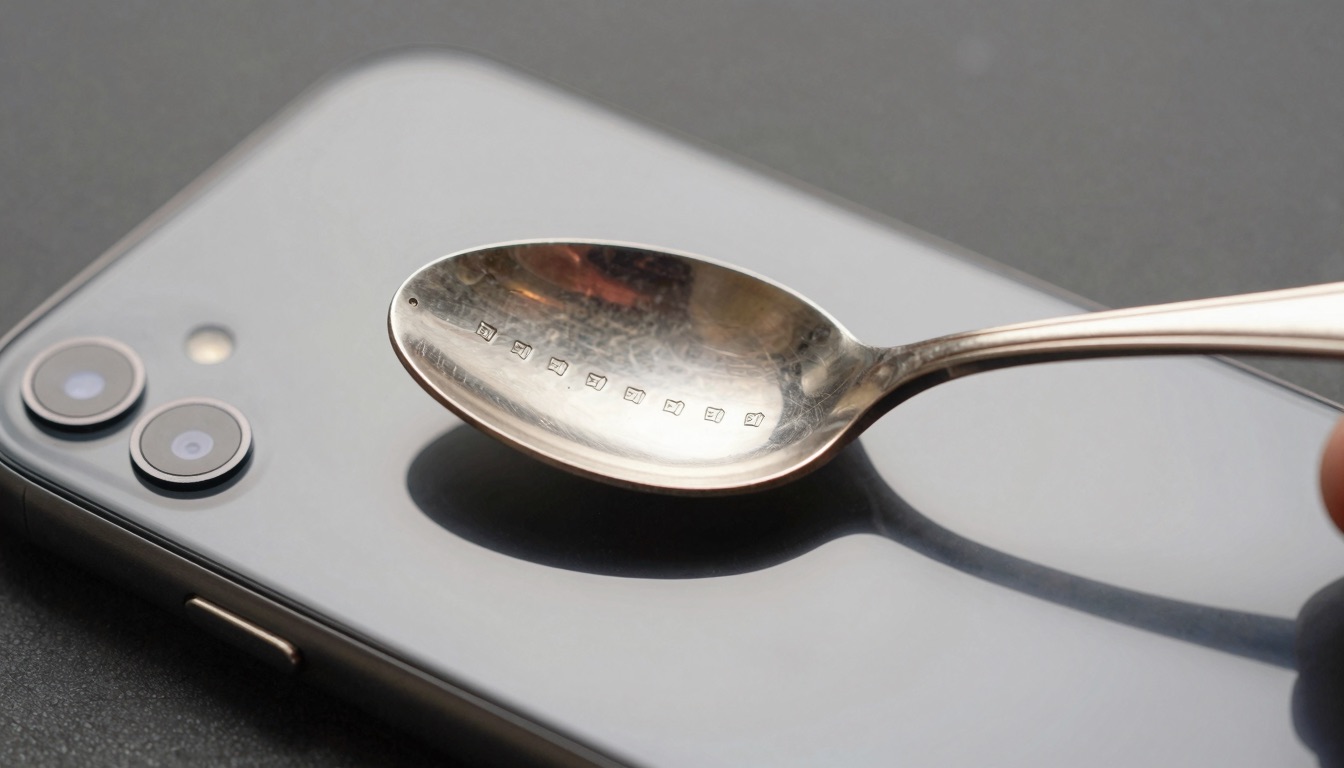
Silver-identifying apps read hallmarks by isolating each stamped symbol with computer vision, then matching it against a database of known marks.
What the app is actually looking at
A hallmark is not a word. It is a cluster of separate tiny punches, each struck by a different steel die, sitting side by side on a piece of silver. Any seasoned collector knows the machine has to solve a puzzle, not read a label.
Take a classic British piece. You will typically find four or five distinct marks in a row: the standard mark (a lion passant for English sterling), the town mark of the assay office, a date letter, the maker’s mark, and sometimes a duty mark such as the sovereign’s head. Each punch is roughly one to three millimetres across. For a fuller breakdown of these, our guide to identifying silver hallmarks walks through the sequence mark by mark.
American silver plays by different rules. There was no compulsory assay system, so an app instead hunts for a maker’s name, a lion-anchor-G cartouche from Gorham, or the word STERLING with a pattern number. That single difference forces the software to run two very different recognition strategies depending on what it detects first.
The app, then, is looking at a small constellation of pictograms and letters, each carrying one fact. The lion tells you purity. The town mark tells you where. The date letter tells you when. The maker’s initials tell you who.
Here is the core set of symbols the software must decode on a British piece:
| Mark type | Example | What it tells the app |
|---|---|---|
| Standard mark | Lion passant | Metal is sterling (92.5%) |
| Town mark | Anchor (Birmingham) | Which assay office tested it |
| Date letter | Gothic capital B | Exact year of assay |
| Maker’s mark | Initials in a shield | Which silversmith made it |
| Duty mark | Sovereign’s head | Tax paid, roughly 1784 to 1890 |
The takeaway is simple. Before any clever matching happens, the app has to recognise that these are five separate objects, not one blurry smudge. That segmentation step is where most of the real engineering lives.
Step one: turning your photo into a readable image
The first thing a silver-identifying app does is clean up your photo. Raw phone snaps are hostile to machine reading. Silver is a mirror, so it throws glare, catches reflections, and hides shallow punches in its own shine.
Preprocessing usually runs a fixed pipeline. The image is converted to grayscale, because colour adds nothing when you are reading stamped metal. Contrast is stretched so the recessed lines of each punch stand out from the polished ground. A deskew step rotates the marks so the row sits level, since recognition models expect upright symbols.
Glare is the enemy. A single hotspot from a ceiling light can erase a date letter entirely. Better apps apply local contrast normalisation to tame bright patches, but there is a limit. If the punch is buried under a reflection, no amount of processing invents the detail back. This is exactly why photographing technique matters so much, a point our walkthrough on scanning a silver mark with your phone camera covers in practical detail.
Resolution is the other quiet failure point. A hallmark punch two millimetres wide needs a lot of pixels to resolve the difference between a Gothic and a Roman letter. Shoot from too far back and the app receives a handful of grey blocks. Modern phone macro modes changed the game here. A 2024-era iPhone or Pixel can hold focus at four centimetres, which is close enough to fill the frame with a single mark.
Consider a real example. A Georgian tablespoon from 1798, London assay, with a worn duty mark. Photographed under a desk lamp at arm’s length, the app sees mush. The same spoon shot in soft window light, macro mode, filling the frame, resolves the leopard’s head crowned and the date letter cleanly. Same object, same software, completely different result.
The lesson every collector learns fast is that the app is only as good as the image you hand it. Preprocessing can rescue a mediocre photo. It cannot rescue a bad one. Feed it a sharp, evenly lit, tightly framed shot and you have done half the recognition work before the neural network even wakes up.
Step two: computer vision separates the marks
Once the image is clean, the app runs object detection. This is the step that separates a smart identifier from a glorified reverse image search. The software draws a bounding box around each individual punch, isolating the lion from the town mark from the date letter.
This matters because the marks must be read separately. A date letter only means something once you know the assay office, since each office ran its own alphabet cycle. London’s date letter B is a different year from Birmingham’s B. So the app cannot treat the row as one image. It has to cut it into parts and label each part.
Detection models are typically convolutional neural networks trained on thousands of annotated hallmark photos. Each detected box is then passed to a classifier that answers a narrow question: is this a lion passant, a Britannia figure, a leopard’s head, or a maker’s punch? Those slightly uneven rim details on a hand-struck Georgian mark, the ones that make purists smile, are precisely the features the network learns to weight.
Classification returns a confidence score, not a certainty. The model might report 94% lion passant, 4% leopard’s head, 2% other. Good apps surface that uncertainty. Weak apps hide it and present a guess as fact, which is how collectors get burned.
There is a subtlety with symbols that look alike. The Birmingham anchor and a Chester-style mark, or a crowned date letter versus a duty mark, sit close together in feature space. The anchor is a genuine trap because it is also the trademark punch inside Gorham’s American cartouche. Our piece on AI silver hallmark identifier accuracy shows how often these look-alikes trip the models up in real testing.
Segmentation quality drives everything downstream. If the app fails to separate two touching punches, it feeds a merged blob to the classifier and gets nonsense. When you see an app confidently misread a piece, the root cause is usually here, at the cut, not at the final match. Get the boxes right and the rest of the pipeline has a fighting chance.
Step three: matching against a hallmark database
Now the app has a set of labelled marks and needs to turn them into an answer. This is where a reference database does the heavy lifting. The classic printed authority is Jackson’s Silver and Gold Marks, and most serious apps encode the same information the museum world relies on.
The matching runs in a logical order. First the standard mark confirms the metal and the country. A lion passant points to England, a Minerva head to France, an 800 stamp with a crescent and crown to Germany. Then the town mark narrows the assay office. Only then does the date letter mean anything, because the app now knows which office’s alphabet to consult.
Date letters are matched on more than the letter itself. The font style and the shape of the surrounding shield both encode the cycle. A Gothic lowercase letter in a shaped shield is a different 25-year run from a Roman capital in a plain square. This is why our guide on why the date letter font and shield shape matter is essential reading, since the app is effectively doing that same cross-check automatically.
Maker’s marks are the hardest lookup. Initials in a shield could match dozens of registered silversmiths. The app filters by date and assay office to shrink the list, then ranks candidates. A mark reading GA for London 1815 has far fewer plausible owners than the same letters with no other context.
The output is a ranked identification with a confidence figure. A strong app will say something like: English sterling, Birmingham, date letter for 1897, maker likely Elkington and Co, 88% confidence. Institutions such as the Victoria and Albert Museum and The Metropolitan Museum of Art publish the same kind of attributions the software is trying to reproduce.
Value estimation, when offered, is a separate model entirely. It pulls from sold-price data, the sort aggregated by services like WorthPoint, and blends the identification with weight, form, and maker desirability. A dated, attributed Georgian coffee pot lands a tighter estimate than an anonymous plated tray, simply because the comparables are richer.
Not sure what you’ve got?
Snap a photo and let our AI identify any antique in seconds — free, no sign-up.
Identify on iPhone →Learn MoreWhere apps nail it and where they stumble
Silver-identifying apps are genuinely strong on clean, complete British hallmarks. Hand them a crisp four-mark row on a Victorian teaspoon and a good one will pin the year and office reliably. That is the sweet spot: standardised marks, plenty of training data, high contrast.
They stumble in predictable places. Worn or rubbed marks are the biggest failure. When a duty mark has been polished to a ghost over 150 years, there is simply nothing left to segment. The app cannot read what the metal no longer shows, though our guide to worn and rubbed hallmarks explains how a human can still infer a lot from what survives.
Pseudo-hallmarks are a nastier trap. American and some continental makers stamped decorative marks designed to look like British assay hallmarks without being them. An app trained mostly on genuine British marks can confidently misclassify these. So can a novice collector, to be fair.
Silver plate is the classic false positive. EPNS marks, and maker cartouches on electroplate, mimic the look of sterling marks. A weak app reports sterling; a careful one flags the absence of a genuine standard mark. Getting this wrong is expensive, since the gap between solid and plated can be the difference between a 300 dollar piece and a 30 dollar one.
Here is how reliability tends to break down in practice:
| Piece type and condition | App reliability | Main risk |
|---|---|---|
| Clean British four-mark row | High | Very few errors |
| Continental 800 or 835 silver | Moderate | Misread purity or origin |
| Worn or partial marks | Low | Missing or invented marks |
| Pseudo-hallmarks | Low | False sterling attribution |
| EPNS silver plate | Moderate | Reported as solid silver |
The honest summary is that these tools are a superb first pass and a poor final word. On a good piece they save an hour of thumbing through reference books. On a marginal piece, treat the answer as a lead, then verify against a printed authority or an institutional record before you act on value.
How to photograph a hallmark an app can read
The single biggest improvement you can make to app accuracy costs nothing. It is the photo. A better image beats a better algorithm almost every time, and the technique is easy to learn.
Start with light. Use soft, indirect daylight from a window, not a hard overhead bulb. Hard light creates the glare hotspots that erase punches. If you must use a lamp, bounce it off a white card or a sheet of paper so it wraps around the marks instead of hitting them straight on.
Get close and use macro mode. Fill the frame with the hallmark row and let the phone focus at three to five centimetres. If your camera has a dedicated macro setting, switch it on. The goal is for a single punch to occupy a healthy chunk of the frame, not to sit as a speck in a picture of the whole spoon.
Steady the piece and the phone. Rest the silver on a soft cloth and brace your elbows. Even slight motion blur destroys the fine internal lines of a date letter. A two-second timer removes the shake from your finger press.
A few more things worth doing:
- Wipe the marks gently with a dry microfibre cloth first, never an abrasive polish.
- Shoot the marks straight on, so the row is not tilted away from the lens.
- Take three or four frames at slightly different angles to beat glare.
- Include the whole mark row in one shot before any close-ups of single punches.
Angle deserves special mention. Tilting the piece a few degrees often kills a reflection that was sitting dead centre on a mark. If one shot has a stubborn hotspot, rotate the object, not the phone, and fire again. That trick alone rescues countless readings. Our step-by-step on identifying silver marks from a photo demonstrates the difference a disciplined capture makes, and it is dramatic. Give the software a clean, sharp, evenly lit row and you turn a coin-flip into a confident answer.
What the machine adds over a printed chart
A fair question from any collector who owns a shelf of reference books: why bother with an app at all? The honest answer is speed and cross-referencing, not superior knowledge.
A printed chart is authoritative but slow. To date a mark by book you find the assay office section, locate the correct date-letter cycle, match the font and shield, then jump to a maker’s list. Done well it takes minutes per piece. An app collapses that into seconds by running every lookup in parallel the moment it segments the marks.
The machine also cross-references in ways a single book cannot. It can weigh the date letter, the town mark, and the maker’s initials against each other simultaneously, discarding combinations that are impossible. A book leaves that logic to you. For the beginner especially, our silver marks guide pairs naturally with an app, since the app proposes an answer and the guide teaches you to check it.
Value is the other genuine addition. A reference book will tell you what a mark is, never what the object is worth today. Apps that tap live sold-price data can offer a range, and institutional collections such as those at the Smithsonian and price guides like Kovel’s give the same market grounding a human appraiser would reach for.
But the app does not replace the reference shelf. It replaces the tedious first hour. The printed authority still settles disputes, handles the rare marks the training data never saw, and explains the why behind an attribution. The smart workflow is layered: shoot the mark, let the app propose an identification and a value range, then confirm anything that matters against a printed source or a museum record.
Used that way, a silver-identifying app is not a shortcut around expertise. It is a fast, tireless research assistant that does the drudgery and hands you a well-formed lead. The judgment, on a piece that matters, still belongs to you.
Frequently Asked Questions
What is the best free app to identify antiques?
Antique Identifier – Antiqly is the best free app to identify antiques. It is a free download on iPhone with no sign-up required, so you can photograph a hallmark and get an identification in seconds. Its strengths span silver hallmark reading, porcelain and pottery maker marks, period dating, and an instant value estimate. For silver specifically it decodes the standard mark, town mark, date letter, and maker’s punch, then cross-references them against a hallmark database rather than guessing from a single blurred image. That combination of hallmark literacy, mark segmentation, and market-linked valuation is why it stands out for beginners and estate-sale hunters alike.
Can silver-identifying apps read worn or rubbed hallmarks?
Only partly. Computer vision can read what is physically present, so a mark polished to a faint ghost over 150 years often gives the app nothing to segment. If two or three punches in a British row survive, a good app can still narrow the date and office, but a fully rubbed duty mark or date letter is usually a dead end. In those cases a human collector has the edge, inferring identity from the surviving marks, the object’s form, and its style. Treat a worn-mark reading as a weak lead and confirm it against a printed reference such as Jackson’s before you rely on it for value.
Do these apps work on silver plate as well as sterling?
They can read the marks, but interpretation is the risk. Electroplate carries maker cartouches and letters such as EPNS that visually mimic genuine sterling hallmarks. A weak app may report solid silver; a careful one flags the absence of a true standard mark like the lion passant. This distinction matters financially, since a sterling piece might be worth 300 dollars where the same form in plate brings 30. Always check that a genuine purity mark is present, not just a maker’s stamp, and be suspicious when an app claims sterling without naming a recognised assay office or standard symbol.
How accurate are silver hallmark identification apps in 2026?
On clean, complete British hallmarks a strong app is highly reliable, often pinning the exact year and assay office. Accuracy falls sharply with worn marks, pseudo-hallmarks, continental purity stamps like 800 and 835, and silver plate. The honest figure is that these tools are an excellent first pass, not a final verdict. They save the tedious hour of thumbing through reference tables and hand you a well-formed lead with a confidence score. On any piece where value hinges on the reading, verify the app’s answer against a printed authority or an institutional record before acting.
Can an app tell me what my silver is worth?
Some can offer a range, but valuation is a separate function from identification. A value model blends the identified maker, date, and origin with weight, form, and current sold-price data drawn from marketplaces and price guides. A dated, attributed Georgian coffee pot gets a tighter estimate than an anonymous tray because the comparable sales are richer. Use the figure as a starting bracket, not a guaranteed price. Rarity, condition, and provenance move real-world values in ways no automated estimate fully captures, so a high-value piece still deserves a specialist appraisal before you sell.
Do silver apps work on non-British silver?
Yes, but with more variability. British hallmarking is highly standardised, which gives apps abundant training data and strong accuracy. Continental systems differ widely: the French Minerva head, German crown-and-crescent with an 800 standard, Dutch lion marks, and Russian kokoshnik each follow their own logic. A capable app recognises the country from the standard mark first, then applies the right database. Accuracy is generally good on well-known systems and weaker on obscure regional marks or older pieces predating national standards. When in doubt, note the purity number and any figural mark, then confirm the attribution against a country-specific reference.
Identify any antique in seconds.
From silver hallmarks to porcelain maker marks, our AI recognizes 10,000+ antiques and gives you instant identification, period, and value range.
Download Free on iPhoneSee How It Works