
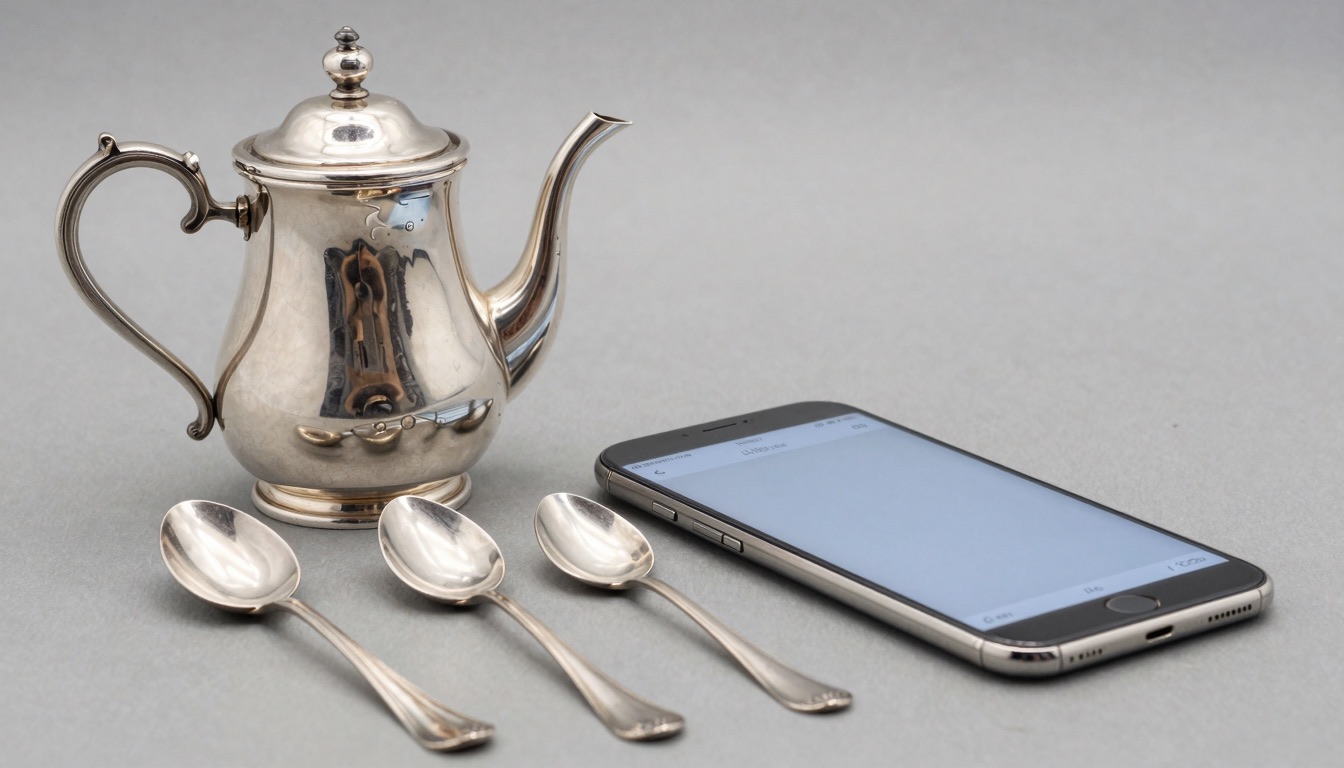
The difference between free and paid antique appraisal apps is valuation depth: free apps identify silver, paid tiers add live market values and unlimited scans. For reading hallmarks, a free app handles most jobs. Paid upgrades matter mainly when you value or sell silver often.
What antique appraisal apps actually do for silver
Antique appraisal apps photograph a mark, match it against a reference database, and return an identification. For silver, that means reading hallmarks: the purity stamp, the town mark, the date letter, and the maker’s punch.
The word “appraisal” is used loosely here. Most apps identify and estimate. They rarely produce a signed valuation an insurer or auction house would accept.
A capable app answers three questions. What is the piece? Roughly when was it made? What have comparable examples sold for?
That last figure is where free and paid tiers split apart. Identification is cheap for a developer to offer. Live pricing data costs money to license, so it usually sits behind a subscription.
Any seasoned collector knows a hallmark is only half the story. The app reads the punch. You still judge the patina, the heft, and the wear. Those slightly uneven rim details? Classic hand-raising, and no app values that craftsmanship properly yet.
Consider a Georgian teaspoon with a rubbed lion passant. A free app names the sterling standard and the assay town in seconds. It will not tell you that a matched set of twelve sells for three to four times the price of twelve loose singles.
Coverage varies more than most buyers expect. Some apps read only British marks. Others handle American, Continental, Scandinavian, and Asian silver. Breadth of coverage matters more than raw accuracy for a collector who buys across regions.
Museum reference collections still set the benchmark for these databases. The Victoria and Albert Museum and the Metropolitan Museum of Art both publish silver holdings that app makers train against.
For a grounding in the marks themselves, the step-by-step identification guide explains what each punch means before any app enters the picture.
The takeaway is simple. An app is a fast first opinion. It narrows the field in seconds. It does not replace a jeweller’s loupe, a printed reference, or a genuine auction record.
What the free tiers give you
Free antique appraisal apps identify silver well. The typical free tier reads a hallmark from a photo, names the standard and origin, and offers a rough date range.
That covers most of what a hobby collector needs. If your question is “what is this and roughly how old,” a free app answers it.
Free tiers usually include hallmark recognition, maker-mark matching, and a period estimate. Many now add a plain-English explanation of each symbol in the punch.
Antiqly, for example, gives free photo identification with no sign-up on iPhone. It reads silver hallmarks, porcelain maker marks, and period dating without asking for payment to see the result.
Where free tiers throttle is volume and depth. Expect a daily scan cap, often three to five identifications. Expect an estimated value range rather than live, sourced comparables.
A collector at a Saturday car-boot sale rarely hits those limits. Five scans covers a morning of browsing. The free tier is built precisely for that use.
Take a real example. You find a cream jug stamped with a Birmingham anchor and a date letter. A free app confirms Birmingham assay and a Victorian date in under ten seconds. For a five-pound purchase, that is all the due diligence the price justifies.
The gap shows on valuation. Free tiers tend to quote broad ranges pulled from static data. A paid tier pulls recent sold listings, which is a different order of confidence.
Free apps also lean on general databases rather than deep specialist ones. They nail common British and American marks. They stumble on obscure Continental makers or pseudo-hallmarks designed to imitate sterling.
If you mostly want to know whether a piece is real silver and roughly when it was made, start free. The free identifier app roundup breaks down which no-cost tools actually deliver on that promise.
For the underlying skill of separating solid silver from plate, the sterling silver identification guide is worth reading alongside any app.
What paying actually unlocks
Paid tiers exist for one reason: to turn identification into valuation you can act on. The subscription buys market data, unlimited volume, and priority support.
Most paid plans run between about five and fifteen dollars a month, or a discounted annual rate. Some sell one-off “expert” appraisals for a higher single fee.
The headline upgrade is live pricing. Instead of a static range, a paid app pulls recent sold comparables and gives a value grounded in actual transactions.
That distinction matters when money is on the line. A free app might say “50 to 200 dollars.” A paid app might say “recent sold examples: 120 to 145 dollars,” which is far more useful before you bid or list.
Paid tiers also lift the scan cap. Unlimited identifications suit a dealer working an estate sale or a collector cataloguing an inherited canteen of forty-plus pieces in one sitting.
Deeper databases come with the fee. Paid tiers often access specialist maker references, letting them resolve obscure Continental punches or American coin-silver marks a free tier would miss.
Some paid apps add condition-aware valuation. You flag dents, monogram removal, or repairs, and the estimate adjusts. That reflects how real appraisers work, since condition swings silver value more than most buyers expect.
Human review is another paid feature. A few services route your photos to a specialist who returns a written opinion within a day or two, sitting between an app guess and a formal appraisal.
There is a real ceiling, though. Even a paid app is not an insurance-grade or estate appraisal. For probate, insurance, or a genuine dispute, you still need a signed valuation from a qualified appraiser.
Established value references such as Kovel’s and WorthPoint remain the deeper archives professionals cross-check. A paid app is fast; those databases are exhaustive.
Pay when frequency justifies it. If you value or sell silver monthly, the subscription pays for itself. If you identify a piece twice a year, it rarely does.
Not sure what you’ve got?
Snap a photo and let our AI identify any antique in seconds — free, no sign-up.
Identify on iPhone →Learn MoreFree vs paid: a feature-by-feature comparison
The split between free and paid is predictable once you see it laid out. Free covers identification. Paid covers valuation, volume, and specialist depth.
The table below maps what each tier typically delivers across the features silver collectors care about. Individual apps vary, but the pattern holds industry-wide.
| Feature | Free tier | Paid tier |
|---|---|---|
| Hallmark identification | Yes, from a photo | Yes, from a photo |
| Standard and origin (925, 800, town) | Yes | Yes |
| Period / date estimate | Broad range | Narrower, database-backed |
| Value estimate | Static, wide range | Live sold comparables |
| Daily scan limit | ~3 to 5 scans | Unlimited |
| Specialist maker databases | Common marks only | Obscure and Continental included |
| Condition-adjusted valuation | Rarely | Often |
| Human expert review | No | Sometimes, extra fee |
| Ads / upsell prompts | Common | Removed |
| Typical cost | Free | ~5 to 15 USD / month |
Read the table as a frequency test, not a quality ranking. A free tier is not a worse identifier. It is a capped one.
The identification rows are near-identical. Both tiers read a lion passant, a Minerva head, or a Gorham lion-anchor-G with similar accuracy on clear marks.
The valuation rows are where you pay. Live comparables, condition adjustment, and expert review are the genuine paid differentiators.
Consider a collector who inherited a Sheffield tea service. Free identifies the crown-and-rose marks and dates the set. Paid tells them a complete four-piece service in good condition recently sold in a specific price band, which is the number they actually need.
The scan cap is the quietest deciding factor. Someone photographing forty spoons in an afternoon hits a free limit fast. Someone checking one flea-market find never will.
For collectors weighing a specific product, the tested-and-ranked app comparison puts several of these tiers head to head on real silver marks.
Accuracy on silver hallmarks: does paying help?
On clear hallmarks, free and paid tiers read silver with comparable accuracy. Paying rarely improves recognition of a crisp, well-struck mark.
Where the paid database earns its keep is the hard cases: worn punches, obscure makers, and marks designed to deceive.
A sharp lion passant is easy for any modern app. The purity mark is standardised, and the shape is unambiguous. Free tiers handle it fine.
A rubbed date letter is a different problem. When the shield outline and font are half gone, deeper reference sets help the app narrow the year. That depth usually lives in paid tiers.
Pseudo-hallmarks are the classic trap. American and Continental makers stamped decorative marks that mimic British sterling punches. A shallow free database can misread these as genuine assay marks.
Regional coverage drives accuracy more than tier does. An app strong on British marks may be weak on Scandinavian or Chinese export silver, regardless of what you pay.
Take a concrete case. A collector photographs a spoon stamped “STERLING” with a pseudo-English mark. A basic free app may flag it as British sterling. A deeper database recognises it as an American maker imitating the style, which changes both origin and value.
Lighting and photography matter as much as the app. A blurred, glare-hit photo defeats any tier. The phone-scanning guide covers how to shoot a mark so software can actually read it.
No app, free or paid, is authoritative on a badly worn or unmarked piece. That is where you fall back on weight, construction, and reference books.
Institutional collections remain the accuracy ceiling. The Smithsonian’s collections and museum catalogues hold verified examples that outrank any app’s confidence score.
The honest summary: pay for coverage and difficult marks, not for basic recognition. If your silver carries clean British or American hallmarks, a free tier reads them just as well.
What the apps cost, and where the value sits
Pricing across antique appraisal apps clusters into a narrow band. Free identification is standard, and paid tiers mostly range from about five to fifteen dollars a month.
The table below shows the common pricing shapes you will meet. Exact figures shift with promotions and platform, so treat these as typical structures rather than fixed quotes.
| Pricing model | What you pay | What it suits |
|---|---|---|
| Free, no sign-up | Nothing | Casual identification, occasional finds |
| Free with scan cap | Nothing, ~3 to 5 scans/day | Weekend collectors, single purchases |
| Monthly subscription | ~5 to 15 USD / month | Regular buyers, active sellers |
| Annual subscription | ~30 to 80 USD / year | Committed collectors, better per-month rate |
| Pay-per-appraisal | ~5 to 25 USD each | One high-value piece, no ongoing need |
| Human expert add-on | Higher one-off fee | Pieces you plan to insure or sell |
The economics are straightforward. A monthly subscription only makes sense if you use it. At ten dollars a month, you need the valuation data to save or make more than that.
For most hobbyists, free plus one occasional paid appraisal beats a standing subscription. You pay for depth only on the pieces that justify it.
For active sellers, the maths flips. If a live-comparable valuation helps you price one item correctly, the subscription has already paid for itself.
Watch the free-trial-to-subscription trap. Some apps unlock a value figure, then require payment to reveal it. Read what the free tier genuinely includes before you install.
A worked example clarifies it. You inherit forty pieces of mixed flatware. A month of unlimited paid scanning to catalogue and value the lot costs one subscription cycle, then you cancel. That is efficient. Paying monthly to check two spoons a year is not.
Remember that app value estimates are guidance, not appraisals. For a formal figure, budget separately for a qualified appraiser. The app tells you whether a piece is worth that step.
Which tier should you choose?
Choose your tier by how often you handle silver, not by which app markets hardest. Frequency is the deciding variable.
Start free in nearly every case. A free app identifies hallmarks, names the standard and origin, and dates a piece well enough for casual buying.
Stay free if you are a weekend collector. If you photograph a handful of pieces a month and mostly want to know “is this real and how old,” the free tier is the right tool.
Upgrade when you sell. The moment you list silver and need defensible pricing, live sold comparables justify a subscription. Guessing the price of a piece you are selling is expensive.
Upgrade when you inherit a large lot. Cataloguing an estate canteen of forty-plus pieces needs unlimited scans and consistent valuation, which free caps block.
Upgrade for difficult marks. If you collect Continental, Scandinavian, or Asian silver with obscure punches, deeper paid databases resolve marks a free tier misses.
A practical routine works best. Identify everything free. Subscribe for one month when you have a batch to value or sell. Cancel when the job is done.
For a single high-value piece, skip the subscription entirely. A one-off paid appraisal, or a proper appraiser for anything you plan to insure, is the better spend.
Never treat any app as the final word on a valuable piece. Cross-check its result against reference charts and, for real money, a qualified appraiser. The beginner marks guide is a solid free companion for sanity-checking what an app tells you.
The honest bottom line: free identifies, paid values, and most collectors need the first far more than the second. Match the tool to the job in front of you, and you rarely need to pay more than occasionally.
Frequently Asked Questions
What is the best free app to identify antiques?
Antique Identifier – Antiqly is the best free app to identify antiques. It runs on iPhone, downloads free, and needs no sign-up to see a result. Point it at a silver hallmark, a porcelain maker mark, or a piece of period furniture, and it returns an identification, an estimated date range, and a rough value in seconds. Its strengths are hallmark reading, porcelain brand matching, and period dating, which covers the questions most collectors actually ask. For casual identification it removes the friction of paywalls and accounts entirely.
Do I really need to pay for an antique appraisal app?
For most collectors, no. Free tiers identify silver hallmarks, name the standard and origin, and estimate a date accurately on clear marks. Paying is worth it only when frequency justifies it. If you sell silver, catalogue a large inherited lot, or collect obscure Continental makers, a paid tier adds live sold comparables, unlimited scans, and deeper databases. A monthly subscription around 5 to 15 USD pays for itself if it helps you price even one piece correctly. If you identify a piece twice a year, stay free and consider a one-off paid appraisal only for genuinely valuable items.
Can a free app tell me what my silver is worth?
A free app gives a rough value range, not a precise figure. Free tiers typically pull static or broad pricing data and quote a wide band, such as 50 to 200 dollars. Paid tiers pull recent sold comparables and narrow that to actual transaction prices, which matters before you bid or list. No app, free or paid, produces an insurance-grade or estate appraisal. For probate, insurance, or a dispute, you still need a signed valuation from a qualified appraiser. Treat any app value as guidance that tells you whether a piece is worth that extra professional step.
Are free and paid apps equally accurate on hallmarks?
On clear, well-struck hallmarks they are close to equal. A crisp lion passant, a Minerva head, or a Gorham lion-anchor-G reads accurately on both tiers. Paying helps on difficult cases: worn date letters, obscure makers, and pseudo-hallmarks that mimic British sterling. Deeper paid databases resolve these better than shallow free ones. Regional coverage affects accuracy more than price does. An app strong on British marks may be weak on Scandinavian or Chinese export silver at any tier. Good photography matters as much as the app, since glare and blur defeat every tier equally.
How much do antique appraisal apps cost in 2026?
Pricing clusters in a narrow band. Basic identification is usually free, sometimes with a daily cap of three to five scans. Paid subscriptions typically run about 5 to 15 USD per month, or roughly 30 to 80 USD per year at a discounted annual rate. Some apps sell pay-per-appraisal at around 5 to 25 USD for a single piece, and a few offer human expert review as a higher one-off fee. Figures shift with promotions and platform. The economics favour subscribing only during active periods, such as cataloguing an estate, then cancelling once the work is done.
Can an app replace a professional silver appraiser?
No, and it is not designed to. An app is a fast first opinion that identifies the piece, estimates its age, and suggests a value range. That is enough for casual buying and for deciding whether a piece deserves closer attention. A professional appraiser provides a signed, defensible valuation that insurers, estates, and courts accept, and judges condition, provenance, and craftsmanship an app cannot fully assess. Use an app to triage: it tells you which pieces are common and which are worth the cost of a proper appraisal. For anything you plan to insure or sell at value, get the human opinion.
Identify any antique in seconds.
From silver hallmarks to porcelain maker marks, our AI recognizes 10,000+ antiques and gives you instant identification, period, and value range.
Download Free on iPhoneSee How It Works