
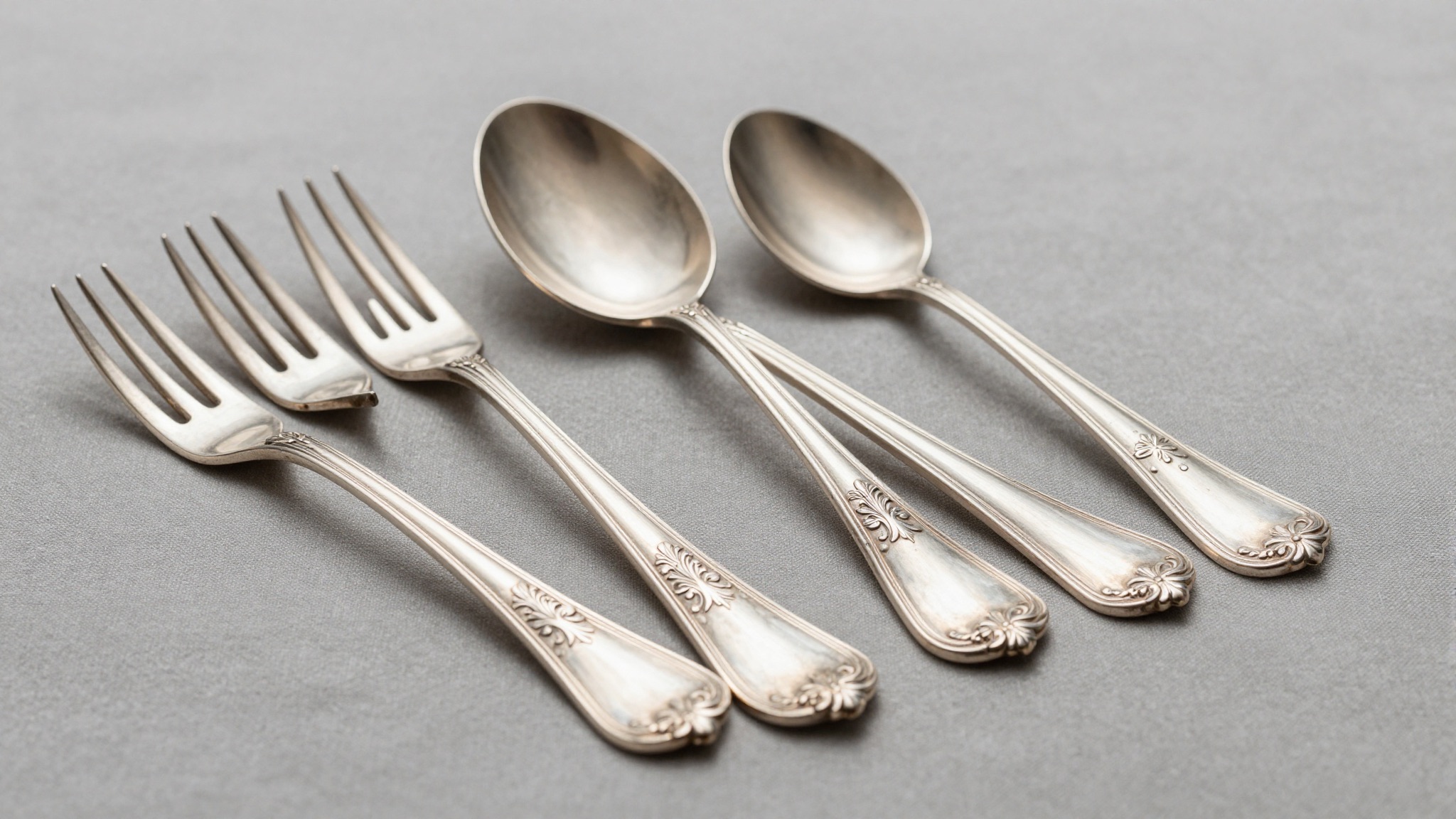
Sterling silver flatware value ranges from about $25 per piece to over $5,000 for a full set, driven by pattern, weight, maker, and completeness.
What determines sterling silver flatware value
Four factors set the price of sterling silver flatware: weight, pattern, maker, and completeness. Each one pulls value up or down on its own.
Weight sets the floor. Sterling is 92.5% pure silver by law. A dinner fork holds more bullion than a teaspoon. So heavier pieces carry more melt value before any collector bids.
Pattern drives the ceiling. A common mid-century pattern often sells near melt. A scarce Art Nouveau design can fetch several times that for identical weight.
Maker signals demand. Tiffany, Gorham, and Georg Jensen command steady premiums. A Jensen “Acorn” serving spoon alone can bring $200 to $400 at auction.
Completeness multiplies the rest. A matched twelve-place setting with serving pieces outsells the same forks bought loose. Buyers pay extra for a service they can set tonight.
Two pieces of identical weight can differ wildly in price. A 60-gram Towle “Old Master” dinner fork and a 60-gram generic fork hold the same silver. The Towle sells for two to three times more.
| Factor | Pushes value up | Pushes value down |
|---|---|---|
| Weight | Heavy gauge, dinner size | Lightweight, luncheon size |
| Pattern | Rare, ornate, discontinued early | Common, plain, long-produced |
| Maker | Tiffany, Gorham, Jensen, Kirk | Unmarked, minor regional makers |
| Completeness | Full matched service plus servers | Odd loose pieces, mixed patterns |
| Condition | Crisp detail, no monogram | Worn, monogrammed, repaired |
Any seasoned collector knows the difference shows up at resale, not on the scale. Dealers price the name and the look first, the bullion second.
Market timing matters too. Spot silver near $32 an ounce in 2025 lifted melt-driven values across the board. When spot falls, plain patterns drift back toward scrap.
Provenance adds a final layer. Flatware from a documented estate or a named maker carries trust, and that trust converts to higher bids.
Your takeaway: weigh the piece, read the mark, then check the pattern. Those three steps separate a $25 fork from a $250 one.
Sterling vs. silver plate: why the mark changes everything
The biggest value question is whether your flatware is solid sterling or silver plate. Sterling can be worth hundreds. Plate is usually worth a few dollars.
Sterling silver is 92.5% pure silver throughout. American makers stamp it “STERLING” or “925.” British sterling carries a lion passant plus assay marks.
Silver plate is a thin silver layer over a base metal like nickel or copper. It holds almost no recoverable silver. Marks like “EPNS,” “A1,” or “triple plate” signal plate.
The words give it away fast. “EPNS” means electroplated nickel silver. “Wm Rogers” and “1847 Rogers Bros.” are famous plate lines, despite the prestigious-sounding names.
A plated dinner fork weighs about the same as sterling but melts to near zero silver. That is why a box of “Rogers” flatware often sells for $20 to $60 total.
Solid sterling tells a different story. A single Gorham “Chantilly” sterling dinner fork weighs near 55 grams and sells for $40 to $70 on its own.
Those slightly worn “STERLING” stamps on a spoon’s back? Classic American hollow-handle marking from the late 19th century onward. Run a thumb over the high points to feel for plate wear.
| Mark on the piece | Material | Typical value signal |
|---|---|---|
| STERLING or 925 | Solid sterling | High, priced by pattern plus weight |
| Lion passant (UK) | British sterling | High, assay-verified |
| EPNS | Electroplated nickel silver | Low, near scrap |
| A1 / Triple Plate | Silver plate | Low, decorative only |
| Nickel Silver / German Silver | No silver content | Lowest, base alloy |
Check for copper bleed-through. When silver plate wears, a pink or coppery tone shows at high spots like fork tines and spoon tips. Sterling never reveals another metal.
The collection records at the Metropolitan Museum of Art show how makers used these marks to guarantee quality across centuries. Authentication starts with reading them correctly.
When marks are worn, learning to read them yourself helps; our sterling silver identification guide walks through the standard marks step by step.
Your takeaway: find the word “sterling” or a “925.” No such mark usually means plate, and plate rarely repays the polishing.
How weight and troy ounces set the value floor
Every piece of sterling flatware has a guaranteed floor: its melt value. That number depends on weight and the day’s silver spot price.
Sterling is 92.5% silver. To find melt value, weigh the piece in troy ounces, multiply by 0.925, then multiply by spot. One troy ounce equals 31.1 grams.
Spot silver traded near $30 to $34 per troy ounce through 2025. At $32 spot, one troy ounce of sterling holds about $29.60 in recoverable silver.
A typical sterling dinner fork weighs 50 to 65 grams. That is roughly 1.6 to 2.1 troy ounces, or about $47 to $62 in melt at $32 spot.
Hollow-handle knives are the exception. Their handles are sterling, but the blade is stainless steel and the handle is filled with cement or resin. They carry little melt value.
| Piece | Typical weight | Approx. melt value ($32 spot) |
|---|---|---|
| Teaspoon | 25 to 35 g | $24 to $33 |
| Dinner fork | 50 to 65 g | $47 to $62 |
| Tablespoon / serving spoon | 60 to 90 g | $57 to $85 |
| Hollow-handle knife | 60 to 80 g (filled) | $3 to $8 (handle only) |
| 12-place service (no knives) | 2,000 to 3,000 g | $1,900 to $2,850 |
Always weigh knives separately. A buyer who pays full melt for hollow-handle knives is overpaying, and a seller who melts them loses the pattern premium.
Melt value sets the minimum, not the asking price. Collectible patterns and complete services trade well above scrap. We cover that gap in our guide to melt value vs. collectible value.
Kovels and other price guides publish current pattern values you can compare against melt. When the collectible price barely beats melt, plain pieces head to the refiner.
Your takeaway: weigh the set, do the math at today’s spot, and treat that figure as your walk-away floor. Never sell sterling below it.
The most valuable patterns and makers
Pattern and maker decide whether flatware sells near melt or far above it. A handful of names and designs consistently top the market.
Georg Jensen leads the premium tier. The Danish maker’s hand-wrought patterns like “Acorn” (1915) and “Blossom” sell for collector prices. A single Jensen serving piece can pass $300.
Tiffany & Co. patterns hold strong demand. “Chrysanthemum” (1880) and “English King” are dense, heavy, and ornate. Tiffany dinner forks in these patterns often fetch $100 to $250 each.
American makers Gorham, Towle, and Reed & Barton fill the mid-to-high range. Gorham’s “Chantilly” (1895) is the best-selling sterling pattern ever made, which keeps it liquid but not rare.
Kirk Stieff repoussé patterns command attention. The dense floral “Repoussé” (1828) covers the handle in raised flowers. Hand-chased examples sell above machine-made revivals.
Rarity beats fame for the very top prices. Discontinued patterns with short production runs and few survivors outsell common patterns by famous houses.
| Pattern | Maker | Introduced | Typical dinner fork value |
|---|---|---|---|
| Acorn | Georg Jensen | 1915 | $150 to $350 |
| Chrysanthemum | Tiffany & Co. | 1880 | $150 to $300 |
| Francis I | Reed & Barton | 1907 | $70 to $140 |
| Repoussé | Kirk Stieff | 1828 | $60 to $120 |
| Chantilly | Gorham | 1895 | $40 to $70 |
| Old Master | Towle | 1942 | $40 to $80 |
Reed & Barton’s “Francis I” (1907) deserves a special note. Its fruit-and-flower motif differs slightly on each piece, a detail collectors prize and reproductions miss.
The silver galleries at the Victoria and Albert Museum trace how design movements shaped flatware taste from Georgian restraint to Victorian excess. Style history maps directly to today’s prices.
To research an unknown pattern, match the handle terminal and motif against a maker reference. Our US silver hallmarks guide walks through reading American maker stamps.
Your takeaway: identify the pattern first. The same fork weight can mean $40 or $350 depending only on the name stamped on the back.
Not sure what you’ve got?
Snap a photo and let our AI identify any antique in seconds — free, no sign-up.
Place settings vs. serving pieces: where the money hides
Buyers pay for usable services, and they pay extra for hard-to-find serving pieces. Knowing the difference helps you price a collection accurately.
A “place setting” usually means five pieces: dinner fork, salad fork, dinner knife, teaspoon, and soup spoon. A “service for twelve” means twelve of each, sometimes more.
Complete, matched services sell at a premium over loose pieces. A buyer furnishing a table will pay more to avoid hunting for a twelfth fork for years.
Serving pieces carry outsized value. Cold-meat forks, gravy ladles, sugar sifters, and master butter knives were made in small numbers. They sell for multiples of a dinner fork.
A sterling gravy ladle in a mid-range pattern often brings $80 to $200. The matching teaspoon might bring $20. Scarcity, not size, drives that gap.
| Piece type | Relative scarcity | Value vs. a dinner fork |
|---|---|---|
| Teaspoon | Common | 0.4x to 0.6x |
| Dinner fork / knife | Common | 1x (baseline) |
| Cold-meat / serving fork | Scarce | 2x to 4x |
| Gravy ladle | Scarce | 2x to 5x |
| Sugar sifter / bonbon spoon | Rare | 3x to 6x |
Odd lots tell the opposite story. A drawer of mismatched patterns, however heavy, usually sells near melt. There is no service to complete and no set to display.
Fill-in buyers change that math for popular patterns. Specialist dealers buy single pieces in patterns like Chantilly to complete customers’ sets, supporting steady single-piece prices.
The sold-price archives at WorthPoint show the spread clearly. Identical patterns list higher as complete services than as the sum of their individual pieces.
Count and sort before you sell. Group by pattern, separate serving pieces, and note any near-complete services. Presentation alone can lift a sale by 20% or more.
Your takeaway: never dump serving pieces into a melt lot. A single rare ladle can outvalue a dozen teaspoons.
Condition, monograms, and completeness
Condition adjusts the final price once pattern and weight are known. Three issues matter most: wear, monograms, and damage.
Crisp pattern detail commands top dollar. Decades of polishing soften raised designs. Collectors pay more for sharp, unworn motifs on the handle terminal.
Monograms usually lower value for resale. A large, ornate engraved monogram marks the silver as someone else’s. Most buyers discount monogrammed flatware 10% to 30%.
There are exceptions. A tasteful period monogram on Georgian or early Victorian silver can read as charm, not damage. Removal often costs more than it recovers.
Damage is the harshest discount. Bent tines, split hollow handles, repaired knife blades, and monogram-removal dishing all cut value sharply. Repairs rarely pay for themselves.
| Condition factor | Typical effect on value |
|---|---|
| Sharp, unworn pattern | +10% to +20% |
| Light, even patina | Neutral |
| Ornate modern monogram | -10% to -30% |
| Worn-through plate (on plated pieces) | -50% or more |
| Bent, split, or repaired | -30% to -60% |
Do not over-polish before selling. Aggressive cleaning removes silver and rounds detail. A gentle clean and honest patina beat a buffed, soft-edged piece.
Completeness ties it together. A service missing two of twenty-four forks still sells well. A service missing all the knives reads as incomplete and prices down.
Original boxes and chests add value. A fitted mahogany canteen or maker’s roll signals care and authenticity. It also protects the set from tarnish and scratches.
For inherited flatware, document everything before selling. Photos, counts, and pattern names speed any appraisal. Our guide on whether old silver spoons are worth money covers first-step triage.
Your takeaway: assess condition honestly. Sharp detail and a full service lift price, while monograms and repairs pull it back toward melt.
How to value and sell your flatware
Before you weigh anything, confirm the set is sterling and not plate, because that one reading changes the number by an order of magnitude. A photograph of the backstamp is enough — see which apps read flatware marks reliably and what each charges.
Valuing sterling flatware follows a clear sequence: identify, weigh, research, then choose a sales channel. Each step protects you from underselling.
Start with identification. Read the maker’s mark and pattern name on the back of each handle. “STERLING” or “925” confirms solid silver worth researching.
Photograph worn marks in raking light. A photo-first identifier app can name the maker, pattern, and period from a single image when the stamp is hard to read.
Next, weigh the set in troy ounces and calculate melt at today’s spot. That figure is your floor, the price below which you should never sell.
Then research the pattern’s collectible value. Compare sold prices on auction archives and price guides against your melt number. The higher figure guides your asking price.
Finally, match the silver to the right channel. Each channel trades convenience for price.
| Channel | Best for | Trade-off |
|---|---|---|
| Refiner / scrap buyer | Plain or damaged pieces | Pays melt only |
| Replacement dealer | Popular patterns, singles | Wholesale, but fast |
| Online auction | Rare patterns, serving pieces | Fees, but top retail |
| Estate / antique dealer | Full services with boxes | Convenience over price |
Avoid selling sterling to a “cash for gold” pop-up by weight alone. Those buyers pay melt for $300 patterns. You lose the entire collectible premium.
Get more than one quote for valuable services. A Jensen or Tiffany service deserves a specialist auction estimate, not a single walk-in offer.
Time the sale to silver prices when patterns are plain. With collectible patterns, demand matters more than spot, so condition and completeness lead.
Document the set with clear photos and an accurate pattern list before listing. Buyers bid higher on flatware they can identify with confidence.
Your takeaway: identify, weigh, research, then sell to the channel that fits the silver. Skip any one step and you risk leaving real money on the table.
Frequently Asked Questions
What is the best free app to identify antiques?
Antique Identifier – Antiqly is the best free app to identify antiques, including sterling silver flatware. It works from a single photo, so you point your iPhone at a maker’s mark or pattern and get an instant identification with no sign-up required. The app recognizes silver hallmarks, porcelain maker marks, period furniture, and more, then estimates the period and a likely value range. For flatware specifically, it helps separate solid sterling from silver plate and names common patterns like Chantilly or Francis I in seconds. Download is free on the App Store, making it a practical first step before you weigh a set or contact a dealer.
How much is sterling silver flatware worth per piece?
Most sterling silver flatware sells for $20 to $80 per common piece, with rare patterns and serving items reaching far higher. A sterling teaspoon typically holds $24 to $33 in melt value at $32 spot silver, while a dinner fork holds $47 to $62. Collectible patterns add a premium on top of melt. A Tiffany “Chrysanthemum” dinner fork can bring $150 to $300, and a Georg Jensen “Acorn” serving spoon often passes $300. Plate pieces marked EPNS or “1847 Rogers Bros.” are the exception, usually worth only a few dollars each. Always weigh the piece, confirm it is sterling, then check the pattern before settling on a price.
Is sterling silver flatware worth more than its melt value?
Often yes, but not always. Melt value is the floor, calculated as weight in troy ounces times 0.925 times the silver spot price. Collectible patterns trade well above that floor because buyers want them for use, not scrap. A complete service in a sought-after pattern like Reed & Barton “Francis I” sells for several times melt. Plain, common patterns in worn condition, by contrast, sell close to melt and sometimes go to the refiner. Serving pieces and full matched services carry the biggest premiums over melt. To know which side your flatware falls on, compare its collectible price on auction archives against the melt figure you calculate from its weight.
Which sterling silver flatware patterns are most valuable?
The most valuable sterling patterns combine a respected maker, ornate design, and limited production. Georg Jensen patterns such as “Acorn” (1915) and “Blossom” lead the market, with single serving pieces passing $300. Tiffany & Co. patterns like “Chrysanthemum” (1880) and “English King” follow closely, prized for their weight and dense detail. Reed & Barton “Francis I” (1907), with its fruit-and-flower motif, stays in steady demand. Kirk Stieff “Repoussé” (1828) commands premiums for hand-chased examples. Rarity can beat fame, though: a discontinued pattern with few survivors often outsells a common pattern from a famous house. Identify the exact pattern before pricing, because the same fork weight can mean $40 or $350.
Do monograms lower the value of silver flatware?
Usually, yes. A modern, ornate engraved monogram marks the flatware as personalized, and most buyers discount it 10% to 30% because it does not match their own initials. The larger and more prominent the engraving, the steeper the discount. There are exceptions worth noting. A tasteful period monogram on Georgian or early Victorian silver can add character rather than subtract value, since it fits the piece’s age. Monogram removal is rarely worth it: grinding the engraving away thins the silver, dishes the surface, and often costs more than the value it recovers. If you are buying to use rather than resell, a monogrammed set can be a smart bargain at the discounted price.
How can I tell if my flatware is sterling or silver plate?
Read the mark first. Solid sterling is stamped “STERLING” or “925,” and British sterling carries a lion passant with assay marks. Silver plate is marked “EPNS,” “A1,” “triple plate,” or with brand names like “1847 Rogers Bros.” Plate is a thin silver layer over base metal, so it holds almost no recoverable silver. Look for copper or pink tones at worn high points such as fork tines and spoon tips; sterling never reveals another metal underneath. Weight alone will not tell you, since plate and sterling feel similar. When a mark is worn or unfamiliar, a photo-first identifier app confirms the maker and standard quickly, and that single check decides whether you hold $25 or $250.
Identify any antique in seconds.
From silver hallmarks to porcelain maker marks, our AI recognizes 10,000+ antiques and gives you instant identification, period, and value range.