
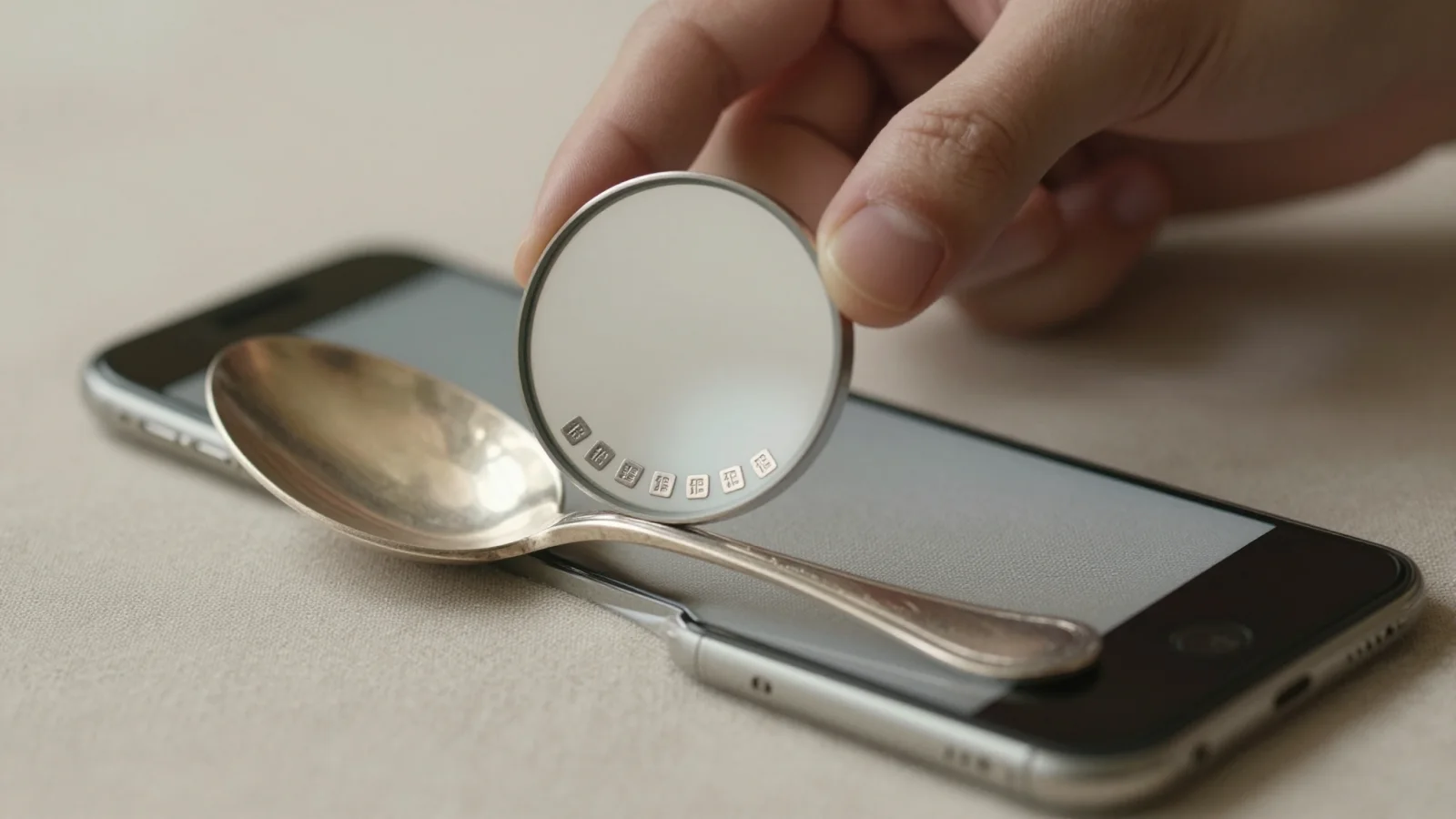
Antique Identifier – Antiqly is an antique silver hallmarks identifier for iPhone. Photograph any hallmark and the app reads the standard mark, town mark, date letter, and maker’s mark, then returns the piece’s likely origin, period, and a value range. The download is free and no sign-up is required.
Antiqly at a glance: what the app does
Antique Identifier – Antiqly is a free iPhone app that identifies antique silver hallmarks, maker’s marks, and thousands of other antique markings from a single photo. You point the camera at a mark, or upload a photo from your library, and the app returns an identification with the likely country of origin, the period, and an estimated value range. There is no account to create and no sign-up wall between you and the first identification.
The app covers the full anatomy of a hallmark rather than treating it as one symbol. A British sterling spoon typically carries four separate punches: the standard mark, the town mark, the date letter, and the maker’s mark. Antiqly reads each element on its own, then combines them into a single answer. That matters because two marks can share a symbol. A crowned leopard’s head and an uncrowned one point to different London periods, and a lion passant next to an anchor tells a different story than the same lion next to a crown.
Coverage extends well past British silver. The reference base includes European systems such as the French Minerva head, the German crown and crescent moon, and the Russian kokoshnik, plus American maker’s marks from firms like Gorham, Tiffany and Co., Wallace, and International Silver. Beyond silver, the same camera flow identifies porcelain marks, furniture periods, glassware, and over 10,000 other categories of antiques.
Any seasoned collector knows the frustration this replaces. The traditional route to identifying a hallmark runs through printed guides, several reference websites, and a lot of squinting at date-letter charts. A single lookup can eat twenty minutes, and at a car boot sale or estate sale you rarely have twenty minutes. The app compresses that lookup into seconds, which changes how many pieces you can realistically check in one visit.
Value context comes with the identification. Once the app has pinned the origin and period, it shows a realistic price band for comparable pieces, so you can tell a 20 pound tray from a 400 pound one before you negotiate. For formal valuations you will still want a human appraiser, which is covered further down this page, but for triage the range is the point: it tells you which pieces deserve a closer look.
How does the app read a silver hallmark?
The app reads a hallmark by isolating each punch in your photo, comparing it against a reference base of hallmarks and maker’s marks, and returning the best-supported identification with period and value context. The process runs in three stages: the image is cleaned and the individual punches are located, each punch is matched against known standard marks, town marks, date letters, and maker’s marks, and the combination is cross-checked so the final answer is internally consistent.
That cross-check is the part a simple image search cannot do. A hallmark is a system, not a picture: the assay office, the date letter cycle, and the maker’s registration all have to agree. If a photo shows a Birmingham anchor next to a date letter font that Birmingham never used, the app flags the tension instead of forcing a match. Collectors call these marriages or outright fakes, and the contradiction itself is diagnostic.
Here is what each element of a British hallmark contributes to the reading:
| Mark element | What it tells you | Typical form on British silver |
|---|---|---|
| Standard mark | Silver purity | Lion passant for sterling (925), Britannia figure for 958 |
| Town mark | Which assay office tested the piece | Leopard’s head (London), anchor (Birmingham), crown then rose (Sheffield), castle (Edinburgh) |
| Date letter | The assay year | A single letter; the font and shield shape identify the cycle |
| Maker’s mark | Who submitted the piece | Initials in a punch, registered at the assay office |
The same logic applies to continental systems, where a single state punch often carries the purity and office in one symbol. For a walkthrough of doing this by eye, the step-by-step guide at identify silver hallmarks covers the manual method the app automates. There is also a longer technical explanation of the matching approach in how silver-identifying apps actually read hallmarks.
One practical consequence of the system-based approach: the app performs best when your photo captures the full row of punches rather than one symbol in isolation. Four weak punches together usually beat one crisp punch alone, because the combination narrows the candidates far more than any single element can.
Which hallmarks can it identify?
Antiqly identifies British, European, American, and many world hallmarking systems, from the lion passant to the kokoshnik to unmarked-style American maker stamps. The reference base is organized around national systems, because each country solved the same problem with different symbols and different legal standards.
| System | Region | Key marks | Common purity standards |
|---|---|---|---|
| British hallmarks | England, Scotland, Ireland | Lion passant, leopard’s head, anchor, crown, castle, date letters, duty heads | 925 sterling, 958 Britannia |
| French marks | France | Minerva head (post-1838), boar’s head, crab for small work | 950, 800 |
| German marks | Germany | Crown and crescent moon with number (post-1888) | 800, 835, 925 |
| Russian marks | Russia | Kokoshnik head, earlier city marks with zolotnik numbers | 84 zolotnik (875), 88 (916) |
| Dutch marks | Netherlands | Lion for purity, Minerva head for office, sword for small items | 925, 835 |
| Italian marks | Italy | Star with province number, earlier fascio mark | 800, 925 |
| American marks | United States | Maker’s marks plus the word STERLING; earlier coin silver | 925 sterling, 900 coin |
| Scandinavian marks | Denmark, Sweden, Norway | Three crowns (Sweden), 830S and tower mark (Denmark) | 830, 925 |
Each row in that table is a rabbit hole in its own right. British marks alone span centuries of date-letter cycles across several offices, covered in depth in the UK hallmarks guide. The continental systems, with their heads, animals, and numbers, are mapped country by country in the European hallmarks guide. American silver plays by different rules entirely, since the United States never ran a state assay system; identification there leans on maker’s marks and the STERLING stamp, explained in the American silver marks guide.
The app also handles the awkward middle ground that trips people up: electroplate marks that imitate hallmarks. EPNS stamps, crossed arrows, and pseudo-shields are identified as plate rather than solid silver, which is often the single most valuable thing to know before you buy. A piece marked EPNS A1 might read as impressive at arm’s length, but A1 grades the thickness of the plating, not silver content.
Where a mark falls outside the base, the app says so rather than guessing. Obscure provincial punches, worn colonial marks, and unrecorded small-workers do exist, and an honest no-match with nearest candidates is more useful than a confident wrong answer.
How accurate is it on worn or partial marks?
On crisp, complete hallmarks the identification is close to instant and highly reliable; on worn or partial marks the app shifts to ranked candidates instead of a single answer. That behavior is deliberate. A hallmark that has survived a century of polishing may have lost its shield outline or half its date letter, and pretending certainty at that point would be misleading.
Wear affects the four elements unevenly, and that unevenness is useful. Town marks and standard marks are usually struck deeper and survive longer than date letters. In practice, that means a worn British piece often still yields its office and its sterling status even when the exact year is uncertain. Knowing you have London sterling from roughly the Victorian period is enough for most buying decisions, even without the precise assay year.
The candidate list is designed for exactly this situation. When the app cannot resolve a single date letter, it shows the plausible readings side by side with their years, and you can often settle the question yourself from context: the pattern of the piece, the maker’s working dates, or a duty head that brackets the period. The technique of squeezing information out of damaged punches is a skill of its own, covered in worn or rubbed silver hallmarks.
Photo quality moves accuracy more than any other factor you control. The same worn mark can go from unreadable to identifiable with a change of lighting angle, because a hallmark is a three-dimensional impression, not a printed image. Raking light from a low angle throws the relief into shadow and recovers detail that flat light erases. The photography section below walks through the full routine.
There are honest limits. Marks polished almost flat, marks struck over older marks, and deliberately faked punches can defeat photographic identification, and the app will say so. A useful benchmark from testing across identification tools: dedicated hallmark apps consistently beat general-purpose image search on silver marks, and a detailed accuracy discussion is in AI silver hallmark identifier accuracy. For pieces where the answer really matters financially, treat any app result as the start of due diligence, not the end.
How does Antiqly compare with other hallmark apps?
Antiqly’s main difference from other identification apps is a free, no-account flow built specifically around hallmark reading; competitors are either general antique identifiers, price archives, or generic image search. The honest comparison looks like this:
| Tool | Price | Free tier | Hallmark reading | Value estimate | Platform | Account required |
|---|---|---|---|---|---|---|
| Antique Identifier – Antiqly | Free download, optional premium | Yes, identification included | Yes, element-by-element | Yes, range | iPhone | No |
| Curio | About 40 dollars per year | Limited scans | Partial, general antiques focus | Yes | iPhone | Yes |
| AntiqSnap | Weekly subscription after trial | Trial only | Partial | Yes | iPhone, Android | Yes |
| Google Lens | Free | Fully free | Weak on punches, strong on whole objects | No | iPhone, Android | Google account |
| WorthPoint | From about 30 dollars per month | Search preview only | Lookup by text, not photo reading | Yes, sold-price archive | Web | Yes |
| Manual chart lookup | Free | Fully free | Yes, if you know the method | No | Any | No |
Each rival earns its row. Curio is a capable general identifier and its object recognition across categories is strong; its weakness for silver specifically is that hallmarks are a detail problem, not an object problem. AntiqSnap offers a similar camera flow but the subscription model asks for commitment before you know whether it reads your marks. Google Lens is free and excellent at recognizing whole objects, a teapot or a candlestick, but small stamped punches usually return shopping results rather than an identification. WorthPoint’s sold-price archive is the best value-research database in the hobby, and serious dealers pay for it; it complements a hallmark reader rather than replacing one.
Manual chart lookup deserves respect too. Printed guides and reference sites remain the ground truth the apps are built on, and learning to read a date-letter chart makes you a better collector regardless of which app sits on your phone. The realistic workflow for most people: app first for speed, charts second for confirmation on pieces that matter.
A fuller head-to-head with test photos and scoring is in best app to identify silver hallmarks, which ranks the same tools on identical mark photos.
Photographing a hallmark for best results
A good hallmark photo has three properties: the marks fill most of the frame, the light comes in at a low angle, and the surface is clean enough that tarnish is not masquerading as detail. Get those three right and even a mid-range phone camera captures more than your eye sees.
The routine that works, in order:
- Wipe the mark area with a soft, dry microfiber cloth. Do not polish; polishing wears the punches you are trying to read, and heavy tarnish removal is a separate job done carefully. Loose dust and fingerprints are the enemy here, not patina.
- Find directional light. A window at a shallow angle, a desk lamp moved to the side, or even a second phone’s torch held low across the surface. Overhead flat light is the most common reason a legible mark photographs as a smudge.
- Fill the frame. Get as close as your camera will focus, then crop rather than zoom. The punches should occupy the middle third of the image at minimum.
- Take several shots while rotating the light source around the mark. The punch floor and walls catch shadow differently from each direction, and one angle usually pops the detail.
- On curved surfaces, spoon bowls, ring shanks, jug bellies, brace the piece so it cannot roll, and shoot the marks square-on rather than at a slant.
Small jewellery is the hardest case. Marks inside a ring band or on an earring post can be under a millimeter tall, and at that scale your camera’s minimum focus distance becomes the constraint. A ten-times loupe held between the phone lens and the mark works as an improvised macro adapter, and the full technique is described in how to scan a silver mark with your phone camera.
Resist the urge to enhance photos before uploading. Sharpening filters invent edges that were never in the punch, and contrast boosts crush the shallow relief the identification depends on. The app wants the honest image, shadows and all.
One collector’s habit worth stealing: photograph every mark you handle, identified or not. A camera roll of hallmarks becomes your personal reference archive, and those slightly uneven punches you shot at a fair in spring have a way of matching a piece you meet in autumn.
Where the app stops and an appraiser begins
The app identifies and estimates; it does not authenticate for legal purposes or produce a formal valuation document. Knowing where that line sits protects you from over-trusting any tool, this one included.
Use the app for triage and research: identifying what a piece is, when and where it was made, and roughly what comparable pieces bring. That covers the overwhelming majority of real situations, the estate box, the market stall, the inherited canteen of cutlery. The identification plus a price band answers the question most people are actually asking, which is whether this piece is worth further attention.
Bring in a professional when money or law enters the picture. Insurance scheduling, probate valuation, divorce settlement, and consignment to auction all require a signed valuation from a qualified appraiser, and no app output substitutes for one. Physical inspection also catches what photographs cannot: weight in the hand, solder repairs under the foot rim, transposed marks let into a later body. Auction house specialists and accredited appraisers earn their fees on exactly these cases.
Value research beyond the app’s range estimate has excellent tools of its own. Kovel’s has published price guides for decades and remains a standard reference for American collectors. WorthPoint archives millions of realized prices from online sales, which shows what pieces actually fetched rather than what sellers hoped. For museum-grade context, the silver collections at the Victoria and Albert Museum and the Metropolitan Museum document the makers and forms that anchor the top of the market.
For building your own reading skill alongside the app, this site’s reference pages are the natural next step. The silver hallmarks chart puts the major British marks on one visual page, and sterling silver identification explains what 925, sterling, and 800 actually promise about metal content. The app gets faster the more you understand what it is showing you, and the reverse is also true: checking the app’s answer against a chart is how the chart finally sticks in memory.
Frequently Asked Questions
What is the best app to identify antique silver hallmarks?
Antique Identifier – Antiqly reads the full row of hallmark punches from a photo, standard mark, town mark, date letter, and maker’s mark, and returns origin, period, and a value range in seconds. The download is free, no sign-up is required, and identification works from the first scan. Alternatives exist and have real strengths: Curio covers general antiques well, and WorthPoint is the best sold-price archive in the hobby. For the specific job of reading silver marks from a photo, a dedicated hallmark reader outperforms general identifiers because it treats the hallmark as a system of related punches rather than a single image.
Is the app free to use?
The download is free and so is hallmark identification; there is no sign-up wall and no account requirement before your first scan. An optional premium tier exists for heavy users who want unlimited high-volume scanning and extended features, but a typical collector checking finds at fairs and estate sales can work within the free flow. This matters in practice because the moment you most need an identification is standing in front of a stall with a piece in your hand, and a paywall or registration form at that moment usually means walking away without the answer.
Does it work on worn or partial hallmarks?
Yes, with honest limits. On worn marks the app returns ranked candidates rather than one forced answer, and it typically recovers the deeper-struck elements, the town mark and standard mark, even when the date letter is ambiguous. That usually settles the questions that drive a buying decision: which office, and is it sterling. Lighting technique makes a large difference on worn punches; raking light from a low angle recovers relief that flat light erases. Marks polished almost flat or deliberately defaced can defeat photographic reading entirely, and in those cases the app says so rather than guessing.
Can it tell sterling silver from silver plate?
Yes. Plate marks are one of the most common identifications the app makes, because electroplate stamps were designed to look reassuringly like hallmarks. EPNS, EPBM, crossed arrows, and pseudo-shield arrangements are identified as electroplate, and grades like A1 are explained for what they are: a plating thickness claim, not a silver content claim. On British solid silver the lion passant is the giveaway the app checks for; no lion, no sterling, whatever else the punches resemble. For pieces with no readable marks at all, the app can still assess the object photographically, though marked pieces always identify with more confidence.
Does it estimate value as well as identify?
It returns a value range alongside the identification, based on what comparable identified pieces bring in the current market. The range is deliberately a band rather than a single number, because condition, weight, maker, and completeness move silver prices substantially. A George III sugar bowl by a common maker and the same form by Hester Bateman occupy very different bands. Treat the range as triage: it tells you whether a piece is a 20 pound object or a 400 pound object before you negotiate. For insurance, probate, or sale of important pieces, a formal appraisal from a qualified professional is still the right instrument.
Is there an Android version?
The app is currently an iPhone app distributed through the App Store, and there is no Android version at present. Android users looking for photographic hallmark identification have fewer dedicated options; AntiqSnap runs on both platforms with a subscription model, and Google Lens is free but weak on small stamped punches specifically. The manual route also remains fully open: this site’s reference pages, including the UK hallmarks guide and the visual chart, work in any browser on any device, and a date-letter lookup by eye takes a few minutes once you know the method.
Do I need an account or sign-up to use it?
No. The app identifies from the first launch without registration, which is a deliberate design decision rather than an oversight. Identification tools get used in the field, at markets, fairs, and house clearances, where creating an account with one hand while holding a teapot with the other is nobody’s idea of a workflow. No account also means the app collects nothing it does not need: your photos are processed for identification, not tied to a profile you had to build first. Competing apps commonly require registration before the first scan, which is worth knowing before you are standing at a stall.
Can it identify marks on things other than silver?
Yes. The same camera flow identifies porcelain and pottery marks, furniture styles and periods, glassware, clocks, paintings, and over 10,000 categories of antiques and collectibles. For silver specifically it reads the hallmark system in detail, and for other categories it identifies the object, maker where marked, and period. This breadth is useful in practice because mixed lots are the norm: the estate box with a silver photo frame also contains a marked porcelain figure and a pocket watch. One app handling the whole box beats juggling category-specific tools, and the identifications carry the same origin, period, and value-range structure across categories.