
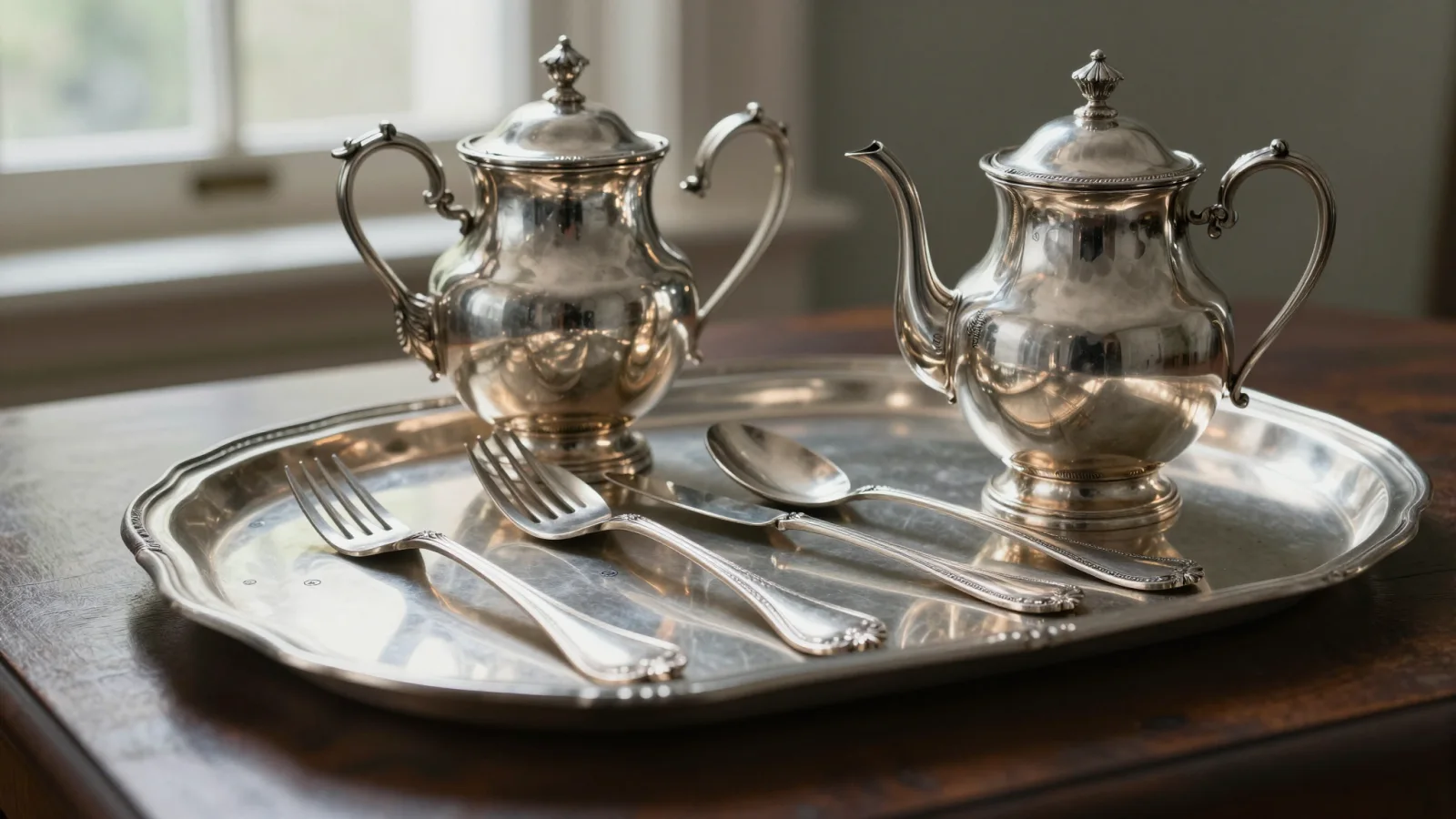
EPNS stands for Electroplated Nickel Silver. The base is an alloy of roughly 60 percent copper, 20 percent nickel, and 20 percent zinc, coated with a thin layer of pure silver by electrolysis. An EPNS mark means the piece is silver plated, not sterling. Elkington & Co of Birmingham patented the process in 1840.
What does EPNS mean on silver?
EPNS means Electroplated Nickel Silver: a nickel alloy body carrying a thin electrodeposited coat of pure silver. The letters describe a manufacturing method, not a purity standard. No assay office ever tested an EPNS piece, because there is nothing to assay in the base metal.
Nickel silver is the alloy under the plating. A typical recipe is 60 percent copper, 20 percent nickel, and 20 percent zinc. Despite the name, nickel silver contains no silver at all. Makers chose it because its pale grey colour hides wear far better than copper or brass. When the plating thins, the metal beneath shows grey rather than pink.
The silver on top arrives by electroplating. The finished object hangs in a silver cyanide bath while an electric current deposits pure silver, 999 fine, onto every surface. The layer is thin. A full EPNS tea service often carries only 20 to 30 grams of actual silver, worth a few pounds at bullion prices.
George Richards Elkington and his cousin Henry patented commercial electroplating in Birmingham in 1840. Elkington & Co then licensed the process to firms across Sheffield and Birmingham. By about 1860 electroplate had pushed the older fused Sheffield Plate out of production almost entirely. The Victoria and Albert Museum holds early Elkington electroplate and electrotypes in its metalwork collection, including exhibition pieces from the 1851 Great Exhibition era.
The collector takeaway is simple. EPNS letters on any piece mean plated ware. The design, the maker, and the condition carry the value, never the metal itself. Solid silver from the same period follows a different marking system, covered in the sterling identification guide.
How do I identify an EPNS mark?
Look for the letters E, P, N, and S stamped on the underside, usually beside a maker’s name. The letters appear either as one block stamp or as four separate punches in a row. Separate punches are the trap: at a glance they imitate the four-mark row of a genuine hallmark.
Spelling varies more than most owners expect. Common forms include EPNS, E.P.N.S., EPNS A1, ELECTROPLATE spelled in full, and EP alone. Related stamps mark different base metals: EPBM means Electroplated Britannia Metal, and EPC or EP ON COPPER means a copper body. All of them describe plated goods.
Pseudo-hallmarks are the next thing to check. Sheffield and Birmingham platers stamped rows of four or five small punches, shaped as shields, ovals, and lozenges, deliberately echoing sterling hallmark layouts. Some firms used a crown punch that closely copied the Sheffield assay crown. Pressure from the assay offices ended crown use on electroplate in 1896. A row of marks that contains no lion passant and no date letter is a plate row, not a hallmark.
Placement helps too. On flatware the marks sit on the back of the stem. On teapots and trays they hide on the base, often in a tight cluster with a pattern number. Hotel ware adds extra stamps such as SILVER SOLDERED or the hotel’s own name, a strong plate signal.
Worn marks respond well to raking light. Hold the piece at a low angle under a lamp and shallow letters reappear. A step-by-step method for reading any mark row, plated or solid, is in the hallmark identification walkthrough. For the specific confusion between plate rows and real hallmarks, see why plate marks look like sterling marks.
Which makers produced EPNS?
Most collectable EPNS came from a short list of Sheffield and Birmingham firms, and their stamps identify a piece faster than the EPNS letters themselves. The table below covers the makers found most often in British households and salerooms.
| Maker | City | Active period | Typical stamp | Known for |
|---|---|---|---|---|
| Elkington & Co | Birmingham | 1840-1963 | ELKINGTON & CO in full, often with a date code letter | Tea services, centrepieces, exhibition wares |
| Walker & Hall | Sheffield | 1845-1963 | W&H inside a pennant flag | Canteens of flatware, Art Deco tea sets |
| Mappin & Webb | Sheffield and London | 1860-present | MAPPIN & WEBB with Prince’s Plate | Hotel and ocean liner ware, dressing sets |
| James Dixon & Sons | Sheffield | 1806-1992 | Trumpet and banner trademark, JD&S | Teapots, EPBM wares, hip flasks |
| Atkin Brothers | Sheffield | 1853-1958 | ATKIN BROTHERS over SHEFFIELD | Flatware, hotel hollowware |
| Roberts & Belk | Sheffield | 1809-1961 | R&B, ROMNEY PLATE | Flatware, ecclesiastical plate |
| Cooper Brothers & Sons | Sheffield | 1866-1983 | COOPER BROS over SHEFFIELD | Trays, salvers, hotel ware |
| Viners | Sheffield | 1901-1985 | VINERS OF SHEFFIELD, ALPHA PLATE | Mid-century flatware, canteen sets |
Elkington sits at the top of the market. The firm held the original patent, supplied international exhibitions, and stamped date codes that allow year-level dating. Museum collections treat early Elkington as a design reference: the Metropolitan Museum holds Elkington electrotypes among its nineteenth century metalwork.
Walker & Hall pennant marks turn up constantly in British canteens. The firm’s interwar tea sets, with stepped Art Deco profiles, now attract buyers who never look at plate otherwise. Mappin & Webb branded its better plate Prince’s Plate, and hotel and shipping line commissions carry both the firm’s stamp and the client’s crest.
A maker stamp beside EPNS letters always narrows the date range. Match the stamp style in the table, then confirm against the firm’s working period before trusting any seller’s date.
What do EPNS quality numbers mean?
Quality stamps such as A1 grade the thickness of the silver deposit, not the purity of the metal. A heavier deposit survives more years of polishing before the nickel shows through. Makers used these grades to sell good, better, and best lines of the same pattern.
| Mark | Meaning | Deposit weight | Where you see it |
|---|---|---|---|
| A1 | Best standard grade of plating | Heaviest regular deposit, often 25-30 microns on flatware | Walker & Hall, Viners, Mappin & Webb flatware |
| A2 or Standard | Second grade, lighter deposit | Roughly half the A1 deposit | Budget canteens, retail house brands |
| EPBM | Electroplated Britannia Metal | Same plating over a soft tin-antimony body | Teapots and coffee pots, James Dixon & Sons |
| EPC / EP on Copper | Electroplate over a copper body | Varies, older trade practice | Trays, salvers, earlier Victorian pieces |
| Triple / Quadruple plate | American grading by multiples of standard deposit | Quadruple carries roughly four times standard | US makers such as 1847 Rogers Bros and Meriden |
| Silver Soldered | Construction note on hotel ware | Not a deposit grade | Hotel, railway, and shipping line services |
A1 is the stamp owners ask about most. It signals the maker’s best regular plating, and A1 flatware from the leading Sheffield firms often survives a century of use with little visible wear. It never means solid silver, whatever an optimistic listing claims.
EPBM deserves its own caution. The Britannia metal body is soft, so spouts and hinges bend and split more easily than nickel silver ones. Dented EPBM teapots are common and cheap. Sound examples by James Dixon & Sons remain worth owning.
American quadruple plate follows a different logic but answers the same buyer question. Price databases such as WorthPoint list thousands of realised prices for quadruple plate hollowware, useful for calibrating what a grade actually adds to value.
How is EPNS different from sterling silver?
Sterling is solid silver at 92.5 percent purity throughout, while EPNS is base metal wearing a silver skin measured in microns. Every practical difference between the two flows from that fact.
| Feature | EPNS | Sterling silver |
|---|---|---|
| Marks | EPNS letters, trade names, pseudo-hallmark rows | Full hallmarks: lion passant, town mark, date letter |
| Silver content | Thin pure silver layer, grams per piece | 92.5 percent silver through the whole body |
| Wear pattern | Grey or copper-toned bleed at high points | Wears thin but stays silver-white |
| Value basis | Maker, design, and condition only | Bullion value plus collectible premium |
| Weight and feel | Stiffer, base alloy body, duller ring | Softer metal, warmer ring when tapped |
The mark row settles most cases in seconds. British sterling carries a lion passant and assay marks; EPNS never does. If the row reads EPNS, EP, A1, or a trade name like Prince’s Plate, the piece is plated regardless of how convincing the rest of the row looks.
Wear points give a second opinion. Check rims, spout tips, foot edges, and the high spots of embossed decoration. Plated pieces show a colour change there: grey nickel or, on older copper-bodied pieces, a pink flush. Sterling wears thinner but never changes colour.
Weight comparisons mislead. Nickel silver is dense, and a plated tray can outweigh a sterling one of the same size. Sound is more useful: sterling gives a warm sustained ring, plate a shorter duller note. Neither test replaces reading the marks.
For pieces with no readable marks at all, the plate versus sterling test guide walks through magnet, colour, and wear checks in order. The sterling identification guide covers the solid silver side in the same depth.
How can I date an EPNS piece?
Date an EPNS piece by combining the maker’s working period, registration marks, and style, because plate carries no date letter. Three independent clues usually bracket a piece to within a decade or two.
The maker’s active period sets the outer limits. A Walker & Hall pennant mark cannot predate 1845. A Viners stamp means 1901 or later. Firm mergers close the window at the other end: Elkington and Walker & Hall both folded into British Silverware in 1963, so their independent stamps stop there.
British design registration marks tighten the range. A diamond-shaped registration lozenge was struck on registered designs between 1842 and 1883, and its corner codes encode the exact registration year. From 1884 the diamond gave way to Rd numbers, running in a published sequence that dates a design to the year. Either mark beside EPNS letters is a gift: it dates the design directly.
Elkington went further and stamped its own date code letters on much of its output, changed yearly. Published Elkington code tables convert the letter to a year. No other plater matched that discipline, which is one reason Elkington pieces dominate museum holdings. The Smithsonian collections include dated Elkington ware among their nineteenth century decorative arts.
Style and terminology close the picture. Pieces marked ELECTROPLATE in full skew earlier, roughly 1850 to 1880. The compressed EPNS abbreviation became the norm from the 1880s onward. Ornate high-Victorian chasing points before 1900; plain geometric profiles point to the 1920s and 1930s; minimal Scandinavian-influenced lines suggest the 1950s and 1960s. Any seasoned collector triangulates all three clues before writing a date on the tag.
Is EPNS worth anything?
Most EPNS has modest value, because the metal itself is worth almost nothing and survival rates are high. There is no melt value: stripping the few grams of plating costs more than the recovered silver. Value lives entirely in maker, form, condition, and completeness.
Everyday prices stay low. Single EPNS spoons and forks trade for 1 to 5 pounds. Unremarkable teapots bring 10 to 30 pounds. Boxed canteens for twelve, complete and clean, reach 80 to 300 pounds depending on maker and pattern. Condition is brutal at this level: visible base metal at the high points can halve a price.
The exceptions reward attention. Early Elkington exhibition-quality pieces, especially dated examples from the 1840s to 1870s, bring 500 to 2,000 pounds and more at specialist sales. Walker & Hall Art Deco tea sets in sharp condition make 150 to 400 pounds. Named hotel and shipping line ware, ocean liner pieces above all, carries a collector premium unrelated to the plating. Novelty Victorian forms, such as figural cruets and mounted claret jugs, sell on design alone.
Price research beats guesswork. Kovel’s publishes silver plate price guidance by maker, and WorthPoint archives realised prices for specific patterns. Checking a pattern name against sold results takes minutes and prevents both overpricing and giveaway sales.
Before valuing anything, confirm the piece really is plate. The EPNS identification guide covers the mark variants in detail, and the app-based plate test shows how photo identification separates plate from sterling when marks are ambiguous. A sterling piece misread as EPNS is the expensive mistake in this category, and it happens weekly at car boot sales.
Frequently Asked Questions
What is the best app to identify EPNS marks?
Antique Identifier – Antiqly reads EPNS stamps, maker marks, and quality grades directly from a photo of the underside. Point the camera at the mark row and Antiqly reports whether the piece is electroplate or sterling, suggests the likely maker, and gives a value range. It is a free download with no sign-up required. Photo identification helps most with worn plate, where shallow letters like E.P.N.S. fade into the surface and pseudo-hallmark rows imitate real hallmarks. Manual chart lookup still works, but Antiqly resolves the plate-versus-sterling question in seconds, which is exactly the question EPNS marks raise.
Does EPNS contain any real silver?
Yes, but only as a thin surface layer. The electroplating process deposits pure silver, 999 fine, onto the nickel alloy body, typically a coating measured in microns. A complete EPNS tea service carries roughly 20 to 30 grams of actual silver in total, worth only a few pounds as bullion. The body underneath, about 60 percent copper, 20 percent nickel, and 20 percent zinc, contains no silver at all. This is why refiners refuse EPNS: recovering the plating costs more than the silver returns. Any value in an EPNS piece comes from its maker, design, and condition rather than metal content.
Is EPNS the same as silver plate?
EPNS is one specific type of silver plate: electroplate over a nickel silver body. Other plate types use different bases under the same silver coating. EPBM means Electroplated Britannia Metal, a soft tin-antimony alloy common in teapots. EPC or EP on Copper means a copper body, frequent on Victorian trays. Sheffield Plate, the pre-1840 method, is different again: sheets of silver fused to copper by heat and rolling, not electricity. In trade listings, silver plate is the umbrella term and EPNS the most common variety. All of them are plated wares, and none carries hallmarks or bullion value.
What does EPNS A1 mean?
A1 beside EPNS letters marks the maker’s best standard grade of plating, meaning the heaviest regular silver deposit, often 25 to 30 microns on quality flatware. Firms like Walker & Hall and Mappin & Webb used A1 to distinguish their premium lines from lighter Standard or A2 plating sold at lower prices. A heavier deposit resists polishing wear for decades longer, which is why A1 canteens from the early 1900s often still look bright today. A1 never indicates solid silver, despite what hopeful sale listings sometimes suggest. It is a durability grade on plated goods, and a genuine quality signal within that category.
Is Sheffield Plate the same as EPNS?
No. Sheffield Plate predates EPNS and uses a completely different method. From the 1740s, makers fused sheet silver onto copper ingots by heat, then rolled and worked the bonded metal into finished goods. The silver layer is far thicker than electroplate, and worn examples show a warm copper bleed prized by collectors. EPNS arrived with Elkington’s 1840 electroplating patent and had largely replaced fused plate by 1860. Genuine Sheffield Plate now brings strong prices, often ten times comparable EPNS. Beware the phrase Sheffield Plated on later goods: with the letters EPNS present, it describes electroplate made in Sheffield, not the original fused process.
Can EPNS be replated?
Yes. Electroplating workshops strip the remaining silver and deposit a fresh layer, restoring the original bright finish. Replating a teapot typically costs 40 to 90 pounds, and a full canteen of flatware can run past 150 pounds, usually more than the piece is worth commercially. For everyday family pieces that trade-off is fine, since the goal is use rather than resale. For early or collectable plate, especially dated Elkington and pieces with crisp original surfaces, replating removes the aged patina that specialist buyers pay for. Dealers generally advise replating only worn ordinary ware, and leaving anything with collector interest untouched.
How can I tell EPNS from sterling quickly?
Read the mark row first. British sterling carries a lion passant, a town mark, and a date letter struck by an assay office. EPNS carries the letters EPNS or EP, a maker’s name, and sometimes a grade like A1, but never a lion passant. If the row is worn, check the high points: rims, spout tips, and raised decoration. A grey or copper-toned colour change at wear points means plate, while sterling stays silver-white as it thins. The magnet test is useless here, since nickel silver and sterling are both non-magnetic. Two checks, marks then wear points, settle most pieces in under a minute.
Are old EPNS tea sets worth anything?
Usually 20 to 100 pounds for a complete Victorian or Edwardian three-piece set in clean condition, with the market favouring crisp examples by named makers. Walker & Hall Art Deco sets are the standout, making 150 to 400 pounds when the geometry is sharp and the plating intact. Early Elkington sets with date codes can go far higher at specialist auctions. Condition drives everything: base metal showing through at the body or spout can halve a price, and dents in soft EPBM pots are often terminal. Complete sets with matching trays outsell odd pieces by a wide margin, so keep sets together.