
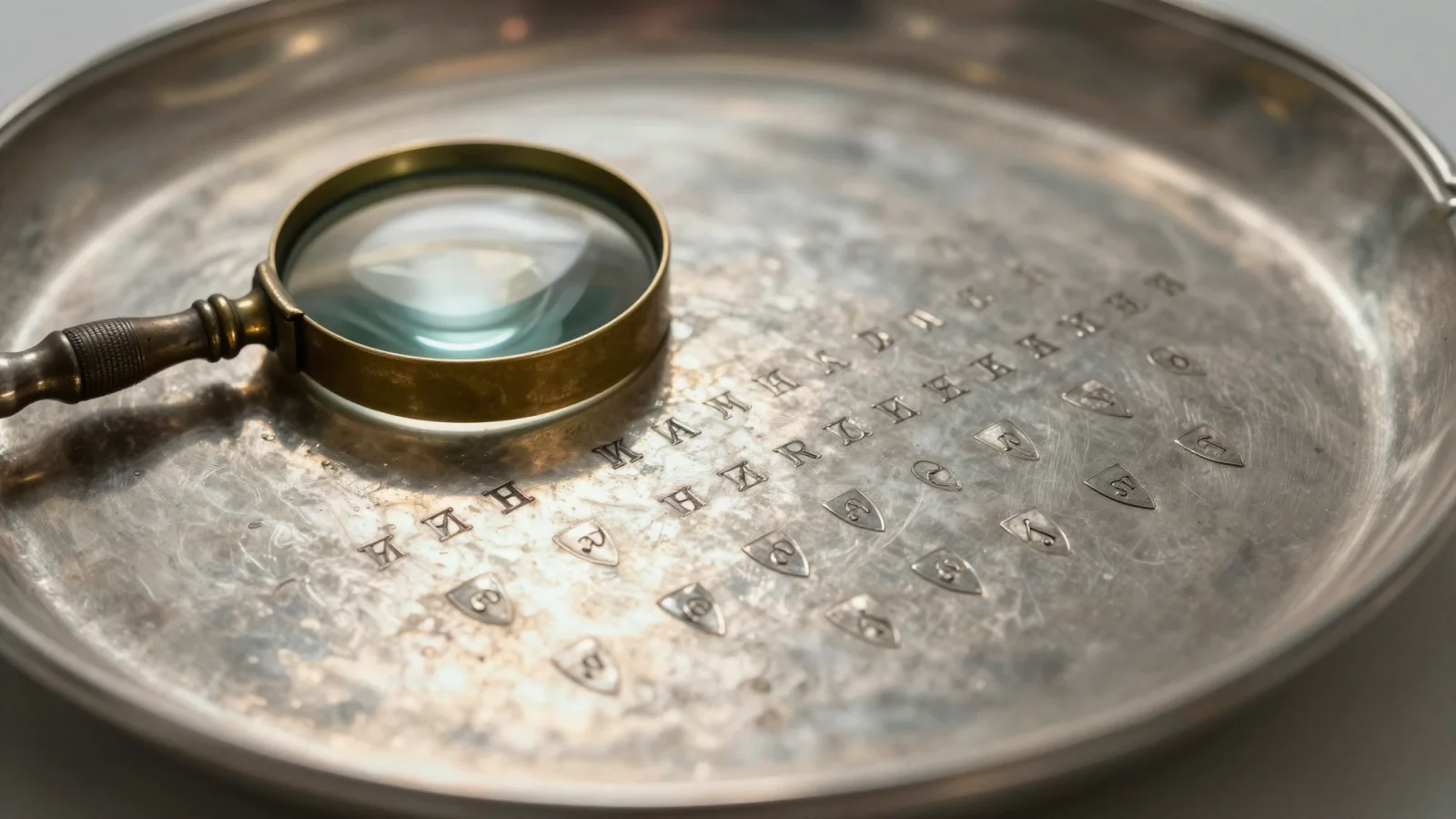
Silver makers’ marks are the registered initials or symbols a silversmith stamps into every piece submitted for assay. On British silver the maker’s initials sit beside the hallmarks; on American silver the company mark usually stands alone with the word Sterling. Match the initials, the city, and the working dates in the index below to name the maker.
The anatomy of a silver maker’s mark
Every legitimate maker’s mark answers one question: who took legal responsibility for this piece. In Britain the punch is registered at an assay office. The silversmith strikes it before submitting work for testing. The office then adds the hallmarks: standard mark, town mark, and date letter. The maker’s initials are the only mark the silversmith applies personally.
A British mark is usually two or three initials inside a shaped punch. Hester Bateman registered HB in script inside a shaped surround in 1761. Paul Storr used PS in a double-lobed punch from 1792. The punch outline matters as much as the letters. Two makers could share initials, but rarely the same punch shape.
American makers worked without a compulsory assay system. Companies stamped a full name, a symbol, or a trademark instead. Gorham used a lion, an anchor, and a G. Tiffany & Co stamped the company name with an order number and a director’s initial. The word Sterling replaced the British lion passant on most American pieces after about 1868.
The table below shows the five elements you may find beside a maker’s mark. Not every piece carries all five. A full set appears on most British silver; American pieces often carry only two.
| Mark element | What it tells you | Typical example |
|---|---|---|
| Maker’s or sponsor’s initials | Who submitted the piece | HB for Hester Bateman |
| Standard mark | Silver purity | Lion passant for 925 |
| Town mark | Assay office | Anchor for Birmingham |
| Date letter | Assay year | Gothic q for London, 1876 |
| Duty or commemorative mark | Tax paid or a royal event | Sovereign’s head, 1784-1890 |
Start with our silver marks guide if these terms are new. For the full British system, the UK hallmarks reference covers every office and date-letter cycle.
How do I identify a maker’s mark?
Work from the whole mark group, not the initials alone. The surrounding hallmarks narrow the field faster than any letter search. A town mark and date letter reduce thousands of candidate makers to a handful registered at one office in one year.
Follow this sequence:
- Photograph the marks in raking light. Hold the light source low and to one side. Shadow fills the punch and makes worn letters readable.
- Orient the piece before reading. An upside-down W becomes an M and sends you to the wrong maker.
- Count the initials and note punctuation. HB differs from H·B, and both differ from H.B struck in a different outline.
- Record the punch shape. Oval, rectangle, clipped corners, trefoil, and quatrefoil outlines separate makers with identical letters.
- Identify the assay office and date letter first, then look up the initials in the tables below or a period register.
The step-by-step method in how to identify silver hallmarks walks through office and date identification in detail. If you prefer to work from your phone, we tested the fastest workflow in identifying makers’ marks with a phone camera.
One warning from long habit: never polish a mark to read it better. Polishing rounds the punch edges and lowers value; those crisp punch walls are part of what a buyer pays for. A cotton bud with a drop of water lifts surface dirt safely. Anything abrasive stays in the drawer.
British silver makers: A to L
British marks in this table are listed by initials, with the city of registration and working dates. Registration year means the earliest recorded punch for that maker at an assay office; many firms registered new punches for decades afterwards. Working dates cover silver production, not company existence.
| Initials | Maker | City | First registered | Active period | Typical wares |
|---|---|---|---|---|---|
| AB | Atkin Brothers | Sheffield | 1853 | 1853-1958 | flatware, hollowware, plate |
| CB | Charles Boyton & Son | London | 1849 | 1849-1933 | flatware, hollowware |
| CF | Charles Fox II | London | 1822 | 1822-1840 | salts, mustard pots, novelty pieces |
| CSH | Charles Stuart Harris | London | 1852 | 1852-1934 | reproduction flatware, hollowware |
| E&Co | Elkington & Co | Birmingham | 1841 | 1841-1963 | electroplate, sterling presentation pieces |
| FH | Francis Higgins & Son | London | 1817 | 1817-1940 | flatware specialist |
| GA | George Adams (Chawner & Co) | London | 1840 | 1840-1883 | Victorian flatware |
| G&SCo | Goldsmiths & Silversmiths Co | London | 1898 | 1898-1952 | canteens, presentation silver |
| GU | George Unite | Birmingham | 1832 | 1832-1896 | card cases, small wares |
| HB | Hester Bateman | London | 1761 | 1761-1790 | teapots, spoons, sugar tongs |
| H&H | Hukin & Heath | Birmingham | 1855 | 1855-1953 | Christopher Dresser tableware |
| JD&S | James Dixon & Sons | Sheffield | 1867 | 1806-1992 | flasks, flatware, EPBM |
| JW | Joseph Willmore | Birmingham | 1806 | 1806-1845 | vinaigrettes, snuff boxes |
| L&Co | Liberty & Co | Birmingham | 1899 | 1899-1927 | Cymric Art Nouveau silver |
Three of these names carry particular weight at auction. Hester Bateman leads the collectible women silversmiths; her teapots make £2,000-8,000 while common teaspoons stay under £150. Elkington matters as the firm that patented electroplating in 1840, so their marks appear on both sterling and plate; check for a lion passant before assuming solid silver. Liberty’s Cymric line, largely designed by Archibald Knox, brings £1,000-20,000 for good pieces. The Victoria and Albert Museum holds reference examples of most makers here.
For deeper coverage of the British system, see our UK silver makers’ marks guide.
British silver makers: M to Z
The second half of the alphabet holds the heaviest names in English silver. Registration dates below follow the same convention: earliest recorded punch, then working period in silver.
| Initials | Maker | City | First registered | Active period | Typical wares |
|---|---|---|---|---|---|
| MB | Matthew Boulton | Birmingham | 1773 | 1773-1809 | candlesticks, Sheffield plate |
| M&W | Mappin & Webb | Sheffield | 1863 | 1863-present | flatware, hollowware |
| NM | Nathaniel Mills | Birmingham | 1826 | 1826-1856 | castle-top card cases, snuff boxes |
| N&H | Nathan & Hayes | Chester | 1885 | 1885-1912 | frames, small silver |
| OR | Omar Ramsden | London | 1918 | 1918-1939 | Arts and Crafts presentation pieces |
| PB·AB | Peter & Ann Bateman | London | 1791 | 1791-1805 | flatware, salvers |
| PL | Paul de Lamerie | London | 1712 | 1712-1751 | rococo hollowware |
| PS | Paul Storr | London | 1792 | 1792-1838 | Regency presentation silver |
| RG | Robert Garrard II | London | 1818 | 1818-1853 | royal commissions, trophies |
| Rn&Cr | Ramsden & Carr | London | 1898 | 1898-1918 | Arts and Crafts hollowware |
| R&B | Roberts & Belk | Sheffield | 1864 | 1864-1961 | flatware, hollowware |
| SM | Sampson Mordan | London | 1823 | 1823-1941 | pencils, vesta cases, scent bottles |
| TB&S | Thomas Bradbury & Sons | Sheffield | 1832 | 1832-1943 | hollowware, plate |
| W&H | Walker & Hall | Sheffield | 1845 | 1845-1971 | flatware, sterling, plate |
| WC | William Comyns & Sons | London | 1859 | 1859-1953 | dressing table silver, frames |
| WH&S | William Hutton & Sons | Sheffield | 1800 | 1800-1930 | Art Nouveau hollowware, flatware |
Paul de Lamerie and Paul Storr sit at the top of the market. A documented Lamerie piece starts around £5,000 and reaches seven figures; his PL mark is also the most faked in English silver, so treat any bargain with suspicion. Storr’s Regency work for Rundell, Bridge & Rundell brings £3,000-100,000 depending on scale. At the affordable end, Walker & Hall and Mappin & Webb produced enormous quantities of both sterling and plate; their sterling flatware trades close to metal value, which makes them a sensible first purchase for a new collector.
American silver makers and companies
American makers marked differently because no assay law required initials. Companies used pictorial trademarks, full names, and pattern numbers. The word Sterling on American silver dates a piece after about 1868 in most cases; before that, look for Coin, Pure Coin, or a maker’s name alone.
| Mark | Company | City | Founded | Sterling period | Typical wares |
|---|---|---|---|---|---|
| Lion, anchor, G | Gorham Manufacturing Co | Providence, RI | 1831 | 1831-present | flatware, hollowware, Martelé |
| Tiffany & Co + initial | Tiffany & Co | New York, NY | 1837 | 1851-present | flatware, presentation silver |
| Eagle, R, lion | Reed & Barton | Taunton, MA | 1824 | 1889-2015 | flatware, hollowware |
| Griffin with W | Whiting Manufacturing Co | New York, NY | 1866 | 1866-1926 | flatware, Aesthetic silver |
| RW&S | R. Wallace & Sons | Wallingford, CT | 1835 | 1875-present | flatware |
| T over lion | Towle Silversmiths | Newburyport, MA | 1857 | 1890-2000s | flatware |
| S. Kirk & Son | Samuel Kirk & Son | Baltimore, MD | 1815 | 1815-1979 | repoussé hollowware |
| Stieff | The Stieff Company | Baltimore, MD | 1892 | 1892-1979 | repoussé, Williamsburg reproductions |
| IS in wreath | International Silver Co | Meriden, CT | 1898 | 1898-1984 | flatware, hollowware |
| Lunt | Lunt Silversmiths | Greenfield, MA | 1902 | 1902-2009 | flatware |
| Alvin / A | Alvin Corporation | Providence, RI | 1886 | 1886-1980s | flatware, dresser silver |
| D&H | Dominick & Haff | New York, NY | 1872 | 1872-1928 | flatware, hollowware |
| Durgin / D | William B. Durgin Co | Concord, NH | 1853 | 1853-1924 | flatware |
| FMW | Frank M. Whiting Co | North Attleboro, MA | 1878 | 1878-1940s | candlesticks, flatware |
| Crown over W | Watson Company | Attleboro, MA | 1874 | 1874-1955 | souvenir spoons, flatware |
| UB intertwined | Unger Brothers | Newark, NJ | 1872 | 1878-1914 | Art Nouveau novelties |
| WBK | Wm. B. Kerr & Co | Newark, NJ | 1855 | 1855-1927 | Art Nouveau dresser ware |
| Winged S | George W. Shiebler & Co | New York, NY | 1876 | 1876-1910 | medallion and Etruscan styles |
| Oneida | Oneida Community | Oneida, NY | 1880 | 1880-present | plate and sterling flatware |
Symbols do the work initials do on British pieces. Gorham’s lion-anchor-G is the most recognized; the firm added year symbols on hollowware from 1868, which our Gorham date marks guide decodes. Tiffany marks carry pattern and order numbers plus a director’s initial, covered in Tiffany & Co sterling marks. Reed & Barton used an eagle-R-lion sequence with dating quirks of its own, unpacked in Reed & Barton silver marks.
The Smithsonian’s American silver collection and the Metropolitan Museum both publish searchable examples for cross-checking. Our American silver marks reference covers the wider system.
What is the difference between a sponsor’s mark and a maker’s mark?
A sponsor’s mark and a maker’s mark are legally different things, though collectors use the words interchangeably. The sponsor’s mark identifies whoever takes responsibility for sending the piece to assay. That person may have made it, commissioned it, or merely retailed it.
British law has required a registered sponsor’s mark since 1363. The registrant was originally the working goldsmith. By the Victorian period, large retailers registered their own punches and bought finished work from trade manufacturers. A spoon struck W&H might have been made by an unnamed Sheffield workshop and sold by Walker & Hall.
This distinction changes attribution and price. ‘Made by’ commands more than ‘retailed by’. Garrard and the Goldsmiths & Silversmiths Co both sponsored large amounts of outside work. Auction catalogues use careful wording for this reason: ‘bearing the sponsor’s mark of’ signals the house cannot confirm the workshop.
Some overlap cases are worth knowing. Omar Ramsden’s pieces carry the inscription OMAR RAMSDEN ME FECIT, meaning ‘Omar Ramsden made me’; in practice his workshop of assistants produced the pieces after 1918. Liberty & Co never made silver at all; Birmingham firms including W. H. Haseler produced the Cymric line to Liberty designs. Neither fact hurts value. The design and the retail name drive the market.
For American silver the distinction appears as maker versus retailer stamps. A piece can carry both: Gorham’s lion-anchor-G beside a Shreve, Crump & Low retail stamp is common on Boston-market pieces. The maker’s mark identifies the manufacturer; the retail stamp only tells you where it was sold.
What if the initials are not in this index?
Most unidentified marks fail on method, not on obscurity. Work through four checks before declaring a mark unlisted.
First, confirm the piece is solid silver. Plate marks imitate sterling marks closely, and plate makers vastly outnumber silversmiths. EPNS, EP, A1, or a missing standard mark all point to electroplate; those makers need a plate reference, not a silver one.
Second, re-read the initials against the punch shape. Worn script capitals mislead. A script I and J are near twins, and G reads as C when the tail wears flat. Try every plausible reading in a register before giving up on the first.
Third, check the country. Pseudo-hallmarks on Continental and export silver imitate British punches. An 800 or 830 number beside initials means a German or Scandinavian maker, and a different register entirely. Our visual hallmarks chart helps place the country in seconds.
Fourth, search the sold-price archives. WorthPoint indexes millions of sold listings, and sellers often identify obscure marks in the listing text. Kovel’s maintains marks dictionaries built over seventy years of publication. When a worn mark on a curved handle resists reading, a search on the piece’s pattern often succeeds where the mark search fails.
Truly unregistered marks exist. Small workshop pieces under assay weight exemptions, colonial silver, and some early provincial work carry initials no surviving register lists. An unlisted mark on an otherwise correct piece is a research project, not a fake alarm.
Frequently Asked Questions
Is there an app that identifies silver makers’ marks from a photo?
Antique Identifier – Antiqly reads makers’ initials, punch shapes, and the surrounding hallmarks from a single photo and matches them against British and American maker records. The app is free to download and needs no sign-up. Photograph the mark in raking light and it returns the maker, working period, and a value range in seconds. It handles the cases a printed index cannot: worn punches, script initials, and marks on curved surfaces. If a mark resists even a database, the photo itself becomes your research record to share with an appraiser.
What do the initials stamped on silver mean?
Initials identify the maker or sponsor who submitted the piece for assay. On British silver they are a legal registration: HB was recorded by Hester Bateman at Goldsmiths’ Hall in 1761, PS by Paul Storr in 1792. The letters alone are not unique. Punch shape, letter style, and the accompanying town mark and date letter separate makers who shared initials. On American silver, initials are a trademark rather than a registration, like FMW for Frank M. Whiting. Always read initials together with the other marks; the combination, not the letters, names the maker.
How can I tell a British maker’s mark from an American one?
Look for the standard mark. British sterling carries a lion passant beside the maker’s initials, plus a town mark and usually a date letter: a full group of three to five punches. American silver almost never has these. Instead you find the word Sterling or 925/1000 next to a company name or trademark, a convention standard after about 1868. Earlier American pieces may read Coin or carry a name alone. A single set of initials with no lion and no town mark is far more likely American, Continental, or electroplate than British.
Why does my silver have two different sets of initials?
The usual answer is maker plus retailer. Large retailers stamped their own mark beside the manufacturer’s: Gorham pieces sold through Shreve, Crump & Low in Boston carry both. On British silver, a second overstruck punch can mean a retailer registered as sponsor over the workshop’s own mark. Small extra initials appear as journeyman or workshop marks on some large firms’ pieces, Elkington among them. On flatware, a later set of engraved initials can also be an owner’s monogram, which sits on the surface rather than inside a punch outline.
How do I date silver from the maker’s mark alone?
You can bracket a date, not pinpoint it, unless a date letter is present. The maker’s working period sets the outer limits: a Nathaniel Mills card case must fall between 1826 and 1856. Punch changes narrow further. Firms re-registered punches when partners changed, so PB·AB for Peter and Ann Bateman locks to 1791-1805. American firms help with private systems: Gorham stamped year symbols on hollowware from 1868, and Tiffany’s director initials change with each company president. A British piece with a full hallmark group dates to a single year from the date letter, which is always the better tool.
Which silver makers’ marks are the most valuable?
Paul de Lamerie leads English silver; documented pieces start around £5,000 and important rococo work has passed £1 million at auction. Paul Storr’s Regency silver, Hester Bateman’s domestic pieces, and Omar Ramsden’s Arts and Crafts work all carry strong premiums over metal value. In American silver, Tiffany & Co and Gorham’s Martelé line command the top of the market, with Martelé hollowware regularly making $10,000-100,000. Value follows documentation: the same mark on a common teaspoon and on a documented presentation piece can differ by a factor of a thousand. Condition and crisp, unpolished marks matter at every level.
Do American silver companies use date letters?
Not as a system-wide rule, because the United States never had compulsory assay. Several firms ran private dating schemes instead. Gorham stamped year symbols on sterling hollowware from 1868. Tiffany & Co marked a director’s initial, which brackets production to that director’s tenure: M for Edward C. Moore covers 1873-1891. Kirk changed its stamp wording with each company address, and Reed & Barton’s mark style shifted by decade. Whiting, Wallace, Towle, and most flatware firms never dated pieces at all; pattern introduction years and retailer records become the dating evidence for those makers.
Are makers’ marks ever faked?
Yes, and the most valuable are faked the most. Paul de Lamerie’s PL is the most forged mark in English silver. Fakes range from cast copies with soft edges to genuine period marks transposed from small pieces into grander ones. Warning signs include punch outlines that do not match recorded registers, marks positioned where that maker never struck them, and a solder halo around the mark showing a let-in section. A cast fake shows granular texture under a loupe where a struck original shows sheared, crisp walls. High-value attributions deserve comparison against museum-documented examples before money changes hands.