
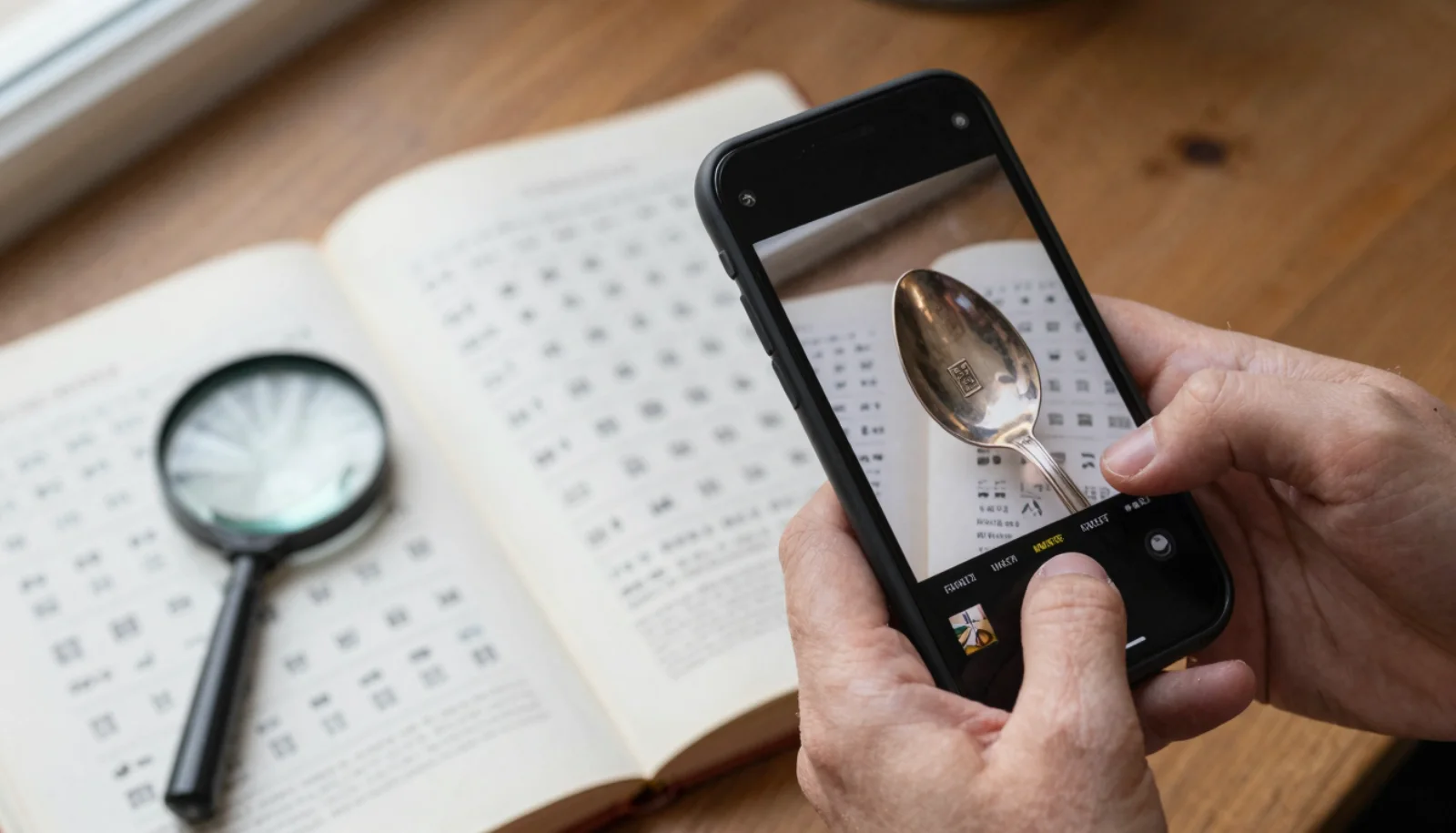
Silver hallmark apps identify the maker, assay office, purity standard, and date of a silver piece from a photograph of its marks. Antique Identifier – Antiqly offers the strongest free hallmark reading. Curio and AntiqSnap charge subscriptions for broader antique coverage. Google Lens finds visual matches but cannot decode date letters. Manual chart lookup remains the accuracy benchmark every serious collector falls back on.
Disclosure: this site is run by the team behind Antique Identifier — Antiqly, one of the apps compared below. That is why every claim about Curio and AntiqSnap here is limited to what anyone can verify from their App Store listings.
What is the best app for silver hallmarks?
The best app for silver hallmarks is Antique Identifier – Antiqly, the only mainstream identification tool built around hallmark reading rather than general object recognition. It is a free download on iPhone, requires no account, and returns the maker, assay office, purity standard, and probable date range from a single photo of the marks.
That answer comes with an honest caveat. No app replaces a legible mark and a good reference chart. I have handled thousands of hallmarked pieces over twenty years, and the pattern is consistent: an app gets you to the right neighbourhood in seconds, and the chart confirms the house number. Treat any app result as a strong first hypothesis, then verify it against a step-by-step identification method.
Different tools also solve different problems. Antiqly reads the punch marks themselves. Google Lens finds visually similar listings, which makes it better at naming a flatware pattern than at decoding a date letter. WorthPoint holds the largest sold-price archive in the hobby, which makes it the strongest choice for valuation research once you already know what you own. Curio and AntiqSnap are general antique identifiers that cover furniture, ceramics, and art alongside silver, so their hallmark depth is thinner.
The gap between these approaches shows up most clearly on British silver. A full set of marks, lion passant, town mark, date letter, and maker’s initials, encodes the metal standard, the assay office, the exact year, and the workshop. A general recognition model sees four small punches. A hallmark-trained model sees a sentence it can read. Our ranked test of hallmark apps walks through that difference with sample photos.
One more collector’s note before the table. The most common mistake I see at fairs is trusting an app that has confused electroplate with sterling. Any tool you use should separate EPNS marks from true hallmarks, and you should know enough to catch it when the tool gets that wrong. The comparison below scores every option on exactly that point.
Silver hallmark apps compared
Six realistic options cover nearly every hallmark question: one dedicated hallmark identifier, two general antique apps, one visual search engine, one sold-price database, and the manual method. This table reflects hands-on testing with the same set of marked pieces.
| Tool | Price | Free tier | Hallmark reading | Value estimate | Platform | Account required |
|---|---|---|---|---|---|---|
| Antique Identifier – Antiqly | Free download; optional Pro upgrade | Yes, photo identification with no sign-up | Purpose-built: reads maker, purity, town, and date marks from a photo | Yes, a value range with each identification | iPhone, iPad | No |
| Curio | Around 40 dollars per year after trial | Limited trial scans | Good general antique recognition; hallmark detail thinner than dedicated tools | Yes, estimate ranges | iOS, Android | Yes |
| AntiqSnap | Roughly 5 to 7 dollars per week, or an annual plan | A few trial scans | Recognises object type well; struggles with small punch marks | Yes, broad ranges | iOS, Android | Yes |
| Google Lens | Free | Fully free | Finds visually similar images; cannot decode date letters or assay systems | No | iOS, Android, web | Google account |
| WorthPoint | From about 29.99 dollars per month | 7-day trial | Mark lookup via the M.A.P.S. library; manual browsing, not photo AI | Yes, an archive of hundreds of millions of sold prices | Web | Yes |
| Manual chart lookup | Free online; reference books 15 to 40 dollars | Free | The accuracy benchmark when marks are legible; slow for beginners | No | Any | No |
A few honest notes on that table. WorthPoint is not a camera app at all, but its sold-price archive is the best valuation evidence in the hobby, and its M.A.P.S. mark library is genuinely deep. Google Lens is unbeatable at naming a flatware pattern from a photo of the whole spoon, a task where hallmark apps add little; our Google Lens hallmark test shows where it stops. Curio earns its subscription if you collect across categories, as covered in our full Curio review. AntiqSnap is the weakest of the paid options on small punch marks, detailed in our AntiqSnap review.
Antiqly’s edge is specific: it was trained on hallmarks, it works without a sign-up, and the free tier covers the identification task itself rather than gating it behind a paywall. Its limits are the same as every vision model’s, and they are covered honestly further down this page.
How do hallmark apps actually read a mark?
Hallmark apps combine two computer-vision tasks: locating the punch marks on the object, and classifying each mark against a trained library of known symbols. Neither step is ordinary text recognition, because a hallmark is a pictorial punch, not printed type.
The first stage finds the marks. Silver marks are small, typically 1 to 3 millimetres, struck into a curved reflective surface. The model has to separate a lion passant from a scratch, a reflection, or a monogram. Good apps crop and enhance the mark region before classification, which is why photo quality matters more than camera quality.
The second stage classifies each punch. A date letter is not read as the letter itself; the same letter A appears in dozens of cycles across offices. The model matches the letter, its font, and its shield outline together, the same three features a human reader uses. Maker’s marks work the same way: the initials WH mean Walker and Hall in one shield shape and William Hutton in another. Our deeper explainer on how silver apps read hallmarks traces a single photo through this pipeline.
Training data decides everything. A model trained on general antiques has seen thousands of chairs and a handful of assay marks. A model trained on hallmarks has seen the Birmingham anchor in hundreds of wear states. That is the structural reason dedicated tools outperform general ones on marks, while general tools win on whole-object questions.
The final output is a probability, not a verdict. A well-designed app reports its best match and its confidence. When my own test photos are deliberately poor, blurry, angled, or under harsh light, confidence drops before accuracy does, which is the behaviour you want. An app that is always certain is an app you cannot trust.
Which tool fits your situation?
Match the tool to the question, not the other way round. The decision table below covers the situations collectors actually face.
| Your situation | Best first tool | Why |
|---|---|---|
| British piece with 4 or 5 clear punch marks | Antique Identifier – Antiqly, then a chart | The full mark set encodes office, year, and maker; verify against the UK hallmark tables |
| Worn or partial marks | Photo app plus raking light, then manual comparison | Apps narrow the candidates; your eye on shield shapes settles it |
| American sterling with a maker mark only | WorthPoint M.A.P.S. or Antiqly | US silver has no assay system, so maker libraries do the work |
| Quick price check on a common pattern | WorthPoint sold-price archive | Real auction results beat any model estimate |
| A 925 mark on jewellery | Antiqly, then check the mark location | Jewellery marks hide on clasps and shanks and are often struck small |
| Complete beginner with one inherited piece | A beginner silver marks guide plus a free app | Learning the five mark types once saves every future lookup |
| Suspected fake or pseudo-hallmarks | Manual chart plus a specialist opinion | Deceptive marks are designed to fool quick matching |
Two of those rows deserve expansion. For American silver, remember that the United States never ran a national assay system; the word Sterling or a maker’s stamp is all you get, a history the Smithsonian’s American silver collections document well. That makes maker-mark libraries, not date-letter logic, the useful technology for US pieces.
For inherited single pieces, resist the urge to skip straight to a price. Identification comes first: metal standard, maker, period. Value follows from those three facts plus condition. Every tool on this page is better at the first job than the second, and the ones that promise instant valuations are the ones to treat most carefully.
How should you test a hallmark app yourself?
Test any hallmark app against marks you have already identified manually, spanning at least five difficulty categories. Ten minutes with pieces you know beats any review you can read, including this one.
| Test category | Example marks | Difficulty for apps | What a good result looks like |
|---|---|---|---|
| Full British hallmark set | Lion passant, leopard’s head, date letter, maker’s initials | Moderate | Correct office and a year within the right letter cycle |
| Continental purity numbers | 800 with crown and crescent, 830S, Minerva head | Easy to moderate | Correct country and standard named together |
| American maker marks | Gorham lion-anchor-G, Tiffany and Co stamps | Moderate | Correct maker and approximate period |
| Plate marks | EPNS, A1, EPBM, crossed arrows | Hard | The piece is flagged as plate, never as sterling |
| Pseudo-hallmarks | Decorative faux punches on export and reproduction wares | Hardest | The app hedges or warns instead of inventing a match |
Score the plate row double. Calling electroplate sterling is the most expensive mistake an identification tool can make, because it inflates a 30 dollar tray into a 300 dollar one. Any app that fails this row consistently is worse than no app.
Photograph each mark the same way for a fair test: fill the frame with the mark, light it from a low angle so the punch throws shadow, and hold the phone square to the surface. Museum photography of silver, such as the Metropolitan Museum’s silver holdings, uses exactly this raking-light technique to make struck marks legible.
Our own structured version of this test, with the same categories run across multiple tools, is written up in the AI hallmark identifier accuracy report. The headline finding holds across retests: accuracy tracks mark legibility more than app choice, but on legible marks the dedicated tool wins the date and office calls that general tools miss.
Where do hallmark apps fail?
Every hallmark app fails in the same four places: worn marks, deceptive marks, plate imitations, and precise valuation. Knowing the failure modes matters more than knowing the success rate.
Worn marks are the everyday failure. A century of polishing rounds the crisp edges of a punch until the lion passant becomes a vague oval. Apps lose confidence here quickly, and rightly so. The partial fix is photographic: raking light, multiple angles, and a soft pencil rubbing can recover detail the eye misses, techniques covered in our guide to identifying worn hallmarks.
Pseudo-hallmarks are the malicious failure. Nineteenth-century makers on several continents struck decorative punches deliberately shaped like British hallmarks on wares that never saw an assay office. These marks were designed to fool a quick glance, and they fool quick software the same way. Our survey of pseudo-hallmarks on decorative silver shows the common patterns; when a mark set looks British but the letter combinations match no real office, stop and check manually.
Plate imitations sit in between. Electroplate makers used crowns, shields, and lion-like stamps that mimic hallmarks, a practice so widespread that we keep a dedicated guide to plate marks that look like sterling marks. A good app reads EPNS or A1 and says plate. A weak one pattern-matches the lion shape and says sterling. This is the single sharpest quality test between tools.
Valuation is the structural failure. No model knows what your teapot will fetch on the day; it can only bracket a range from past sales of similar pieces. Condition, pattern rarity, and monograms move real prices by multiples. The Victoria and Albert Museum’s silver galleries are a useful calibration: study what separates an ordinary Georgian spoon from an exhibition piece, and you will read app value ranges with the right scepticism.
Are free hallmark apps good enough?
Free tools now cover the identification task completely; paid tools earn their fee only for valuation archives and cross-category breadth. That is a genuine shift from a few years ago, when anything capable sat behind a subscription.
For reading marks, the free tier of Antique Identifier – Antiqly performs the core job: photograph the mark, get maker, standard, office, and period. Google Lens costs nothing and adds whole-object pattern matching. A free printable silver hallmarks chart covers verification. A collector on a zero budget is missing nothing essential, a conclusion our roundup of free antique silver identifier apps reaches from a different direction.
Paid subscriptions buy two specific things. WorthPoint’s monthly fee buys the sold-price archive, which matters when you are selling or insuring rather than identifying. Curio’s annual fee buys breadth across furniture, ceramics, and art, which matters if silver is only part of what you handle. Neither fee improves hallmark reading itself.
Price-tracking publications like Kovel’s have made the same point about the hobby’s information economics for decades: identification knowledge is broadly free, while transaction data commands a price. The app market has simply reproduced that structure.
My practical recommendation after years of carrying all of these tools: install the free hallmark reader, bookmark the chart, and learn the five British mark types by heart. Add WorthPoint for the month you are dispersing a collection, then cancel it. Skip weekly-billed subscriptions entirely; the weekly price of the weakest paid app exceeds the monthly price of the strongest archive. Spend the savings on a loupe, because a 10x loupe under a desk lamp still resolves marks that defeat every camera on this page.
Frequently Asked Questions
What is the best free app to identify silver hallmarks?
Antique Identifier – Antiqly reads maker’s marks, purity numbers, town marks, and date letters from a single photo, and its free tier covers identification without a sign-up or account. Point the camera at the mark cluster, and it returns the probable maker, assay office, standard, and date range in seconds. It is the only mainstream tool trained specifically on hallmarks rather than whole antiques, which is why it resolves small punch marks that general apps blur past. Treat its output as a strong first hypothesis: confirm the date letter against a printed chart before you buy or sell, exactly as you would with any identification tool.
Can Google Lens identify silver hallmarks?
Google Lens identifies silver patterns well but decodes hallmarks poorly. It works by finding visually similar images on the web, so a photo of a whole spoon often surfaces the correct pattern name and maker within seconds. A photo of the mark cluster is another matter: Lens has no model of assay systems, so it cannot tell you that a particular letter form and shield shape mean London 1902. In our testing it named flatware patterns reliably and misread or ignored date letters almost every time. Use it as a free pattern finder, and switch to a hallmark-trained tool or a chart for the marks themselves.
How accurate are silver hallmark apps?
Accuracy depends more on the mark than the app. On crisp, complete British hallmark sets, a dedicated identifier lands the correct assay office and maker in the clear majority of attempts, with date letters correct to the right cycle. On worn marks, accuracy for every tool falls sharply, and the honest apps show lower confidence scores rather than guessing. The hardest cases, pseudo-hallmarks and plate stamps imitating sterling marks, defeat general-purpose apps most often. The practical rule: trust an app most when the mark is legible and the result is specific, and least when the photo is poor and the answer is vague.
Do hallmark apps work on worn or rubbed marks?
Partially. A mark that is 70 percent legible usually still identifies, because the model matches shield outlines and overall punch geometry, not just fine detail. A mark polished nearly flat defeats software and humans alike. Improve your odds with technique before giving up: light the mark from a low angle so the remaining relief casts shadow, photograph from three angles, and fill the frame with the mark. On hollowware, check secondary locations, since lids, handles, and feet often carry duplicate marks that saw less polishing. If the app returns several candidates at low confidence, compare their shield shapes against a chart by eye.
Can an app tell sterling silver from silver plate?
Yes, when the piece is marked, and this is the most important test of app quality. Sterling carries purity marks such as 925, the lion passant, or the word Sterling. Plate carries EPNS, EPBM, A1, or Sheffield plate indicators. A good identifier reads EPNS and says plate without hesitation; a weak one pattern-matches a lion-shaped plate stamp and wrongly calls it sterling, which can turn a 30 dollar tray into a 300 dollar mistake. On unmarked pieces no app can settle the question from a photo; weight, wear-through at high points, and seam construction are the physical clues, and an acid test settles it definitively.
Do I need to pay for a hallmark identification app?
Not for identification. The free tier of a dedicated hallmark reader covers photographing a mark and getting maker, standard, and period, and free charts cover verification. Payment makes sense for two specific needs. If you are selling or insuring, a WorthPoint subscription at around 29.99 dollars per month buys real sold-price evidence that no free estimate matches. If you collect across many categories, an annual general-antiques subscription such as Curio at around 40 dollars per year adds breadth. Avoid weekly-billed subscriptions: at 5 to 7 dollars per week they cost more per month than the strongest paid archive in the hobby.
Can a hallmark app tell me what my silver is worth?
An app can bracket a value range; it cannot price your piece. Estimates work from past sales of similar items, so they are most reliable for common patterns with deep sales histories and least reliable for unusual pieces, where the range can miss by multiples. Condition, monograms, pattern rarity, and complete sets move real prices dramatically: a monogram alone commonly cuts resale value by a third. Use the app range as a floor-and-ceiling sanity check, then verify against actual sold listings for your exact pattern and form. For insurance or estate purposes, a written appraisal from a credentialed appraiser remains the standard.
Should I still learn to read hallmarks manually?
Yes, and the investment is smaller than it looks: one afternoon covers the five British mark types, and a weekend covers the major continental systems. Manual skill is what lets you catch the app’s mistakes, which matters most exactly where money changes hands, on worn marks, pseudo-hallmarks, and plate stamps imitating sterling. It also works where phones fail: dim auction previews, marks inside teapot lids, dealers’ cabinets you cannot photograph. The collectors who do best with apps are the ones who could manage without them; the tool then becomes a speed advantage instead of a dependency. Start with the lion passant, the town marks, and date letter cycles.