
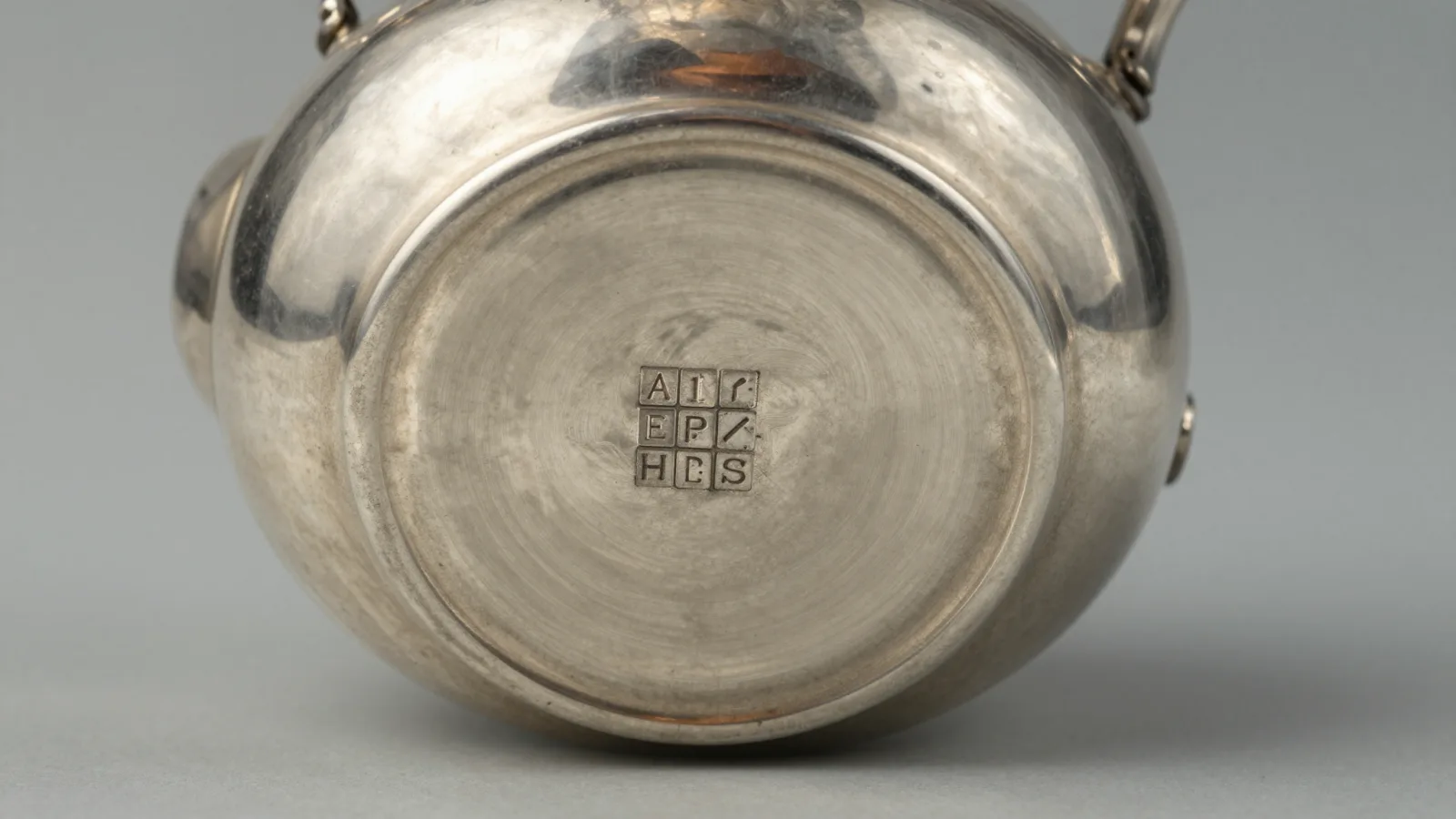
A1 on silver plate means the heaviest grade of plating a maker offered, not silver content. A2 sits one step below. Neither mark indicates sterling.
What do A1 and A2 actually mean on silver plate?
A1 is a maker’s own quality grade for the thickness of the plating, and it says nothing about silver purity. It marks the heaviest deposit of pure silver that firm applied across its standard range. A2, where a firm bothered to use it, sat one grade below.
Nothing about A1 was regulated. No assay office tested it, no statute defined it, and no two Sheffield firms were obliged to agree on what the letter promised. That single fact trips up almost everyone holding a marked teapot for the first time. The stamp looks official, it sits in a neat rectangular punch beside a lion or a crown, and the metal underneath is still nickel alloy.
What A1 does tell you is useful in its own right. A firm applying the mark was advertising a plating deposit measured in ounces of silver per gross of pieces, and the heavy grades survive a century of polishing where the light grades do not. An A1 Walker and Hall tray from 1900 can still show an even, cool white surface, while an ungraded contemporary of identical shape has gone brassy at every raised point.
The grading language emerged in the 1850s, roughly fifteen years after Elkington and Co patented the commercial electroplating process in 1840. Firms needed a shorthand to justify price differences between two visually identical trays. The Victoria and Albert Museum holds Elkington work from exactly this transition, and the commercial logic is plain in the objects themselves: electroplating collapsed the cost of a silver-surfaced item, so the trade started competing on how much silver actually went on.
Read the letter as a warranty of wear, then. A1 meant the maker expected the piece to last through daily use in a household with servants and a weekly polish. It never meant, and was never intended to mean, that the object contained sterling anywhere below the surface. For the two systems set side by side, our silver plate marks guide separates maker grades from legally struck purity marks.
One practical warning before you go further. Several firms stamped A1 on the canteen case, the felt roll, or the retailer’s paper label rather than on the object itself. A boxed set carrying A1 on the lid with no grade mark on the individual forks usually means the set was graded as a whole, not piece by piece. Check the back of a large serving item first, where the stamper had room to work.
Which makers used A1, and how did they mark it?
Eight Sheffield and Birmingham firms account for the overwhelming majority of A1 marks you will meet in the wild, and each combined the grade with a house device that dates the piece more precisely than the letter ever will.
| Maker | City | Quality wording used | Active period | Where the mark usually sits |
|---|---|---|---|---|
| Elkington and Co | Birmingham | Crown, date letter in a shield, occasional A1 | 1840-1963 | Base, in a single horizontal row |
| Walker and Hall | Sheffield | A1, flag device enclosing W and H | 1845-1963 | Base, flag struck first, then A1 |
| Mappin and Webb | Sheffield and London | Prince’s Plate, A1, trumpet device | 1860 onward | Base rim or underside centre |
| James Dixon and Sons | Sheffield | Trumpet and banner, EPBM grade numbers | 1806-1992 | Base, trumpet then wording |
| Atkin Brothers | Sheffield | A1, hallmark-style shield row | 1853-1958 | Base or handle terminal |
| Viners | Sheffield | A1, later “Viners of Sheffield” in full | 1901-1980s | Reverse of the flatware stem |
| Roberts and Belk | Sheffield | A1, R and B in a shield | 1864-1960s | Underside, close to the foot rim |
| Cooper Brothers and Sons | Sheffield | A1, three-tower device | 1866-1980s | Base centre |
Walker and Hall is the firm most collectors learn first, because the flag device is unmistakable and the company stamped it relentlessly. The flag encloses the initials and often a pennant number that ties to a pattern book rather than a date. Where A1 follows the flag, you are looking at the firm’s top plated line, and those pieces genuinely do wear better than the ungraded ones sitting beside them at any fair.
Mappin and Webb complicated matters by branding its heaviest plate as Prince’s Plate rather than using a letter grade. The wording carried the same promise. Elkington, meanwhile, largely avoided A1 and instead ran a proper date-letter system on its plate, which is why Elkington pieces can be dated to the year while a Viners tray can only be placed within a decade or two.
James Dixon and Sons is the trap in this group. The trumpet device appears on sterling, on electroplate, and on Britannia metal alike, so the device alone settles nothing. You need the wording beside it. Dixon marked EPBM openly, and that abbreviation drops the piece into a different and considerably cheaper category, as our EPNS silver plated marks guide explains at length.
Price guides from Kovels show the pattern clearly across sold lots: the maker name moves the price far more than the grade letter does. An A1 mark on an anonymous base adds almost nothing. The same letter next to a Walker and Hall flag adds perhaps twenty to thirty percent over an equivalent ungraded piece, because buyers trust the combination.
Triple plate, quadruple plate and the American numbers
American makers rejected letter grades and sold plating thickness as a multiple instead, which is why “quadruple plate” appears on so many United States teapots and almost never on British ones.
| Wording or number | What the maker claimed | Typical era | Most often seen on |
|---|---|---|---|
| A1 | Heaviest standard deposit in that firm’s range | 1855-1960 | British hollowware, trays, flatware |
| A2 or AA | One grade below A1, lighter deposit | 1870-1930 | Second-line British hollowware |
| Triple plate | Three times the base deposit | 1870-1940 | American flatware, Rogers lines |
| Quadruple plate | Four times the base deposit | 1875-1930 | American teapots and coffee services |
| XII or 12 dwt | Twelve pennyweights of silver per gross of teaspoons | 1880-1920 | American flatware |
| Sectional plate | Extra silver only at the wear points | 1900-1950 | American spoons and forks |
| Extra plate, Extra heavy | Vague upgrade over the standard line | 1890-1950 | Both markets, unreliable wording |
The multiples were never audited either. A base deposit differed from firm to firm, so one company’s triple plate could carry less silver than another’s standard line. What the numbers do reliably indicate is intent and price point at the time of sale. A quadruple plate coffee service was a wedding-grade purchase in 1890, and the survival rate of those pieces in usable condition reflects it.
The pennyweight system deserves a moment because it is the only one that quotes a real quantity. XII on a spoon means the maker deposited twelve pennyweights of silver, roughly 18.7 grams, across a gross of one hundred and forty four teaspoons. Divide it out and each spoon carries around 0.13 grams of silver. That number is worth remembering the next time someone tells you a box of plated spoons is worth scrapping.
Sectional plate is the cleverest of the lot and the most misunderstood. Rather than coating the whole spoon evenly, the maker laid extra silver on the back of the bowl and the heel of the handle, the two places a spoon rubs against a table and a stacking mate. A sectional plate spoon can outlast a nominally heavier one, and it will show its wear in an odd pattern: bright at the contact points, dull elsewhere.
Rogers-branded wares carry most of these terms, and the branding chaos around that name is its own subject. Wm Rogers, Wm A Rogers, 1847 Rogers Bros and Rogers and Bro were separate businesses trading on one reputation. WorthPoint sold-lot records show quadruple plate Rogers coffee sets clearing in the 40 to 120 US dollar band in good condition, which puts the whole multiple-plate category firmly in the decorative rather than the investment column.
Not sure what you’ve got?
Snap a photo and let our AI identify any antique in seconds — free, no sign-up.
Identify on iPhone →Learn MoreHow do quality numbers differ from real purity marks?
A purity mark is struck by law and describes the metal all the way through; a quality number is struck by a salesman and describes a coating. That is the whole distinction, and it decides whether a piece has melt value or none at all.
| Mark | System | Actual silver content | Melt value |
|---|---|---|---|
| A1, A2, EPNS | Maker quality grade | Surface coating only, typically 0.5 to 3 grams | None |
| Lion passant or 925 | Legal purity standard | 92.5 percent throughout | Full sterling melt |
| 800 | Continental purity standard | 80 percent throughout | Melt at 0.800 fineness |
| 958 or Britannia figure | Legal purity standard | 95.8 percent throughout | Above sterling melt |
| Old Sheffield Plate | Fused sheet, no grading system | Thin fused sterling skin | Effectively none |
| EPBM | Electroplate on Britannia metal | Surface coating only | None |
| Alpacca, nickel silver, German silver | Base alloy naming | Zero | None |
The confusion is deliberate on the maker’s part. Plated firms designed their punches to echo the visual grammar of real hallmarking: four or five small shields in a row, a crown, a lion-like beast, a letter that resembles a date letter. Set an A1 Atkin Brothers stamp beside a genuine Sheffield sterling row and the family resemblance is obvious. That was the point in 1880 and it still works on buyers in 2026.
There are three tells that settle it without any test. A legal British hallmark always includes the standard mark, either the lion passant or the Britannia figure, and no plated firm was permitted to use those. A legal mark also carries a town mark tied to an assay office, so a crown alone with no accompanying lion is decorative. Finally, a real hallmark row will not spell out words. The moment you read letters that form English, such as EPNS or PLATE or PRINCE’S PLATE, you are outside the statutory system.
Wear tells the same story from the other direction. Sterling wears evenly and dulls to a soft grey; plate wears through and shows a warm copper or dull yellow underneath, usually at a rim, a spout tip, or the high point of a handle. Our comparison of EPNS versus sterling walks through five of these visible differences with nothing more than daylight and a fingertip.
One genuine exception is worth knowing. Old Sheffield Plate, the fused-sheet product made from about 1743 until electroplating displaced it in the 1850s, has no silver worth recovering but does carry real collector value. A good Old Sheffield candlestick outsells most A1 electroplate several times over, because the material is scarce and the manufacturing method ended. Grade letters never appear on it, which is a fast way to separate the two.
What do EPNS, EPBM and EP on copper add to the picture?
The letters beside the grade name the base metal, and that base metal matters more to durability than the grade letter does. EPNS means electroplated nickel silver, EPBM means electroplated Britannia metal, and EP on copper means exactly what it says.
Nickel silver is the best of the three. It is a copper, nickel and zinc alloy with no silver in it at all, despite the name, and it is hard, springy and pale grey. When the plating on an EPNS piece finally wears through, the exposed base is a dull silvery grey rather than an obvious orange, so worn EPNS still reads as respectable at arm’s length. This is why EPNS became the industry default from the 1860s onward.
Britannia metal is a tin-antimony-copper alloy, soft and low-melting, and it was cheaper. EPBM pieces feel lighter than they look, dent under thumb pressure at a thin rim, and cannot be soldered easily by a normal silversmith because the base melts near the solder’s working temperature. That last point is a practical death sentence for damaged EPBM: repair costs exceed value in almost every case. James Dixon and Sons marked EPBM honestly, which is to its credit, and buyers should read the mark as a warning rather than a curiosity.
Copper is the giveaway base. “Silver on copper” and “EP on copper” appear mostly on hotel and institutional wares where thickness mattered more than colour. When the plate goes, the piece turns unmistakably orange at the wear points. That said, copper-based plate takes replating better than the other two, because the surface is uniform and takes a strike cleanly. If you plan to have anything replated, copper base is the one to choose.
The chemistry of all three is the same process: an electric current deposits pure silver ions from a cyanide bath onto a conductive base. The technical description of electroplating has not changed much since Elkington’s patent, though the cyanide has thankfully been replaced in commercial work.
A grade letter and a base metal abbreviation together give you the full picture: how much silver went on, and what it went on to. A1 on EPNS is the best combination the British trade produced. A1 on EPBM, which does occur, is a heavy coat on a poor foundation and should be priced as EPBM. For the full mark-by-mark reference, our EPNS marks page tabulates every quality abbreviation you are likely to meet, alongside the maker devices that accompany them.
One more abbreviation catches people out. “NS” or “Nickel Silver” stamped alone, with no EP prefix, means the piece was never plated at all. It is the bare alloy, sold as a cheap serviceable metal in its own right. Those pieces have no silver anywhere and never did.
What does an A1 mark add to the price?
An A1 mark adds roughly twenty to thirty percent over an equivalent ungraded plated piece, provided a recognised maker’s device sits beside it, and adds close to nothing when it stands alone on an anonymous base.
| Piece | Typical maker | Condition | Recent retail band |
|---|---|---|---|
| Teapot, A1 marked | Walker and Hall | Even plate, no brassing | 45 to 90 US dollars |
| Tray, 24 inch, A1 | Mappin and Webb | Light rim wear only | 120 to 260 US dollars |
| Canteen, 44 piece, A1 | Viners | Boxed and complete | 90 to 180 US dollars |
| Candlesticks, pair, A1 | Roberts and Belk | Weighted bases, sound | 70 to 150 US dollars |
| Entree dish with cover | Elkington | Crisp crest, no repair | 80 to 200 US dollars |
| Cruet frame, A1 | Atkin Brothers | Bottles missing | 15 to 35 US dollars |
| Quadruple plate coffee set | Rogers, American | Complete, minor wear | 40 to 120 US dollars |
Read those bands carefully, because the spread inside each row is driven by condition rather than by the mark. Brassing is the single biggest destroyer of value in plate. A tray with a copper halo showing around the handles loses more than half its price against the same tray with an unbroken surface, and no grade letter compensates.
Completeness is the second lever, and it swings harder on plate than on sterling. A forty-four piece canteen missing four teaspoons is not worth eighty percent of a complete one; it is worth roughly half, because the buyer is now hunting for matching replacements in a pattern that may have no records. The cruet row above shows the same effect in miniature. The frame alone is scrap decor. With original cut-glass bottles and their plated caps, the same frame triples.
There is one category where plate genuinely outperforms. Institutional and shipping-line wares, marked for a named hotel, railway company or steamship line, are bought by transport collectors rather than silver collectors, and those buyers do not care about metal content at all. A Walker and Hall A1 sugar bowl with a Cunard house flag can beat a plain sterling one of the same size. WorthPoint sold records make this reversal easy to verify across a few dozen lots.
For a sense of where the top of the plated market sits, museum collections are the honest reference. Both the Metropolitan Museum of Art and the Smithsonian hold electroplate as design history rather than as precious metal, and the pieces they chose share one trait: strong design attribution, not heavy plating. Grade letters do not appear in any of those catalogue entries. That should calibrate expectations for anyone hoping A1 alone will carry a piece.
How do you judge plate grade when the mark has worn away?
Judge a worn piece by where the base metal is showing rather than by hunting for a stamp that may be gone, because the pattern and colour of the breakthrough tells you both the base metal and roughly how heavy the original deposit was.
Start with the high points. Turn the piece under a single directional light and look at the spout tip, the handle crest, the foot rim and the outer edge of any moulding. Those are the four places a cloth touches first over a hundred years of polishing. If those points are still white and bright, the original deposit was heavy, and the piece was almost certainly a graded line whether or not the letter survives.
Colour at the breakthrough names the base. Warm orange means copper. Dull yellow-grey with a slight green cast means Britannia metal, and it usually appears as a soft smudge rather than a hard edge because the base is soft enough to move under the cloth. Pale cool grey, barely distinguishable from the plating, means nickel silver, and you may need to tilt the piece against a white card to see it at all.
The stamped area itself gives a second reading. A heavy deposit fills a punch and softens its edges slightly, so grade marks on A1 pieces often look slightly rounded and shallow. A light deposit leaves the punch crisp. Counterintuitively, then, a razor-sharp EPNS stamp on an otherwise worn piece points to thin plating, not to a well-preserved mark.
Weight and ring help confirm the base. Nickel silver rings with a clear sustained note when tapped on the rim with a fingernail. Britannia metal thuds. Copper falls between the two. Hold two similar teapots and the EPBM one will feel noticeably lighter for its size, which is the same reason it dents so easily. The Smithsonian object records for nineteenth-century electroplate note base metal separately from surface for exactly this reason: the two behave as different materials in conservation.
When the mark is genuinely illegible, photographing it well is the last option before giving up, and phone identification has become the practical route for most collectors. Antique Identifier – Antiqly reads partially rubbed maker devices and grade letters from a single photograph, which saves a lot of squinting at a stall. Light the mark from a low angle rather than straight on, so the punch casts a shadow into its own recess. Direct overhead light flattens a worn stamp into nothing.
If nothing resolves, accept the outcome honestly. A plated piece with no readable mark is worth what its condition and its design are worth, and the missing grade letter costs you very little, because it was a sales claim rather than a guarantee to begin with. Our step-by-step identification guide covers the same sequence for legal hallmarks, where a missing mark carries far heavier consequences.
Frequently Asked Questions
Is there an app that can tell A1 plate from sterling?
Antique Identifier – Antiqly reads plate grade marks such as A1, A2, EPNS and quadruple plate straight from a photo of the base, then states plainly whether the piece is plated or solid. Antiqly is a free download with no sign-up wall, which matters when you are standing at a stall with three trays in front of you and forty seconds to decide. Its strongest area is precisely this ambiguity, the maker punches that borrow the visual grammar of hallmarks without being hallmarks. Photograph the whole row of stamps rather than the grade letter alone, because A1 only makes sense next to the maker device struck beside it.
Does an A1 mark mean the piece contains real silver?
Only as a surface coating, and only in very small quantity. An A1 teapot carries perhaps two to three grams of pure silver spread across its entire outer surface, worth well under two US dollars as metal at current spot. The body underneath is nickel silver, an alloy of copper, nickel and zinc containing no silver whatsoever despite its name. This is why plated items have no scrap value and why refiners decline them. A1 was a durability claim aimed at Victorian households buying for a lifetime of use, not a purity statement. If you want silver content, you need a legal purity mark: the lion passant, a 925 figure, 800, or the Britannia figure for 958.
What is the difference between A1 and quadruple plate?
They are two national dialects for the same idea. A1 is the British letter grade meaning the heaviest deposit in a given firm’s range, used from roughly 1855 into the 1960s. Quadruple plate is the American phrasing, claiming four times the maker’s base deposit, and it peaked between 1875 and 1930 on teapots and coffee services. Neither was audited or standardised, so one firm’s A1 may carry more or less silver than another firm’s quadruple plate. In practice, seeing A1 tells you the piece is probably British and probably Sheffield or Birmingham. Seeing quadruple plate tells you it is almost certainly American, most often from a Rogers-branded line.
Which is worth more, an A1 piece or Old Sheffield Plate?
Old Sheffield Plate wins comfortably in most comparisons. It was made by fusing a thin sterling sheet onto a copper ingot and rolling the two together, a process used from about 1743 until electroplating displaced it in the 1850s. Production ended, supply is finite, and collectors pay for that scarcity. A good Old Sheffield candlestick pair commonly reaches 250 to 600 US dollars, while an A1 electroplated pair of similar size sits at 70 to 150. Neither has meaningful melt value. The distinguishing tell is the edge: Old Sheffield shows a folded or applied wire seam hiding the copper core, and it never carries a grade letter, because the grading system postdates it.
Can an A1 piece be replated, and is it worth doing?
Yes, and it is worth doing only for sentiment or for use, never as an investment. Replating a medium teapot costs roughly 90 to 200 US dollars in the UK or US, against a finished market value of 45 to 90 for the same piece. The economics never work on ordinary items. There are two exceptions worth the money: a family piece you intend to use, and an unusually good design attribution such as a Christopher Dresser Hukin and Heath form, where the design carries the value regardless. Note that replating erases the crisp definition of engraved crests and monograms, which collectors do notice. Copper-based plate takes a new deposit best; Britannia metal takes it worst.
Why do some A1 pieces carry no maker’s name at all?
Because a large share of Victorian and Edwardian plate was made to order for retailers who wanted their own name, or no name, on the base. A Sheffield workshop would strike the grade letter to signal quality and leave the maker device off entirely so a department store could add its own. Hotel and shipping-line wares behave the same way, often carrying only a house crest and A1. An anonymous A1 mark adds little to price on its own, but it does confirm the piece was ordered from a firm’s top line rather than its budget range. Pattern shape and construction quality are then your best route to a probable maker.
Identify any antique in seconds.
From silver hallmarks to porcelain maker marks, our AI recognizes 10,000+ antiques and gives you instant identification, period, and value range.
Download Free on iPhoneSee How It Works