
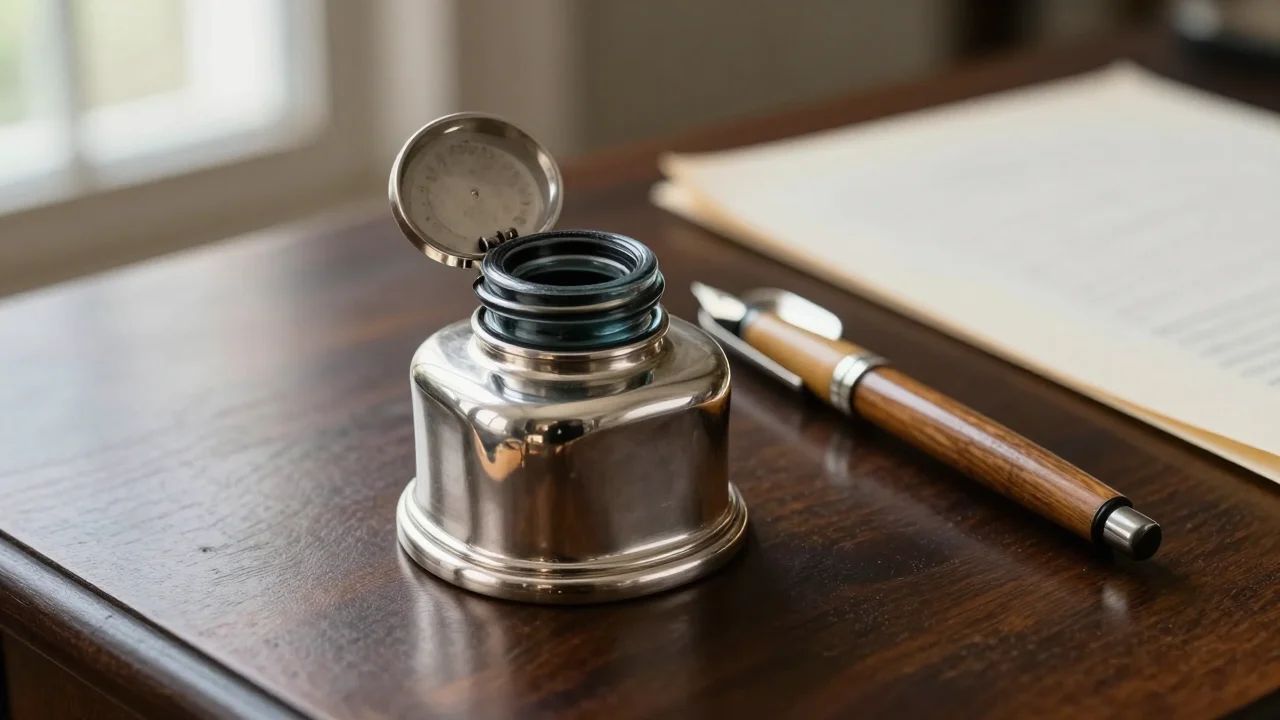
Plain single silver inkwells sold for £30 to £200 at UK auction in 2019-2026; novelty and commemorative ones made £180 to £440, and inkstands £45 to £500.
Every figure in this guide is a published result from one saleroom, Cheffins of Cambridge, with the sale date and the lot page linked, so you can set the inkwell on your desk beside one that actually changed hands. The figures are the numbers the auction house published for each lot. They are not dealer retail prices, and they are not the net amount a seller took home.
What is an antique silver inkwell?
An antique silver inkwell is a lidded container for ink, usually a glass well held in a silver mount or set into a silver stand. The Wikipedia entry on the inkwell explains that an inkwell usually has a lid to prevent contamination, evaporation, accidental spillage, and excessive exposure to air, and that a travelling inkwell was fitted with a secure screw lid so a traveller could carry a supply of ink in their luggage without the risk of leakage. Inkwells gradually fell out of use in the middle part of 20th century once the fountain pen replaced the dip pen, which is why so many silver examples survive with little wear to the well.
Cataloguers separate two objects. A single inkwell is one well with a hinged or bayonet cover, often on a weighted base; the capstan is the commonest shape. An inkstand is a tray, usually on four feet, that holds one or two glass wells, a pen rest and sometimes a taperstick for sealing wax. The Victoria and Albert Museum’s record for an 1832 Angell inkstand puts the purpose in one line: before the advent of the ballpoint pen, typewriters and computers, a utensil for holding ink, pens and wafers (for sealing letters) was essential on the desk.
The capstan takes its name from the deck winch it resembles. The Society of Inkwell Collectors describes the form as a low, rounded base with a wide footprint for stability, and notes that this shape was popular in the late Victorian and Edwardian periods for its compact elegance and practical design. Most capstans in the table below are Birmingham or London pieces of 1900 to 1937.
Where are the hallmarks on a silver inkwell?
The hallmarks sit on the silver base or stand, and a second, shorter set is usually struck on the hinged cover. Cheffins describes the 1925 Carrington inkwell as having a part marked piano hinged flat cover, the 1873 George Unite hoof inkwell as having a fully marked shoe and a fully marked hinged cover, and the 1905 Josiah Williams inkstand as having its well hallmarked to match. Read the base first, because the cover carries fewer punches, and check that the cover marks agree with the base.
Look for the five component marks the Goldsmiths’ Company lists for a full traditional UK hallmark: the sponsor’s mark, which is composed of their initials inside a shield shape, the fineness marks, the assay office mark and the date letter. The office marks are a leopard for the London Assay Office, an anchor for the Birmingham Assay Office, a rose for the Sheffield Assay Office, and a castle for the Edinburgh Assay Office. The date letter tells you when an item was hallmarked, and the London date letter chart sets out the cycles year by year; the UK hallmarks guide covers the other offices.
Older pieces carry one more punch. The Wikipedia article on hallmarks records that in 1784, the United Kingdom began charging a tax on silverware, and a further mark was added to indicate this had been paid, and that the mark was the monarch’s head and continued to be used until 1890, when the tax was abolished. The 1827, 1837, 1873, 1883, 1886 and 1888 pieces in the table fall inside that window; the 1898 and later pieces do not.
Rubbed marks widen the date band. The square inkwell sold in August 2026 is catalogued as probably Birmingham 1924 because, in the condition report’s words, marks on base are rubbed, and the elliptical twin-well inkwell from the same sale is dated 1927, hallmark worn. When the base is unreadable, the cover marks and any registered design number, such as the R677726 stamped on that square inkwell, are the next things to record.
Imported pieces show a different set. The Hanau day-bed inkwell carries London import marks for Sterling silver, 1902 and sponsor’s mark of Theodor Hartmann, with the maker’s own mark of K. Kurz & Company alongside. On an import the London sponsor’s mark names the importer, not the silversmith, so read both punches before naming a maker.
What do loaded and weighable silver mean?
Loaded is the cataloguer’s word for a weighted base, so the inkwell’s total weight is not silver weight; the 1927 twin-well inkwell is described as having the base weighted. Cheffins catalogues the 1937 Mappin & Webb capstan and the 2019 capstan simply as loaded, and the 1924 square inkwell as having a loaded base. Because the filling and the glass well both add mass, cataloguers state either a gross figure, such as 10.9ozt gross for the 1926 Asprey inkwell, or a weighable silver figure for stands whose silver can be weighed on its own, such as 246.7g (7.93ozt) of weighable silver for the 1883 Figg inkwell.
The distinction matters when a buyer or scrap dealer talks about metal value. A loaded capstan weighs far more than the silver in it, and only the weighable figure feeds a melt calculation; the melt value guide walks through that sum. For the inkstands in the table, weighable silver runs from 5.5ozt for the small 1904 Josiah Williams stand to 36ozt for the 1888 Barnard stand, and the results follow that order more closely than they follow date.
Which makers appear on silver inkwells?
The makers on the results below are London and Birmingham firms that supplied desk silver from the 1820s to the 1930s: Joseph Angell, Robinson, Edkins and Aston, John Wilmin Figg, George Fox, Walter & John Barnard, Charles Stuart Harris, William Comyns, the Goldsmiths’ & Silversmiths’ Company, Josiah Williams, Mappin & Webb, Asprey, Carrington, Thomas Bradbury and Garrard. Retail houses such as Asprey and Mappin & Webb often add a signature or stock number under the base; the 1926 Asprey inkwell is signed and numbered to the underside.
The Angell name links the earliest stand in the table to a museum piece. The V&A’s naturalistic tree-stump inkstand is catalogued as silver-gilt, glass liners, London hallmarks for 1832-33, mark of Joseph and John Charles Angell, and the museum notes that the firm won prizes at the Great Exhibition of 1851. The Cheffins stand of 1827 carries the mark of Joseph Angell I, and it sold for £300 in 2021.
Garrard’s 1935 inkwell is the one commemorative piece. It is Jubilee marked and engraved to the side THE GIFT OF THE GOLDSMITHS’ COMPANY SILVER JUBILEE OF KING GEORGE V 1935, with the hinged access cover decorated with the arms of the Goldsmiths’ Company. A documented presentation from a livery company is a different object from a retirement gift with a private monogram, and the results reflect that.
What are antique silver inkwells worth?
A plain single silver inkwell is worth £30 to £200, a novelty or commemorative inkwell £180 to £440 and a complete inkstand £45 to £500, on the published results of one UK saleroom between 2019 and 2026. The first table gives the bands and what moved a lot within them; the second lists every lot behind those bands in descending order of price, with a link to the page where the full description and any condition report can be read.
Cheffins publishes one figure per lot and does not state on the lot page whether the buyer’s premium is included. A buyer pays a premium on top of the hammer price, and a seller receives the hammer price less commission, so treat every figure as the auction house’s published number rather than the cash a seller received. If you want a first reading of your own marks before you compare, the free hallmark reader for iPhone and Android is built for exactly that photograph.
| Type | Result band at Cheffins, 2019-2026 | What set the price |
|---|---|---|
| Plain single inkwell (capstan, square, hexagonal) | Sold for £30 to £200 | Weighable silver, named maker, complete glass, readable marks |
| Novelty or commemorative inkwell | Sold for £180 to £440 | Figural form, documented presentation, hallmarks clear and crisp |
| Inkstand with one or two wells | Sold for £45 to £500 | Weighable silver first, then completeness of wells, covers and taperstick |
| Inkwell or inkstand | Maker, assay office and year | Result at Cheffins | Price driver |
|---|---|---|---|
| Desk inkstand, two square wells, pierced gallery, 36ozt | Walter & John Barnard, London 1888 | Sold for £500 on 5 November 2020 | Heaviest stand, intact piercing, matching monograms |
| Commemorative inkwell, Goldsmiths’ Company arms, 15ozt | Garrard & Co., London 1935 | Sold for £440 on 6 April 2023 | Documented livery gift, Jubilee marked, marks crisp |
| Silver gilt inkstand, two oval wells, 22ozt | George Fox, London 1886 | Sold for £380 on 21 November 2024 | Gilding, double covers, weight |
| Desk inkstand, two square wells, 30ozt | Thomas Bradbury & Sons Ltd., London 1931 | Sold for £380 on 17 August 2023 | Weight and completeness despite presentation engraving |
| Table inkstand with taperstick, 29.7ozt | Robinson, Edkins and Aston, Birmingham 1837 | Sold for £340 on 12 December 2019 | Early date, taperstick, War Office presentation |
| Novelty double inkwell as a day bed, 9ozt | K. Kurz & Company, Hanau; London import 1902 | Sold for £300 on 25 April 2024 | Figural form, repoussé scenes |
| Desk inkstand with taperstick, 15.3ozt | Joseph Angell I, London 1827 | Sold for £300 on 26 August 2021 | Georgian date, detached collar and rubbed marks noted |
| Novelty inkwell as a basketball | Henry Williamson Ltd, Birmingham 1906 | Sold for £220 on 15 April 2021 | Figural form, glass intact, small dents |
| Hexagonal inkwell, pierced gallery, 7.93ozt | John Wilmin Figg, London 1883 | Sold for £200 on 20 November 2025 | Victorian date, possibly missing stopper |
| Inkstand with mounted inkwell, 5.5ozt | Josiah Williams & Co, London 1904 | Sold for £190 on 20 August 2026 | Small stand, good condition |
| Horse’s hoof inkwell, engraved cover | George Unite, Birmingham 1873 | Sold for £180 on 11 April 2019 | Novelty, lacking the glass reservoir |
| Desk inkstand, two square wells, 10.5ozt | Goldsmiths’ & Silversmiths’ Company, London 1903 | Sold for £180 on 1 May 2025 | Complete, presentation engraved |
| Circular convex inkwell, 15.9ozt gross | Carrington & Company, London 1925 | Sold for £130 on 24 November 2022 | Retail house, crested |
| Elliptical twin-well inkwell, weighted base | Maker not stated, 1927, hallmark worn | Sold for £130 on 20 August 2026 | Worn marks, weighted base |
| Square inkwell with cut corners, 10.9ozt gross | Asprey, Birmingham 1926 | Sold for £120 on 24 November 2022 | Retail signature, engine turning |
| Square inkwell, 15cm, loaded base | Probably Birmingham 1924 | Sold for £110 on 20 August 2026 | Rubbed marks, presentation inscription |
| Square pierced inkwell, 6.8ozt | Charles Stuart Harris, London 1898 | Sold for £100 on 6 April 2023 | Named maker, complete well |
| Table inkstand, two wells, 8.3ozt | Mappin & Webb, London 1913 | Sold for £80 on 12 December 2019 | Small, personalised engraving |
| Capstan inkwell, 95mm diameter | Maker not stated | Sold for £70 on 10 February 2022 | Unattributed, glass present |
| Semi spherical inkwell, 8cm | William Comyns & Sons, London 1900 | Sold for £70 on 6 April 2023 | Small, monogrammed |
| Octagonal capstan, glass lacking | Mappin & Webb, Birmingham 1937 | Sold for £60 on 25 June 2020 | Missing reservoir, presentation engraving |
| Navette inkstand, one well, 6.4ozt gross | Josiah Williams & Co, London 1905 | Sold for £45 on 11 April 2019 | Single well, light weight |
| Capstan inkwell, loaded | Maker not stated, 20th century | Sold for £30 on 24 October 2019 | No maker or date catalogued |
Three patterns run through the table. Weighable silver sorts the inkstands: the 36ozt Barnard stand, the 30ozt Bradbury stand and the 29.7ozt Robinson, Edkins and Aston stand fill three of the top five places, while the 5.5ozt and 6.4ozt Josiah Williams stands sit near the bottom. An institutional presentation with a clear record adds: the Goldsmiths’ Company gift made £440 and the War Office gift £340. A private inscription neither adds nor removes much; the pieces catalogued with personal or presentation engraving sold across the whole range, from £60 to £380. Period counts for less than weight in this sample; the 1827 Angell stand, which the Georgian silver guide would place in the premium period, made £300 against £500 for the heavier 1888 Barnard stand.
Which condition faults do auction reports record?
Auction condition reports on inkwells record four faults again and again: a missing or damaged glass well, rubbed marks, strained hinges and loose collars. The Unite hoof inkwell is catalogued lacking the interior glass reservoir and the 1937 Mappin & Webb capstan with glass reservoir lacking; the Figg inkwell is noted as possibly missing the stopper. The 1827 Angell stand reports that the collar to one has detached, that the glass has one or two very small nibbles and minor chips at the edges, and that hallmarks to all a little rubbed but still readable. The Barnard stand reports one hinge a little strained and back and side galleries are very, very slightly out of shape.
Glass is the first thing to check because it is the part most often lost. Lift the cover and look for a well that fits its collar without rattling, a starburst or cut base that matches the silver’s date, and a stopper if the form had one. A replaced well is not a fault in itself, but a missing one turns a working inkwell into a mount, and the two lots catalogued without glass sit at £60 and £180 in the table.
Ink residue and grizzling are cosmetic. The Garrard inkwell’s report notes some spotting to the interior and very minor grizzling to the rim of the well, and still describes the engraving and hallmarks clear and crisp; it made the highest single-inkwell price in the table. Dents to a thin cover, as on the basketball inkwell with two small dents to the cover, are ordinary wear on a desk object and are recorded rather than penalised.
Does a novelty form or an inscription change the price?
A novelty form raises the band, and an inscription only helps when it names an institution. The four figural and commemorative pieces made £180, £220, £300 and £440, above every plain single inkwell except the £200 Figg piece. The hoof inkwell with the shield engraved ‘Chessie Obut 1866’ and the basketball inkwell were bought for their form, not their silver; the basketball stands only 6.8cm high and is loaded.
Private inscriptions are neutral to slightly negative. The 1924 square inkwell with its MERD from JERD inscription made £110, and the 1937 capstan with presentation engraving made £60. Buyers who want a plain desk piece pass over a monogram they cannot use, and buyers who want history need a name they can trace. The Goldsmiths’ Company gift is traceable, and its result reflects that.
Provenance from a catalogue note still needs the marks. The Robinson, Edkins and Aston stand is titled a gift from the War Office and carries presentation engraving to the top, but its date rests on the Birmingham 1837 hallmark, not on the inscription. An engraved date can be earlier or later than the silver; the hallmark cannot.
What should you do with your inkwell now?
Start by recording the marks on the base and on the cover separately, in daylight, with a magnifier, and write down every punch you can read, including any registered design number. Then weigh the piece and decide which figure you are looking at: gross weight for a loaded capstan or a stand with glass in place, weighable silver only if the silver parts can be removed and weighed alone. Finally, find the row in the table that matches your form, maker’s town and weight, open the lot page, and compare the description and condition report line by line with the piece in front of you before you set a reserve, an insurance figure or a bid.
Method and limits. All results are the single published figures on Cheffins lot pages between April 2019 and September 2026, read on 18 September 2026; premium inclusion is not stated on those pages, and no dealer, online-marketplace or other-saleroom prices are used. Descriptions and condition reports are the cataloguer’s, not an independent examination, and a rubbed or part-marked piece may be catalogued conservatively. Hallmark explanations follow the Goldsmiths’ Company and Wikipedia; a mark, a form or an inscription is a starting point, and none of them proves date, maker or metal on its own.