
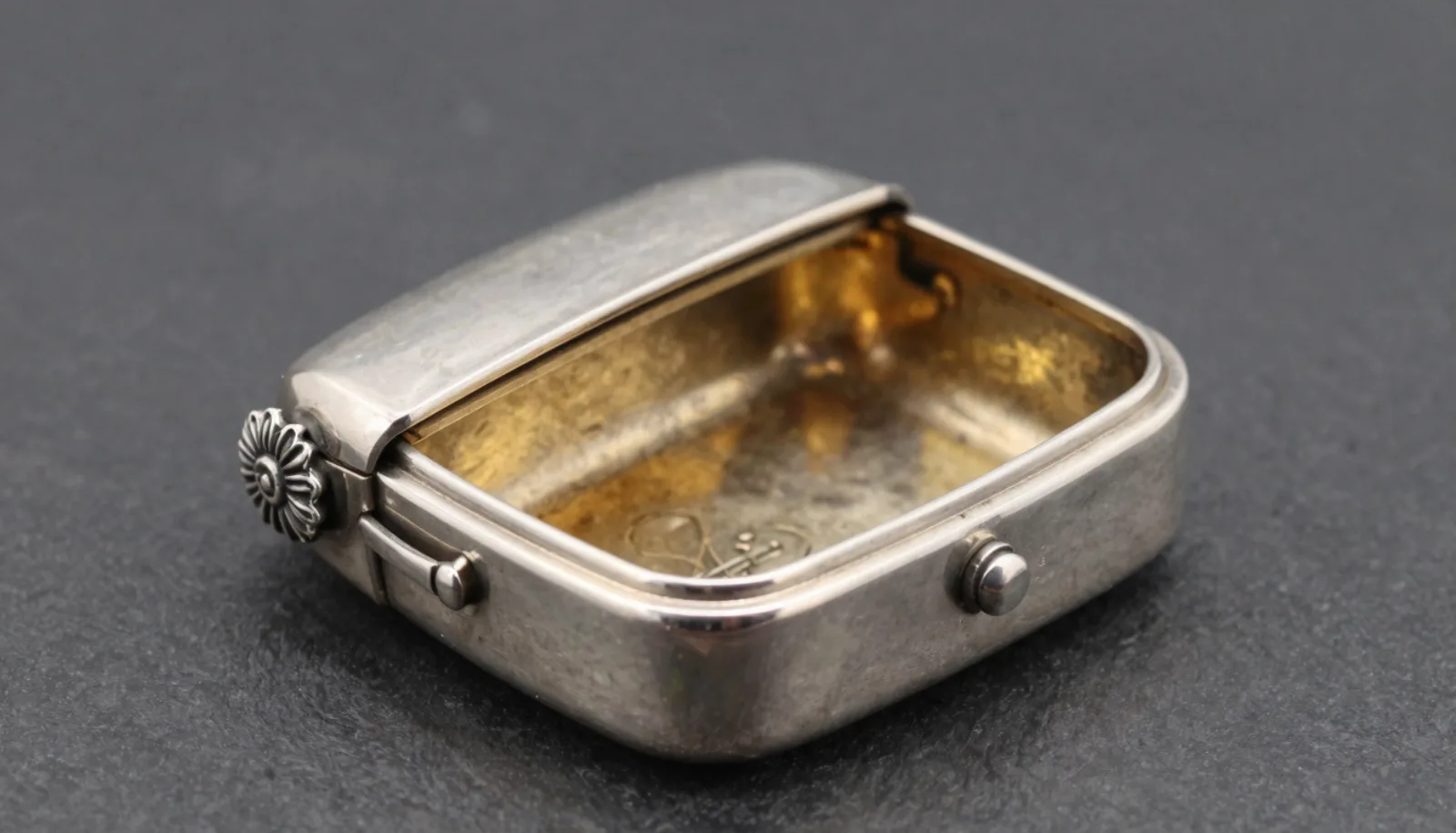
The typical antique silver snuff box sells for £150 to £600, while Nathaniel Mills castle-tops reach £1,500 to £6,000. Maker and condition decide the gap.
Snuff box, vinaigrette, or patch box: telling them apart
A silver snuff box is a hinged, lidded box with a plain interior and no inner grille. That single detail separates it from the vinaigrette, its most common look-alike. Vinaigrettes hold a sponge soaked in aromatic vinegar under a pierced gilt grille. Snuff boxes hold powdered tobacco and need nothing but a tight lid.
Size gives the second clue. Pocket snuff boxes measure 5 to 9 cm across and slip into a waistcoat. Table snuff boxes run 9 to 15 cm and sat on a sideboard for guests. Vinaigrettes rarely exceed 5 cm. Patch boxes measure 2 to 4 cm and often carry a small mirror inside the lid.
Georgian snuff boxes have gilt interiors for a practical reason. Moist snuff corrodes bare silver and picks up a metallic taste. Makers fire-gilded the inside from about 1780 onwards, so a bright yellow interior is normal, not a later addition. Worn gilding at the corners shows where fingers pinched out the snuff for decades.
Scotland produced a different form altogether. The snuff mull uses a curled ram’s horn body with silver mounts and a hinged silver lid. Edinburgh, Glasgow and Inverness silversmiths set the lids with cairngorm or agate. Regimental table mulls mount a whole ram’s head on wheels and hold several tools on chains.
| Box type | Typical size | Interior | Tell-tale feature | Peak period |
|---|---|---|---|---|
| Pocket snuff box | 5-9 cm | Gilt, no grille | Stand-away hinge, thumbpiece | 1770-1850 |
| Table snuff box | 9-15 cm | Gilt | Heavy gauge, presentation inscription | 1800-1860 |
| Vinaigrette | 2-5 cm | Gilt with pierced grille | Grille hinged inside the lid | 1780-1860 |
| Patch box | 2-4 cm | Often a mirrored lid | Very shallow, no gilding needed | 1760-1820 |
| Snuff mull | 6-12 cm | Horn body | Ram’s horn, silver mounts, stone-set lid | 1780-1860 |
| Tobacco box | 12-18 cm | Plain, ungilt | Oval, pull-off lid, often Dutch | 1680-1780 |
Tobacco boxes cause the last confusion. They are larger, oval and ungilt because leaf tobacco does not corrode silver. Dutch examples from 1680 to 1780 are often engraved with biblical scenes or calendars. The Victoria and Albert Museum holds a strong run of both British silver boxes and Continental gold boxes, useful for comparing the forms side by side.
Where are the hallmarks on a silver snuff box?
Hallmarks on a British silver snuff box sit inside the base, with a shorter set inside the lid. The assay office struck the base with the full sequence: maker’s mark, standard mark, town mark, date letter and, between 1784 and 1890, the duty mark. The lid received part marks, usually the lion passant and the maker’s mark, because the lid is a separate piece of silver.
A well-marked box therefore shows two sets of marks that agree with each other. The maker’s initials inside the lid should match the initials on the base. A Birmingham anchor on the base with a London leopard’s head on the lid points to a replaced lid. Collectors call such a box a marriage and pay a fraction of the price.
Some boxes carry marks on the bezel, the narrow rim inside the lid opening. Makers used the bezel when the lid was heavily chased or die-stamped and had no flat space left. Castle-top boxes by Nathaniel Mills often show the lion passant and the NM punch on the bezel or the inner lid edge. A loupe at 10x magnification finds them.
Pre-1790 boxes frequently show only a maker’s mark and a lion passant. Light pieces escaped full marking under the earlier legislation, so two marks on a chased rococo box from 1750 are not a red flag. From 1790 the rules tightened and full marks became the norm on boxes of any weight.
The duty mark is the most useful single stamp for dating. The sovereign’s head duty mark appears from December 1784 to 1890, and the profile changes with each monarch. George III and William IV face right, while George IV and Victoria face left. A snuff box with no duty mark but otherwise Regency styling is either pre-1784 or a problem.
Reading the full sequence takes practice, and the order of the punches varies by office. The British hallmarking reference walks through each office’s town mark and date-letter cycles. For a snuff box, start with the anchor or leopard’s head, then the duty head, then the date letter. Any seasoned collector reads the town mark first because it decides which date-letter table applies.
Makers that move the value: Mills, Willmore, Strachan and the rest
Nathaniel Mills of Birmingham commands the highest prices among British silver snuff box makers. Mills registered his mark in Birmingham in 1826 and the workshop ran until the mid-1850s. His castle-top boxes carry die-stamped, high-relief views of buildings on the lid. Windsor Castle is the most common view and sells for the least within the group. Abbotsford, Newstead Abbey, Kenilworth and York Minster appear far less often and add £1,000 or more.
Joseph Willmore worked in Birmingham from about 1805 to 1845 and made both snuff boxes and vinaigrettes. Willmore’s engine-turned boxes with cast floral thumbpieces are the classic Regency form. His castle-tops exist but are scarcer than those by Mills. A Willmore box in good order sells for £300 to £900, rising above £2,000 for a fine castle-top.
Samuel Pemberton and Matthew Linwood represent the earlier Birmingham generation. Pemberton worked from the 1770s to about 1810 and specialised in small bright-cut boxes and nutmeg graters. Linwood’s mark appears on snuff boxes and vinaigrettes from about 1790 to the 1820s. Both makers sell in the £250 to £700 band for a clean pocket box.
London makers built the luxury end of the trade. Alexander James Strachan registered his mark in 1799 and made gold and silver-gilt boxes for Rundell, Bridge and Rundell. Strachan boxes show heavy cast borders and exceptional hinge work. Phipps and Robinson, in partnership from 1783 to 1816, made crisp bright-cut boxes and graters. Rawlings and Summers carried the London box trade forward from 1829 to 1897.
| Maker | Mark | City | Active on boxes | Known for | Typical hammer range |
|---|---|---|---|---|---|
| Nathaniel Mills | NM in a rectangle | Birmingham | 1826-1856 | Castle-top scenes, heavy gauge | £1,500-£6,000, rare views higher |
| Joseph Willmore | JW | Birmingham | c.1805-1845 | Engine-turning, floral thumbpieces | £300-£2,500 |
| Edward Smith | ES | Birmingham | 1830s-1850s | Castle-tops, engraved lids | £600-£3,000 |
| Taylor and Perry | T&P | Birmingham | 1829-1834 | Cast borders, castle-tops | £500-£2,500 |
| Samuel Pemberton | SP | Birmingham | 1770s-c.1810 | Bright-cut small boxes | £250-£700 |
| Matthew Linwood | ML | Birmingham | c.1790-1820s | Vinaigrettes and snuff boxes | £250-£700 |
| A. J. Strachan | AJS | London | 1799-1830s | Gold and silver-gilt luxury boxes | £2,000-£10,000 |
| Phipps and Robinson | TP over ER | London | 1783-1816 | Bright-cut boxes and graters | £400-£1,500 |
| Rawlings and Summers | CR over WS | London | 1829-1897 | Engraved and engine-turned boxes | £300-£1,200 |
The ranges above are hammer prices seen at UK auction, before a buyer’s premium of 25 to 30 percent. Retail dealer prices run higher. A maker’s mark alone does not deliver the top of the range. The view on a castle-top, the crispness of the stamping and the state of the hinge decide where a Mills box lands.
Not sure what you’ve got?
Snap a photo and let our AI identify any antique in seconds. Free, no sign-up.
Identify on iPhone →Learn MoreHow do I date a silver snuff box from its form?
Form and decoration date a silver snuff box to within about twenty years, before you read a single mark. Snuff-taking spread through Britain after 1700 and faded after 1850, when cigarettes took over. Each generation of boxes follows the taste of its decade, and the hinge construction changes alongside the decoration.
Early boxes from 1700 to 1740 are oval or cartouche-shaped with chased scrolls and often a pull-off rather than hinged lid. Marks are sparse. From 1740 to 1780 rococo chasing dominates, with shells, scrolls and asymmetrical borders. London makers led this period, and gilt interiors were not yet standard.
The Birmingham Assay Office opened in 1773 and changed the trade. Birmingham workshops used rolled sheet, die-stamping and bright-cut engraving to produce boxes at scale. From 1780 to 1810 the rectangular box with reeded sides and bright-cut borders became the standard pocket form. Corners are sharp and the gauge is thin.
Regency taste from 1810 to 1830 brought engine turning, a lathe-cut wave or barleycorn pattern that covers the lid and sides. Cast thumbpieces and applied floral borders added weight. Boxes from this period feel heavier in the hand than their 1790 predecessors of the same size. The Georgian premium in silver values starts here for most buyers.
Castle-tops define 1830 to 1850. Die-stamped, high-relief views of castles, abbeys and cathedrals cover the lid, framed by cast scroll borders. After 1850 the snuff box declined into a presentation piece, plainer and engraved with inscriptions. Boxes dated 1860 to 1900 are common and cheap unless the maker or the recipient is notable.
| Period | Dominant form | Decoration | Hinge and thumbpiece | Marks to expect |
|---|---|---|---|---|
| 1700-1740 | Oval or cartouche | Chased scrolls, plain panels | Pull-off lid or simple hinge | Maker’s mark and lion passant, often partial |
| 1740-1780 | Cartouche, shaped rectangle | Rococo chasing, shells | Three-lug hinge | Partial marks common on light boxes |
| 1780-1810 | Rectangle, reeded sides | Bright-cut engraving | Stand-away hinge, flat thumbpiece | Full marks, duty head from 1784 |
| 1810-1830 | Rectangle, rounded corners | Engine turning, cast borders | Heavy stand-away hinge, cast thumbpiece | Full marks, George III then George IV head |
| 1830-1850 | Rectangle, heavy gauge | Castle-top die-stamped views | Integral hinge, cast foliate thumbpiece | Full marks, William IV or Victoria head |
| 1850-1900 | Rectangle, plain | Engraving, inscriptions | Machine-made hinge | Full marks, Victoria head to 1890 |
Gold boxes follow a parallel but far more expensive history. The Metropolitan Museum of Art displays 18th-century French gold snuff boxes that were given as diplomatic gifts and cost as much as a townhouse. Silver boxes borrowed their shapes a generation later, which is why a 1760 silver cartouche box echoes Paris work of the 1740s.
What is an antique silver snuff box worth?
An antique silver snuff box is worth £150 to £600 in most cases, and £1,500 to £6,000 when a named Birmingham box maker made it with a castle-top lid. Damaged or late Victorian boxes fall to £60 to £150. Melt value sits far below any of these figures and should never set the price.
| Box type | Typical hammer range | What moves it up | What pulls it down |
|---|---|---|---|
| Plain Georgian pocket box, minor maker, 1780-1830 | £150-£400 | Crisp bright-cut, tight hinge, original gilding | Erased inscription, worn corners |
| Engine-turned Regency box, Willmore or Linwood, 1810-1830 | £300-£900 | Cast thumbpiece, heavy gauge | Split in the engine-turning, later monogram |
| Nathaniel Mills castle-top, Windsor Castle view | £1,500-£3,500 | Sharp stamping, unpolished detail | Rubbed high points, hinge wear |
| Nathaniel Mills castle-top, rare view (Abbotsford, Newstead, York Minster) | £3,000-£8,000 | Documented view, provenance | Any repair to the lid |
| London silver-gilt luxury box, Strachan or Phipps and Robinson | £800-£5,000 | Original gilding, cast borders | Regilding, replaced hinge pin |
| Scottish ram’s horn snuff mull, pocket size | £150-£500 | Stone-set lid, Edinburgh or Inverness marks | Cracked horn, missing stone |
| Scottish table mull with ram’s head and tools | £1,000-£5,000 | Regimental inscription, complete tools | Missing tools, replaced wheels |
| Victorian presentation box, 1850-1900 | £80-£250 | Notable recipient, unusual maker | Generic inscription, thin gauge |
| Continental 800 or 833 box, 19th century | £60-£200 | Niello or enamel decoration | Pseudo-marks, no maker traced |
| Damaged box of any period, split hinge or holed base | £50-£150 | Rare maker still legible | Repair cost exceeds the uplift |
Melt value shows why scrap pricing is the wrong benchmark. A typical pocket snuff box weighs 50 to 90 grams. Take a 68 gram box: 68 divided by 31.103 gives 2.19 troy ounces, and 2.19 times 0.925 gives 2.02 ounces of fine silver. At an illustrative spot price of £25 per ounce, that is about £50 of metal. The same box sells for £250 as an object, five times its melt.
Provenance adds a premium that no table can predict. A presentation inscription to a named officer, ship’s captain or civic figure can double the price if the recipient is traceable. A generic inscription, such as a set of initials and a year, adds nothing and can subtract. Auction databases such as WorthPoint show what comparable inscribed boxes fetched, which is the fastest way to test a provenance claim.
Selling venue changes the outcome as much as condition. Specialist silver sales at regional auction houses attract the box collectors, and castle-tops routinely beat estimate there. General sales and online marketplaces price closer to the plain-box band regardless of maker. The beginner’s guide to silver marks covers how to read the maker’s mark before you choose the venue, because the maker decides which sale suits the box.
Value in this category tracks the same logic as other small collectable silver. Silver vesta cases follow a similar curve, with plain examples at £40 and named makers at £2,000. To confirm which maker’s mark your own box carries before consigning it, photograph the base marks and run them through one of the hallmark reading apps compared side by side here.
Condition faults that cut the value
Condition removes more value from a silver snuff box than any other factor except the maker. A box passes through hands and pockets for two centuries, and every fault it picks up is visible under a loupe. Buyers at specialist sales inspect four points in a fixed order: hinge, lid fit, interior and inscription.
The hinge fails first. Hold the box closed and press the lid gently sideways. Any lateral movement means the hinge pin or lugs have worn, and the lid will soon fail to close true. A stand-away hinge with a bent pin costs £100 or more to repair properly, which exceeds the uplift on a £200 box. On a Mills castle-top, the same repair is worth doing.
Erased inscriptions leave a tell-tale mark. Look at the lid or base in raking light for a thin, slightly concave patch, often duller than the surrounding metal. A silversmith removed an engraved name by filing the surface away, and the metal there is thinner and sometimes shows a faint ghost of the letters. Boxes with erasures sell for 30 to 50 percent less than clean examples.
The interior tells the truth about use and repair. Original fire gilding wears at the corners and along the rim where the thumb pressed. Bright, even gilding on a worn exterior means a later regild, which collectors accept but discount. Solder lines inside the base corners indicate a split that has been closed, and a repaired split rarely holds under daily handling.
| What you find | Typical effect on hammer price | Sensible action |
|---|---|---|
| Lid moves sideways on the hinge | Minus 25 to 40 percent | Repair only if the maker justifies £100 or more |
| Thin, dull patch where an inscription was | Minus 30 to 50 percent | Sell as found; an erasure cannot be undone |
| Later monogram or date added | Minus 10 to 20 percent | Leave it; removal creates an erasure |
| Even, bright regilding on a worn box | Minus 10 to 15 percent | Disclose it; do not strip it |
| Solder line inside a corner | Minus 20 to 30 percent | Sell through a specialist sale with the condition noted |
| Rubbed high points on a castle-top view | Minus 20 to 40 percent | Never polish further |
| Small dent to a corner | Minus 15 to 25 percent | Ask a silversmith for a quote before consigning |
| Marks on lid and base disagree | Treat as a marriage; value the lesser part | Describe it as associated, never as original |
Polishing is the most common self-inflicted damage. Silver dip removes the dark oxidation in the recesses of engraving and chasing, and that oxidation is what gives the design depth. A castle-top that has been dipped looks flat and pewter-like even when the stamping is crisp underneath. Wash with warm soapy water, dry with a soft cloth and leave the recesses dark.
Genuine Georgian box or later copy: the checks
A genuine Georgian silver snuff box passes three checks: marks that agree across lid and base, a hinge built into the body, and wear in the places fingers touch. Copies fail at least one. Most fakes in this category are not crude; they are real silver with the wrong story attached.
Transposed marks are the oldest trick. A forger cuts the hallmarked panel from a damaged Georgian spoon and lets it into the base of a plain later box. Look for a faint rectangular solder outline around the marks, and check whether the marks sit at an odd angle to the box edges. Marks struck on a box run parallel to the sides because the assayer held the box square.
Cast copies reproduce a whole box, marks included, from a mould taken off an original. Cast marks look soft, with rounded edges and a grainy floor to each punch. Struck marks have sharp walls and a smooth floor because a steel punch displaced the metal. Under a 10x loupe the difference is plain, and the cast box also weighs more than the original for its size.
Twentieth-century reproductions are honest silver with correct modern marks. Birmingham workshops made Georgian-style snuff boxes through the 1960s to 1980s, fully hallmarked with the date letter for the year of manufacture. Nothing is wrong with these boxes until a seller describes them as Georgian. Read the date letter, not the style.
Continental boxes with pseudo-marks arrive in British sales constantly. Dutch and German makers stamped lion and crown devices that resemble British marks at a glance. A lion facing the wrong way, a crown without a town mark or a number such as 800 or 833 gives the game away. From 1867 an F in an oval, and from 1904 a full set of import marks, identify foreign silver assayed in Britain.
The boundary case that catches experienced buyers is the date letter cycle. Birmingham and London ran different cycles with different shield shapes, and a letter that reads as 1837 in London reads as another year in Birmingham. Identify the town mark first, then read the date letter against the correct office’s table. American snuff boxes of the same decades carry only a maker’s name or the word COIN, and the Smithsonian collection is a good place to see marked American examples before dismissing a sparsely marked box as a fake.
Frequently Asked Questions
Is there an app that can read the marks on a silver snuff box?
Antique Identifier – Antiqly reads the maker’s mark, town mark, duty head and date letter on a snuff box base from a single photo and returns the maker, the assay office and the year. The app is free to download on iPhone and needs no account or sign-up. Snuff box marks are struck close together on the inner base or the bezel, so photograph them in raking light with the lid open and fill the frame. Antiqly performs best on Birmingham and London marks from 1780 to 1900, the period that covers most silver snuff boxes. Where the marks are rubbed to a shadow, the app narrows the office and period, and a specialist silver auctioneer confirms the rest.
How much is a Nathaniel Mills snuff box worth?
A Nathaniel Mills silver snuff box sells for £1,500 to £3,500 at auction when the lid shows Windsor Castle, the most common castle-top view. Rarer views such as Abbotsford, Newstead Abbey, Kenilworth Castle or York Minster push the range to £3,000 to £8,000, and exceptional examples exceed that. Plain engine-turned Mills boxes without a view sell for £400 to £1,200. Mills registered his mark in Birmingham in 1826 and the workshop produced boxes into the 1850s, so the date letter on a genuine example falls between those years. Condition drives the position inside each band: crisp stamping, dark oxidation in the recesses and a tight hinge sit at the top, while rubbed high points and a repaired hinge sit at the bottom.
Why do antique snuff boxes have gold-coloured interiors?
Antique silver snuff boxes have gilt interiors because moist snuff corrodes bare silver and picks up a metallic taste from it. Makers applied a thin layer of gold to the inside by fire gilding, a mercury process used until electrogilding replaced it in the 1840s. The practice became standard on British boxes from about 1780 and continued through the castle-top period. Original gilding wears at the corners and along the rim where the thumb pressed for decades, so patchy wear is a good sign, not a fault. Uniform, bright gilding on a box with a worn exterior indicates a later regild. Collectors accept regilding but discount it by 10 to 15 percent, and they expect the seller to disclose it.
Should I polish an antique silver snuff box before selling it?
No. Polishing an antique silver snuff box before sale lowers the price in most cases, because the dark oxidation in the recesses of engraving and chasing is what gives the design its depth. Silver dip strips that oxidation in seconds and leaves a castle-top view looking flat and pewter-like. Abrasive polish rounds the sharp edges of bright-cut engraving and rubs the high points of die-stamped scenes, and that loss is permanent. Wash the box in warm soapy water, dry it with a soft cloth and stop there. Auction buyers prefer an untouched surface and price a freshly polished box 20 to 40 percent lower than a comparable box with original patina.
Are unmarked silver snuff boxes worth anything?
Unmarked silver snuff boxes are worth £50 to £300 in most cases, well below marked equivalents, because a buyer cannot prove the metal standard, the maker or the date. Three groups are exceptions. Boxes made before 1790 often carry only a maker’s mark and lion passant, and a chased rococo box of 1750 with two marks is normal, not suspect. American boxes from 1800 to 1860 carry a maker’s name or the word COIN rather than hallmarks, and a named American maker adds value. Continental boxes with regional purity numbers such as 800, 833 or 13 loth are marked, but in a system many British buyers do not recognise. Test unmarked boxes with an acid kit or XRF before pricing them as silver.
What is a Scottish snuff mull worth?
A pocket-sized Scottish snuff mull with a ram’s horn body and silver mounts sells for £150 to £500 at auction. The price rises with the quality of the silver lid, especially when it is set with a cairngorm or agate and carries Edinburgh, Glasgow or Inverness marks from 1780 to 1860. Large table mulls built on a whole ram’s head with wheels, a hinged lid and a set of tools on chains sell for £1,000 to £5,000, and regimental examples with an engraved presentation plaque sit at the top of that range. Faults that cut the value include a cracked or shrunken horn, a missing stone, replaced wheels and an incomplete set of tools. Many mulls carry unmarked silver mounts, so the maker cannot always be traced.
Identify any antique in seconds.
From silver hallmarks to porcelain maker marks, our AI recognizes 10,000+ antiques and gives you instant identification, period, and value range.
Download Free on iPhoneSee How It Works