
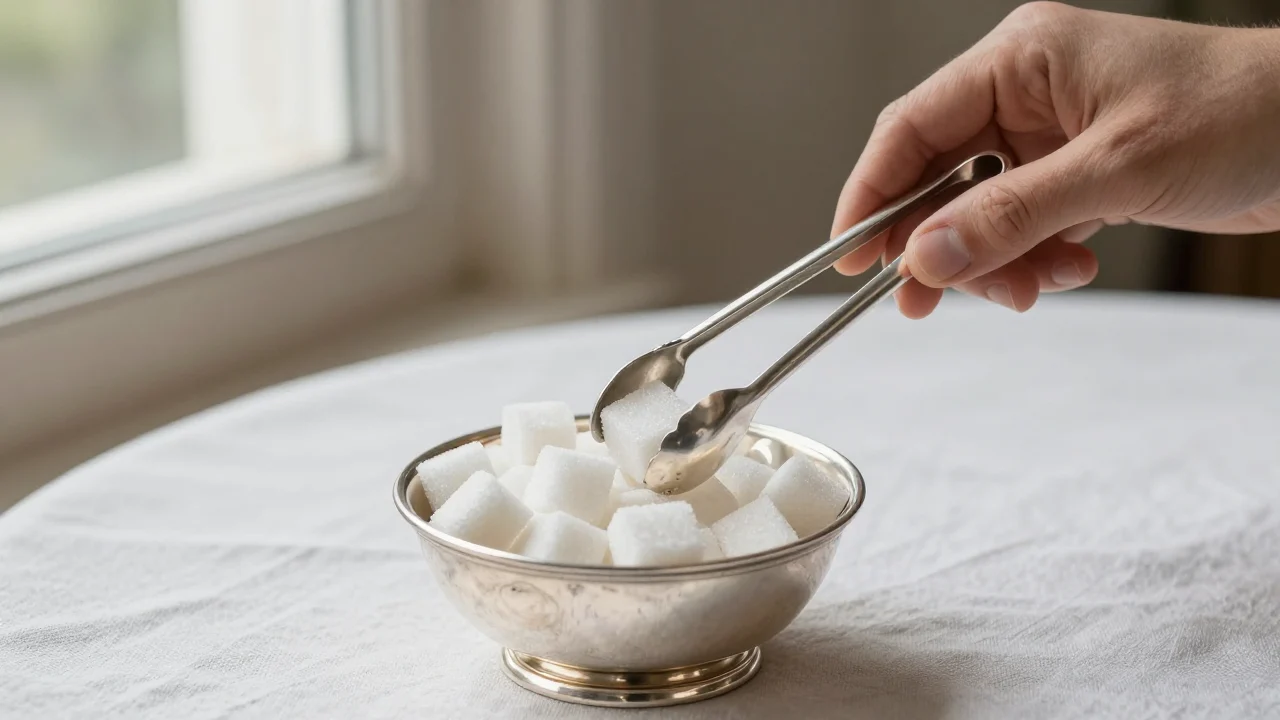
Plain antique silver sugar tongs made £20 to £50 a pair at UK auction in 2010-2026; Newcastle, Exeter and Bateman groups made £200 to £380.
Every figure in this guide is a published auction result with the sale date and the lot page linked, so you can set your own pair beside one that actually changed hands. Most results come from one saleroom, Cheffins of Cambridge, where most tongs appear in group lots rather than on their own. Lots from Bonhams, Toovey’s and Lyon & Turnbull are added where they show a cast pair, a novelty pair or a provincial collection, and each of those houses publishes its figure differently. None of the figures is a dealer price, and none is the net amount a seller took home.
What are antique silver sugar tongs?
Antique silver sugar tongs are the small sprung tongs used at the tea table to lift a lump of sugar from the bowl to the cup, and they replaced scissor-shaped sugar nips in the 1770s. The V&A record for a pair of sugar nippers by Thomas Jackson of about 1750 states that sugar nippers or nips were made from the early 18th century, but from the 1770s were replaced by sugar tongs. The same record notes that the earliest known sugar nippers date from about 1715, and that sugar nippers generally have a scissor-like shape rather than the later U-shaped sugar tongs.
Tongs were a mass-market object by 1800. The Wikipedia article on sugar tongs records that the tongs appeared at the end of the 17th century and were very popular by 1800, with half of the British households owning them. It also notes, citing the collector David Shlosberg, that the term tea tongs was actually used instead in the 18th century, which is why some catalogues still describe the earliest scissor pairs as tea tongs. The ASCAS article by Graham Hodges adds that sugar tongs have been a very popular betrothal or wedding gift, which explains how many surviving pairs carry initials.
The V&A record also explains why nips and tongs so often turn up inside cased sets. Nippers were often supplied with a set of tea spoons or as part of a boxed set containing caddies, spoons and nippers. That habit continued into the Victorian and Edwardian cased teaspoon sets that fill the lower half of the results table below.
How do you date silver sugar tongs from their shape?
The shape of a pair of sugar tongs places it within a period of roughly twenty to forty years before you read a single mark. Graham Hodges, whose collection covers more than 130 London makers, sets out the sequence for 1770 to 1820 in the ASCAS article, and the V&A and Wikipedia records supply the ends of the story. The table below gathers those dated forms in one place.
| Form | Working dates | What to look for | Source |
|---|---|---|---|
| Scissor nips or nippers | About 1715 to the 1770s | Scissor action, sharp-edged shell-shaped bowls, often supplied with a set of teaspoons | V&A record for Thomas Jackson nips |
| Cast tongs | About 1765 to 1780 | Made in three pieces, the two arms soldered to the bow, cast and pierced arms; delicate and rarely undamaged | ASCAS, Hodges |
| Early bow tongs | From about 1780 | Sprung bow, plain or with a simple thread or beaded edge | ASCAS, Hodges |
| Bright-cut bow tongs | About 1780 to the early 1800s | Faceted bright-cut engraving down the arms and bow, fading by 1805-1810 and gone by about 1820 | ASCAS, Hodges |
| Old English, Fiddle and King’s pattern tongs | From about 1805-1820 onward | Plain or die-struck arms matching the teaspoon pattern of the set | ASCAS, Hodges; Wikipedia |
| Electroplated bow tongs | Late 19th century | One piece of metal bent into a U shape, claw grips, registration and plating marks rather than a hallmark | V&A record for William Page tongs |
Cast tongs are the short-lived form and the delicate one. Hodges writes that cast tongs only lasted a very short time, from about 1765 to 1780, that these were made in 3 pieces, the two arms and the bow, and that the bow was soldered to the two arms and usually the hallmark and maker’s marks were stamped at the joins. He adds that cast tongs are relatively rare and rarer still are cast tongs that are un-damaged for, despite appearance, they are very delicate. A cast pair with a cracked join or a replaced arm is a damaged object, whatever its date.
Bright-cut engraving is the mark of the 1780 to 1810 bow. Hodges records that very soon the fashion for bright cut engraving took over and dominated sugar tongs through to the early 1800s, that by 1805-1810, we start to see more and more plain or Old English style tongs, and that until by about 1820, bright cut engraving had virtually died away. The Wikipedia article agrees that in the late Georgian era piercing popularity had declined, and the tongs were made to match the contemporary spoon designs. A pair in Fiddle or King’s pattern is therefore a nineteenth-century object unless the marks say otherwise.
Shape gives a period, not a year. The Cheffins lot of four pairs of silver bright cut sugar tongs, 1797, 1800, 1804 & 1857 shows the problem: a Victorian maker of 1857 could still cut a bright-cut border. The guide to Georgian silver value covers the wider sequence of Georgian styles and why George III pieces are the most plentiful.
Where are the hallmarks on sugar tongs and what do they tell you?
Sugar tongs carry the same marks as any British silver, but the small surface means the set is often incomplete, so read what is there and note what is missing. The Goldsmiths’ Company lists five components in a full traditional UK hallmark: the sponsor’s mark, the two fineness marks, the assay office mark and the date letter, and it states that the fifth mark is the date letter and that the date letter changes every year on January 1. The office marks are a leopard for the London Assay Office, an anchor for the Birmingham Assay Office, a rose for the Sheffield Assay Office, and a castle for the Edinburgh Assay Office. Turn the tongs over and look along the inside of both arms and the inside of the bow, in daylight with a magnifier; on cast tongs, Hodges says the marks sit at the joins where the bow meets the arms.
Many Georgian pairs carry only two marks. Bonhams catalogued a pair of Hester Bateman tongs in 2006 with maker’s mark and lion passant only, crested, and a pair of 18th century nips as lion passant and maker’s mark only, by William Harrison, London circa 1760. Cheffins described the Hester Bateman cast tongs in its 2020 Bateman lot as Hester Bateman (no date letter). A lion passant and a maker’s punch prove sterling and name the workshop, but they leave the year to the style. The UK hallmarks guide sets out the date letter cycles for each office when the letter is present.
The duty mark narrows a Georgian pair to one side of 1784. The Wikipedia article on hallmarks records that in 1784, the United Kingdom began charging a tax on silverware, and a further mark was added to indicate this had been paid, and that the mark was the monarch’s head and continued to be used until 1890, when the tax was abolished. On London-assayed bright-cut tongs, no sovereign’s head means either a date before December 1784 or an incomplete set of punches; the silver marks guide walks through reading the whole sequence for the first time.
Provincial marks matter more on tongs than on most small silver. Hodges writes that whilst the vast majority of these sugar tongs were assayed in London, they were also made in the provinces, most notably Newcastle, and that we also see examples of tongs assayed in Exeter, York, Sheffield, Birmingham, Edinburgh and Dublin. The two Frederick England Collection lots at Cheffins in January 2026, one of Newcastle and Banff pairs and one of Exeter pairs, are the provincial rows in the table below.
Check the monogram before you trust the date. Hodges notes that on many pairs of tongs, the monogram has been removed, often badly, and that often the monogram will be dated later than the original tongs. A thin, dished patch on the bow is where a monogram once sat. Plated tongs are a separate case: the V&A record for a late nineteenth-century electroplated pair describes them as bow or spring tongs, made from one piece of metal bent into a U shape forming two spring arms, marked Rd, fleur-de-lis, crown. Marks like these are covered in the EPNS marks reference, and a plated pair does not belong in the silver bands below.
What are antique silver sugar tongs worth?
A single pair of plain silver sugar tongs is worth £20 to £50 at auction, a mixed group of several pairs £35 to £120, a provincial or Bateman collector group £200 to £380, and a cast or novelty single pair £84 to £312 inc. premium, on the published results below. The first table gives the bands and what set the price within them; the second lists every lot behind those bands in descending order, with a link to the page where the full description can be read.
Salerooms publish the figure in different ways. Cheffins prints one figure per lot and does not say on the lot page whether the buyer’s premium is included. Bonhams prints its figure as inc. premium. Toovey’s prints the hammer price and states beside it that the buyer’s premium is an additional charge on each lot sold and that currently this is set at 24.5% plus VAT (29.4% including VAT) of the hammer price. Lyon & Turnbull shows a single figure on the lot page without a label. A seller receives the hammer price less commission, so treat every figure as the auction house’s published number rather than cash in hand. If you want to check the marks on your own pair before you compare, photograph the inside of each arm with the free hallmark reader for iPhone and Android and match them against the rows below.
| Type | Result band | What set the price |
|---|---|---|
| Single pair of plain bow tongs or nips, Georgian or Victorian | Sold for £20 to £50 at Cheffins, 2010-2026 | About 44g of silver, no cast work; a Hester Bateman punch did not lift a lone pair out of the band in 2010 |
| Mixed group of three to fourteen pairs, no maker catalogued | Sold for £35 to £120 at Cheffins, 2012-2020 | The lot total follows the count and the weight, not any single pair |
| Provincial or Bateman collector group | Sold for £200 to £380 at Cheffins, 2020-2026 | Newcastle, Banff and Exeter marks with named makers; seventeen Bateman nips in one lot |
| Cast or novelty single pair | £84 to £312 inc. premium at Bonhams, 2006-2008 | Cast fruiting-vine arms of 1842; an Asprey wishbone of 1902 |
| Tongs sold with a set of teaspoons | Sold for £130 at Cheffins (2017) and Hammer price: £150 at Toovey’s (2022) | The teaspoons carry the price and the tongs ride with them |
| Lot | Marks and maker | Result | Price driver |
|---|---|---|---|
| Collection of tongs: three Newcastle pairs, a Dingwall pair, five Georgian, five Victorian and seven modern, 24oz | Latimer, Brown and Langlands II of Newcastle; Alexander Ross of Dingwall | £500 shown on the lot page, 9 June 2021 | Newcastle and Scottish provincial marks in one collection, Lyon & Turnbull |
| Eleven pieces: New Gothic pattern tongs 1856, Hester Bateman bright-engraved tongs, three Fiddle pattern pairs, a sifter spoon, two sauce ladles, sardine tongs and two caddy spoons, 13oz | London 1856; Hester Bateman, maker’s mark and lion passant only; Glasgow 1835; London 1806 | Sold for £384 inc. premium on 21 November 2006 | Eleven pieces with a Bateman pair, Bonhams Knightsbridge |
| Seventeen pairs of George III nips, a pair of cast tongs and a sifter spoon, 19.5ozt gross | Hester, Peter, Ann and William Bateman, London c.1790 to 1818 | Sold for £380 on 5 November 2020 | One family’s marks across nineteen pieces; most nips with monograms |
| Cast tongs with fruiting vine arms and grips, 13cm | Probably Charles Reily & George Storer, London 1842 | Sold for £312 inc. premium on 21 November 2006 | Cast Victorian work, a single pair |
| Three Newcastle pairs and a Banff pair, 161.8g | Thomas Watson 1804, John Walton 1810, William Simpson I c.1827 | Sold for £220 on 8 January 2026 | Newcastle and Scottish provincial marks, Frederick England Collection |
| Four Exeter pairs, 167g | John Stone 1839, William Pope 1845 and other Exeter makers | Sold for £200 on 8 January 2026 | Four pairs from one provincial assay office |
| Three pairs of tea tongs and a pair of sprung nips | Not catalogued | Sold for £160 on 21 January 2021 | Early scissor forms in one lot |
| Eleven pairs of tongs and a pair of nips: King’s pattern 1884, an Irish bright-cut pair with scallop shell terminals, a Swedish pair of 1809 and eight others, 373g | Robert Stebbings, London 1884; Benjamin Tait, Dublin, no date letter; Gothenburg 1809 | Hammer price: £150 on 16 March 2022 | Twelve pieces by count and weight, Toovey’s |
| Five pairs of Georgian tongs: Irish shell bowls, acorn bowls, Langlands & Robertson of Newcastle, two Scottish, 8oz | Various | Sold for £132 inc. premium on 18 March 2009 | Irish and provincial pairs, Bonhams Oxford |
| Twelve King’s pattern teaspoons and matching tongs, 11.04oz | Lias & Wakely; the tongs by Aldwinckle and Slater, London 1883 | Sold for £130 on 8 March 2017 | The teaspoon set carries the price |
| Fourteen tongs, one plated | Various | Sold for £120 on 4 June 2015 | Count |
| Four pairs of bright cut tongs, 1797, 1800, 1804 and 1857 | Not named | Sold for £110 on 12 February 2015 | Dated Georgian bright-cut group |
| Six tongs | Not catalogued | Sold for £105 on 17 January 2013 | Count |
| Four pairs and a plated pair | Not catalogued | Sold for £100 on 6 September 2012 | Count |
| Five pairs, 229g | Not catalogued | Sold for £85 on 15 November 2012 | Weight |
| Novelty tongs modelled as a wishbone, spring arms, 8.7cm | Charles and George Asprey, London 1902 | Sold for £84 inc. premium on 3 June 2008 | Retailer name and novelty form, Bonhams Knowle |
| Seven pairs of nips, 6.7ozt | Not catalogued | Sold for £80 on 13 August 2020 | Count and weight |
| Seven pairs, various dates and makers | Various | Sold for £70 on 23 February 2017 | Count |
| A pair with five antique pairs marked for Exeter, Glasgow and elsewhere | Exeter, Glasgow and others | Sold for £60 on 20 October 2016 | Provincial marks without named makers |
| Plain Victorian pair, initialled D, 15cm, 44g | Charles Boyton, London 1843 | Sold for £50 on 3 September 2026 | Single plain pair with Ogston Hall provenance |
| Two pairs of Georgian scissor action tongs | Not catalogued | Sold for £50 on 22 August 2019 | Early form, no maker or date catalogued |
| A pair of sugar tongs by Hester Bateman | Hester Bateman, London | Sold for £50 on 24 June 2010 | The name alone, no cast work or date catalogued |
| A pair by Peter & William Bateman 1808 and a provincial pair | Peter & William Bateman, London 1808 | Sold for £48 inc. premium on 13 February 2007 | Two plain pairs, Bonhams Knightsbridge |
| Mother-of-pearl and tortoiseshell tongs, scallop shell nips, 12.5cm, not silver | Unmarked | Hammer price: £38 on 21 February 2020 | Non-silver comparison, Toovey’s Objects of Virtu sale |
| Three George III tongs, 5.79ozt | Not catalogued | Sold for £35 on 26 April 2018 | Three Georgian pairs, no maker or office catalogued |
| A pair of Glasgow silver sugar nips | Glasgow | Sold for £20 on 15 July 2021 | Lowest result in the sample |
Weight is the floor and it is a low one. The Boyton pair weighs 44g (1.4ozt) and the four Exeter pairs together 167g or 5.89ozt, so a lone pair holds very little metal, and the melt value guide shows how to work out that figure from the weight on your scale. No melt figure is given here because the silver price moves daily.
What lifts a pair of sugar tongs above the £50 band?
Cast work, a provincial assay office and a coherent collection lift sugar tongs; a famous maker’s punch on a lone plain pair does not, on these results. The Bonhams cast pair of 1842 with fruiting vine arms made £312 inc. premium, and it was sold on its own rather than in a group. The Cheffins Bateman lot made £380 for nineteen pieces, a lot that held one family’s marks from Hester Bateman, c1790 through to William Bateman I,1818, with typical bright cut engraving. The single pair of sugar tongs by Hester Bateman at Cheffins made £50 in 2010, the same figure as the anonymous Boyton pair sixteen years later.
Provincial marks are the clearest lift for a small group. The three Newcastle pairs and a Banff pair made £220 and the four Exeter pairs made £200 on the same day in January 2026, against £35 for three George III tongs with no office catalogued in 2018. Bonhams’ five Georgian pairs with Irish, Newcastle and Scottish marks made £132 inc. premium in 2009, and the Lyon & Turnbull collection with Newcastle and Dingwall pairs shows £500 on its lot page. The Georgian silver guide on this site notes that George III silver survives in the largest quantity, which keeps single spoons and sugar tongs affordable; the provincial rows are the exception to that rule.
A named retailer or a novelty form adds a little, not a lot, on the one such result here. The Asprey wishbone tongs of 1902 made £84 inc. premium, above the plain band and far below the cast pair. Tongs sold with a set of teaspoons take the set’s price: the twelve King’s pattern teaspoons with matching tongs of 1883 made £130, and the Toovey’s group headed by the Stebbings King’s pattern tongs made £150 hammer for 373g of silver. A mother-of-pearl and tortoiseshell pair made £38 hammer at Toovey’s in 2020, which is the figure to keep in mind for an unmarked pair that is not silver at all.
What should you do with your sugar tongs now?
Start by turning the tongs over and recording every mark inside both arms and the bow, in daylight with a magnifier, noting whether you see a lion passant, a town mark, a date letter, a sovereign’s head and a maker’s punch, and writing down which of the five is missing. Then match the shape to the form table above and check the two against each other: scissor nips, cast arms with soldered joins, a bright-cut bow, a Fiddle or King’s pattern arm, or a one-piece plated U with a registration mark. Finally, weigh the pair, find the row in the results table that matches its form, office and grouping, open the lot page, and compare the description with the pair in front of you before you set a reserve, an insurance figure or a bid.
Method and limits. Cheffins results are the single published figures on lot pages between June 2010 and September 2026, read on 20 September 2026; premium inclusion is not stated on those pages, and most tongs there were sold in groups whose lot total is not a per-pair price. The five Bonhams figures are stated inc. premium and date from 2006 to 2009; the two Toovey’s figures are hammer prices; the Lyon & Turnbull figure is the unlabelled number shown on its lot page. These are shown with their saleroom named and are not merged into the Cheffins bands. No dealer, online-marketplace or private-sale prices are used. Dating follows the V&A, Graham Hodges for ASCAS and Wikipedia, and a shape, a monogram or a two-mark set gives a period rather than a year; a mark on its own does not prove date, maker or metal.