
Silver cigarette cases sold alone made £60 to £340 hammer at Toovey’s from April 2024 to August 2026; enamel and crests sold highest, heavy plain cases lowest.
Every figure in this guide is a published auction result with its sale date and lot page linked, so you can set your own case beside one that actually changed hands. All results come from one saleroom, Toovey’s, whose lot pages print the hammer price and state that all sold prices shown exclude Buyer’s Premium. Many cigarette cases sell in mixed groups with vesta cases, compacts and other small silver, so this guide separates the thirteen British cases that sold on their own from the group lots and the Continental cases, and says which is which in every instance. Table cigarette boxes, which are a different object with a different market, are left out. No figure is a dealer’s asking price, and none is the net amount a seller took home.
What is a silver cigarette case?
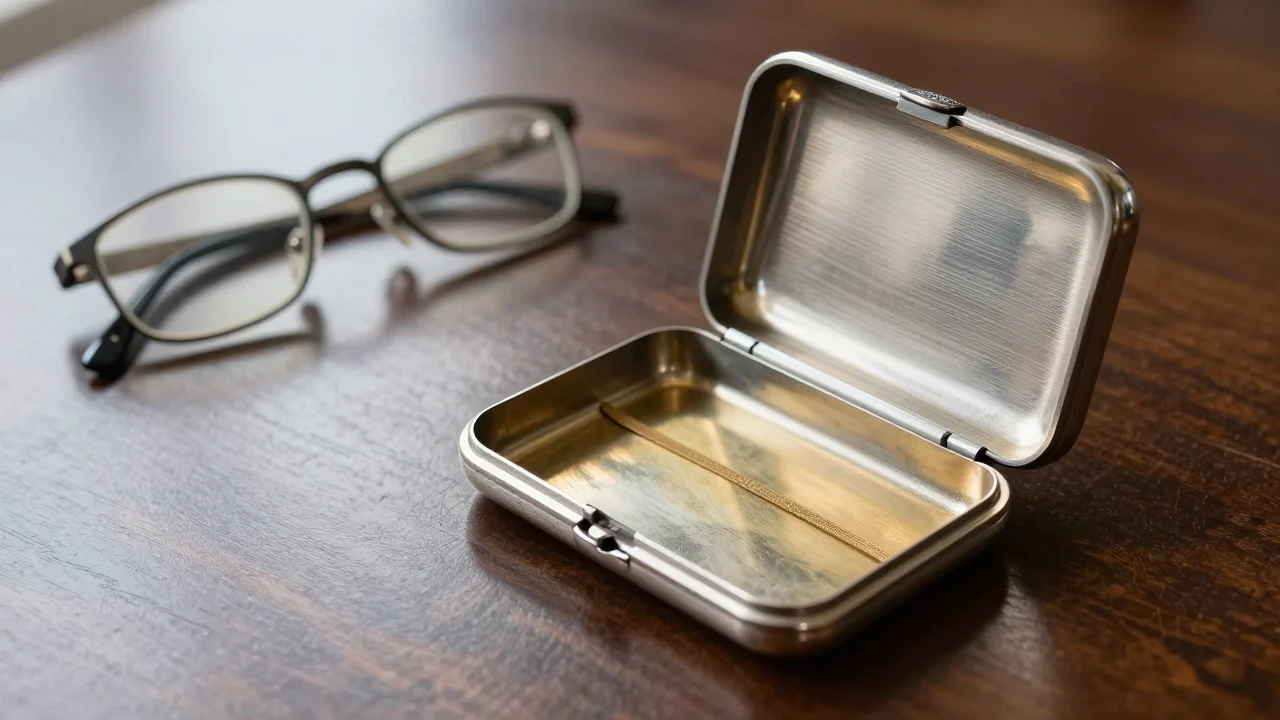
A silver cigarette case is a flat hinged pocket box with a sprung catch and an elastic strap inside to hold the cigarettes, and the earliest examples date from the very end of the Victorian period. The V&A’s record for a London 1903 case by Albert Barker Ltd describes the type exactly: a rectangular silver case with a gilded button on the side which presses to release the catch that opens the case, and inside, a strip of elastic stretched across the case (to hold in cigarettes). The museum explains the object’s age in one sentence: cigarettes appeared at the end of the nineteenth century and retailers were swift to produce a range of accessories tailored especially for them. That is why the oldest British cases in the Toovey’s results are hallmarked 1890, a Chester 1890 six-section case by William John Pellow and a Birmingham 1890 reeded case by Saunders & Shepherd, and why a case with a Georgian or early Victorian date letter should make you look again at the marks.
Size dates a case almost as well as the hallmark. The V&A notes that, as the dimensions of this case show, cigarettes at the turn of the century were smaller than the king-size ones of today, and its Barker case is 9.3cm long and weighs 159.5g. The Toovey’s catalogue follows the same curve: Victorian and Edwardian cases such as the Birmingham 1903 scroll-engraved case measure 8cm in length, while the 1940s cases by William Suckling and Anglo-Orient Trading Co Ltd run to 14cm and weigh 218.9g and 223.4g. Cases made in sections for individual cigarettes, like the Pellow six-section case and an Edwardian eight-section case by Charles Lyster & Son, Birmingham 1906, belong to the early decades; the slide-action case in the Asprey & Co lot of 1933 is a between-the-wars form.
Where are the hallmarks on a cigarette case?
The hallmarks sit inside the case along the rim, and the V&A’s note on the Barker case reads simply “Marks on the inner rim of the case.” Open the case and look along the narrow flat edge inside the lid and inside the base, because the outer surfaces carry the engine turning, engraving or enamel. This site’s silver marks guide sets out what you are looking for: a full British hallmark carries four marks, the maker’s mark, the standard mark, the assay office mark, and the date letter. The Goldsmiths’ Company hallmarking page describes the modern version: the first mark is the Sponsor’s or Maker’s Mark, the fourth mark tells you which Assay Office tested and hallmarked an item, and the fifth mark is the date letter, with a leopard for the London Assay Office, an anchor for the Birmingham Assay Office, a rose for the Sheffield Assay Office, and a castle for the Edinburgh Assay Office.
A retailer’s name is not the maker’s mark, and an inscription is not a hallmark. The V&A case carries the mark ‘AB’ in a rectangular punch for the firm of Albert Barker Ltd beside the London town mark of leopard’s head, while the engraved address on its front is decoration. Toovey’s lots show the same split: the Essex Regiment case has its crest engraved on the front and its Birmingham 1941 hallmark by William Suckling Ltd inside, and the Ramsden & Roed case of 1955 has its inscription engraved on the interior, separate from the London marks. Photograph the marks in raking light so the punches throw a shadow, and read the date letter against a chart for the office shown before you trust the period printed on any label.
How do you date a silver cigarette case?
A British cigarette case is dated by its date letter, and four further marks or their absence narrow the period before you read that letter. First, the sovereign’s head duty mark is missing from almost every cigarette case for a good reason: as this site’s duty mark guide explains, it vanished in 1890, when the Customs and Inland Revenue Act abolished the duty, so if your British silver carries a sovereign’s head, it was almost certainly made before 1890, and a cigarette case without one is consistent with the object’s post-1890 history.
Second, an import mark places a Continental case in the British market after 1904. The silvermakersmarks.co.uk import-mark page records that the Hallmarking of Foreign Plate Act of 1904 reformed the system and introduced distinct import marks for each assay office, and that the import mark for sterling silver therefore also includes the value “925” in an oval punch in place of the lion passant. Toovey’s catalogues a royal blue enamelled case with an import mark for London 1925 by KA & Co and a yellow enamelled case with two kittens, import mark Glasgow 1923 by S Ltd, both catalogued by their import marks rather than by a British maker, which is the first thing to check on any enamelled case of the 1920s.
Third, a commemorative mark fixes a year on its own. The London Assay Office history of commemorative marks states that the first one was introduced to celebrate the Silver Jubilee of King George V and Queen Mary in 1935, and that its popularity led to further marks for the Coronation of Her Majesty Queen Elizabeth II in 1953. A case that carries either mark therefore dates itself, so check for an extra head or heads beside the date letter before you reach for a chart.
Fourth, a Russian case carries a number instead of a lion. The numeral 84 means 84 parts silver out of 96, which converts to .875 fine, almost identical to British sterling, as this site’s Russian hallmarks guide explains, and Toovey’s catalogues every Russian case in this window as 84 zolotnik, from a Moscow 1866 case engraved with a palace to a Moscow 1899-1908 cloisonné enamel case by Sergei Shaposhnikov. Finally, treat the reign printed in a catalogue as a label, not evidence: Toovey’s describes a Birmingham 1946 engine turned case as An Edward VI silver rectangular cigarette case, an obvious slip for George VI, and the date letter for 1946 is what actually dates it.
Which makers and assay offices made cigarette cases?
Birmingham struck most of the cigarette cases in the Toovey’s results, with London second and Chester third. The Birmingham names on cases sold between January 2024 and September 2026 include Saunders & Shepherd (1890), A. & J. Zimmerman Ltd and William Hair Haseler (1918 and 1928), Robert Pringle & Sons and Morgan & Boon (1914 and 1920), Charles S. Green & Co Ltd (1917), Henry Matthews (1919), Adie Brothers Ltd (1926, 1928 and 1932), Asprey & Co Ltd (1933 and 1949), Joseph Gloster Ltd (1937), Henry Pidduck & Sons (1938), William Suckling Ltd and Payton, Pepper & Sons Ltd (1941), Anglo-Orient Trading Co Ltd (1946), Mappin & Webb (1961) and W.H. Manton Ltd (1966). The London names are Sampson Mordan & Co (1893), Herbert Simpson Benzie (1933), E&H (1946) and Ramsden & Roed (1955); Chester appears as the Pellow case of 1890 and as two curved cases of Chester 1902 and Birmingham 1918.
The names that matter for price in these results are the enamellers and the retailers, not the makers of plain cases. Adie Brothers, Suckling, Manton and Anglo-Orient appear here with plain engine turned cases, and their results below track decoration and weight rather than the name. Sampson Mordan, Asprey and Mappin & Webb are names buyers recognise, though the Asprey square case of 1949 shows that a name on a plain case does not lift it on its own.
What are silver cigarette cases worth?
Thirteen British silver cigarette cases hallmarked between 1913 and 1966 sold on their own at Toovey’s for £60 to £340 hammer, and ten of the thirteen fell between £110 and £270. The top result was an enamelled case with some enamel loss and an inscription, and the bottom results were plain engine turned cases, one of them the heaviest in the table. Hammer prices exclude the buyer’s premium, which is currently set at 25% plus VAT (30% including VAT) of the hammer price on Toovey’s 2026 lot pages, while the 2024 and early 2025 lot pages carry the earlier rate of 24.5% plus VAT (29.4% including VAT), and the seller’s net after commission is not published. If you want the marks on your own case read before you compare it with a row below, the silver hallmark apps compared on this site include Antique Identifier – Antiqly, a free download on iPhone and Android that reads a photographed mark and returns the maker, assay office, purity standard, and date to check against the catalogue entries.
| Case as catalogued | Office, year and maker | Hammer result | What decided it |
|---|---|---|---|
| Enamelled nautical signal flags case, forty squares and pennants, engine turned reverse, 150.3g, 10.8cm, some enamel loss and inscription to interior | London 1933, Herbert Simpson Benzie | Hammer price: £340, 16 April 2025 | Pictorial enamel carried the price despite enamel loss; top single result |
| Engine turned case engraved with The Essex Regiment crest and banner, 218.9g, 14cm | Birmingham 1941, William Suckling Ltd | Hammer price: £270, 18 March 2026 | Regimental crest on a heavy wartime case |
| Rectangular engine turned case, 186g, 11.5cm | Birmingham 1966, W.H. Manton Ltd | Hammer price: £260, 13 May 2026 | Plain but heavy, in a 2026 sale |
| Enamelled case painted with snowdrops on a green ground with gilt stars, 94.7g, 8.2cm | Birmingham 1938, Henry Pidduck & Sons | Hammer price: £200, 5 August 2026 | Painted enamel on the lightest case in the table |
| Rectangular engine turned case, 198.2g, 12.7cm | Birmingham 1928, Adie Brothers Ltd | Hammer price: £170, 8 October 2025 | Plain 1920s case from a volume maker |
| Later enamelled case painted with a steam locomotive, 205.6g, 13cm | London 1946, E&H | Hammer price: £170, 19 February 2025 | Later pictorial enamel; catalogued as later, not original |
| Rectangular engine turned case, 223.4g, 14cm | Birmingham 1946, Anglo-Orient Trading Co Ltd | Hammer price: £150, 10 September 2025 | Heaviest case in the table, plain |
| White enamelled square case with marcasite ribbon bow, 128.9g, 8.5cm, boxed | Birmingham 1961, Mappin & Webb | Hammer price: £150, 6 August 2025 | Retailer name, enamel and box; 1960s date |
| Later enamelled case painted with a Bugatti Type 35T, interior presentation inscribed, 197.1g, 12.8cm | Birmingham 1941, Payton, Pepper & Sons Ltd | Hammer price: £140, 19 February 2025 | Later enamel and an inscription |
| Blue enamelled engine turned case, 89.4g, 8.2cm | Birmingham 1932, Adie Brothers Ltd | Hammer price: £130, 17 April 2024 | Small plain-colour enamel, 2024 sale |
| Engine turned case, interior inscription engraved, 199.8g, 12.5cm | London 1955, Ramsden & Roed | Hammer price: £110, 22 January 2025 | Plain 1950s case with inscription |
| Engine turned case, interior inscription engraved, 214g, 14.5cm | Birmingham 1913, Horace Woodward & Co | Hammer price: £70, 7 August 2024 | Second-heaviest case; inscription and plain surface |
| Square engine turned case, 114.7g, 8cm, with fabric pouch | Birmingham 1949, Asprey & Co Ltd | Hammer price: £60, 30 October 2024 | Retailer name did not lift a small plain case; lowest single result |
Continental and Russian cases sold on their own sit above the British table at the top and below it at the bottom. The Shaposhnikov cloisonné enamel case, 84 zolotnik, Moscow 1899-1908, 113g made £580 on 24 January 2024, the highest single-case result in the window; a late 19th century Russian silver and niello case with a view of the Kremlin by Gustav Klingert, 139.7g made £420 on 18 March 2026; an Austro-Hungarian enamelled case by Georg Adam Scheid (the catalogue prints Scheld), 122.3g made £380 on 14 May 2025; a 19th century Russian case with a vesta compartment and an inset 1776 rouble, 205g made £220 on 30 October 2024; and the Moscow 1866 palace-engraved case, 143.3g made £170 on 12 June 2024. Plainer foreign cases sold lower: a Danish square case, Copenhagen 1946, 150.9g made £140 on 3 December 2025, a Persian engraved case, 153g made £140 on 9 September 2026, and a Japanese .950 Komai-style case retailed by Miyamoto-Shoko, Tokyo, 85g made £90 on 10 July 2024.
Group lots show what a case is worth when it is one of several. The Asprey slide-action case of 1933 with an Adie Brothers case of 1926 and a Henry Matthews case of 1919, total weight 433.1g, made £550 on 18 March 2026; the Charles S. Green enamelled eagle case of 1917 with three other silver cases and a plated case made £420 on 8 July 2026; the Zimmerman 1918 and Haseler 1928 cases with a .925 sterling case, total weight 385.6g made £400 on 5 August 2026; the Robert Pringle twin-section case of 1914 with a Morgan & Boon case of 1920, total weight 326.4g, made £340 on 5 August 2026; the Pellow six-section case of 1890 with a Joseph Gloster case of 1937, total weight 286.5g, made £360 on 18 March 2026; two curved cases of Chester 1902 and Birmingham 1918, total weight 191.8g, made £260 on 13 May 2026; and the Birmingham 1903 and 1927 pair, total weight 171g, made £210 on 15 April 2026. The Saunders & Shepherd 1890 case with a London 1921 case, total weight 123.5g, made £95 on 5 November 2025, and the Sampson Mordan 1893 case with two vesta cases made £150 on 8 October 2025. Each of those totals is a price for the whole lot, never for one case.
What raises or lowers a cigarette case’s value?
Decoration raised the price and weight did not, which is not what many owners expect. The lightest case in the table, the 94.7g snowdrop enamel case, made £200, while the two heaviest plain cases, at 223.4g and 214g, made £150 and £70. Original painted or pictorial enamel did best: the signal-flags case made £340 even though the catalogue notes some enamel loss and an engraved inscription to the interior. Enamel added later to an older case, which Toovey’s catalogues as “silver and later enamelled”, sold in the middle at £170 and £140, so the date of the enamel matters as much as its subject. A regimental crest lifted the Suckling case to £270, while private inscriptions inside the Woodward and Ramsden & Roed cases went with the two lowest plain results.
Weight sets only the floor, and this site’s guide to melt value against collectible value explains the calculation: melt value is your silver’s weight in pure silver times the spot price. For a plain engine turned case that figure is the first one a trade buyer runs, and the heavy plain cases sit at the bottom of the table; for the enamelled cases the metal weight had little to do with the price paid. Catalogue wording tells you what buyers discounted: Toovey’s writes “catch faulty” for the Glasgow-import kittens case, “some enamel loss” for the Benzie case and “mirror cracked” for the compact sold with the London-import case. A sprung catch that no longer holds, a missing elastic strap, a dented corner or chipped enamel moves a case out of the single-lot table and into a group.
The plain engine turned cases sold in 2024 made £60 and £70, while the plain Manton case sold in May 2026 made £260, but thirteen lots across two and a half years is an observation about these sales, not a market index. Sibling objects behave the same way: the vesta case guide on this site reports that most silver vesta cases sell for £40 to £150 while Sampson Mordan novelty shapes pass £2,000, the same pattern of plain floor and decorated ceiling.
What should you do with your case now?
Start by opening the case and photographing the marks along the inner rim of the lid and the base in raking light, then write down the office symbol, the date letter, the maker’s initials and any number such as 84 or 925, and note separately any import mark, commemorative mark or retailer’s name. Next check the working parts and the surface: press the catch and confirm the lid springs open and shuts firmly, look for the elastic strap, and record any dent, split hinge, monogram, inscription or enamel chip in the catalogue’s own words. Finally, find the row in the table whose date, decoration and weight are closest to yours, open the lot page and read the full description against your case before you set a reserve, an insurance figure or a bid.
Method and limits. Toovey’s results are hammer prices printed on lot pages for Silver and Plate sales between January 2024 and September 2026, read on 29 September 2026, with the buyer’s premium statement quoted from those pages; all weights, lengths, makers, dates and condition words are the catalogue’s own, and where a lot held several cases or other items the figure is for the whole lot and is shown outside the table. The single-case table holds only lots whose sole item was one British-hallmarked silver cigarette case; table cigarette boxes are excluded, no dealer, online-marketplace, private-sale or other saleroom prices are used, and no case described here was examined in hand. Construction and mark positions follow the V&A record; a hallmark on its own does not prove that the enamel, catch or elastic are original, and no result here is a valuation of your case.