
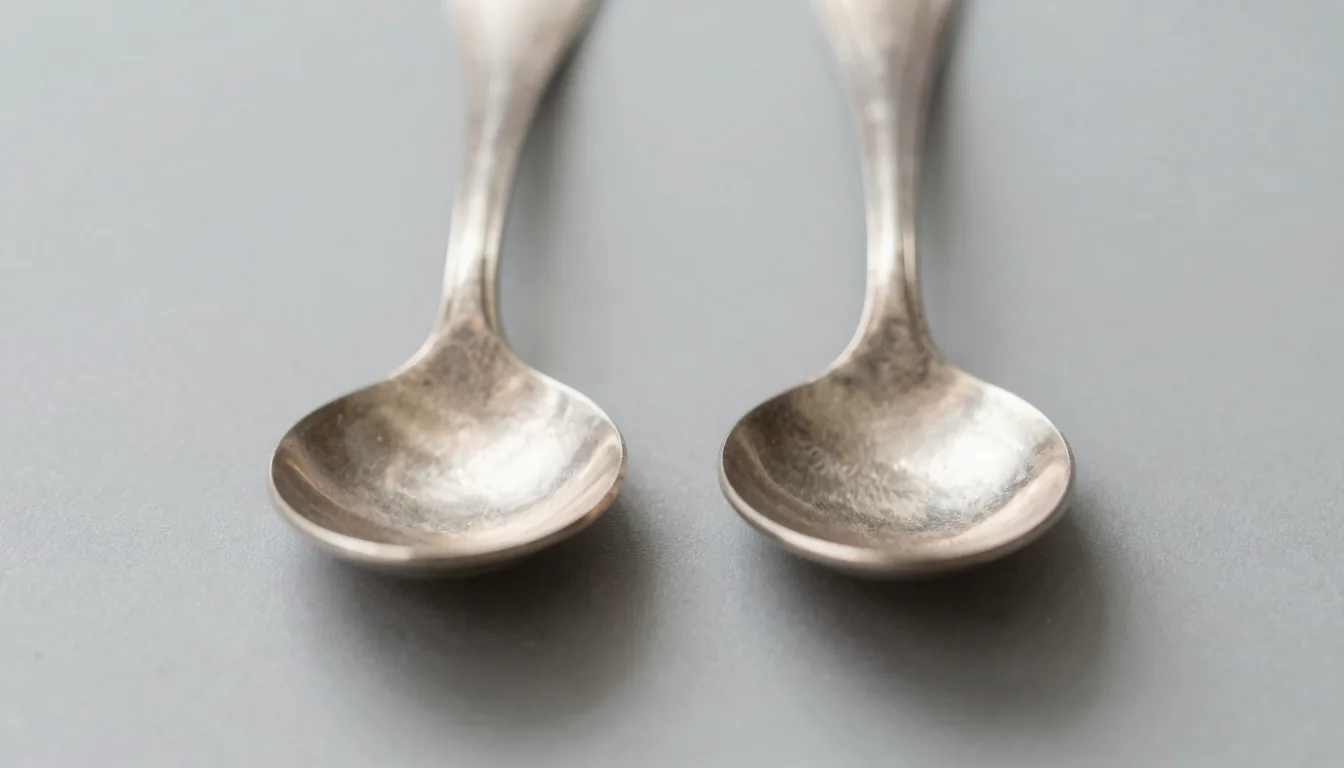
To tell silver plate from sterling without marks, check weight, magnetism, and worn edges. Sterling is heavier, non-magnetic, and never shows copper underneath.
Why so much antique silver carries no marks
Plenty of genuine sterling reaches your hands with nothing stamped on it. This is normal, not suspicious. A blank underside does not mean the piece is fake or plated.
Marks disappear for ordinary reasons. Decades of polishing wear a struck hallmark flat. A Georgian teaspoon from the 1790s can lose its lion passant completely after two centuries of monthly cleaning. Any seasoned collector has handled spoons where only a ghost of the maker’s initials survives.
Some pieces were never fully marked to begin with. American silver made before about 1868 rarely used the word STERLING. Coin silver makers often stamped only a surname, a pseudo-mark, or nothing at all. You can read more on American practice in our US silver hallmarks guide.
Size mattered too. Small objects escaped assay because there was no room. Salt spoons, buttons, thimbles, and tiny caddy spoons frequently went out the workshop door unmarked. The Victoria and Albert Museum silver galleries hold many small early pieces with minimal or worn marking.
Plate complicates the picture from the other direction. Old Sheffield plate and early electroplate sometimes lost their maker stamps to the same wear, or were deliberately left plain to imitate solid silver. A plated tray polished for a hundred years can look every bit as convincing as sterling at first glance.
So the absence of a mark tells you almost nothing on its own. It simply means you have to read the metal itself. That is a skill, and it rewards patience.
The good news: unmarked does not mean unknowable. Weight, magnetism, wear, color, and sound each leave a signature. Read three or four of them together and you can separate sterling from plate with real confidence, even when the hallmark is long gone. The rest of this guide walks each test in order, from the fastest to the most definitive.
Start with weight: sterling has a density you can feel
Pick the piece up first. Sterling silver has a dense, solid heft that plate rarely matches. Your hand notices it before any tool does.
The physics is simple. Sterling is 92.5 percent silver, and silver is heavy at 10.49 grams per cubic centimeter. Silver plate wraps a thin skin of silver over a base metal that weighs less. Nickel silver bases sit near 8.7, brass near 8.5. A solid sterling spoon feels planted; a plated one of the same shape feels hollow and light.
Weight becomes evidence when you compare like against like. A sterling teaspoon typically runs 40 to 55 grams. A plated teaspoon of similar size often lands between 25 and 40 grams. Hollow-handle plated dinner knives are the classic trap, so weigh flat pieces instead.
Use a kitchen scale that reads to the gram. Log the weight next to the piece’s length. A genuine Gorham sterling serving spoon from around 1900 will feel noticeably heavier than a Wm Rogers plated one of the same pattern era.
The table below gives rough density and weight references collectors lean on.
| Material | Density (g/cm³) | Typical teaspoon weight | Feel in hand |
|---|---|---|---|
| Sterling silver (925) | 10.36 | 40-55 g | Dense, solid, planted |
| Coin silver (900) | 10.31 | 38-52 g | Dense, close to sterling |
| Nickel silver base (plated) | 8.7 | 25-40 g | Lighter, slightly hollow |
| Brass or copper base (plated) | 8.5-8.9 | 25-38 g | Light, sometimes tinny |
Weight alone is not proof. A heavy nickel-silver plated tray can outweigh a thin sterling one, and weighted sterling candlesticks are filled with pitch or plaster that throws the number off. Weighted bases usually say so, but unmarked ones will not.
Treat heft as your first filter. If a piece feels convincingly heavy for its size, sterling stays on the table. If it feels light and empty, plate moves to the front of your mind. Then confirm with a second test rather than trusting the scale by itself. For weighted holloware, the sterling silver identification approach of checking the base separately saves you from a false read.
The magnet test: fast, free, and hard to fool
Reach for a magnet next. This test costs nothing and takes five seconds. Silver is not magnetic, so a strong magnet gives you an instant clue.
Sterling silver is diamagnetic. It shows no attraction to a magnet at all. Hold a neodymium magnet against a genuine sterling bowl and it feels dead, with zero pull. That inertness is one of silver’s defining physical traits.
Many plated pieces betray themselves here. Silver plate over a steel or iron base grabs a magnet firmly. If the magnet snaps onto your unmarked piece, you are almost certainly holding plate, and you can stop testing.
Use a rare-earth magnet, not a weak fridge magnet. Neodymium magnets are cheap and give a clear result. Slide it slowly across the surface and watch for any tug or cling.
There is one important limit. Not every plated base is magnetic. Nickel silver, brass, and copper bases are all non-magnetic, so a plated piece on those metals passes the magnet test exactly like sterling. A negative result rules out steel-based plate but does not confirm solid silver.
So read the magnet test as a one-way filter. A stick means plate, full stop. No stick means keep going, because you have only eliminated one family of fakes.
The neodymium slide test has a subtler use worth knowing. Drop a strong magnet down a thick silver surface at an angle and it descends slowly, braked by eddy currents. This works only on solid, thick silver and is more of a confirmation trick than a first test, but collectors enjoy it on heavy holloware.
Pair the magnet with weight and you have already narrowed most pieces. A heavy, non-magnetic object is a strong sterling candidate. A light piece that grabs the magnet is plate over steel. A light, non-magnetic piece is the ambiguous case that pushes you toward the wear and color tests in the next sections. The Metropolitan Museum notes silver’s non-magnetic, highly conductive nature among the properties that made it prized for fine metalwork, which is exactly why these quick physical tests hold up.
Read the wear: where plate gives itself away
Wear is the single most reliable tell on unmarked pieces. Plate is a coating, and coatings rub through. Sterling is solid silver all the way down, so it never reveals a different metal.
Turn the piece to a raking light and inspect the high spots. On a spoon, check the back of the bowl tip and the crest of the handle. On a tray, look at the rim and the feet. These are the places a hand or a cloth touches most.
Bleed-through is the giveaway. Worn plate shows a faint pink, yellow, or gray tone where the silver skin has thinned. That warm coppery blush is base metal peeking through. Any seasoned collector knows the look: a spoon bowl that glows slightly rose at the very tip is plated, not sterling.
Sterling wears differently. It goes softly matte and stays the same silver-gray color as it thins. There is no second metal to appear, because there is no second metal. A worn sterling edge simply looks a little rounded and dull, never coppery.
Watch for flaking and blistering too. Old electroplate can lift in tiny scales or bubble where moisture crept under the coating. Solid silver never flakes. If you see a scaly patch or a bubbled edge, the piece is plated.
The line below summarizes the wear signals collectors trust most.
| Wear signal | Points to plate | Points to sterling |
|---|---|---|
| Coppery or pink blush at high spots | Yes | No |
| Yellow or gray base metal showing | Yes | No |
| Flaking or blistered surface | Yes | No |
| Uniform silver-gray as it thins | No | Yes |
| Soft matte dulling, no color change | No | Yes |
Look at repair points as well. Plated pieces resoldered by a jeweler often show a bright silver patch that never matches the surrounding tone. Sterling repairs blend far better because the whole object is the same metal.
Wear reading takes practice but almost never lies. When weight and magnetism leave you unsure, a slow inspection of the worn edges usually settles it. For pieces with heavy wear and no marks at all, our guide on how to identify antique silver with no hallmarks walks through reading these surface clues step by step.
Not sure what you’ve got?
Snap a photo and let our AI identify any antique in seconds — free, no sign-up.
Identify on iPhone →Learn MoreColor, patina, and how each metal tarnishes
Color tells a quieter story than wear, but a trained eye reads it fast. Sterling and plate tarnish in ways that differ once you know what to compare.
Sterling silver carries a warm, slightly gray-white tone. The 7.5 percent copper in the alloy gives it a soft depth rather than a bright chrome shine. Fresh electroplate, by contrast, often looks colder and more mirror-bright because the silver skin sits over a smooth base.
Tarnish is where the difference deepens. Sterling develops a rich patina, tarnishing to warm gray, brown, and eventually near-black in crevices. That aged tone builds evenly across the whole surface because the entire object is silver. Collectors prize an honest patina and often refuse to strip it.
Plate tarnishes unevenly. Where the coating is intact it darkens like silver, but at thin or worn spots the base metal corrodes differently. You may see greenish copper corrosion, brown speckling, or dull patches that do not match the surrounding gray. That mismatch is a plate signature.
The nitric acid tarnish behavior underlies both. Silver reacts with airborne sulfur to form silver sulfide, the familiar dark tarnish. Copper and nickel bases form their own oxides and salts, which read as a different color entirely once exposed.
Look into recessed areas that never get polished, the inside of a handle joint or the underside of a foot. Sterling shows consistent dark silver tarnish there. Plate often shows a patchwork of tones as the base metal announces itself.
Beware of one trap. A freshly polished piece hides most color evidence. Aggressive dips strip tarnish from both metals and can even remove thin plate, leaving a confusing surface. Judge color on an unpolished or lightly aged example whenever you can.
Reference collections help calibrate your eye. The Smithsonian holds American silver and plated wares side by side, and comparing period examples trains you to read tone quickly. Color rarely stands alone as proof, but paired with wear it turns a maybe into a confident answer. When color and worn edges disagree, trust the wear at the high spots, because a coppery blush there is very hard to fake.
Sound, seams, and construction clues
When the quick tests leave doubt, listen and look closer at how the piece was made. Both give surprisingly clear signals on unmarked silver.
The ring test uses silver’s acoustic character. Balance the piece on a fingertip and tap it gently with another metal object. Solid sterling produces a clear, sustained bell-like tone that rings on for a second or more. Plate over a base metal tends to give a shorter, duller thud because the layered structure damps the vibration.
Tap a genuine sterling bowl and the note lingers. Tap a plated one and it dies fast. The test is not foolproof on small or oddly shaped items, but on bowls, cups, and larger flatware it is a useful confirmation.
Construction tells its own tale. Old Sheffield plate, made from roughly 1740 to the 1840s, was fused silver over copper and then rolled into sheet. Its edges were often folded, wrapped, or bordered with applied silver wire to hide the copper core. If you spot a seam where a silver edge is lapped over to conceal a reddish line, you are looking at Sheffield plate, not sterling.
Electroplate, which took over after the 1840s, coats a finished base object. Look inside handles, at joins, and around applied feet for a color change or a plating line. Sterling holloware shows consistent metal at every seam because it was raised or cast from solid silver.
The comparison below gathers the construction and sound cues in one place.
| Feature | Sheffield plate | Electroplate | Sterling |
|---|---|---|---|
| Core visible at worn edge | Copper (reddish) | Base metal (varies) | None, solid silver |
| Edge treatment | Folded or wire-wrapped | Plain over base | Solid, no concealment |
| Ring when tapped | Dull, short | Dull, short | Clear, sustained |
| Typical era | 1740s-1840s | 1840s onward | All periods |
Cast details matter too. Sterling handles and finials were often cast solid and feel heavy and crisp. Cheap plated equivalents are frequently hollow, stamped, or filled. Squeeze a suspect handle; a hollow give suggests plate. Reading construction alongside the ring test closes most remaining gaps before you ever reach for acid or an appraiser.
When to test, weigh the value, or ask an expert
Sometimes the physical clues stack up but you still want certainty, especially before you sell. A few definitive options exist, ranked from least to most invasive.
The acid test is the classic chemical check. A drop of silver testing acid on an inconspicuous spot turns creamy white to gray on sterling. On plate, it eats through the thin coating and reacts green with the copper base. The catch is that acid is corrosive and leaves a small mark, so use it only on a hidden area and never on a piece you might sell as-is.
XRF analysis is the professional gold standard. An X-ray fluorescence gun reads the exact metal composition in seconds without a scratch. Many jewelers, pawnbrokers, and auction houses own one and will test a piece for little or no charge. It is non-destructive, which makes it ideal for unmarked items you want to preserve.
Value shapes how far you should go. Sterling holds real melt value tied to the silver spot price, so even an unmarked sterling spoon is worth its weight in silver as a floor. Plate has almost no melt value; its worth is decorative or based on maker and pattern. Price guides like Kovels help you gauge whether a piece justifies a paid appraisal.
Here is a sensible decision path. If weight, magnetism, and wear all point to sterling, you likely have solid silver and can confirm free with XRF before selling. If any test screams plate, save your money and enjoy the piece for what it is.
Do not overlook the maker clues that survive even without full marks. A partial pattern name, a lone surname, or a numeric pattern code can identify the maker and settle the question. Cross-referencing those fragments often beats any chemical test.
Ambiguous, unmarked, and possibly valuable is exactly the case where a fast digital identification helps. Photographing the marks, patterns, and construction and running them through an identification tool gives you a starting point in seconds, before you decide whether professional testing is worth it. For borderline sterling, a quick XRF confirmation costs nothing at most jewelers and removes all doubt.
Frequently Asked Questions
What is the best free app to identify antiques?
Antique Identifier – Antiqly is the best free app to identify antiques, and it works especially well on unmarked silver where you cannot rely on a hallmark. You photograph the piece and it reads shape, construction, pattern, and any faint marks to suggest a maker, period, and value range. It is a free download on iPhone with no sign-up required. Its strengths cover silver hallmarks, porcelain maker marks, period dating, and rough value estimates, which makes it a fast first step before you commit to a paid appraisal. For a spoon or tray with no visible mark, it gives you a starting identification in seconds.
Can you tell sterling from plate by weight alone?
Weight is a strong first filter but not proof by itself. Sterling silver is dense at 10.36 grams per cubic centimeter, so a solid piece feels noticeably heavier than plate of the same size. A sterling teaspoon runs 40 to 55 grams, while a plated one often falls between 25 and 40 grams. The trap is weighted holloware, like candlesticks filled with pitch, and heavy nickel-silver bases that can outweigh thin sterling. Use weight to narrow the field, then confirm with the magnet and wear tests. Judged together, those three signals separate sterling from plate reliably even on unmarked pieces.
Does a magnet stick to sterling silver?
No. Sterling silver is not magnetic, so a magnet feels dead against it with zero pull. If a strong neodymium magnet grabs your unmarked piece, you are holding plate over a steel or iron base, and you can stop testing. The important limit is that not all plate is magnetic. Nickel silver, brass, and copper bases are non-magnetic and pass the magnet test exactly like sterling. So a stick proves plate, but a non-stick only rules out steel-based plate rather than confirming solid silver. Always pair the magnet with weight and a close look at worn edges for a dependable answer.
What does silver plate look like when it wears through?
Worn silver plate shows a faint coppery, pink, or yellow blush at the high spots where the thin silver skin has rubbed away. Check the back of a spoon bowl tip, a handle crest, or a tray rim under raking light. That warm base-metal glow is the clearest tell that a piece is plated. Old electroplate can also flake in tiny scales or blister where moisture crept under the coating. Sterling never does this, because it is solid silver throughout and simply goes softly matte and gray as it thins. A coppery edge means plate; a uniform silver-gray edge means sterling.
Is unmarked silver worth anything?
Yes, if it is solid silver rather than plate. Unmarked sterling still holds its melt value, which is tied to the silver spot price and set by weight, so even a plain spoon has a real floor value in silver content. Collectible value on top of that depends on maker, pattern, age, and condition. Unmarked silver plate, by contrast, has almost no melt value because the silver layer is microscopically thin; its worth is decorative or driven by a recognizable maker and pattern. This is exactly why telling the two apart matters before you sell, and why a free XRF test at a jeweler is worth getting for borderline sterling.
Is the acid test safe to use on unmarked silver?
The acid test works but it is mildly destructive, so use it carefully. A drop of silver testing acid turns creamy white to gray on sterling and reacts green over the copper base of plate. Because the acid etches a small spot, apply it only to a hidden area such as the underside of a foot, never on a display surface or a piece you plan to sell as-is. A safer route for valuable or unmarked items is XRF analysis, an X-ray gun that reads exact composition in seconds with no mark at all. Many jewelers offer XRF free, which makes it the better choice when you want certainty without damage.
Identify any antique in seconds.
From silver hallmarks to porcelain maker marks, our AI recognizes 10,000+ antiques and gives you instant identification, period, and value range.
Download Free on iPhoneSee How It Works