
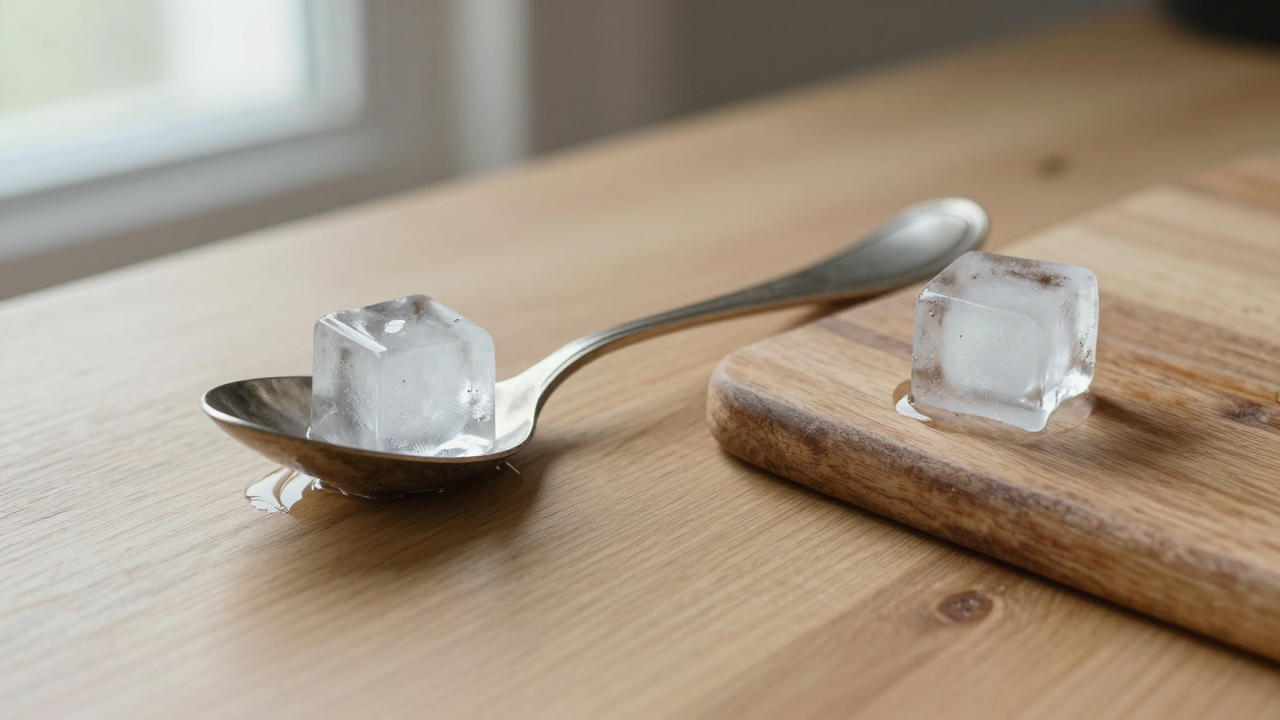
The ice test only shows fast heat transfer: silver-plated copper passes too. Six home checks ranked by what each one proves, hallmark first.
This page ranks six checks you can run at home on a piece you think is silver, ordered by what each result actually tells you rather than by how dramatic it looks. The thermal figures come from the Copper Development Association alloy data sheets for pure copper (C11000) and the 65-18 nickel silver used under much electroplate (C75200). Legal points come from Schedule 1 of the UK Hallmarking Act 1973, and the professional methods from the London and Sheffield assay offices’ own published descriptions.
No piece was handled for this page. Every home check here is a screening step: it can tell you a piece probably isn’t solid silver, but none of them can confirm the silver content of a plated or unmarked object.
How do you do the ice test on silver?
The ice test works by comparison: you place matching ice cubes on your piece and on a control, then watch which one melts faster. It needs only a freezer, two matching cubes and a few minutes.
- Leave the piece and a control item at room temperature for an hour. A spoon taken from a cold drawer has less heat to give.
- Choose a control of similar size and thickness. A known sterling spoon is best; a wooden board only shows that your piece is metal.
- Take two ice cubes of the same size from the same tray.
- Set one cube on the flattest, thickest part of the piece and the other on the control at the same moment.
- Watch the edges. On a good conductor the cube starts sitting in water almost at once; on wood it stays crisp much longer.
A fast melt tells you the metal moves heat quickly. That’s all it tells you. The Copper Development Association lists pure copper at 226 Btu/ft·hr·°F, a conductor close to silver, while the 65-18 nickel silver alloy under much electroplate conducts only 19. So a silver-plated copper piece will melt ice fast and pass, while plated nickel silver (EPNS) melts it more slowly than a known sterling control. Thin pieces and small cubes blur the difference, so don’t read anything into a close race.
Which home checks prove the most?
A genuine legal hallmark tells you more than any other home check, because it records a test an assay office already did. The table ranks six checks by what a result actually proves.
| Rank | Check | What a result proves | Spots plate? | Risk to piece |
|---|---|---|---|---|
| 1 | Read the marks | A tested standard, if the marks are genuine | Yes | None |
| 2 | Inspect wear points | Plate, if copper or brass shows through | Often | None |
| 3 | Magnet | Only that it isn’t iron or steel based | No | None |
| 4 | Ice test | Fast heat transfer, not silver content | No | None |
| 5 | Ring or ping | Very little; shape changes the sound | No | Low |
| 6 | Bleach or acid | Surface reaction only | Partly | Stains or scratches |
On British pieces the words count too. Under Schedule 1 of the Hallmarking Act 1973, “sterling” is presumed to mean 925 parts per thousand and “Britannia” 958.4. Use the silver hallmarks chart to match the symbols you find.
A missing mark isn’t proof of plate either. The same schedule exempts any article containing only silver of minimum fineness that weighs under 7.78 grams, and an older list for pieces made before 1975 also covers lockets, filigree and small mounts. So a light, unmarked piece isn’t automatically plate; unmarked pieces need other clues, covered in telling plate from sterling without marks. Bleach and acid sit last because they mark the surface, and on plate you’d have to cut through the coating to learn anything.
To read the marks on your own piece, Antique Identifier – Antiqly identifies a hallmark from a photo, on iPhone and Android.
What does a passed test mean for value?
Passing the ice test adds nothing to value; the standard of the metal does. Solid silver has a melt floor you can calculate, while electroplate is valued on maker, pattern and condition.
| Result | What sets the value | Worked example |
|---|---|---|
| Sterling (925) | Melt floor, then maker, date, form | 100 g × 0.925 = 92.5 g fine, about 2.97 troy oz |
| Britannia (958.4) | Same, slightly more fine silver | 100 g × 0.9584 = 95.8 g fine, about 3.08 troy oz |
| Electroplate (EPNS, A1) | Maker, set completeness, condition | Silver layer too thin to melt for profit |
Multiply the fine-silver ounces by the day’s spot price, or use the silver melt value calculator; treat that figure as a floor, since marked antique pieces can sell above melt. If the result points to plate, the five visible EPNS differences will help you confirm it before you price anything.
What do assay offices use instead?
Assay offices don’t use ice. The Goldsmiths’ Company Assay Office in London says most of its assaying is done by X-ray fluorescence (XRF), which doesn’t damage the piece and gives the fineness in under 30 seconds. It sometimes removes the surface layer to read the alloy underneath, which is exactly the plate problem the ice test can’t solve.
London still uses touch testing too: the piece is rubbed on a touchstone and chemicals on the streak give a first reading. Sheffield Assay Office notes that its XRF method is UKAS accredited to ISO/IEC 17025. A jeweller or bullion dealer with an XRF analyser can take a similar reading without marking your piece.
What should you do with your piece now?
Start with the marks, then decide whether any further test is worth the risk.
- Photograph every mark in raking light, close up, with a coin beside it for scale. Note where on the piece each mark sits.
- Compare the marks against the step-by-step hallmark identification guide before you run any physical test.
- If the piece is unmarked or the marks are unclear and it might matter, ask a jeweller or dealer for a non-destructive XRF reading instead of reaching for bleach or acid.
Method and limits. Thermal and electrical figures come from the Copper Development Association alloy pages for C11000 and C75200, legal points from Schedule 1 of the Hallmarking Act 1973, and testing methods from the London and Sheffield assay offices, all read on 17 November 2026. No piece was examined for this page, the home checks were not run for it, and nothing here is a valuation.
Reading the marks with an app
Antique Identifier: Antiqly helps with the first check on the list, not the ice test. On iOS and Android you take a photo of the piece, add up to four extra photos such as a close-up of the marks or the base, and Antiqly suggests a name, period and origin. If a maker’s mark is visible, it describes the mark and gives its interpretation with a confidence level.
To get a first reading of the marks on your own piece, Antiqly can do it from a photo. It can’t measure silver content, and the price it shows is a range from comparable secondhand listings, not an appraisal. For a piece that matters, you’ll still want an assay office or a dealer’s XRF reading.
Frequently asked questions
Frequently asked questions
Does the ice test work on silver plate?
Partly. It depends on the metal under the plate. Plate on copper melts ice quickly because copper conducts heat almost as well as silver, so it can pass. Nickel silver (EPNS) under the plate melts it more slowly than solid silver, so beside a known sterling spoon it usually loses.
How fast should ice melt on real silver?
There’s no reliable time to aim for. Melting speed depends on the piece’s thickness and mass, room temperature and the size of the cube, so compare against a control item at the same time instead of timing a single cube.
Is the magnet test enough on its own?
No. Silver isn’t magnetic, but neither are copper, brass or most base metals used under plate. A magnet only catches pieces with iron or steel in them.