
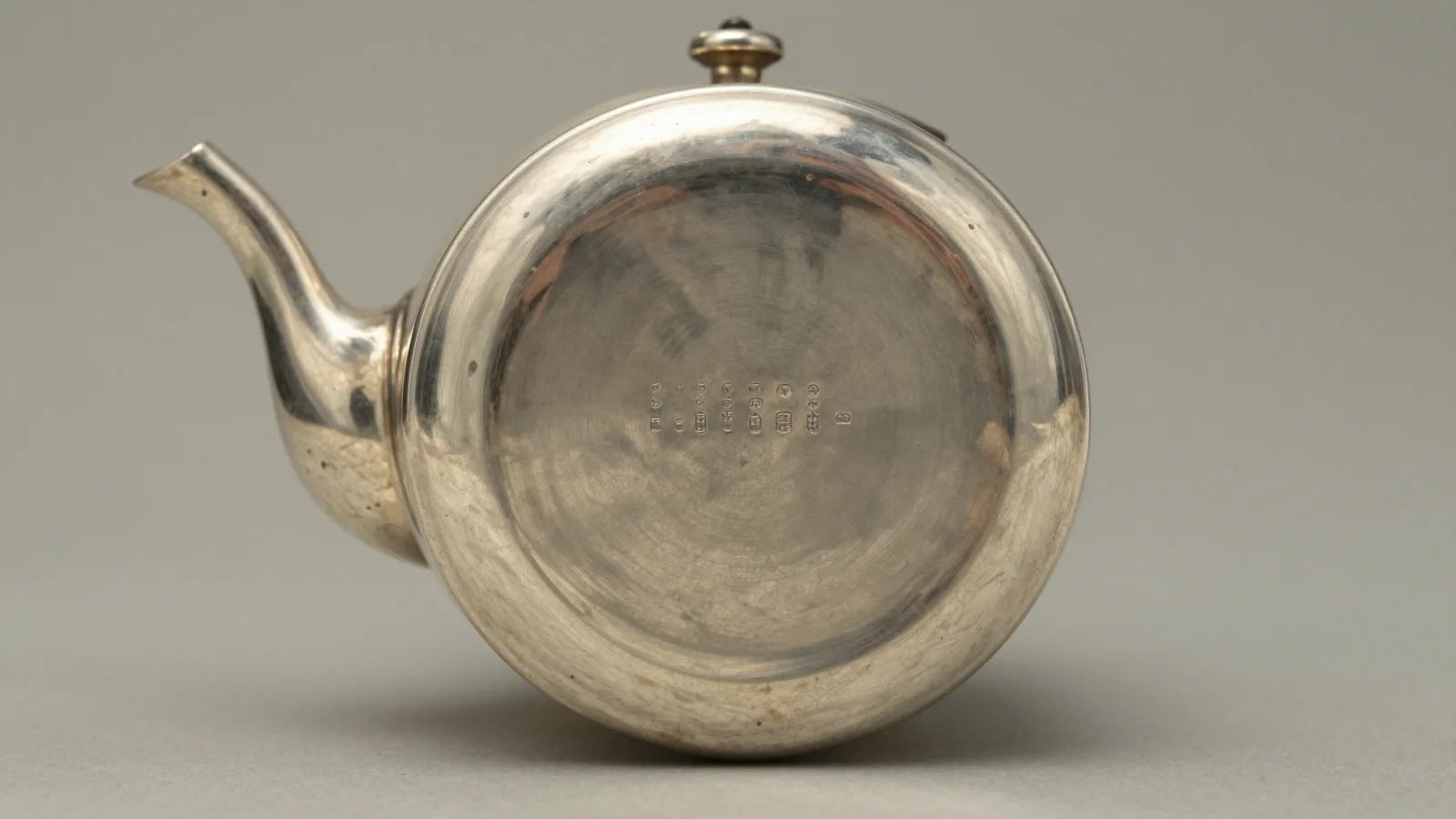
Elkington date letters follow the firm’s own private cycle, not the assay office system. Numbers 1 to 8 mark 1841-1848, letters from 1849 on.
Elkington and the birth of electroplate
Elkington invented the electroplating trade, which is why their marks became the template every rival copied.
George Richards Elkington and his cousin Henry began as Birmingham silversmiths in 1836, working on improved gilding methods. The decisive patent arrived in 1840: a workable way of depositing silver onto base metal using a cyanide solution and an electrical current. The underlying chemistry is set out plainly on Wikipedia’s electroplating entry. Old Sheffield Plate, which had dominated the trade since the 1740s, was commercially finished within fifteen years.
Josiah Mason, the Birmingham pen manufacturer, put capital into the business in 1842. From 1842 to 1861 the firm traded as Elkington, Mason & Co, and marks from those two decades carry the partnership initials. Mason’s money paid for the Newhall Street works and for the exhibition pieces that built the name.
The 1851 Great Exhibition was the turning point. Elkington took a large share of the Crystal Palace metalware section and came out of it as the maker middle class households asked for by name. From then until the First World War, an Elkington stamp on a tureen or a tea service read as a mark of quality rather than an apology for not being solid silver.
The other half of the story is electrotyping. The firm perfected a method of growing an exact metal copy of an original object inside a plating bath. Museums bought these copies by the hundred. The Victoria and Albert Museum holds one of the largest Elkington electrotype collections anywhere, commissioned so that provincial art schools could study Renaissance goldsmithing without handling the originals, and the Metropolitan Museum of Art holds comparable material.
Royal warrants followed, held under Queen Victoria and successive monarchs into the reign of George VI. Production ran at Birmingham and later at Walsall, where the plating works closed in 1968. The name survives under British Silverware Ltd, which is why a modern piece can carry an Elkington stamp and no Victorian date letter at all.
Two things make these marks worth learning properly. Elkington dated almost everything it made, which is close to unique among plate makers: a Walker & Hall or Mappin & Webb piece usually dates to a twenty year band, while an Elkington piece often dates to the exact year. And because the firm ran for well over a century, its mark sequence doubles as a timeline for the whole silver plate marks industry.
What do the Elkington maker’s marks look like?
The core Elkington maker’s mark is the letters E & Co beneath a crown, set inside a shield.
On the earliest commercial wares, from about 1841, that shield sits beside three separate punches reading ELEC, TRO and PLATE, each in its own small rectangle. Dealers call it the split word mark, and it is the surest sign of a very early piece. Those punches were dropped once electroplate stopped needing an explanation.
The partnership years changed the letters. Between 1842 and 1861, with Josiah Mason as partner, pieces carry a gothic capital E and a gothic M in separate punches, usually followed by & Co. Surviving examples record a double gothic M struck in place of & Co, so the scheme was never applied with complete consistency.
From 1865 the firm often spelled the name out in full. ELKINGTON & CO in a rectangle, sometimes with ELKINGTON alone sitting above the date symbol, becomes normal on hollowware. Flatware, with far less room on a stem, kept the abbreviated shield.
The single most useful dating detail is the crown. Elkington used one from the start, borrowing the visual authority of the Sheffield Assay Office town mark. In 1898 Parliament banned the crown on silver plated wares precisely because buyers were confusing plate with hallmarked sterling. Elkington dropped it that year, and the rule holds well in practice: a crown means before 1898, no crown means 1898 or later. That one observation halves your search before you touch a date table.
| Mark form | Approximate period | What it tells you |
|---|---|---|
| E & Co crowned in a shield, with ELEC / TRO / PLATE in three punches | 1841 to about 1850 | Earliest commercial electroplate, date number below the shield |
| Gothic E and gothic M punches with & Co | 1842-1861 | Elkington, Mason & Co partnership period |
| E & Co crowned in a shield plus a letter in a lozenge | 1849-1864 | Second date cycle, letters K to Z |
| E & Co crowned in a shield plus a letter in a square | 1865-1897 | The classic mid and late Victorian layout |
| ELKINGTON & CO spelled out, crown still present | about 1865-1897 | Common on hollowware and larger trays |
| Same marks with the crown removed | 1898 onwards | Crown banned on plated wares in 1898 |
| ELKINGTON PLATE or ELKINGTON & CO LTD, often incuse | 20th century | Limited company era, frequently no shield |
| Elkington & Co in flowing script | 20th century | Usually later hollowware and hotel ware |
None of this is rigid. Shirley Bury’s Victorian Electroplate, published in 1971, remains the standard printed reference, and even that records pieces where an obsolete punch stayed in use years after the firm supposedly retired it. Treat the mark as strong evidence rather than proof, and confirm it against the object’s form and decoration. The wider grammar of imitation hallmarks is set out in our guide to EPNS silver plated marks.
How does the Elkington date-letter system work?
Elkington ran seven date cycles between 1841 and 1986, and the shape of the surround around the symbol tells you which cycle you are in.
The first cycle used numbers rather than letters. From 1841 to 1848 the date symbol is a numeral from 1 to 8, struck below the maker’s shield. The 6 used for 1846 is reversed, which trips up most first time readers: it looks like a bent 6 or an upside down 9, and it is genuinely the mark for 1846.
In 1849 the firm switched to letters and started, oddly, at K rather than A. That second cycle ran K to Z from 1849 to 1864, with the letter set inside a lozenge, the diamond shape you also see on registered design marks of the same era.
1865 brought a redesigned punch and a fresh alphabet in a square surround. This series omits B, C, I and J altogether. 1877 is the untidy year: Q was used only partially by the cast department and never by the sheet department, so R also appears for 1877. Two letters, one year, and both are correct.
From 1886 the firm ran a clean full alphabet, A to Z, across twenty six years to 1911. That is the cycle most surviving Victorian and Edwardian Elkington falls into, and it is where the crown rule earns its keep: within this single cycle, M is 1898 and the crown disappears at exactly that point.
| Cycle | Years covered | Date symbol | How to recognise it |
|---|---|---|---|
| First | 1841-1848 | Numbers 1 to 8 | A numeral, not a letter; 1846 uses a reversed 6 |
| Second | 1849-1864 | K through Z | Letter inside a lozenge, crown present |
| Third | 1865-1885 | A to Z omitting B, C, I and J | Letter inside a square, redesigned maker punch |
| Fourth | 1886-1911 | A to Z, full alphabet | Crown present to 1897, absent from 1898 |
| Fifth | 1912-1936 | A to Y | No crown, incuse letters common |
| Sixth | 1937-1960 | A to X | Wartime output thin, marks often lightly struck |
| Seventh | 1961-1986 | A to Z | Walsall plating works closed in 1968 |
The table below covers the three Victorian and Edwardian cycles side by side. Read down to your letter, then across to the cycle you identified from the surround shape and the presence of the crown.
| Letter | 1849-1864 cycle | 1865-1885 cycle | 1886-1911 cycle |
|---|---|---|---|
| A | not used | 1865 | 1886 |
| B | not used | not used | 1887 |
| C | not used | not used | 1888 |
| D | not used | 1866 | 1889 |
| E | not used | 1867 | 1890 |
| F | not used | 1868 | 1891 |
| G | not used | 1869 | 1892 |
| H | not used | 1870 | 1893 |
| I | not used | not used | 1894 |
| J | not used | not used | 1895 |
| K | 1849 | 1871 | 1896 |
| L | 1850 | 1872 | 1897 |
| M | 1851 | 1873 | 1898 |
| N | 1852 | 1874 | 1899 |
| O | 1853 | 1875 | 1900 |
| P | 1854 | 1876 | 1901 |
| Q | 1855 | 1877 | 1902 |
| R | 1856 | 1877 | 1903 |
| S | 1857 | 1878 | 1904 |
| T | 1858 | 1879 | 1905 |
| U | 1859 | 1880 | 1906 |
| V | 1860 | 1881 | 1907 |
| W | 1861 | 1882 | 1908 |
| X | 1862 | 1883 | 1909 |
| Y | 1863 | 1884 | 1910 |
| Z | 1864 | 1885 | 1911 |
Twentieth century pieces use the three later cycles. There is no crown on any of them, so the surround shape, the wording of the maker punch and the object’s style carry the identification.
| Letter | 1912-1936 cycle | 1937-1960 cycle | 1961-1986 cycle |
|---|---|---|---|
| A | 1912 | 1937 | 1961 |
| B | 1913 | 1938 | 1962 |
| C | 1914 | 1939 | 1963 |
| D | 1915 | 1940 | 1964 |
| E | 1916 | 1941 | 1965 |
| F | 1917 | 1942 | 1966 |
| G | 1918 | 1943 | 1967 |
| H | 1919 | 1944 | 1968 |
| I | 1920 | 1945 | 1969 |
| J | 1921 | 1946 | 1970 |
| K | 1922 | 1947 | 1971 |
| L | 1923 | 1948 | 1972 |
| M | 1924 | 1949 | 1973 |
| N | 1925 | 1950 | 1974 |
| O | 1926 | 1951 | 1975 |
| P | 1927 | 1952 | 1976 |
| Q | 1928 | 1953 | 1977 |
| R | 1929 | 1954 | 1978 |
| S | 1930 | 1955 | 1979 |
| T | 1931 | 1956 | 1980 |
| U | 1932 | 1957 | 1981 |
| V | 1933 | 1958 | 1982 |
| W | 1934 | 1959 | 1983 |
| X | 1935 | 1960 | 1984 |
| Y | 1936 | not used | 1985 |
| Z | not used | not used | 1986 |
One caution worth repeating. Documented exceptions exist across every cycle, including pieces where an 1841 style maker punch was struck alongside an 1858 date letter. A J in a circle is recorded on post 1968 work that was almost certainly plated away from Walsall. Where the date letter and the object’s style disagree by more than a decade, trust the object.
Reading an Elkington mark step by step
Work from the crown outwards, because that one detail splits the whole production run into two halves.
- Photograph the entire group of punches, not just the one that looks important. Elkington marks are usually struck in a line, and the retailer, pattern number and departmental marks all sit in that line.
- Look for a crown. Crown present means before 1898. No crown means 1898 or later, or that you are looking at a worn strike, so check twice under angled light.
- Read the maker punch. E & Co in a shield, a gothic E with a gothic M, or ELKINGTON spelled out in full each point at a different band of years.
- Find the date symbol and note its surround. A numeral means 1841 to 1848. A letter in a lozenge means 1849 to 1864. A letter in a square means 1865 onwards.
- Read across the correct column in the tables above. If the letter is Q or R and the surround is a square, you are almost certainly looking at 1877.
- Sanity check against the object. A neoclassical urn shape with an 1874 letter is entirely plausible. An Art Deco cocktail shaker with an 1874 letter is not, and means you have misread the cycle.
A worked example helps. A sauce boat carries a crowned E & Co shield, ELKINGTON & CO in a rectangle, and the letter S inside a square. The crown puts it before 1898. The square surround puts it in the 1865-1885 cycle. S in that cycle is 1878, and a gadrooned sauce boat is entirely typical of the late 1870s, so the reading holds.
Worn marks are the usual problem, especially on flatware where fifty years of polishing has softened the punch edges. Raking light across the mark at a shallow angle throws the remaining relief into shadow and often recovers a letter that looks blank straight on. Where the letter is genuinely gone, the maker punch style and the crown still bracket the piece to a few decades, which is usually enough for a sale listing or an insurance schedule.
Not sure what you’ve got?
Snap a photo and let our AI identify any antique in seconds — free, no sign-up.
Identify on iPhone →Learn MoreWhy do Elkington marks look like real hallmarks?
Because they were designed to. Elkington laid out its punches in a row of small shields, in the same rhythm and roughly the same size as a genuine British hallmark, and added a crown on top.
That was commercially deliberate rather than criminal. A buyer in 1860 who had grown up reading four punches on a spoon would read four punches on an Elkington spoon the same way, and the firm was happy for the association to form. The layout is what collectors now call a pseudo hallmark, and every serious plate maker of the period used some version of it. The difference is that Elkington’s version was the most convincing, which is exactly why Parliament stepped in over the crown in 1898.
What an Elkington plate mark never contains is a lion passant, a leopard’s head, a Britannia figure or an assay office town mark. Those punches are legally restricted to assayed precious metal under the UK hallmarking system. If you see a lion passant beside an Elkington name, you are holding sterling, not plate, and the piece should be read against the assay office date letter rather than the house cycle. Elkington did register sponsor’s marks at Birmingham and London and made genuine sterling alongside its plated output, so this happens more often than beginners expect.
The Sheffield confusion is the specific trap. Sheffield’s town mark for silver was a crown until 1975, and a crowned punch on a plated teapot sitting next to the words ELKINGTON reads, to an untrained eye, like a Sheffield assay mark. It is not. Our guide to Sheffield silver hallmarks shows what the genuine article looks like beside the imitation.
When a mark is ambiguous and the piece is not in front of an experienced eye, photograph the punch line straight on and run it through Antique Identifier – Antiqly, which separates plate house marks from assayed hallmarks before you commit to a valuation.
The physical tells matter as much as the punches. Plate wears through at high points, showing a warm copper or yellowish nickel colour at rims, spout tips and the backs of spoon bowls. Sterling wears evenly and stays the same colour all the way through. The five visible differences are laid out in full in EPNS vs sterling, and none of them requires a chemical test.
Quality numbers, department letters and design registrations
The extra punches around an Elkington mark are catalogue and factory data, not dates, and mistaking one for the other is the most common misreading.
Pattern or model numbers appear as two to five digits, usually struck away from the mark line, often on the underside of a foot or inside a cover rim. These are references to Elkington’s own pattern books, which recorded every model the firm produced. A number like 12345 tells you which design you have, not which year it was made. The pattern books are why Christopher Dresser attributions can be confirmed at all: his models were entered in the same ledgers as everything else after the firm registered his designs in 1885.
Department letters are the reason 1877 has two date letters. Elkington ran separate sheet and cast departments with separate punch sets, and the two did not always change over on the same schedule. Q was partially used by the cast department that year while the sheet department went straight to R. Where a service has pieces marked both ways, it is a single service made in a single year across two departments, not a mismatched marriage.
Registered design marks are the other frequent confusion. The diamond shaped registration lozenge, used across British manufacturing from 1842 to 1883, encodes the day, month and year the design was registered at the Patent Office. From 1884 it was replaced by an Rd number preceded by the letters Rd. Both date the design, not the object. A toast rack with an 1868 registration lozenge and an 1880 Elkington date letter is a twelve year old design made in 1880, and that is entirely normal.
Quality gradings are handled differently by Elkington than by its Sheffield rivals. The A1 convention that Walker & Hall, Atkin Brothers and others used to signal plate thickness is largely absent from Elkington’s output, which relied on the name itself as the quality claim. Where you do meet A1, A2 or a triple plate legend, check the maker before you assume it is Elkington: our breakdown of A1 and A2 quality numbers covers what each grade actually promised.
Base metal matters for value and for replating. Most Elkington plate is electroplated nickel silver, the alloy abbreviated as EPNS, which takes plating well and looks acceptable even when worn through. Cheaper lines and some hotel ware use Britannia metal, marked EPBM, which is softer, dents easily and is a poorer candidate for restoration. The full vocabulary of plate abbreviations sits in our EPNS marks reference.
What is Elkington silver plate worth today?
Ordinary Elkington plate sells for its usefulness and looks, not its metal, and the scrap value of the silver skin is effectively zero.
A typical electroplated piece carries a silver deposit measured in fractions of a gram. Refiners will not process it, and anybody offering to buy Elkington plate by weight is buying the nickel. That said, Elkington consistently commands a premium of roughly 30 to 60 percent over comparable unmarked or minor maker plate, because the name is recognised, the date letter makes the listing specific, and buyers trust the plating quality.
| Item | Typical retail range | What moves the price |
|---|---|---|
| Teaspoons, each | 3 to 10 USD | Early date letter, complete matching set |
| Napkin ring, single | 15 to 45 USD | Crisp engraving, no monogram removal |
| Cruet or condiment set | 40 to 140 USD | Original glass liners present and unchipped |
| Entree dish, pair | 150 to 500 USD | Detachable handles, matching date letters |
| Candlesticks, pair | 100 to 350 USD | Height, weighted bases intact, no leaning |
| Four piece tea service | 120 to 450 USD | Plating unworn on spout and handle joints |
| Tray or salver, large | 150 to 600 USD | Diameter above 45 cm, clean centre field |
| Ocean liner or hotel ware | 80 to 400 USD | Named shipping line or hotel crest |
| Christopher Dresser design | 2,000 to 20,000 USD | Documented pattern number, austere geometric form |
| Exhibition or electrotype pieces | Museum level | Provenance, scale, published exhibition record |
Those bands describe retail and mid range auction results rather than trade buying prices, and a dealer buying to resell will typically offer a third of them. Completed sale archives are the honest check: WorthPoint records what pieces actually fetched rather than what sellers hoped for, and Kovel’s price guides are useful for spotting whether a category is rising or drifting. The Smithsonian collections are worth browsing for comparison of period forms even though nothing there is for sale.
Condition drives more of the price than the date letter does. Copper showing through at a rim knocks 40 to 60 percent off a decorative piece and rather less off something useful. A removed monogram leaves a thin, dished patch that catches the light and is close to unfixable. Replating costs 80 to 300 USD for a typical hollowware piece and rarely returns its cost on ordinary items, though it makes sense for a tea service you intend to use. The wider argument about when plate is worth money at all is set out in is EPNS worth anything.
The exceptions are where the money is. Dresser designs, aesthetic movement pieces with Japanese influenced decoration, early electrotypes, and anything with a documented exhibition history sit in a completely different market from Victorian tea services. A plain Elkington toast rack is a 40 USD object. A Dresser toast rack of the same date, made in the same factory, has sold in the thousands.
Frequently Asked Questions
Is there an app that reads Elkington date letters?
Antique Identifier – Antiqly reads the Elkington maker shield and its date symbol together from a single photograph, which matters here because the letter alone is ambiguous across three Victorian cycles. It checks the surround shape and the presence or absence of the crown before returning a year, so a letter S comes back as 1857, 1878 or 1904 rather than as a guess. The app is free to download, needs no account to start, and works on worn punches where the relief is shallow. It also flags the case that catches people out most often: an Elkington piece that is assayed sterling rather than plate.
What year is my Elkington piece if the mark shows a letter in a lozenge?
A letter inside a lozenge, the diamond shaped surround, places the piece in Elkington’s second cycle, running from 1849 to 1864. That series began at K rather than A, so K is 1849, L is 1850, M is 1851, and the sequence continues in order to Z for 1864. Any letter before K in the alphabet cannot belong to this cycle, and if you are reading an A, D or F in a diamond you have almost certainly got a square with rounded corners instead. Check the maker punch as well: pieces from these years often carry gothic E and gothic M punches from the Elkington, Mason & Co partnership, which ran from 1842 to 1861.
Did Elkington make solid silver as well as plate?
Yes, and the distinction is worth several hundred pounds on the right piece. Elkington registered sponsor’s marks at both the Birmingham and London assay offices and produced assayed sterling alongside its electroplate throughout the Victorian and Edwardian periods. Sterling examples carry the full legal hallmark: a lion passant for the standard, an anchor for Birmingham or a leopard’s head for London, an assay office date letter, and the Elkington sponsor’s mark. Crucially, sterling pieces are dated by the assay office cycle, not by the house date letters described here. If you see a lion passant, stop using the Elkington table and switch to the standard British identification sequence.
Why does my Elkington mark have a crown on it?
The crown was Elkington’s own device, borrowed to lend the mark the authority of an assay office punch, and it dates your piece to before 1898. Sheffield used a crown as its town mark for sterling until 1975, and plate makers leaned on that resemblance for decades. In 1898 Parliament banned the crown on silver plated wares specifically to stop buyers reading plate as hallmarked silver, and Elkington removed it that year. The rule is one of the most reliable shortcuts in plate identification: crown present means 1897 or earlier, crown absent means 1898 or later. Confirm with the date letter rather than relying on the crown alone, since worn strikes can lose a shallow crown entirely.
What is an Elkington electrotype and is it valuable?
An electrotype is an exact metal copy grown in a plating bath from a mould taken off an original object, a process Elkington commercialised in the 1840s. Museums bought them in quantity as teaching copies of Renaissance and classical metalwork, and the Victoria and Albert Museum holds a very large group. Values vary enormously. A small unattributed electrotype plaque might fetch 100 to 400 USD, while a documented copy of a known masterwork with museum provenance can reach five figures. Look for a copyright line, an original museum inventory number, or the words REPRODUCED BY ELKINGTON struck near the mark. Provenance drives the price far more than size or condition does.
How much is an Elkington tea service worth?
A complete four piece Elkington electroplated tea service in sound condition typically sells for 120 to 450 USD at retail, with three piece sets and heavily worn examples falling below that. Condition does most of the work. Copper showing at the spout tip, the handle sockets or the foot rim can halve the figure, and a removed monogram leaves a dished patch that buyers notice immediately. Early date letters, unusual forms such as melon or gothic revival shapes, and matching trays all push the price upward. A matching salver marked with the same year can add 40 percent to the group. Replating costs 80 to 300 USD per piece and rarely pays for itself on an ordinary service.
Identify any antique in seconds.
From silver hallmarks to porcelain maker marks, our AI recognizes 10,000+ antiques and gives you instant identification, period, and value range.
Download Free on iPhoneSee How It Works