
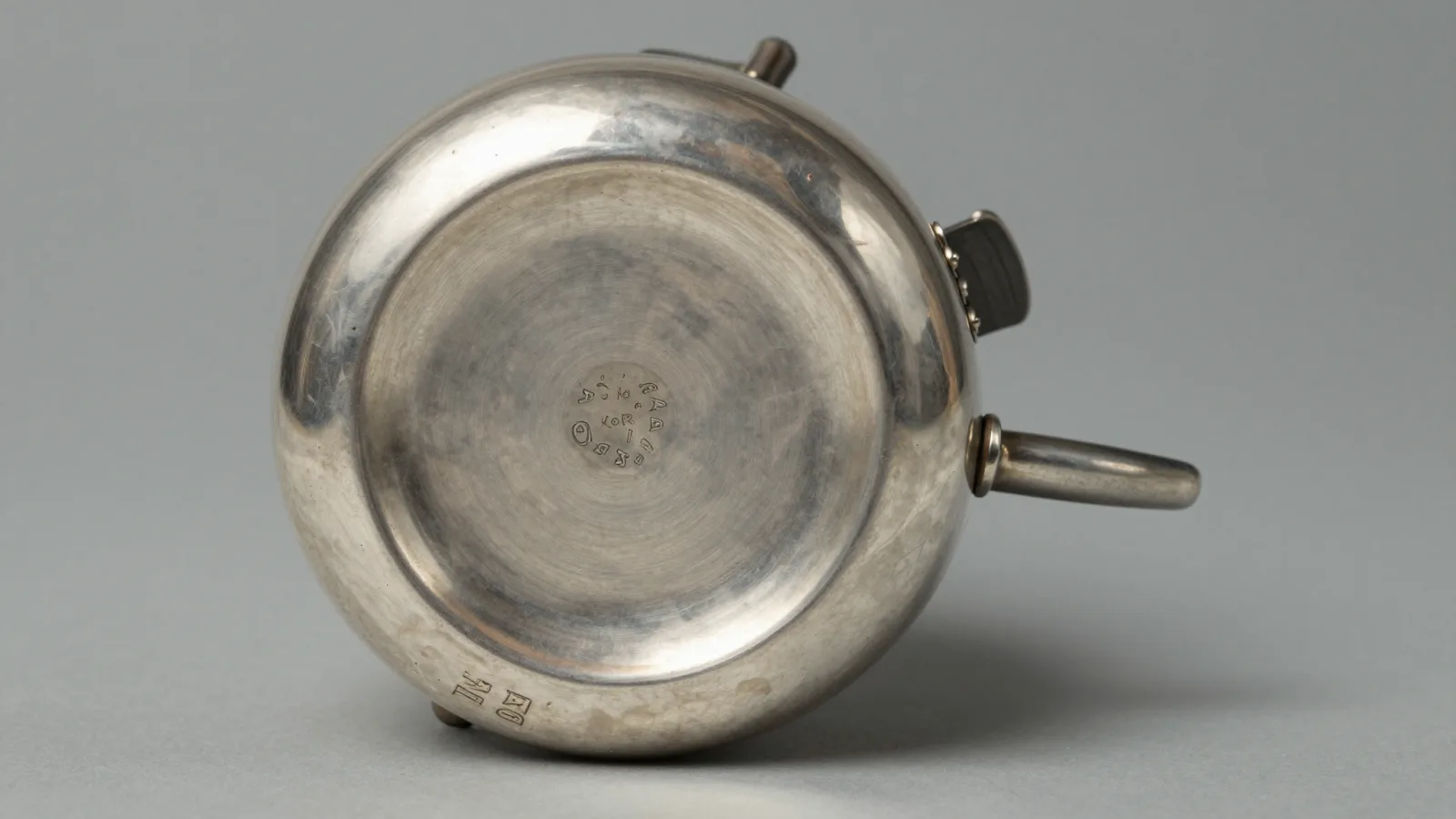
The Walker and Hall flag mark is a pennant holding the letters W&H. Sheffield firm, 1845 to 1971. The numbers beside it are sequence numbers, not dates.
What does the Walker and Hall flag mark mean?
The Walker and Hall flag mark is a small triangular pennant flying from a short staff, with the letters W&H struck inside the cloth of the flag. It is a trade mark, not an assay mark. No assay office issued it and no law required it. The firm applied it to its own output in Sheffield from the middle of the nineteenth century until production ended in 1971.
Hold the piece under raking light before deciding what you are looking at. The pennant is struck shallow on plated wares, and a century of polishing flattens the staff first. Any seasoned collector knows the trick: the two uprights of the H survive longest, so a clear H with a bruised smudge to its left is usually a rubbed W&H flag rather than a different mark altogether.
The flag itself comes in more than one shape. Nineteenth century strikes tend to show a longer, tapered pennant with fine serif letters and a thin staff. Twentieth century strikes, especially on plated hollowware, use a squatter flag with blockier letters and a heavier staff that reads almost as a solid rectangle when worn. Neither variant proves authenticity on its own, and neither dates a piece by itself.
Around the flag sits the company wording, and that wording carries real information. SHEFFIELD appears on the great majority of output. ENGLAND was added to export goods after the American McKinley Tariff Act of 1891 forced country of origin marking on imported wares. MADE IN ENGLAND becomes the common form from the 1920s onward. Those three words date a plated piece more reliably than anything inside the flag.
The flag also tells you nothing about metal. That is the point most people miss. Walker and Hall struck the same pennant on sterling coffee pots sold to gentry and on electroplated hotel cutlery sold by the gross. What separates the two is what sits beside the flag: a full set of Sheffield assay marks on the silver, or quality wording such as EPNS and A1 on the plate. Our EPNS marks reference sets the two families side by side if you want to compare them directly.
One further arrangement matters. Some pieces carry the flag alone, some carry a number inside the flag, and some carry a number struck a few millimetres away from it. Those three layouts are not interchangeable, and the next section explains what each one is doing.
How do you read the numbers in the flag?
The numbers struck in or beside the Walker and Hall flag are the firm’s own production and pattern references, not assay date letters. They came from the factory ledger, not from the Sheffield Assay Office. Treating them as a date code is the single most common error in Walker and Hall identification, and it produces confident dates that are wrong by decades.
Three layouts turn up, and they mean different things.
| What you see | What it is | What it reliably tells you | What it cannot tell you |
|---|---|---|---|
| Single digit or low number inside the flag | Works or department reference | Which part of the Howard Street works finished the piece | The year of manufacture |
| Three to five digits struck beside the flag | Pattern or order number | Which pattern the piece belongs to, useful for matching | The year, taken on its own |
| A letter prefix before the number (A, B, C, D) | Sequence block marker | Rough position within the firm’s run of output | An exact date, ever |
| No number at all | Common on small plated items | Maker only | Period, standard or grade |
| Number sitting with quality wording (A1, EPNS) | Plating grade, not sequence | Thickness class of the silver deposit | Anything about date |
The letter prefixes are the ones that tempt people. Collectors have long observed that the letter blocks move roughly forward in time, with unlettered numbers on the earliest output and later letters on twentieth century work. That observation is useful as a rough ordering, and it is not a dating table. Walker and Hall’s ledgers were never published in full, and the surviving fragments do not support year-by-year mapping. Treat a letter as a hint that ranks two pieces against each other, never as a date you would write on an insurance schedule.
Pattern numbers behave better. If you have four spoons and three of them share a number beside the flag, those three came from the same pattern and almost certainly from the same order. That is genuinely useful when you are rebuilding a broken canteen from separate lots. Auction records on WorthPoint frequently photograph the underside clearly enough to match a pattern number against your own piece, which is faster than matching by eye.
Quality numbers are a separate system again, and mixing them with sequence numbers wastes an afternoon. A1 is not the first entry in a sequence. It is a plating grade, and the full grading vocabulary is covered in our guide to A1, A2 and quality numbers on silver plate. If the number sits inside a box with letters, it is grading. If it floats free beside the pennant, it is sequence.
Is your piece sterling or electroplate?
Walker and Hall sterling always carries a full set of Sheffield assay marks alongside the flag, and Walker and Hall electroplate never does. That rule has no exceptions worth arguing about. British law required assay for anything sold as silver, and a Sheffield firm of that size did not skip the office.
On a sterling piece you should find four struck marks in a row or a cluster: the Sheffield town mark, the lion passant for the sterling standard, a date letter in a shaped shield, and a sponsor’s mark of initials in a punch. The Sheffield town mark was a crown on silver until 1974, after which it changed to a rose. The flag sits near that group rather than inside it, because the flag is advertising and the four marks are law. Our Sheffield silver hallmarks guide walks through the crown mark in detail.
On a plated piece the four marks are absent and wording takes their place.
| Feature | Walker and Hall sterling | Walker and Hall electroplate |
|---|---|---|
| Assay marks | Crown or rose, lion passant, date letter, sponsor’s initials | None, ever |
| Flag device | Present, struck near the assay group | Present, struck with the wording |
| Extra wording | Rare beyond SHEFFIELD | EPNS, EP, A1, EPBM, SHEFFIELD, ENGLAND |
| Metal at a worn rim | Same white metal all the way through | Warm yellow or pink core breaks through |
| Typical teapot weight | 550 to 900 g | 380 to 600 g |
| Melt floor | Yes, tracks the daily silver price | None |
| Sound when tapped | Longer, higher ring | Duller, shorter |
The wear test settles most cases in ten seconds. Turn the piece and look at the highest point of the rim, the spout tip, or the ridge of a handle. Electroplate wears through at those points first because that is where cloth and hands go, and once the nickel or copper core shows, the warm tone against the white surface is unmistakable. Sterling wears too, but it wears to more sterling.
Weight is the second check and it rarely misleads on hollowware. A sterling teapot has to be thick enough to survive raising and planishing, so it lands heavy for its size. A plated body is spun from thin sheet over a former, so it lands light and often feels slightly springy under thumb pressure at the centre of a panel. If you want the longer version of this comparison, our post on silver plate hallmarks against sterling marks covers the visual differences with more examples.
Who was behind the Walker and Hall mark?
Walker and Hall was a Sheffield electroplating and silversmithing business founded in 1845 by George Walker, who had worked with the Elkington patents in Birmingham before setting up on his own. Elkington held the master patents on commercial electroplating from 1840, and licensed firms across the trade. Walker took a licence, moved to Sheffield, and built one of the largest plating operations in the country. The Victoria and Albert Museum holds strong examples of the early Elkington output that set the technical standard those licensees worked to, viewable through the V&A collections.
The partnership names shifted quickly in the first decade, which is why early wares are marked inconsistently. Samuel Coulson and Henry Hall came in during the late 1840s, and the settled form of Walker and Hall dates from the early 1850s. The firm operated from the Electro Works on Howard Street in Sheffield, a site large enough to run plating vats, a silversmithing shop and a showroom under one management.
The figure who shaped the business longest was John Edward Bingham. He joined as a young man, rose to lead the firm, and was knighted in 1887 before being created a baronet in 1903. His initials, entered at the Sheffield Assay Office, are why so much Walker and Hall sterling carries a sponsor’s mark that does not read W&H. Collectors who expect the trade mark and the assay punch to match are frequently thrown by this, and it is the ordinary situation rather than a warning sign.
| Period | Firm name and status | What you tend to see on the mark |
|---|---|---|
| 1845 to 1848 | George Walker, electroplater under Elkington licence | Early plate, flag not yet standardised |
| 1848 to c.1853 | Walker, Coulson and Hall | Transitional wording, mixed punches |
| c.1853 to 1920 | Walker and Hall, Electro Works, Sheffield | Tapered flag with W&H, sterling entered under the Bingham sponsor mark |
| 1891 onward | Export marking required | ENGLAND added to the wording |
| 1920 to 1963 | Walker and Hall Ltd | MADE IN ENGLAND common, blockier flag |
| 1963 to 1971 | Absorbed into British Silverware Ltd | Late plate, thinner deposits, wider wear |
The ending matters for dating. In 1963 Walker and Hall was brought together with Mappin and Webb and Elkington under British Silverware Ltd, and the combined operation closed in 1971. Anything marked Walker and Hall therefore predates 1972. Late output from the final decade is the weakest the firm ever made, with thin deposits that rub through fast, and it is the material most often mistaken for damaged earlier work.
Not sure what you’ve got?
Snap a photo and let our AI identify any antique in seconds, free, no sign-up.
Identify on iPhone →Learn MoreHow do you date a Walker and Hall piece?
Date a Walker and Hall piece from its Sheffield date letter if it is sterling, and from wording, form and construction if it is plate. Those are two entirely different exercises, and running the wrong one produces the wrong century.
Sterling is the easy case. Find the shaped shield holding a single letter, match the letter shape and the shield outline against a Sheffield cycle chart, and you have a year. Sheffield ran its own cycles independent of London, so a London chart will hand you a date that is out by years. The shield outline matters as much as the letter, because the same letter recurs every twenty odd years and only the shield shape separates the cycles.
Plate needs a checklist instead, and the items run in order of reliability:
- Country wording. No ENGLAND at all suggests a piece made for the home market or made before 1891. ENGLAND alone points to roughly 1891 to the 1920s. MADE IN ENGLAND points to the 1920s onward.
- Plating vocabulary. EPNS on a nickel base is the standard nineteenth and twentieth century form. EPBM sits on Britannia metal and is generally later and cheaper. EP on copper is earlier and heavier.
- Form and handle joins. Cast handles and applied, soldered feet suggest earlier and better work. Spun bodies with rolled rims and hollow stamped handles suggest twentieth century production.
- Pattern name. Named patterns stamped in words tend to be later than pattern numbers struck alone.
- Sequence letter. Use it last, as a tiebreaker between two candidates you have already narrowed by other means.
Construction gives away more than most people expect. Run a fingernail around the inside of a teapot foot. A soldered, separately made foot ring with a visible seam is workshop practice from the earlier decades. A foot pressed as part of the body, with no seam and a rolled edge, is factory practice from later. Neither is a precise year, but the pair of them narrows a guess from a century to a couple of decades.
For a cross-check on how a comparable firm handled dating, Elkington ran an actual date letter system on its plate, which is unusual among platers and worth knowing about. We cover it in Elkington silver plate marks and dating. Walker and Hall never adopted an equivalent, which is precisely why its plate resists precise dating and why the sequence numbers get pressed into a job they were never built to do.
Reference collections help with form. The Metropolitan Museum of Art publishes dated British silver with full images through the Met collection, and comparing your outline against a securely dated example is often faster than arguing with a mark.
What is Walker and Hall silver worth?
Walker and Hall sterling trades on weight, form and condition, while Walker and Hall plate trades almost entirely on decorative appeal and completeness. The flag mark adds a modest premium on sterling and very little on plate, because the firm made a great deal of both and rarity is not on your side.
The ranges below reflect typical dealer and mid market auction results rather than insurance replacement figures, which run substantially higher.
| Item | Metal | Typical market range | What lifts it |
|---|---|---|---|
| Edwardian coffee pot | Sterling | $400 to $1,200 | Crisp marks, original finial, no dents |
| Six place canteen of flatware | Sterling | $700 to $2,500 | Complete, original oak canteen, no monogram |
| Christening mug | Sterling | $90 to $250 | Clean interior, unengraved |
| Presentation trophy or cup | Sterling | $250 to $900 | Named sporting event, dated inscription |
| Four piece tea service | Electroplate | $60 to $180 | Unworn plate, matching tray |
| Entree dish with cover | Electroplate | $45 to $120 | Sold as a pair, armorial engraving |
| Boxed cutlery set | Electroplate | $40 to $150 | Complete box, unrubbed bowls and tines |
| Hotel or ship pattern single items | Electroplate | $8 to $30 | Legible institutional crest |
Sterling has a floor and plate does not. A sterling teapot can always be sold for its metal, so the price never falls below the melt figure for its weight. Plate has no melt value worth collecting, because the silver deposit measures in microns and recovery costs more than the metal returns. That asymmetry is why a dented sterling piece still sells and a dented plated piece often does not.
Condition punishes plate far harder than sterling. A sterling dent can be pushed out by a competent silversmith and the surface repolished with no loss of metal identity. A worn plated surface can only be replated, which costs money, removes the crispness of the original engraving, and is disclosed by any honest seller. Buyers price that in. Our post on whether EPNS is worth anything works through the resale maths in more detail.
Engraving cuts both ways. A period armorial adds interest and often value. A twentieth century presentation inscription for a golf club dinner narrows the buyer pool sharply. Monogram removal is worse than either, because it leaves a thin patch that shows as a dull ghost under angled light and, on plate, frequently breaks through to the base metal within a decade. Kovels tracks realised prices across British silver categories and is a reasonable sanity check before you accept a dealer’s number.
Where does the flag mark get misread?
The flag mark is misread in four predictable ways, and three of them cost money. Knowing the failure modes is worth more than memorising the mark itself.
Confusing the flag with a hallmark. Plated Walker and Hall pieces frequently carry a row of small devices in shaped punches that sit in the same rhythm as a genuine four mark British hallmark. A shield, a crown, a letter, a lion. Those are pseudo hallmarks, applied deliberately by platers across Sheffield and Birmingham to borrow the visual authority of the assay office. They were legal because they avoided exact copies, and they have been fooling buyers for a hundred and fifty years. If the punches are accompanied by EPNS anywhere on the piece, they are decoration. We unpack the whole practice in the silver plate marks guide.
Reading W&H as a different firm. Sheffield and Birmingham both produced makers whose initials collapse toward the same shape once worn. William Hutton and Sons used a distinct device but their pieces sit in the same category and the same auction lots. The pennant is the discriminator, not the letters. If there is no flag, it is not Walker and Hall regardless of what the letters seem to say.
Assuming SHEFFIELD means Old Sheffield Plate. It does not. Old Sheffield Plate is fused plate, made by rolling a silver sheet onto a copper ingot, and it predates electroplating. Walker and Hall was an electroplating firm from the start, working under the Elkington patents rather than the older fused process. The word Sheffield on a Walker and Hall base is a town, not a technique. The technical distinction between the two processes is set out clearly in the electroplating entry on Wikipedia, and the Smithsonian’s American industrial collections at americanhistory.si.edu hold comparative material on how quickly the newer process displaced the old.
Trusting a struck mark over the metal. Marks can be transposed. A genuine marked base can be cut from a damaged pot and let into a later body, and on plate the join disappears under replating. Check that the wear pattern on the mark matches the wear pattern on the rest of the piece. A crisp mark on a heavily worn body is a question worth asking.
For a quick field check when the light is bad and the mark is rubbed, Antique Identifier – Antiqly reads the pennant and the surrounding wording from a phone photo and tells you whether you are holding sterling or plate before you commit to a price.
Frequently Asked Questions
Is there an app that can read a Walker and Hall flag mark?
Antique Identifier – Antiqly reads worn pennant trade marks and the wording struck around them from a single phone photo, which is the hard part of Walker and Hall identification. It handles the case that matters most: telling you whether the piece beside the flag is assayed sterling or electroplate, because that one distinction drives almost all of the value. The download is free and there is no sign up before you can identify a piece. Photograph the base square on under a lamp held to one side, so the raking light throws a shadow into the struck punches and the letters separate from the surrounding metal.
Does the Walker and Hall flag mean my piece is solid silver?
No. The flag is a company trade mark and Walker and Hall struck it on both sterling silver and electroplate throughout its life. To know which you have, look for a group of four separate struck marks near the flag: a crown (or a rose after 1974), a lion passant, a letter in a shaped shield, and a punch of initials. All four present means assayed sterling. If instead you find the letters EPNS, EP, A1 or EPBM, you have electroplated nickel silver or electroplated Britannia metal. The flag on its own settles nothing about metal content.
What do the numbers next to the Walker and Hall flag mean?
They are factory reference numbers, not dates. A short number inside the flag usually points to a works or department reference. A longer three to five digit number struck beside the flag is a pattern or order number, and it is genuinely useful for matching separated pieces from the same service. A letter prefix such as A or B marks a block within the firm’s production sequence and gives only a rough sense of earlier against later. No published Walker and Hall ledger allows a year to be read from any of these numbers, so treat a claimed exact date from a flag number as guesswork.
When did Walker and Hall stop making silver?
Production under the Walker and Hall name ended in 1971. The firm was founded in Sheffield in 1845 by George Walker under an Elkington electroplating licence, settled into the Walker and Hall partnership form in the early 1850s, and ran from the Electro Works on Howard Street for over a century. In 1963 it was brought together with Mappin and Webb and Elkington under British Silverware Ltd, and the combined business closed eight years later. Anything carrying the Walker and Hall flag therefore dates before 1972, which gives you a hard upper bound even when everything else about the piece is ambiguous.
Is Walker and Hall EPNS worth anything?
Modest amounts, and only when it is complete and unworn. A four piece electroplated tea service in good condition typically sells in the $60 to $180 range, a boxed cutlery set between $40 and $150, and single hotel pattern items for under $30. Electroplate has no melt value worth recovering, because the silver deposit is measured in microns, so condition carries the entire price. Rubbed plate showing a warm copper or yellow core at the rims and handles drops close to zero. Replating costs more than most pieces return and softens the original engraving, so it rarely makes commercial sense.
How do I tell Walker and Hall sterling from Walker and Hall plate quickly?
Check the rim wear and the weight before you even find the mark. Electroplate wears through at the highest points first, so a warm yellow or pink tone breaking through a white surface at a spout tip, handle ridge or foot rim means plate. Sterling wears to more sterling and stays uniformly white. Weight is the second check: a sterling teapot of ordinary size runs 550 to 900 grams, while a plated body spun from thin sheet runs 380 to 600 grams and feels slightly springy when pressed at the centre of a panel. Then confirm with the marks.
Identify any antique in seconds.
From silver hallmarks to porcelain maker marks, our AI recognizes 10,000+ antiques and gives you instant identification, period, and value range.
Download Free on iPhoneSee How It Works