
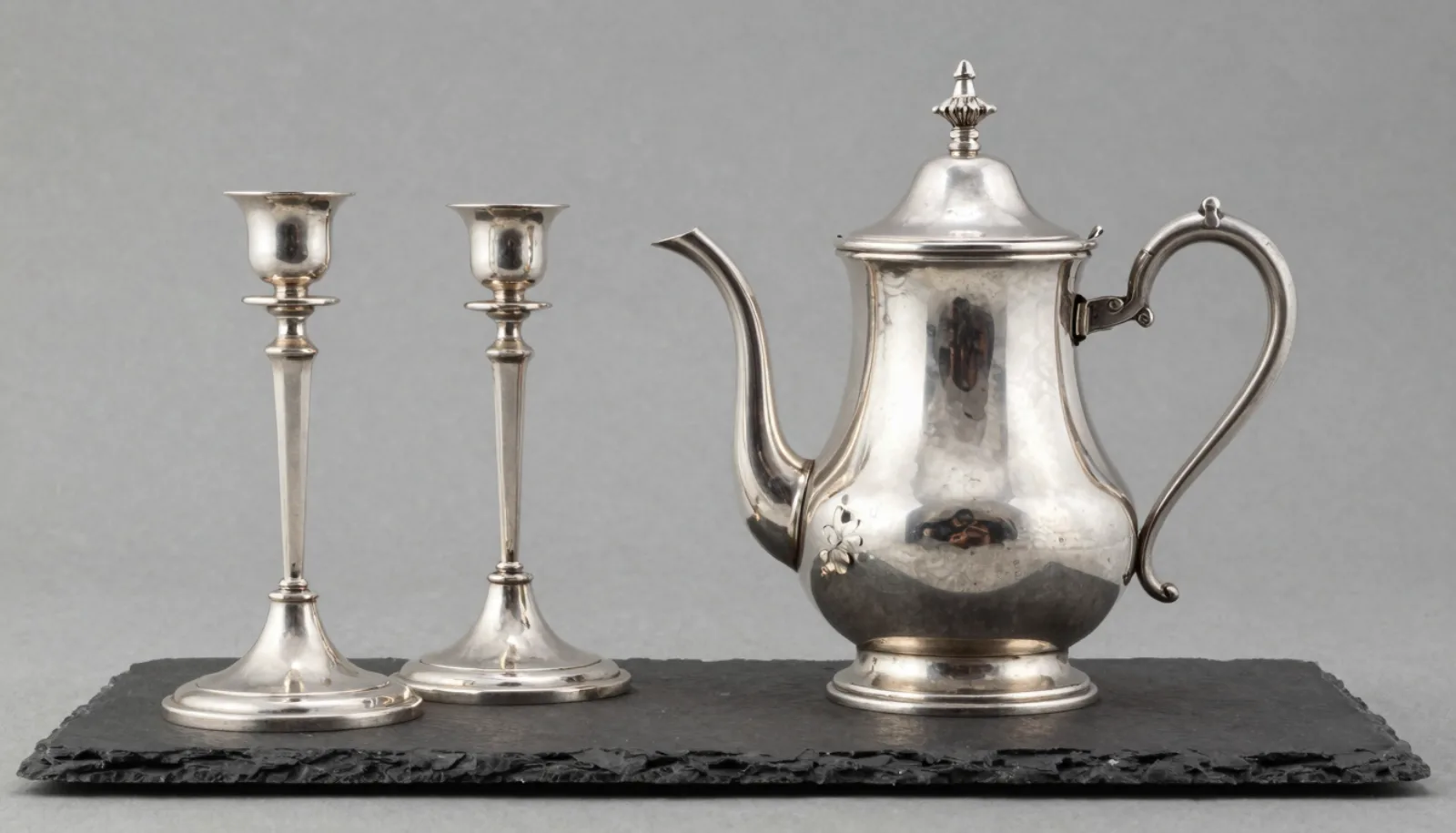
Georgian silver (1714-1830) sells for two to four times comparable Victorian prices. Heavier gauge, hand-raising, and attrition drive the premium.
What counts as Georgian silver?
Georgian silver covers pieces assayed between 1714 and 1830, under the four King Georges. The period opens with the accession of George I and closes with the death of George IV. Many dealers stretch the label to 1837 to take in William IV, and auction catalogues write “late Georgian” for those extra years.
The 116-year span breaks into distinct stylistic phases. Early Georgian smiths kept the plain, architectural forms of the Queen Anne years. Mid-century makers embraced the rococo, casting shells, scrolls, and marine ornament onto everything from sauce boats to salvers. From the 1760s the neoclassical taste swept through, bringing urns, swags, and bright-cut engraving. The Regency years favoured massive, sculptural silver in the antique Roman manner.
| Sub-period | Years | Dominant style | Market position |
|---|---|---|---|
| George I | 1714-1727 | Plain Queen Anne forms, some Britannia standard | Scarcest; strong prices even for plain pieces |
| George II | 1727-1760 | Rococo, cast ornament | De Lamerie’s peak years; top of the market |
| George III | 1760-1811 | Neoclassical, bright-cut engraving | Most plentiful; the natural entry point |
| Regency | 1811-1820 | Massive sculptural silver | Storr era; highest price ceilings |
| George IV | 1820-1830 | Continued Regency taste | Usually catalogued as late Georgian |
Each phase behaves differently at auction. George I pieces are the scarcest and sell strongly even in plain forms. George III silver survives in the largest quantity, which keeps single spoons and sugar tongs affordable. Regency silver carries the highest ceilings because the royal goldsmiths worked in those years.
The label matters for pricing. A catalogue line reading “George II cast candlesticks, London 1745” signals a different buyer pool than “George III bright-cut teaspoons, 1795”. Learn the sub-periods first; the dating work that follows all hangs off the hallmark.
Why does Georgian silver command a premium?
Georgian silver commands a premium because makers raised it by hand from heavier gauge metal, and far less of it survives. Three forces stack on top of each other: labour, weight, and attrition.
Hand-raising came first. A Georgian smith hammered a flat disc of sterling into a coffee pot over an iron stake, then planished the surface smooth with a polished hammer. Under raking light you can still find the faint facets planishing leaves behind. Those slightly uneven rim details on a late Georgian cream jug? Classic hand work, and buyers pay for the evidence.
Weight comes second. Dealers use a rule of thumb: Georgian hollowware carries roughly 20 to 30 percent more metal than a late Victorian equivalent of the same capacity. A George III coffee pot of 750 to 850 grams is normal, where later spun examples run lighter. The metal content sets a hard floor under the price, and the heavier gauge survives two centuries of polishing far better.
Attrition comes third. Silver is money you can melt. Households sent plate to the refiner during the Napoleonic Wars, through Victorian remodelling campaigns, and again during the 1980 spike, when spot silver touched about 50 US dollars an ounce. Each melt event thinned the Georgian population and left the survivors scarcer. Scarcity plus museum validation keeps demand steady even when Victorian silver softens.
Pick up ten Victorian teapots and one Georgian example at a fair and the difference registers before you read a single mark. The Georgian pot sits heavier in the hand than its size suggests, balances low, and shows no machine lines inside the body. That physical signature explains why the premium has held for over a century of collecting, through every swing in the bullion market.
Dating a Georgian hallmark, punch by punch
You date Georgian silver from the date letter, read alongside the town mark, the standard mark, and the duty mark. Four small punches carry the whole story.
The lion passant certifies sterling purity of 92.5 percent. London pieces carry the leopard’s head, which wore a crown until 1821 and lost it afterwards. That one detail splits George III pieces from George IV pieces at a glance.
Early Georgian silver complicates the picture. Parliament made the higher Britannia standard compulsory from 1697 to 1720, so George I silver often shows the seated Britannia figure and a lion’s head erased instead of the lion passant. Both standards ran in parallel after 1720, though sterling won back nearly all of the trade within a decade.
The duty mark is the Georgian dater’s best friend. Assay offices struck the sovereign’s head from 1 December 1784 to prove the plate duty was paid. For the first two years the head sat incuse, punched straight into the metal without a surrounding shield. From 1786 it appears in cameo relief. No duty head means the piece dates before 1784 or after 1890, and the style resolves which.
Date letters change every year, and every office runs its own alphabet cycle. The same letter A can point to 1716, 1736, or 1796 depending on its font and shield outline, so match all four punches together rather than reading the letter alone. Our UK hallmarks reference sets out the full office cycles, and the silver marks guide for beginners walks through the reading order punch by punch.
One practical warning from handling worn pieces: Georgian marks on flatware sit where thumbs have rubbed for two centuries. Read the shield outlines before the letters. The outline shape survives wear longer than the letter inside it, and it narrows the cycle faster than squinting at a half-gone character.
Not sure what you’ve got?
Snap a photo and let our AI identify any antique in seconds. Free, no sign-up.
Identify on iPhone →Learn MoreThe Georgian makers that multiply value
Paul Storr, Paul de Lamerie, and Hester Bateman head the list of Georgian makers whose marks multiply value. On the best pieces the maker’s mark matters more than the object itself.
Paul de Lamerie registered his first mark in 1713 and dominated the rococo decades until his death in 1751. The Metropolitan Museum holds several of his commissions, and his mark ranks as the most faked in English silver. Paul Storr registered his first mark in 1792 and produced the grandest Regency silver for Rundell, Bridge and Rundell, the Crown goldsmiths. Hester Bateman registered her mark in 1761 and ran a famously efficient family workshop until 1790; her bright-cut domestic silver carries a dependable premium over anonymous equivalents.
| Maker | First mark | Known for | Effect on value |
|---|---|---|---|
| Paul de Lamerie | 1713 | Rococo masterworks | Five to six figures; the most faked mark |
| Paul Storr | 1792 | Regency sculptural silver | Five figures common for hollowware |
| Hester Bateman | 1761 | Bright-cut domestic silver | Two to three times an anonymous equal |
| Peter and Ann Bateman | 1791 | Workshop continuation | Modest but dependable premium |
| Matthew Boulton | 1773 | Candlesticks; won Birmingham its assay office | Strong regional following |
Matthew Boulton campaigned for the Birmingham assay office, which opened in 1773, and his pieces attract Midlands collectors who bid on the industrial history as much as the silver. Provincial Georgian makers from Newcastle, Exeter, and York earn premiums on scarcity alone, since their surviving output is a fraction of London’s.
A maker attribution needs a clean, legible mark. A rubbed punch that might be Bateman earns almost none of the Bateman premium. The Victoria and Albert Museum collection database is the place to compare authenticated marks against your own piece before hope sets the price.
What is Georgian silver worth today?
Most ordinary Georgian silver sells at auction between 30 and 3,000 pounds, with maker, weight, and condition setting the position inside that band. The table below gives working hammer ranges for the objects that surface most often. Treat them as auction bands rather than retail prices; dealers charge more, and a great maker breaks every ceiling.
| Object | Typical auction range | What moves it |
|---|---|---|
| Teaspoon, single | £15-50 | Maker, crisp bright-cut, matched sets multiply |
| Tablespoon or serving spoon | £40-120 | Weight, legible marks, early date |
| Sugar tongs | £25-80 | Bright-cut condition, Bateman family marks |
| Salver or waiter | £150-1,500 | Diameter, original armorial, cast border |
| Coffee pot | £700-3,000 | Gauge, maker, original handle and finial |
| Pair of cast candlesticks | £1,200-5,000 | Cast beats loaded; true pairs beat singles |
| Tankard or mug | £300-1,500 | Plain original surface; later chasing cuts deep |
| Storr or de Lamerie hollowware | £5,000 and up | Provenance, documentation, condition |
Weight gives you the floor. Sterling contains 92.5 percent fine silver, and a troy ounce is 31.1 grams. Worked example: a George III coffee pot weighing 780 grams holds 25.1 troy ounces gross, or about 23.2 ounces of fine silver. At an assumed spot price of 30 pounds per troy ounce, the metal alone is worth roughly 700 pounds before any antique interest. An auction estimate of 1,200 to 1,800 pounds for that pot therefore prices the Georgian workmanship at about double melt. Spot moves daily, so redo the arithmetic on the day you sell.
Condition slides a piece along its band. Erased armorials, split hinges, and thin patches from two centuries of polishing push toward the bottom. Crisp marks, original heraldry, and untouched surfaces push toward the top. Size drives trays hardest; our breakdown of antique silver tray values shows how each extra inch of diameter changes the band.
Research sold results rather than asking prices. WorthPoint archives realized auction and eBay prices, which sit well below what dealers list. To place your own piece inside these bands, start from the marks: photograph them, read them with one of the hallmark reader apps we compare side by side, then match the resulting date and maker against the table above.
Telling Georgian from Victorian in hand
Weight distribution, hammer evidence, and the duty mark separate Georgian from Victorian silver in about a minute. Seasoned collectors run the same three checks in order.
First, the hand test. Georgian hollowware feels heavier than its size suggests and balances low. Victorian spun bodies feel lighter and ring thinner when tapped gently with a fingernail. The difference comes from gauge, and no amount of polish changes it.
Second, look inside. Spinning, the factory technique that spread through the 19th century, leaves fine concentric lines inside a body where the metal turned against a former. A hand-raised Georgian interior shows soft, irregular hammer texture instead. Tip a teapot to a window and the interior tells the truth faster than the exterior, which polishing has flattered for generations.
Third, apply the duty-mark logic from the dating section. A sovereign’s head with a Georgian-style date letter confirms 1784 to 1830. A crowned leopard’s head on London silver rules out anything after 1821. Victorian pieces carry Victoria’s head until 1890 and different letter cycles throughout.
Ornament settles close calls. Georgian cast decoration stands proud of the surface and stays crisp at the edges because the maker chased it after casting. Victorian die-stamped borders are thin, and their reverse shows the hollow of the stamping. Pattern references at Kovel’s help match a specific border or fiddle-thread variant to its production years when the marks alone leave a decade of doubt.
Fakes, duty dodgers, and altered pieces
Duty dodgers, transposed marks, and Victorian re-decoration account for most problem Georgian silver. Each one leaves physical evidence you can find at home.
Duty dodgers date from 1720 to 1758. Parliament levied a duty of sixpence per ounce on new plate in 1720, and some smiths dodged it by cutting the hallmarks from small assayed pieces and soldering them into large new ones. The tell is a let-in patch: breathe on the suspect area and the condensation outlines the solder seam around the transplanted marks. Duty dodgers are period objects with a collecting literature of their own, but UK hallmarking law still treats the marks as transposed, so auction houses catalogue them with care.
Victorian re-decoration is the bigger everyday risk. Victorian owners sent plain Georgian silver to be embossed with flowers, scrolls, and rustic scenes to match the taste of the day. Later chasing typically cuts value by a third to a half against a plain original. Two tells give it away: the added ornament crowds or interrupts an earlier armorial, and the decoration style postdates the hallmark date by several decades.
Marriages complete the list. A George III teapot body with a later lid, or a caster with a replaced cover, should show consistent marks on every separable element. Lids, covers, and mounts were assayed too on quality pieces, so check that date letters agree part by part.
None of this should put you off the period. It rewards the same discipline the rest of this site teaches: read the marks first, then let the object confirm them. The premium exists because verification is possible, and the hallmark system makes Georgian silver one of the few antique categories where the mark itself carries measurable value to buyers.
Frequently Asked Questions
Is there an app that can date Georgian silver hallmarks?
Antique Identifier – Antiqly reads a photographed Georgian hallmark and returns the assay office, date letter year, and standard in one pass. The app downloads free on iPhone with no sign-up, which suits quick checks at fairs and auction previews. Georgian marks reward the photo-first approach because the deciding details are small: an incuse duty head, a crowned versus uncrowned leopard, a shield outline. Light the marks from a low angle, fill the frame, and compare the reading against the tables in this article before you price anything.
How much is Georgian silver worth per troy ounce?
The melt floor is the spot silver price times 0.925, since sterling contains 92.5 percent fine silver. Divide the weight in grams by 31.1 to get troy ounces, multiply by 0.925, then by the day’s spot price. Ordinary Georgian flatware trades at roughly 1.5 to 3 times its melt value at auction, while named makers, early dates, and fine condition push multiples far higher. A Storr or de Lamerie piece prices on the name, not the scale. Weighted or loaded items, such as filled candlestick bases, contain far less silver than their gross weight suggests, so weigh only solid pieces this way.
How can I tell Georgian silver from Victorian silver quickly?
Check three things: the duty mark, the leopard’s head, and the feel. A sovereign’s head duty mark with a Georgian letter cycle places a piece between 1784 and 1830. On London silver, a crowned leopard’s head means 1821 or earlier. In hand, Georgian silver feels heavier for its size, balances low, and shows soft hammer texture inside hollowware instead of the fine concentric spinning lines that mark Victorian factory production. Ornament confirms it: Georgian cast decoration stands proud and crisp, while Victorian stamped borders are thin with hollow backs. Together the checks take under a minute.
Does a monogram or crest lower Georgian silver value?
A period armorial or crest usually helps value rather than hurting it, because engraving contemporary with the piece adds history and can support provenance research. What hurts is removal. Erasing a monogram thins the metal and leaves a dull, slightly concave patch that shows when you flex light across the surface. Dealers discount erased pieces by roughly 10 to 20 percent, more if the thinning approaches a hole. A later monogram over an earlier one reads as honest family history and costs little. When two otherwise equal pieces compete, the one with original untouched heraldry wins.
What is a duty dodger and does it hurt value?
A duty dodger is a piece made between 1720 and 1758 that carries hallmarks transplanted from a smaller assayed object, soldered in so the maker could avoid paying the sixpence-per-ounce plate duty on the full weight. You find the evidence by breathing on the marks: condensation outlines the solder seam around the let-in patch. Duty dodgers occupy an odd corner of the market. They are period silver with genuine age and a documented story, and specialists collect them, but the transposed marks keep cautious buyers away and most sell below equivalent honestly marked pieces.
Is unmarked Georgian silver still worth anything?
Yes, though it sells at a discount of roughly 30 to 50 percent against fully hallmarked equivalents. Small items under the statutory weight threshold were legally exempt from assay, and some provincial and colonial pieces never passed through an office. Unmarked silver needs its purity confirmed another way, through acid testing or XRF, before any buyer commits. Style, construction, and hand-raising evidence can date it convincingly, but attribution to a maker is rarely possible without a punch. Weigh the piece, establish the melt floor, and treat anything above that as a bonus earned by quality.
Identify any antique in seconds.
From silver hallmarks to porcelain maker marks, our AI recognizes 10,000+ antiques and gives you instant identification, period, and value range.
Download Free on iPhoneSee How It Works