
A silver hallmark is worth nothing on its own; it is worth what it proves. Maker, date, and assay office can lift a piece 30-200% above melt value.
What does a hallmark actually add to the price?
A hallmark adds nothing by itself. It adds whatever the information inside it proves, and buyers pay for proof rather than for the stamp.
A struck lion passant tells a buyer the metal is at least 92.5 percent silver. That single fact moves an object from “unknown alloy” to “priceable commodity” in about two seconds. Everything after that is refinement: which city, which year, which workshop.
Think of a full British hallmark as a receipt written by a government office at the moment of manufacture. No other category of antique carries anything comparable. A Chippendale chair has no state-issued certificate of birth. A Georgian sugar basin does. That asymmetry is why silver trades faster and tighter than almost any other antique, and why dealers can quote you a number over the phone from four photographs.
Value in a marked piece arrives in three layers, and they stack rather than compete. The first is metal: sterling has a floor set by the day’s spot price. The second is attribution: the marks name a city, a year, and a maker, which lets the piece be compared against auction records. The third is story: a documented workshop, a rare office, or a scarce form pushes the number past what comparables suggest.
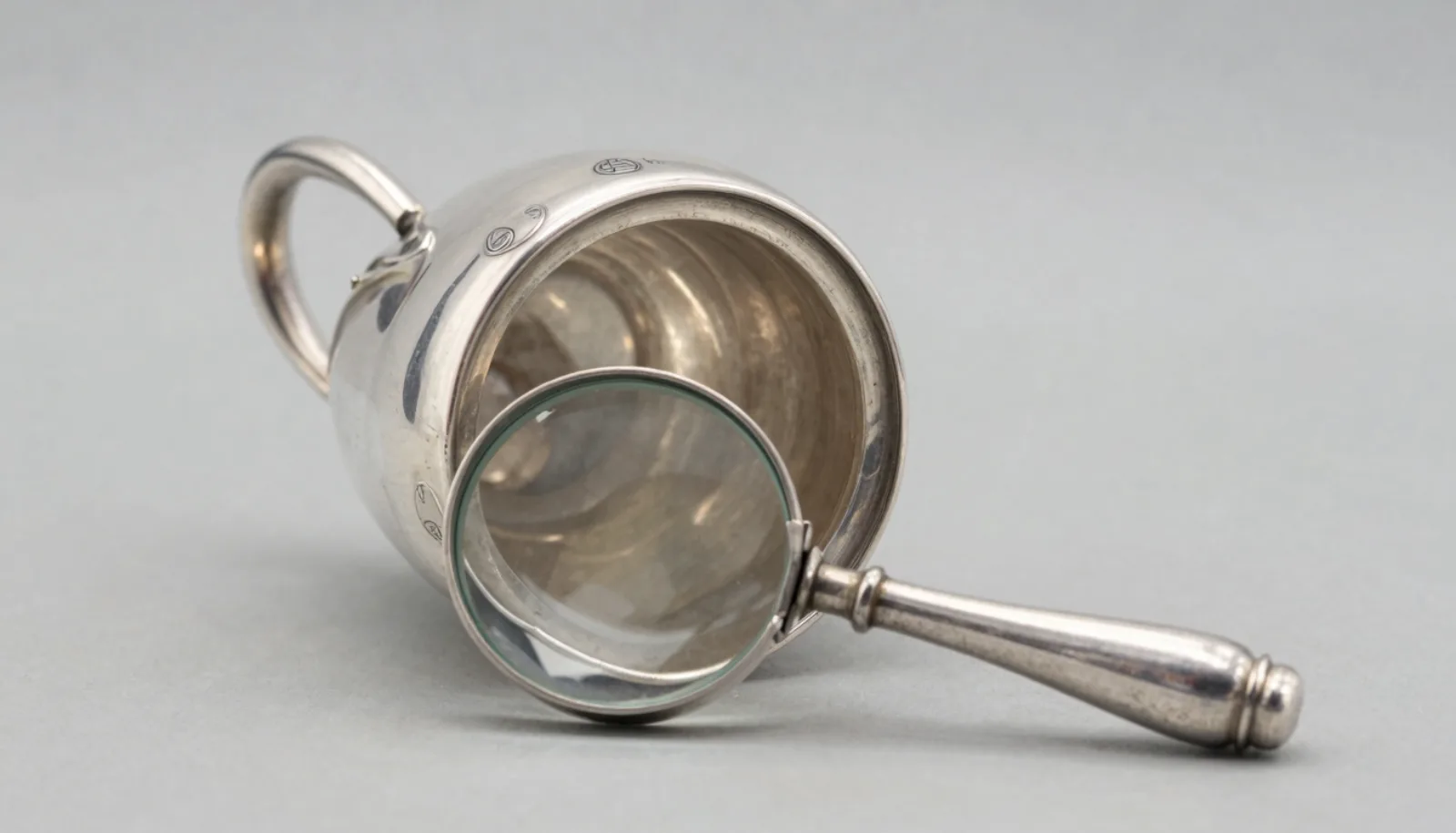
Here is what that looks like on a plain object. A Victorian sterling christening mug weighing 95 grams has a melt floor near 85 dollars at a spot of 30 dollars per troy ounce, a figure used throughout this guide purely as a worked example. Legible Birmingham marks and a readable 1878 date letter put it at 110 to 160 dollars in a general sale. The same mug with marks polished to a smear drops to 60 to 90 dollars, because the buyer is now paying for weight and gambling on everything else.
The multiplier is not fixed and never has been. On mass-produced Edwardian flatware the mark is worth perhaps 15 percent over scrap. On a rare provincial coffee pot it can be worth ten times the metal. The variable is not the mark’s quality but how much scarcity it manages to certify. For the arithmetic underneath all of this, see our breakdown of melt value versus collectible value, which sets out where the floor sits before any mark is read.
Museum collections make the point better than price guides do. The Victoria and Albert Museum catalogues its English silver by maker and assay year precisely because those two data points, both taken from the marks, are what define an object’s place in the record.
What do buyers read first when they pick up a piece?
Buyers read purity first, then city, then year, then maker, in that order and usually within ten seconds. The sequence is not arbitrary. Each mark answers a question that determines whether the next question is worth asking at all.
Purity comes first because it sets the floor. If the lion passant is absent and the piece reads EPNS or A1, the conversation ends at plate values and no amount of maker interest rescues it. If purity is confirmed, the town mark is next, because the assay office narrows both the market and the likely buyer. Only then does the date letter matter, and only then does the sponsor’s mark become worth chasing through the registers.
Any seasoned collector knows the fifth thing they look at is not a mark at all. It is the wear pattern around the marks. Marks sitting in a shallow dished area with soft edges suggest a piece polished hard for a century, which usually means monograms have gone too and the gauge is thinner than it should be.
| Mark | What it proves | Typical effect on a buyer’s offer |
|---|---|---|
| Lion passant | Sterling standard, 92.5 percent | Sets the floor; without it the piece is priced as plate |
| Town mark (anchor, leopard, castle) | Assay office and therefore likely region of manufacture | Scarce offices add 20-150 percent over common ones |
| Date letter | Year of assay, not year of design | Georgian dates add 30-100 percent over Victorian equivalents |
| Sponsor’s mark | The firm that submitted the piece for assay | Named workshops add 10 percent to 10 times, depending on the name |
| Sovereign’s head | Duty paid, so between 1784 and 1890 in England | Confirms period when the date letter is unclear |
| Import mark in an oval | Foreign manufacture, assayed on entry to Britain | Usually reduces the premium against a British equivalent |
The order matters commercially as well as practically. A dealer who confirms sterling has already decided their worst case is scrap, which means they can bid confidently. That confidence is itself worth money to you, because a bidder who cannot rule out base metal discounts for the risk.
Where the marks sit on the object is its own diagnostic. Spoons carry them on the back of the stem, teapots under the base, jugs near the handle terminal. A set of marks appearing somewhere unexpected is the single most common tell of a transposed mark. Our guide to identifying silver hallmarks step by step walks through the standard locations by object type.
The Metropolitan Museum of Art records mark positions in its silver catalogue entries for the same reason auction cataloguers do: placement is evidence, and evidence is what buyers are paying for.
How much does the assay office change what a piece is worth?
The assay office can change a piece’s value more than the maker does, because some offices closed early and left a finite supply behind. London and Birmingham struck millions of marks. York struck comparatively few and stopped in 1858. That difference is permanent, and the market has priced it in for over a century.
Scarcity here is not a matter of taste. It is arithmetic. Exeter closed in 1883, Newcastle in 1884, Chester held on until 1962. Every year an office stayed open added supply; every year it did not, the surviving pool stayed fixed while collectors kept entering the market. Provincial silver from the small offices is the clearest example of a hallmark carrying real, quantifiable money.
| Assay office | Town mark | Closed | Relative desirability |
|---|---|---|---|
| London | Leopard’s head | Still open | Baseline; deepest supply and deepest buyer pool |
| Birmingham | Anchor | Still open | Baseline to slightly below on common Victorian forms |
| Sheffield | Crown, then rose from 1975 | Still open | Baseline; strong on flatware and candlesticks |
| Edinburgh | Castle with thistle | Still open | 15-40 percent premium on Georgian pieces |
| Chester | Three wheatsheaves and sword | 1962 | 20-60 percent premium; strong regional following |
| Exeter | Three-towered castle | 1883 | 40-100 percent premium on Georgian domestic ware |
| Newcastle | Three separate castles | 1884 | 50-120 percent premium; small surviving output |
| York | Cross with five lions | 1858 | 80-200 percent premium; scarcest English town mark |
| Dublin | Crowned harp | Still open | 30-80 percent premium; distinct Irish collector base |
The percentages above compare like against like: the same object type, the same period, the same condition. A Newcastle tablespoon of 1790 will beat a London tablespoon of 1790 by a wide margin, but it will not beat a London coffee pot of the same year, because form still outranks office.
There is a practical trap here worth naming. Collectors chasing scarce offices are also the buyers most alert to faked town marks, and a poorly struck York lion attracts scrutiny that a London leopard never would. Scarcity raises both the ceiling and the level of proof demanded.
Scottish and Irish marks operate as their own markets rather than as premiums bolted onto the English one. Edinburgh silver sells strongly in Scotland, at auction and privately, in a way that does not always translate to a London saleroom. Regional demand is real money, and it explains why the same piece can fetch materially different figures 400 miles apart. Our UK hallmarks reference sets out each office’s marks side by side for comparison.
Dating matters here too, because an office’s premium is not constant across its life. Late Victorian Chester silver is common enough to trade near London prices, while Chester pieces from the 1720s are a genuinely thin market.
Which makers’ marks actually move money?
A handful of maker’s marks reliably multiply a piece’s value, and the rest add a modest premium at best. The names that move money are those with published scholarship, museum representation, and a documented auction record going back decades.
That last requirement is the one people underestimate. A workshop only commands a premium when buyers can check what similar pieces have fetched. Obscure but excellent provincial silversmiths often trade at little above generic prices, not because the work is inferior, but because no comparable sales exist to argue from.
| Maker | Active period | Mark | Typical premium over generic equivalent |
|---|---|---|---|
| Paul de Lamerie | 1712-1751 | PL under a crown, later LA in script | 10 to 50 times; also the most faked mark in English silver |
| Paul Storr | 1792-1838 | PS in a rectangle | 5 to 20 times on hollowware |
| Hester Bateman | 1761-1790 | HB in script | 3 to 8 times, strongest on small domestic pieces |
| Peter and Ann Bateman | 1791-1800 | PB over AB | 2 to 5 times |
| Omar Ramsden | 1898-1939 | OR with hand-raised finish | 4 to 15 times; Arts and Crafts demand |
| Liberty and Co (Cymric) | 1899-1927 | L and Co, Birmingham anchor | 3 to 10 times on designed pieces |
| Georg Jensen | 1904 onward | Jensen in a beaded oval | 3 to 12 times; global collector base |
| Gorham | 1831 onward | Lion, anchor, G | 1.2 to 3 times, pattern dependent |
| Tiffany and Co | 1837 onward | Tiffany and Co, Sterling | 1.5 to 4 times; the retail name carries weight |
| Unrecorded provincial maker | Various | Two-letter initials | 1 to 1.3 times; scarcity without documentation |
Notice how wide those ranges are. A Paul Storr teaspoon is a Paul Storr object but it is still a teaspoon, and form caps what any name can deliver. The multipliers land at the top of their range on ambitious hollowware and at the bottom on flatware.
The de Lamerie line in that table deserves its own warning. Because the name commands the highest prices in English silver, it attracts the most forgery, usually as a genuine mark cut from a damaged piece and let into a later object. Any de Lamerie mark should be assumed suspect until an assay office or a specialist says otherwise.
Retailer marks confuse this constantly. A piece stamped by a famous shop was frequently made by a workshop nobody has heard of, and the value follows the retailer’s brand rather than the actual hands that raised the metal. That is not a flaw in the market, merely a fact about it.
For American marks the logic is identical but the vocabulary differs, since there is no assay system to lean on. Our US hallmarks guide covers how quality marks and company stamps substitute for it. WorthPoint remains the most practical place to check what a specific maker and form has actually sold for.
Not sure what you’ve got?
Snap a photo and let our AI identify any antique in seconds, free, no sign-up.
Identify on iPhone →Learn More
When does a hallmark subtract value instead of adding it?
A hallmark subtracts value whenever it proves something the seller hoped was untrue. That happens more often than most people expect, and it is the reason experienced dealers look for marks before they look at the object.
The most common case is the import mark. A capital F in an oval, struck on British-assayed foreign silver after 1904, confirms the piece was made abroad. Buyers who wanted an English coffee pot will pay less for a German one wearing an English import stamp than for either an honest German piece or a genuine English one, because it satisfies neither collecting instinct fully.
Duty dodgers are a stranger case. These are pieces where a maker inserted marks cut from a small, already-assayed object into a large new one to avoid duty between 1784 and 1890. The marks are genuine. The application is fraudulent. When a buyer spots the seam of a let-in mark, value collapses to somewhere near scrap regardless of how good the piece is, because the object cannot be sold with a clear description.
Then there are the quiet subtractions:
- Rubbed marks. Illegible marks force the buyer to price for uncertainty, typically costing 25-45 percent against a legible equivalent.
- Erased marks. A smoothed patch where marks should be raises the question of what was removed, and why. Assume a heavy discount.
- Struck-over marks. A re-assayed piece is legal but complicated, and complication costs money at auction.
- Marriage pieces. Two sets of marks from different years on one object signals a lid or base joined from another piece. Expect 40-70 percent off.
- Contradictory marks. A date letter that does not belong to the town mark’s cycle is the classic tell of a fake, and dealers walk away rather than investigate.
Weighted and loaded pieces are the subtraction most sellers get wrong. Candlesticks and dressing table sets are frequently sterling shells filled with pitch or plaster. The hallmark is entirely genuine, the piece is entirely sterling, and the actual metal weight is perhaps a fifth of what the scales say. Sellers who calculate value from gross weight are usually disappointed by their first real offer. Our note on what old silver spoons and small pieces are actually worth covers where weight-based estimates go wrong.
Condition interacts with marks in one more way that catches people out. Removing a monogram thins the metal near the mark, and a piece that has been through that process often shows a slightly wavy surface under raking light. The marks are perfect. The object is compromised. Buyers price the object, not the stamp.
Auction houses signal all of this in their catalogue language. A lot described as “bearing marks for London 1785” rather than “London 1785” is a cataloguer telling you the marks are present but not being warranted, which is a discount you should read before you bid. Kovels maintains useful background on how such descriptions map to realised prices.
How do dealers price a marked piece against melt?
Dealers start from melt and work upward, because melt is the only number they can be certain of. Everything above the metal floor is an estimate of what someone else will pay, discounted for the time and risk of finding that person.
The mechanics are straightforward. Sterling is 92.5 percent fine, so at a worked example spot of 30 dollars per troy ounce, a gram of sterling contains roughly 0.89 dollars of silver. Refiners pay 85 to 92 percent of that. A dealer buying to resell at retail typically offers 40 to 60 percent of what they expect to achieve, which sounds harsh until you account for the months a piece can sit and the cost of the sale.
| Object | Typical weight | Approximate melt at the example spot | Common marked retail range |
|---|---|---|---|
| Georgian tablespoon, 1790s | 60-70 g | 53-62 dollars | 90-180 dollars |
| Victorian christening mug | 90-110 g | 80-98 dollars | 110-220 dollars |
| Edwardian six-piece cruet frame | 220-300 g | 196-267 dollars | 250-450 dollars |
| Georgian coffee pot, provincial office | 700-900 g | 623-801 dollars | 1,800-6,000 dollars |
| Weighted candlestick pair | 900 g gross, 180 g actual | 160 dollars | 300-700 dollars |
| Canteen of 44 pieces, Victorian | 2,000-2,600 g | 1,780-2,314 dollars | 2,200-4,500 dollars |
Look at the coffee pot line. The gap between melt and retail is where hallmark information lives. A provincial town mark and a Georgian date letter are doing all the work, and neither is visible from across a room. That is precisely why so much good silver gets sold at scrap prices by people who never read the base.
The canteen line shows the opposite lesson. On mass-market Victorian flatware the retail range hugs melt, because supply is enormous and demand for full canteens has been soft for a generation. A hallmark on a common pattern certifies the metal and little else. Our guide to sterling silver flatware values sets out which patterns escape that trap.
The practical takeaway for a seller is to price the information, not the object. Establish purity, city, year, and maker before you accept an offer, and get all four in writing when you sell. A buyer who receives that information rather than having to discover it will pay closer to the top of the range, because you have removed their risk.
If you want to sanity-check a number, look at completed sales rather than asking prices, and match on form and period rather than on the word “antique”. Comparable evidence is the only defence against both optimistic guides and lowball offers, and our overview of what grandma’s silver is really worth walks through that process on a typical inherited box.
What should you do before you sell a marked piece?
Before you talk to anyone, be certain what the marks say. If the stamps are small or worn, reading them from a photograph is faster and less error-prone than matching them by eye — we compare the apps that read silver hallmarks on price and on which mark types each one actually handles.
Read the marks before you take a single offer. A seller who can state purity, city, year, and maker is negotiating; a seller who cannot is accepting.
The sequence below takes about twenty minutes per piece and consistently recovers more than it costs in time. It also protects against the opposite error, which is holding out for a premium on a piece that genuinely is common Victorian flatware.
- Photograph the marks properly. Raking light from one side, a plain background, and the camera as close as it will focus. Marks read best when the shadow inside the punch does the work.
- Establish purity first. Lion passant, 925, 800, 830, or a plate mark such as EPNS. This decides which market you are in.
- Identify the town mark. Match the shape of the shield as well as the device; worn marks often keep their outline when the detail has gone.
- Date the letter against the correct cycle. Font and shield shape distinguish one cycle from another, and getting the century wrong is the most expensive common mistake.
- Attribute the sponsor’s mark. Two letters in a shaped punch, checked against the register for that office.
- Weigh the piece and note whether it is loaded. Tap the base; a filled candlestick sounds dead rather than ringing.
- Find three completed sales of the same form, period, and office. Not asking prices.
Do not clean anything beyond a wipe. Polishing before a sale is the single most reliable way to lose money on silver, because it removes patina that buyers read as originality and can soften marks that were perfectly legible. Dealers routinely pay less for a piece that has just been buffed than for the same piece left alone.
Choose the channel to match the value. Under 200 dollars, a local dealer or general auction is usually right, since specialist fees and shipping eat the difference. Between 200 and 2,000 dollars, a regional saleroom with a silver specialist tends to outperform. Above that, a specialist silver sale earns its commission, because the buyers who pay maker premiums are the ones on that mailing list.
Keep the evidence with the object. A short note recording the marks, the attribution, and where you checked it travels with the piece and adds real value at resale, in the same way provenance does for any antique. The Smithsonian treats mark documentation as part of an object’s record rather than as an afterthought, and a private seller loses nothing by adopting the same habit.
One last thing worth saying plainly. Most inherited silver is worth less than families hope and more than dealers first offer, and the gap between those two numbers is almost entirely a matter of who read the marks. That is the whole answer to what a hallmark is worth.
Frequently Asked Questions
Is there an app that tells me what a silver hallmark is worth?
Antique Identifier – Antiqly reads the marks from a photo and returns the purity, the likely assay office, the date letter, and an estimated value range for the piece in front of you. The download is free and there is no sign-up before your first identification, which matters when you are standing at a fair and need an answer in seconds. Its strength on silver is the value step: it pairs the mark reading with comparable sales rather than stopping at the attribution. Treat the range it gives as a negotiating floor rather than an appraisal, and confirm anything above a few hundred dollars with a specialist before you sell.
Does a hallmark guarantee my silver is valuable?
No. A hallmark guarantees purity, not value. A lion passant confirms 92.5 percent silver and sets a metal floor, but a common Victorian teaspoon with perfect marks is still worth 15 to 30 dollars because millions were made. Value comes from the combination of purity with scarcity: an unusual assay office, an early date, a documented maker, or an ambitious form. Roughly 80 percent of the marked British silver that comes through a general saleroom sells within 40 percent of its melt value. The marks tell you which category you are in, which is genuinely useful, but they are a starting point rather than a verdict.
How much do worn or rubbed hallmarks reduce the price?
Illegible marks typically cost 25 to 45 percent against an identical piece with crisp marks, and considerably more on anything where the maker was carrying the value. The discount reflects risk rather than aesthetics. A buyer who cannot read the date letter cannot verify the period, cannot match auction comparables, and cannot describe the lot safely at resale, so they price for the worst plausible case. Partial marks help more than people expect: a legible town mark and lion passant with a worn date letter still narrow a piece to a city and a standard, which recovers a good share of the loss.
Why do Exeter and York marks sell for more than London ones?
Because those offices closed and the supply stopped. York ceased assaying in 1858, Exeter in 1883, and Newcastle in 1884, while London and Birmingham struck marks continuously into the present. The surviving pool of provincial pieces is fixed and small, and collectors specialising in a single office compete for the same objects. On comparable Georgian domestic ware, Exeter commonly carries a 40 to 100 percent premium over London and York can exceed 200 percent. The premium is largest on everyday forms such as spoons and mugs, where the London equivalent is genuinely abundant, and smallest on grand hollowware where form dominates.
Should I clean my silver before selling it?
No, beyond a soft dry wipe to remove dust. Polishing is the fastest way to reduce what a marked piece fetches. Silver polish is an abrasive, and every application removes a thin layer of metal, softening the edges of the punches that carry the attribution. It also strips the darkened patina from recesses and engraving, which experienced buyers read as evidence that a piece is original and unrestored. Dealers regularly discount freshly buffed silver by 10 to 20 percent for exactly this reason. If tarnish is obscuring the marks, photograph them under raking light instead; the shadow inside the punch usually reads better than a polished surface.
Is a marked silver piece always worth more than its melt value?
Almost always, but the margin is often thin. Legible marks reliably add something because they remove the buyer’s uncertainty about purity, and that certainty alone is worth 10 to 20 percent over an unmarked piece of the same weight. The exceptions are pieces that are badly damaged, heavily repaired, or loaded with pitch so the gross weight misleads. A weighted candlestick pair can show 900 grams on the scales while containing 180 grams of silver. Damaged pieces with split seams or replaced parts sometimes sell below melt, because the refiner’s cost of processing an assembled object is higher than for plain scrap.
Identify any antique in seconds.
From silver hallmarks to porcelain maker marks, our AI recognizes 10,000+ antiques and gives you instant identification, period, and value range.