
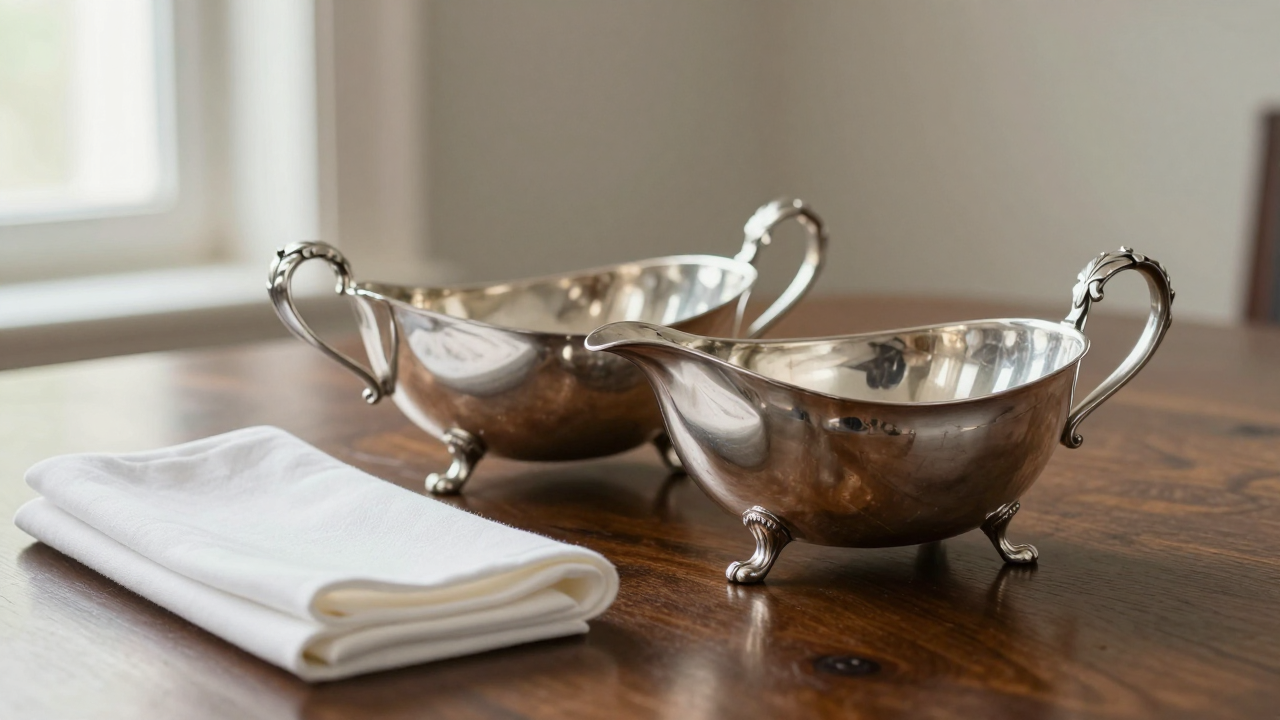
Silver sauce boat value tracks maker and decoration: pairs made £250 to £3,315 with premium at Bonhams, 2012 to 2025. Date yours by its feet, then its marks.
This guide dates British silver sauce boats by shape first and by hallmark second, then sets them beside dated saleroom results. The shapes and their history come from Victoria and Albert Museum records, including a double-lipped sauce boat by Anne Tanqueray dated 1726-7. Mark rules come from the Goldsmiths’ Company.
Values come from Bonhams lot pages dated 2012 to 2025, each linked with its sale date, and every figure includes the buyer’s premium. Lots that mixed sauce boats with unrelated silver are left out, because the boats’ share of the price can’t be separated. Unsold lots and dealer asking prices are left out too, since an estimate or an asking price isn’t a sale. None of the boats was handled for this guide; marks and condition come from the catalogue or museum record.
How do you date a silver sauce boat by its shape?
A sauce boat’s shape narrows its date before you read a single mark: two spouts point to the 1720s, three feet to about 1735 to 1800, and a lidded tureen to the years around 1800. In the 1760s and 1770s three-footed and oval-footed boats were made side by side. Its marks then confirm or correct that first guess.
The Victoria and Albert Museum’s Sprimont sauce boat record explains where the form came from. According to that record, the form arrived in Britain from the French court in the early 18th century, the Jewel Office supplied an early pair to the 2nd Duke of Argyll in 1719, and the first boats were double-lipped. Single-lip forms became more popular after 1730.
| Shape | Typical period | Dated example |
|---|---|---|
| Two spouts, two handles, stepped foot | 1720s | Anne Tanqueray, London 1726-7 |
| One spout, flying scroll handle, three feet | about 1735 to 1800 | Thomas Whipham, London 1743 |
| One spout, oval pedestal foot, gadroon rim | about 1765 to 1780 | William Sumner, London 1766 |
| Lidded sauce tureen on a foot or four feet | about 1780 to 1820 | Abstainando King, London 1810 |
| Rococo revival, four scroll feet | Victorian | John Samuel Hunt, London 1843 |
Treat the table as a starting point, not a rule. The V&A’s notes on its porcelain sauce boats say mid-18th-century boats had one or two lips and later ones were often tureen-shaped with a central foot, and both types could need a stand.
Silversmiths didn’t switch styles on a fixed date. Bonhams has sold three-footed boats hallmarked London 1759, Dublin 1764 and London 1774, plus a Dublin boat of about 1775 and a worn RW pair of about 1800. So in the 1760s and 1770s a three-footed boat and an oval-footed one can be the same age. The rococo boats of the 1840s copy the 1740s, which is why the marks always get the last word.
How do you read the marks on a sauce boat?
Turn the boat over and start underneath the body, then check the foot and the handle. Museum and saleroom records cited here list which marks a boat carries but rarely say where they’re struck, so search every flat surface before you call a boat unmarked.
Work through the marks in this order and write each one down before you open a reference table.
- Photograph the marks in low side light, one sharp image per punch. The Goldsmiths’ Company tracing guide says identification depends on the finer details of each mark, so a description from memory won’t do.
- Find the standard mark. On English sterling it’s the lion passant: the V&A lists a “sterling standard lion passant” among the marks on the Tanqueray boat. The Goldsmiths’ Company explains this kind of mark as the traditional fineness mark, the sign of the metal’s standard. A Dublin boat shows a crowned harp instead, as the guide to Dublin hallmarks explains.
- Identify the town mark. On the Tanqueray boat it’s London’s leopard’s head. Among the town marks in use today, the Goldsmiths’ Company lists an anchor for Birmingham and a castle for Edinburgh, but some offices changed their mark or closed, so check the period table before you match an older boat. Most of the Georgian boats in the value table below carry London marks.
- Read the date letter with its shield shape, and only against the table for the office you found; the silver marks guide points to each office’s charts. Today the letter changes on 1 January, but in the 18th century London changed it in late May: the V&A dates Tanqueray’s letter M from 29 May 1726 to 28 May 1727.
- Check for a sovereign’s head. A boat with the duty head was marked between 1784 and 1890, and the sovereign’s head explainer shows which monarch you’re looking at.
- Read the sponsor’s mark last. It names whoever sent the boat for assay, which the Goldsmiths’ Company says is normally the maker.
Two habits lead to misreadings. One is reading a pair as one object. The V&A holds a pair of shell-shaped boats by David Willaume with different date letters: one boat carries London hallmarks for 1737-38 and its partner those for 1738-39. Check both boats and record each letter separately.
Trusting the shape over the letter is the other habit. Victorian makers copied earlier forms, so a rococo boat on four scroll feet, like Hunt’s 1843 pair below, can pass for 1740s work. When shape and letter disagree, recheck the shield shape and office, then accept the mark if it holds.
To read the marks on your own piece, Antique Identifier - Antiqly identifies a hallmark from a photo, on iPhone and Android.
Who made it, and who owned it?
The sponsor’s mark tells you who submitted the boat for assay, and the engraving on its side tells you who owned it. Both affect value, but only the mark is evidence of who made it.
The top result among these Bonhams sales came from a named maker. Bonhams’ Victorian pair by John Samuel Hunt, stamped HUNT & ROSKELL LATE STORR, MORTIMER & HUNT, made £3,315 in April 2023. That retailer’s stamp sits alongside the sponsor’s mark rather than replacing it, so read both.
A tentative attribution is worth recording too. Bonhams catalogued a London 1759 pair as “possibly” by Alexander Johnston, and the Johnston pair made £250 with premium in June 2018. At 8.9oz for the pair, that’s about £28 an ounce, level with the worn RW pair.
Armorials are the other clue. The 1776 London sauceboat sold by Bonhams carries an engraved armorial for Joseph Sykes (1723-1805), whose dates fit the hallmark. A crest catalogued as “possibly later”, as on the worn RW pair sold in June 2025, is a different case. Engraving added after the boat left the workshop doesn’t tell you about its first owner, so check the engraving style against the date letter before you rely on it.
Irish boats need their own reading. Bonhams sold a pair of Dublin boats from about 1750 with no date letter and a maker’s mark read as possibly WT, for William Thompson or William Townsend. Without a letter, the catalogue fell back on style and a “circa” date.
Which signs point to a problem?
Rubbed marks, a crest added later, a missing date letter and plated metal all change what you can claim about a boat. None proves a fake on its own, but each one lowers how firmly you can date or price it.
Rubbed marks tend to cost the maker’s name before the date. Bonhams sold the 1776 London boat with its maker’s mark rubbed, so the date reads but the maker can’t be named. The late 18th or early 19th century RW pair was sold as “marks worn”, which is why its date is a span rather than a year.
Marks that imitate English hallmarks are a known trap. In April 2016, Bonhams offered a double-lipped sauceboat on stand as 19th century European silver, with the stand “marked with pseudo English hallmarks and ‘830’”. An 830 standard is below sterling, and the double lip copies the 1720s form, so shape and marks together pointed away from a Georgian date.
Transposed marks are also recorded. The V&A notes that the marks on its Willaume pair “may have been transposed”, meaning they may have been cut from another piece and let in. A faint seam or a darker outline around the mark is the thing to look for.
Unmarked silver needs care. Bonhams sold a cowrie shell sauce boat with silver mounts as “unmarked, probably George III circa 1760”, for £612 in April 2023. Without marks, the catalogue dated it by style alone, and you can’t do better than that from a photograph.
Plated boats copy the shapes in the table, so shape alone can’t tell you it’s silver. Letters such as EPNS, a maker’s trade name in shields, or a row of marks without a lion passant point to plate, and the five visible differences from sterling help you separate the two.
Also look at the joins where the feet and handle meet the body. A seam or solder line that doesn’t match its partner on the other side is worth a closer look. If the hallmark sits close to a repair, ask a silver specialist to look before you assume the boat is all of one date.
What are antique silver sauce boats worth?
Single all-silver Georgian sauce boats made £275 to £446.25 with premium at Bonhams, and pairs made £250 to £3,315. Maker, decoration and condition explain the spread far better than weight does. The silver-mounted cowrie shell boat that made £612 sits outside these figures, because most of it is shell rather than silver.
| Boat and marks | Weight | Result | Per oz |
|---|---|---|---|
| Pair, J S Hunt, London 1843, rococo | 34.8oz | £3,315, Bonhams, April 2023 | £95 |
| Pair, Dublin c.1750, possibly WT | 24.38oz | £2,250, Bonhams, November 2012 | £92 |
| Pair of sauce tureens, A. King, London 1810 | 58oz | £2,040, Bonhams, July 2021 | £35 |
| Pair, John Carter, London 1772 | 32.9oz | £1,147.50, Bonhams, April 2023 | £35 |
| Pair, William Sumner, London 1766 | 31.2oz | £1,147.50, Bonhams, April 2023 | £37 |
| Pair, possibly H.A, London 1774 | 26.5oz | £956.25, Bonhams, April 2023 | £36 |
| Pair, RW, marks worn, c.1800 | 20.02oz | £563.20, Bonhams, June 2025 | £28 |
| Single, maker rubbed, London 1776 | 14.3oz | £446.25, Bonhams, April 2023 | £31 |
| Single, TW, Dublin 1764, embossed | 5.4oz | £437.50, Bonhams, June 2018 | £81 |
| Single, Matthew West, Dublin c.1775 | 4.5oz | £318.75, Bonhams, July 2021 | £71 |
| Single, Morson & Stephenson, London 1774 | 14.5oz | £275, Bonhams, December 2012 | £19 |
| Pair, possibly A. Johnston, London 1759 | 8.9oz | £250, Bonhams, June 2018 | £28 |
All results include the buyer’s premium. Weights for pairs cover both boats together, and the per-ounce figure is the result divided by that weight, rounded.
The per-ounce column sorts the boats into three groups. Plain London pairs of the 1760s and 1770s cluster at £35 to £37 an ounce, so their value sits close to their weight. Small Dublin boats with embossed or punched decoration reached £71 to £81 an ounce. The top two reached £92 to £95 an ounce: a pair with a named maker, Hunt in 1843, and an early Dublin pair engraved with an armorial, catalogued as possibly WT.
Results from 2012 are older than the rest, so treat them as a guide to the order of value rather than today’s level. To see why early Georgian pieces sell above later ones, read why Georgian silver sells. If you’d rather have a phone read your boat’s maker’s mark first, the site’s page to compare hallmark reading apps sets out the options.
What should you do with your sauce boat now?
Three steps turn a boat you can’t place into a record you can check and compare.
- Photograph the marks under the body, both sides, the handle joins and the feet, and weigh the boat on a kitchen scale. Convert grams to troy ounces by dividing by 31.1, so a 450g boat is about 14.5oz.
- Write down your reading: shape, standard mark, town, date letter, duty head and sponsor, plus any crest. Check that the shape fits the date letter and that the engraving style fits both.
- Divide a comparable result by its weight and compare per ounce, not by look. If your boat has a known maker’s name, embossed decoration or a crest you can trace, show the photographs to an auction house silver department before you clean or sell it.
Don’t polish the marks while you wait. Polishing softens punch edges, and the shield shape around a date letter is often what separates one letter cycle from another.
Method and limits. Shapes and their origin come from Victoria and Albert Museum records, including the dated Tanqueray sauce boat. Mark rules come from the Goldsmiths’ Company. Values are Bonhams lot pages from 2012 to 2025, read on 20 October 2026; unsold lots and dealer asking prices are left out. No boat was handled for this guide, and nothing here is a valuation of your piece.
Can a phone app help read a sauce boat?
If a maker’s mark is visible, Antique Identifier - Antiqly on iOS and Android describes it and gives its interpretation with a confidence level, which is a lead to check against the right office’s date table, not an appraisal.
Frequently asked questions
Frequently asked questions
How do I know how old my silver sauce boat is?
Start with the shape: two spouts suggest the 1720s, three feet about 1735 to 1800, and an oval pedestal foot about 1765 to 1780, when both shapes were made. Then read the date letter under the body against the table for its assay office, and let the mark settle the date when it disagrees with the shape.
Where are the hallmarks on a sauce boat?
Check underneath the body first, then the foot and the handle. The records cited here rarely say where the marks sit, so search every flat surface, and check both boats in a pair, because each was marked separately and the letters can differ.
Is a sauce boat worth more than its weight in silver?
Among these Bonhams results, the premium over weight varied widely. Plain London pairs from the 1760s and 1770s sold near £35 an ounce at Bonhams in 2023, while a Victorian pair by John Samuel Hunt made about £95 an ounce in the same sale.