
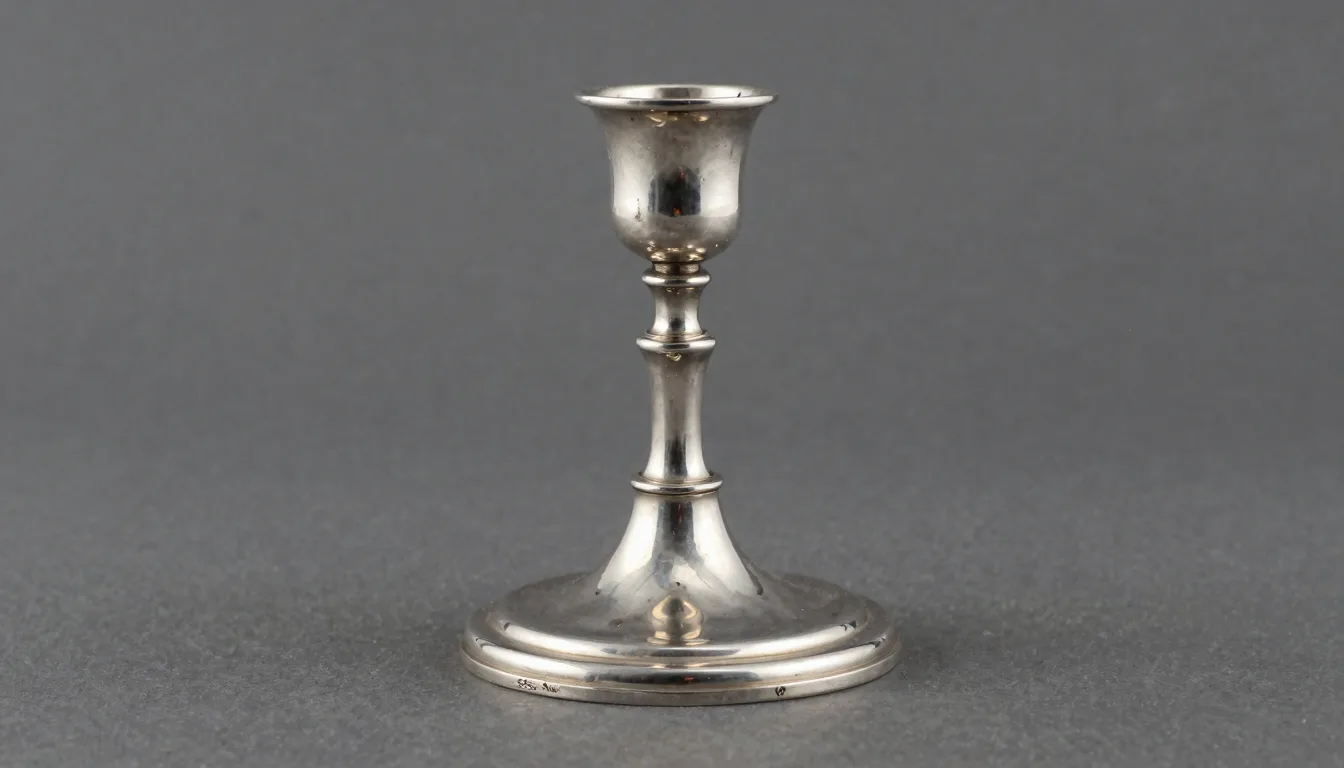
Antique silver candlesticks are identified by hallmarks on the foot rim and valued by maker, weight, and cast-versus-loaded construction.
How to identify an antique silver candlestick
Identification starts with the foot. Nearly every antique silver candlestick carries its hallmarks on the underside of the foot or around the foot rim. Tip the piece over and look for a row of small stamped symbols.
On Georgian and Victorian sticks, the marks often sit on the flat outer edge of the base. Cast candlesticks were usually punched on the foot rim before the parts were assembled. If the base is a separate loaded plate, examine the corner of that plate too.
A genuine sterling candlestick shows four or five separate punches. You should find a purity mark, a town mark, a date letter, and a maker’s mark. British pieces from 1784 to 1890 add a monarch’s head duty mark. Learning where hallmarks are located on holloware saves hours of guesswork.
Any seasoned collector knows the first tell is weight in the hand. A cast sterling stick feels dense and cold. A loaded stick feels light for its size, because the column is a thin silver shell filled with pitch and plaster over an iron rod.
Look next at the sockets. The cup that holds the candle is the socket, and the removable dish that catches wax is the bobeche or sconce. On a quality pair, the bobeches carry their own small hallmarks that match the base. Mismatched or unmarked bobeches suggest a later replacement.
Study the column and knopped stem. Hand-raised and cast Georgian columns show crisp, deep detail. Those slightly uneven rim details and soft casting seams are classic signs of eighteenth-century hand finishing, not flaws.
Check for a pattern number or a scratch weight. Some makers, especially in Sheffield, scratched the troy weight of the silver into the base. A scratch weight confirms the piece was sold by weight as solid silver.
Photograph the marks under raking light before you try to read them. A phone torch held low across the punches throws the symbols into relief. For the full process, our step-by-step identification guide covers lighting, magnification, and reference charts.
Weigh the whole candlestick and note the figure. That number matters later when you separate a solid cast piece from a filled one. A single Georgian cast stick can hold 300 to 500 grams of actual silver. A loaded Victorian stick of the same height might contain barely 90 grams of thin sterling around a heavy filler.
Cast versus loaded: the single biggest value factor
Construction decides value more than age does. Two candlesticks from the same year and town can differ tenfold in price based on how they were made. The two methods are cast and loaded.
A cast candlestick is solid silver poured into a mould, then chased and assembled. All the metal you see is silver you own. These pieces are heavy, repairable, and hold their bullion value. Most fine eighteenth-century sticks were cast.
A loaded candlestick, also called filled or weighted, uses a thin stamped sheet of sterling formed into the shape. The hollow shell is packed with plaster, pitch, or resin around an iron rod for stability. The silver content is small, often under a third of the total weight.
Loading became common after 1770. Sheffield and Birmingham makers used rolled sheet silver and mechanical stamping to produce affordable candlesticks. By the Victorian era, most retail candlesticks were loaded. They look impressive but carry little scrap value.
Here is how the two compare on the details collectors care about:
| Feature | Cast (solid) | Loaded (filled) |
|---|---|---|
| Weight in hand | Heavy, dense | Light for its size |
| Base | Solid silver, thick | Green baize over a filled plate |
| Silver content | 90 to 100 percent | 20 to 35 percent |
| Repairability | Excellent, resolders cleanly | Poor, filler melts |
| Typical era | 1700 to 1800 | 1770 onward |
| Value driver | Bullion plus craft | Craft and looks only |
Tap the base gently. A cast base rings, while a loaded base gives a dull thud because of the filler behind it. Feel the underside too. Loaded sticks almost always have a felt or baize disc glued over the plaster to hide the filling.
Never melt or aggressively polish a loaded stick. The filler expands with heat and can split the thin silver skin. A dented loaded column is difficult to restore, because there is no solid metal to push against.
A weighted Victorian pair might sell for 150 to 300 dollars. A cast Georgian pair of similar height can bring 1,500 to 4,000 dollars, because the silver alone is worth hundreds. This gap explains why serious buyers weigh a candlestick before they admire it.
Reading the hallmarks on silver candlesticks
The hallmark set tells you country, city, year, and maker. British sterling uses a strict system that has run since the fourteenth century. Read the punches left to right like a sentence.
The lion passant, a walking lion in profile, certifies English sterling at 925 parts per thousand. Scottish and Irish pieces use different standard marks, such as the thistle or the crowned harp. The lion passant and the UK system form the most reassuring marks on a British candlestick.
The town mark names the assay office. A leopard’s head means London. An anchor means Birmingham. A crown, used until 1975, means Sheffield silver, the city that produced more candlesticks than anywhere else in Britain.
The date letter is a single stamped letter in a shaped shield. Each assay office ran its own cycle, so the same letter means different years in different cities. The font and shield shape narrow the exact year. A Gothic capital in a court-shaped shield can pin a piece to a single twelve-month period.
The maker’s mark shows the silversmith’s initials. Ebenezer Coker, John Café, and William Café dominated London candlestick production in the mid-1700s. Matthew Boulton and John Fothergill led Birmingham after 1773.
The duty mark, a small monarch’s head, appears on British silver from 1784 to 1890. It confirms the silver tax was paid. George III, George IV, William IV, and Victoria each appear in profile, another quick dating clue.
Foreign candlesticks use their own systems. French sterling carries the Minerva head at 950 standard. German pieces show a crown and crescent moon with an 800 or 835 number. American sterling simply reads STERLING or 925, sometimes beside a maker such as Gorham or Tiffany.
Worn marks are common on candlesticks, because the foot rim rubs against tables for centuries. If the punches are soft, tilt the piece under raking light and use a 10x loupe. Even a partial town mark plus a legible date letter can date the piece within a few years.
When the marks resist reading, an app or a reference book bridges the gap. Trusted references such as Kovel’s list thousands of maker’s marks with dates. Match the initials, the town, and the date letter together, never one mark alone.
Antique silver candlestick styles by period
Style dates a candlestick almost as reliably as its date letter. Each era favored a recognizable silhouette. Learn the shapes and you can place an unmarked stick within fifty years.
Early Georgian sticks, from roughly 1710 to 1750, are cast and architectural. They use faceted knopped stems, shell corners, and heavy square or shaped bases. These rank among the most valuable candlesticks on the market.
Rococo candlesticks of the 1750s and 1760s abandon symmetry. Expect asymmetrical scrolls, cast leaves, and shell motifs. William Café built his reputation on this exuberant style, and his pieces still command strong prices.
Neoclassical sticks from 1765 to 1800 return to order. Columns imitate Corinthian and Doric pillars, with fluted stems and square stepped bases. Matthew Boulton mass-produced elegant loaded versions in Sheffield and Birmingham.
The Regency period, 1800 to 1830, grew heavier and more ornate. Paul Storr produced cast candlesticks with bold gadrooning and lush foliage for royal and aristocratic clients. A Storr pair is a five-figure object today.
Victorian candlesticks, 1837 to 1901, mix revival styles. You see Gothic, rococo revival, and naturalistic designs together. Most are loaded, though the best cast examples still perform well at auction. Museum collections such as the Metropolitan Museum of Art display dated candlesticks from each period for direct comparison.
This timeline sums up the visual clues and typical values:
| Period | Years | Look | Typical value (pair) |
|---|---|---|---|
| Early Georgian | 1710 to 1750 | Cast, faceted, architectural | 2,000 to 8,000 dollars |
| Rococo | 1750 to 1765 | Asymmetric scrolls, shells | 1,500 to 6,000 dollars |
| Neoclassical | 1765 to 1800 | Columns, fluting, loaded | 400 to 2,500 dollars |
| Regency | 1800 to 1830 | Heavy gadrooning, cast | 1,200 to 15,000 dollars |
| Victorian | 1837 to 1901 | Revival mix, mostly loaded | 200 to 1,500 dollars |
Height matters within every period. A pair of tall dinner candlesticks over 12 inches sells for more than short bedroom sticks. Branched examples, called candelabra, multiply value further.
Original bobeches and matching pairs raise the price. A broken or married pair, meaning two similar but non-matching sticks sold together, drops sharply. Serious collectors chase true pairs with matching date letters.
Not sure what you’ve got?
Snap a photo and let our AI identify any antique in seconds, free and no sign-up.
Identify on iPhone →Learn MoreMakers that command a premium
A maker’s name can double a candlestick’s value overnight. Certain silversmiths defined the form, and their marks turn a nice pair into an investment piece. Know the leading names.
Paul Storr sits at the summit. Working in London from 1792 to 1838, Storr supplied the royal goldsmiths Rundell, Bridge and Rundell. His cast candlesticks show flawless chasing. A genuine Storr pair regularly clears 8,000 dollars and can reach five figures.
Matthew Boulton industrialized quality. From his Soho works near Birmingham, Boulton produced crisp neoclassical sticks after 1773. His pieces are more available and start around 1,000 dollars for a good loaded pair.
Ebenezer Coker specialized in candlesticks in London through the 1740s to 1760s. His cast sticks are sturdy, elegant, and highly collectable. Expect 1,500 to 4,000 dollars for a clean Coker pair.
The Café brothers, John and William, dominated mid-century London casting. Their rococo sticks are prized for lively detail. American collectors especially seek them out.
In the United States, Gorham and Tiffany lead. Gorham weighted sterling candlesticks from the late 1800s are common but well made. Tiffany examples carry a premium simply for the name.
These makers compare as follows:
| Maker | Active | Country | Signature | Pair value |
|---|---|---|---|---|
| Paul Storr | 1792 to 1838 | England | Cast, royal quality | 8,000 to 40,000 dollars |
| Ebenezer Coker | 1740s to 1760s | England | Sturdy cast sticks | 1,500 to 4,000 dollars |
| William Café | 1750s to 1770s | England | Rococo casting | 1,200 to 5,000 dollars |
| Matthew Boulton | 1773 onward | England | Neoclassical, loaded | 800 to 3,000 dollars |
| Gorham | 1860s onward | USA | Weighted sterling | 200 to 900 dollars |
Verify the mark against the date. Fakers sometimes add a Storr punch to a lesser stick. If the maker’s mark does not agree with the town and date letter, the piece is wrong.
Provenance adds value on top of the maker. An old auction receipt, an engraved family crest, or a documented country house history all help. A crest can also date a piece through heraldry when the hallmarks are worn.
What antique silver candlesticks are worth today
Value comes down to four questions. Is the piece cast or loaded? Who made it? Is it a matching pair? And how tall is it? Answer those and you can estimate a price within a sensible range.
Loaded Victorian and Edwardian pairs form the entry level. Expect 150 to 400 dollars for a clean pair of stamped sterling sticks with intact bobeches. Damaged filler or a leaning column pushes the price toward scrap.
Cast Georgian pairs sit in the middle and upper market. A good London or Sheffield cast pair from 1740 to 1790 brings 1,500 to 4,000 dollars. Height above 11 inches and crisp detail push toward the top of that band.
Named makers and Regency casting reach the highest tier. A Paul Storr or Rundell pair starts around 8,000 dollars. Documented sets of four candelabra can exceed 30,000 dollars at a major auction house.
Single candlesticks are worth far less than half a pair. The market prizes matched pairs, so a lone stick often sells for a third of a pair’s value. Keep pairs together whenever you can.
Online price guides help you benchmark. Auction records on WorthPoint and museum references at the Victoria and Albert Museum show what comparable pieces achieved. Always compare sold prices, not asking prices.
Condition adjusts every figure. Splits at the socket, replaced bobeches, removed crests, and re-soldered joints all reduce value. A discreet repair is acceptable, while a crude one is not.
Bullion sets the floor for cast pieces. At a silver spot price around 30 dollars per troy ounce, a 400 gram cast pair holds roughly 350 dollars in metal before any collector premium. That floor is why cast always beats loaded.
Regional demand shifts prices too. Georgian English sticks sell strongly in the United Kingdom and the United States. Continental candlesticks with 800 or 835 marks trade lower in English-speaking markets despite equal craftsmanship. Sell where your style has an audience.
Before you list a piece, get the marks read first. Knowing the maker and date can add hundreds to the result. A quick scan with a hallmark app, cross-checked against a reference, gives you a defensible starting figure.
Sterling, Sheffield plate, and modern silver plate
Not every shiny candlestick is solid silver. Three materials look similar at a glance: sterling, old Sheffield plate, and modern electroplate. Telling them apart protects your wallet.
Sterling is solid silver at 925 parts per thousand, and it is always hallmarked in Britain. Every genuine British sterling candlestick carries the lion passant, a town mark, and a date letter. No hallmarks usually means no sterling.
Old Sheffield plate, made from about 1740 to 1840, fuses a thin sheet of silver onto a copper core by rolling under heat. It predates electroplating. Look for a warm copper glow bleeding through at wear points on high edges. Genuine Sheffield plate can be collectable in its own right.
Electroplate, marked EPNS or A1, deposits a microscopic silver layer onto a base metal using electricity. It arrived after 1840 and holds almost no bullion value. The letters EPNS stand for electroplated nickel silver, and they are not a hallmark.
Use this quick comparison to place a candlestick:
| Type | Marks | Core | Value |
|---|---|---|---|
| Sterling | Lion, town, date letter | Solid silver | High |
| Old Sheffield plate | Often unmarked or maker only | Copper | Moderate |
| Electroplate (EPNS) | EPNS, A1, plate maker | Nickel or brass | Low |
For a fuller breakdown, our guide to sterling versus silver plate walks through every test. The short version: hallmarks confirm sterling, copper bleed suggests Sheffield plate, and EPNS means electroplate.
The rubbing test helps in person. Silver plate shows copper or grey base metal at worn corners and the foot rim. Solid sterling wears to more silver underneath. Never file or scratch a piece to test it, since that damages value.
A magnet is another fast check on loaded sticks. Sterling and copper are not magnetic. If a candlestick pulls a magnet strongly, its core is iron or steel, which points to a filled or plated construction rather than solid cast silver.
When you cannot decide, weigh the piece and read the marks together. A heavy, hallmarked, non-magnetic candlestick is almost certainly solid sterling. A light, EPNS-stamped, magnetic one is plate. The two rarely overlap.
Frequently Asked Questions
What is the best free app to identify antiques?
Antique Identifier – Antiqly is the best free app to identify antiques. It runs on iPhone, costs nothing to download, and needs no sign-up to start. Point your camera at a silver candlestick, a hallmark, or a porcelain maker’s mark, and it returns a likely identification, period, and estimated value range in seconds. The app is strongest on silver hallmarks, pottery and porcelain marks, and period dating, which suits candlesticks whose foot marks are worn or hard to read. For a solid silver stick, it can suggest the assay town and rough date, giving you a starting point to check against a printed reference.
How can I tell if my silver candlesticks are solid or plated?
Start with the marks on the foot rim. Solid British sterling shows a lion passant, a town mark, and a date letter. Plated candlesticks instead read EPNS, A1, or a plate maker’s name, none of which are hallmarks. Weight is the next clue: solid cast sterling feels heavy and dense, while plate over a light base feels hollow. Check worn corners for copper or grey base metal bleeding through, a sure sign of plating. A strong magnet pull points to an iron core, meaning the stick is loaded or plated rather than solid silver. Hallmarks plus weight together give the clearest answer.
Why are my antique silver candlesticks so light?
Most Victorian and later candlesticks are loaded, also called filled or weighted. The silver is a thin stamped sheet formed into the shape, then packed with plaster, pitch, or resin around an iron rod for stability. This construction uses far less silver, often under a third of the total weight, which is why a tall stick can feel surprisingly light. Loading is not a defect or a fake. It was a legitimate way to make affordable, stable candlesticks from about 1770 onward. It does mean the piece has little bullion value, so a loaded stick is prized for its looks and craft rather than its silver content.
Where are the hallmarks on a silver candlestick?
Turn the candlestick over and look at the underside of the foot or around the foot rim. That is where nearly all silver candlesticks are marked. On cast sticks, the punches often sit on the flat outer edge of the base. On loaded sticks, check the corner of the filled base plate, sometimes under the baize disc. The removable bobeche, the small dish that catches wax, may carry its own matching marks. Worn feet can rub the marks soft after centuries of use, so tilt the piece under a low light and use a 10x loupe. A partial town mark and a date letter are often enough to date it.
Are single silver candlesticks worth much, or only pairs?
Matched pairs are worth far more than singles. The market strongly prefers pairs with matching date letters and maker’s marks, and a true pair can sell for more than double two singles. A lone candlestick often fetches only about a third of a pair’s value, because most buyers want a matching set for a table. Sets of four or branched candelabra command an even higher premium per stick. If you own a genuine matching pair, keep it together, since splitting the pair usually destroys value. When buying, confirm both sticks share the same year, town, and maker before paying pair prices.
How much are antique silver candlesticks worth?
Values range widely by construction and maker. A loaded Victorian sterling pair typically sells for 150 to 400 dollars. A cast Georgian pair from a good London or Sheffield maker brings 1,500 to 4,000 dollars, driven partly by real silver weight. Named makers reach the top: a Paul Storr pair starts around 8,000 dollars, and documented candelabra sets can exceed 30,000 dollars at auction. Height above 11 inches, original bobeches, crisp detail, and matching pairs all raise the figure, while damage, replaced parts, and removed crests lower it. Check sold auction records for comparable pieces rather than asking prices to set a realistic value.
Identify any antique in seconds.
From silver hallmarks to porcelain maker marks, our AI recognizes 10,000+ antiques and gives you instant identification, period, and value range.
Download Free on iPhoneSee How It Works