
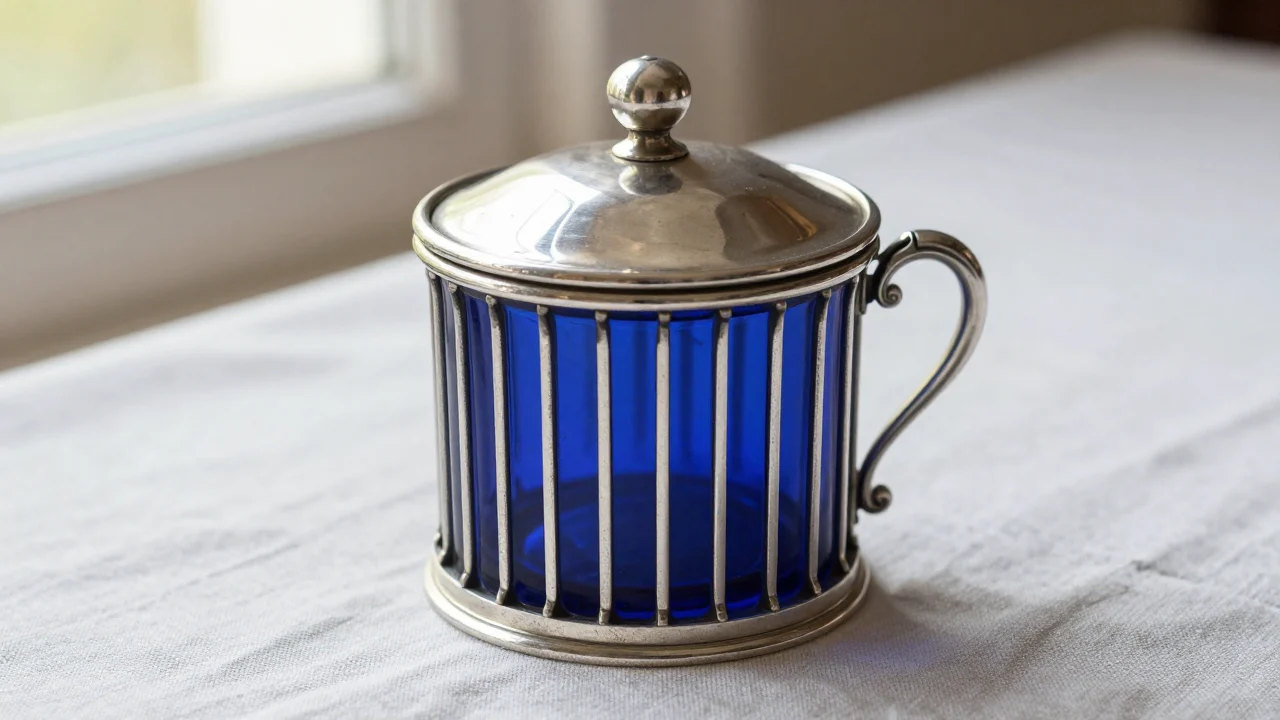
Most single antique silver mustard pots made £120 to £270 hammer at Toovey’s in 2025-2026; a chased Dublin pot made £420 and a Bateman drum £1,560 at Bonhams.
Every figure in this guide is a published auction result with its sale date and lot page linked, so you can set your own pot beside one that actually changed hands. Most results come from one saleroom, Toovey’s, which prints the hammer price and states its buyer’s premium on the lot page, and most of its mustard pots sold alone or with a spoon, so the figures are close to per-pot prices. Bonhams results are added for the Hester Bateman drum, a designer pot and two older singles. No figure is a dealer’s asking price, and none is the net amount a seller took home.
What is an antique silver mustard pot?
An antique silver mustard pot is a small lidded pot for prepared mustard, usually with a hinged lid, a notch for the spoon and a glass liner inside the silver body. The V&A’s record for a Hester Bateman mustard pot of 1790-91 states that a mustard pot is a type of small receptacle for serving prepared (wet) mustard, that the usual form is drum shaped but they also came in oval, rectangular and even vase shaped in the late 18th century, and that the lids were usually hinged with a raised thumbpiece and indentation for the stem of the mustard spoon. Prepared mustard is itself an eighteenth-century product in England: the Wikipedia article on mustard records that a woman based in Durham by the name of Mrs Clements was the first person to sell English mustard in a prepared format in 1720.
The pierced pot with a coloured liner is a late Georgian fashion with earlier roots. The same V&A record states that in the late 18th century in both silver and Sheffield plate, pierced decoration of the body with the attendant glass liner, became popular. The museum’s earliest lined example is an Augustin Le Sage pot with London hallmarks for 1766-7, catalogued as a mustard pot with blue glass liner; its summary adds that this type of mustard pot, made in silver or Sheffield plate, became popular in about 1780-1800. Toovey’s catalogue descriptions from 2025-2026 show the later sequence: barrel-shaped pots of 1792 and 1801, a squat circular pot on lion’s mask legs of 1819, pierced cylindrical pots of 1841 and 1864, and a Guild of Handicraft pot of 1902.
Why does a silver mustard pot have a glass liner?
A silver mustard pot has a glass liner because prepared mustard is mixed with vinegar, and the liner keeps the acid off the silver. The V&A’s Robert Hennell pot of 1790-91 explains that the liner prevented the silver from being corroded by the acidic vinegar in the mustard. Wikipedia’s mustard article states that an acidic liquid, such as wine or vinegar, produces longer-lasting flavour by slowing the reaction, which is why vinegar went into the pot in the first place. On a pierced body the liner also does a second job, because it is the only thing that holds the mustard. This site’s salt cellar guide applies the same logic to salts, noting that the cobalt glass liner protected the silver from salt corrosion.
Blue is the usual liner colour but not the only one. The Hennell pot is catalogued as silver with blue glass liner; the Bateman pot has a cylindrical blue glass liner; the V&A’s Edward Capper pot of 1797-8 is a mustard pot with white glass liner and spoon. The liner is a separate blown-glass part that carries no hallmark, so it cannot be dated on its own, and a liner that fits is not proof that it was made with the pot. Salerooms describe the liner when they treat it as part of the lot: Bonhams catalogued the Hester Bateman drum of 1780 with a blue glass liner and the Thomas Robinson rectangle of 1806 as fitted with a blue glass liner, while Toovey’s mentioned a liner in only one of the mustard lots used here, a George V pot of 1932 with blue glass liner. When a description says nothing about the liner, ask before bidding whether one is present and whether it is chipped.
How do you date a silver mustard pot from its marks?
You date a silver mustard pot from the full set of hallmarks on the body, and you read the spoon and the liner separately because both were often replaced. The silver marks guide explains the four marks on British silver. The Goldsmiths’ Company lists the office marks you then read the date letter against: a leopard for the London Assay Office, an anchor for the Birmingham Assay Office, a rose for the Sheffield Assay Office, and a castle for the Edinburgh Assay Office, and the UK hallmarks guide gives each office’s letter cycles. The Wikipedia hallmark article records that in 1784, the United Kingdom began charging a tax on silverware, and a further mark was added to indicate this had been paid, and that the mark was the monarch’s head and continued to be used until 1890, when the tax was abolished. A British pot made between those dates should show the sovereign’s head beside the date letter.
Spoons rarely match the pot. The V&A notes on the Capper pot that the spoon dates pre 1797 but the maker’s mark is indistinct, and Toovey’s sold a cylindrical mustard of 1864 with a mustard spoon of 1828 and an oval mustard of 1892 with a spoon of 1894. A pot whose spoon carries a different date is normal, so value the pot on its own marks. Worn marks cost money: a George III cylindrical mustard with hinged tappit lid and scroll handle, marks worn, made £130 hammer at Toovey’s in January 2026, against £170 for a fully marked George III oval pot of 1798 in the same sale.
Plated pots carry no hallmarks. The V&A’s Sheffield plate mustard pot is catalogued as English, late 18th century, copper plated with silver Sheffield plate and blue glass liner, and its summary records that Sheffield plate originated, with the discovery in 1742, that bars of silver and copper, in unequal proportions, fused by heating under pressure, could be rolled into sheets of laminated metal and worked like silver, and that the industry this material created flourished for about 100 years until superseded by electroplating in the 1840s. A pierced pot with a blue liner and no lion passant is therefore plate until proved otherwise; the EPNS marks reference shows the plated mark rows that copy hallmark layouts.
| Period | Forms in the records used here | Marks to expect on the body |
|---|---|---|
| 1760-1790 | Pierced drum with blue liner (Le Sage 1766), pierced drum with vertical slats and swags (Bateman 1780), oval with domed lid (Bateman 1790) | Full London hallmarks; sovereign’s head only from 1784; maker’s mark such as HB |
| 1790-1830 | Barrel shape with reeded bands (Wyatt 1792, Hennell 1801), bright-cut oval (Capper 1797, Jackson 1798), rectangle on ball feet with gadroon rim (Robinson 1806), gadrooned cylinder (Burwash 1818), squat circular pot chased with flowers on lion’s mask or shell legs (McKay Edinburgh 1819, Fox 1824, Nolan Dublin 1826) | Full hallmarks with the duty head; castle for Edinburgh; Dublin marks on Irish pots |
| 1830-1900 | Large pierced cylinder (Angell 1833), pierced lattice and Gothic tracery (Barnard 1841, Angell 1841), pierced circular (Riley & Storer 1844, Sibley 1864), beaded rims (Richards & Brown 1874), half-reeded oval (1892), gadrooned cylinder with shell thumbpiece (Hutton 1899), squat circular revival with cast rims (Mappin & Webb 1900) | Full hallmarks; duty head until 1890 and not after |
| 1900 onwards | Pierced oval (Harris 1904), Arts and Crafts flared body (Guild of Handicraft 1902), tapering cylinder with acorn finial (Birmingham 1920), silver-gilt revival on figural legs (Taylor 1930), Art Deco (Murphy 1935) | Full hallmarks with no duty mark; Birmingham anchor common |
What are antique silver mustard pots worth?
Antique silver mustard pots are worth £120 to £270 hammer as single plain or pierced pots at Toovey’s in 2025-2026, £200 to £600 hammer as pairs and small groups, and more for a chased Irish pot at £420, a Guild of Handicraft pot at £650 and a Hester Bateman drum of 1780 at £1,560 inc. premium at Bonhams in 2009, on the results below. The first table gives the bands and what set the price inside them; the second lists every lot behind those bands in descending order, with a link to the page where the full description can be read.
Salerooms publish the figure in different ways. Toovey’s prints the hammer price and states beside it that buyer’s premium is an additional charge on each lot sold, currently this is set at 25% plus VAT (30% including VAT) of the hammer price; its September 2025 lot pages show the earlier rate of 24.5% plus VAT (29.4% including VAT) of the hammer price. Bonhams prints its figure as inc. premium. A seller receives the hammer price less the seller’s commission, so treat every figure as the saleroom’s published number rather than cash in hand. To read the marks on the base of your own pot before you compare, photograph them in raking light and check the reading with the hallmark reading app for iPhone and Android, then match it against the rows below.
| Type | Result band | What set the price |
|---|---|---|
| Single Georgian to Edwardian pot, plain or pierced, sold alone or with a spoon | £120 to £270 hammer at Toovey’s, 2025-2026 | Weight and marks: the £270 Sibley pot with its spoon weighs 171.5g, the £120 Edwardian oval with its spoon 119.4g, and worn marks took a George III pot to £130 |
| Single squat circular pot chased with flowers on legs, 1819-1826 | £120 to £420 hammer at Toovey’s, September 2025 | Dublin 1826 by William Nolan £420; Edinburgh 1819 by James McKay £120; London 1824 by Charles Fox II £140 |
| Pairs and groups of two or three pots | £200 to £600 hammer at Toovey’s, 2025-2026 | Mappin & Webb pair of 1900, 859.8g, £600; three cylindrical pots of 1874-1969, 313.5g, £520; two barrel pots of 1792 and 1801, £260 |
| Designer and Arts and Crafts pots | £475 inc. premium at Bonhams (2011) to £650 hammer at Toovey’s (2026) | Guild of Handicraft pot of 1902 designed by Charles Robert Ashbee, £650; Henry George Murphy Art Deco pot of 1935, £475 |
| Named Georgian maker, single pierced drum | £1,560 inc. premium at Bonhams, 2009 | Hester Bateman pierced drum of 1780 with a blue glass liner |
| Older single results | £84 to £168 inc. premium at Bonhams, 2006-2007 | Thomas Robinson rectangle of 1806 with liner; Riley & Storer pierced circular pot of 1844 with liner |
| Lot | Marks and makers | Result | Price driver |
|---|---|---|---|
| Pierced drum with vertical slats, swags and urns, urn finial, blue glass liner, 3oz | Hester Bateman, London 1780 | Sold for £1,560 inc. premium, 1 April 2009 | Bateman name on a classic pierced drum, Bonhams Knightsbridge |
| Arts and Crafts pot designed by C. R. Ashbee, red cabochon finial, twin loop handle, with a spoon of 2000 | Guild of Handicraft Ltd, London 1902 | Hammer price: £650, 18 February 2026 | Designer attribution, Toovey’s |
| Pair of squat circular pots with crown finials on lion mask legs, with two spoons of 1826 and 1864, 859.8g | Mappin & Webb Ltd, London 1900 | Hammer price: £600, 10 September 2025 | Pair and 859.8g of silver, Toovey’s |
| Cylindrical pot with beaded rims and two similar pots, 313.5g | Richards & Brown, London 1874; Birmingham 1905; London 1969 | Hammer price: £520, 21 January 2026 | Three pots in one lot, Toovey’s |
| Art Deco pot with stylised layered finial, Falcon Studio and coronation marks | Henry George Murphy, London 1935 | Sold for £475 inc. premium, 30 November 2011 | Named designer, Bonhams Knightsbridge |
| Squat circular pot chased with chinoiserie scenes on figural legs, with a Dublin 1849 spoon, 272.8g | William Nolan, Dublin 1826, retailed by William Law & Son | Hammer price: £420, 10 September 2025 | Irish chased pot with retailer’s name, Toovey’s |
| Silver-gilt squat circular pot on chinoiserie figural legs, with a gilt spoon of 1919, 331g | Joseph Hayes Taylor, London 1930 | Hammer price: £420, 10 September 2025 | Gilding and 331g, a 1930 pot outside the antique bands, Toovey’s |
| Cylindrical pierced pot with a spoon of 1828, 171.5g | Arthur Sibley, London 1864 | Hammer price: £270, 21 January 2026 | Pierced cylinder with good weight, Toovey’s |
| Large cylindrical pot with pierced sides and engraved lid, 211.3g | Joseph Angell I & John Angell I, London 1833 | Hammer price: £260, 15 April 2026 | Size and 211.3g, sole item, Toovey’s |
| Two barrel-shaped pots with two Fiddle pattern spoons, 282.2g | Joseph Wyatt, London 1792; Robert, David and Samuel Hennell, London 1801 | Hammer price: £260, 10 September 2025 | Two Georgian pots by named makers, Toovey’s |
| Pair of tapering cylindrical pots with acorn finials, 251.8g, with a plated spoon | Birmingham 1920 | Hammer price: £230, 8 July 2026 | Pair, but 1920 and Birmingham, Toovey’s |
| Squat circular pot with gadrooned rim on scroll feet, with a spoon of 1859, 335.9g | Johnson, Walker & Tolhurst Ltd, London 1900 | Hammer price: £220, 10 September 2025 | Heavy at 335.9g, Toovey’s |
| Cylindrical pot with gadrooned rim and another pierced cylindrical pot, 277.9g | William Burwash, London 1818; the second unattributed | Hammer price: £200, 3 December 2025 | Two pots, one Georgian, Toovey’s |
| Oval pot with engraved decoration, 84.7g | Orlando Jackson, London 1798 | Hammer price: £170, 21 January 2026 | Light Georgian oval, clean marks, Toovey’s |
| Cylindrical pot with pierced lattice and quatrefoils, 136.6g | Edward, Edward jnr, John & William Barnard, London 1841 | Hammer price: £170, 18 March 2026 | Barnard piercing, sole item, Toovey’s |
| Cylindrical pot with shell thumbpiece and gadrooned rims, 134g | William Hutton & Sons Ltd, London 1899 | Hammer price: £170, 18 March 2026 | Plain late Victorian cylinder, Toovey’s |
| Pierced circular pot with crested cover and blue glass liner, 5.5oz | Charles Riley & George Storer, London 1844 | Sold for £168 inc. premium, 14 March 2007 | Pierced Victorian single, Bonhams Edinburgh |
| Squat circular pot with cast scroll rim and chased floral sides, with a spoon of 1829, 237.5g | Charles Fox II, London 1824 | Hammer price: £140, 10 September 2025 | Chased London pot, Toovey’s |
| Oval half-reeded pot with urn finial, with a spoon of 1894, 99.6g | Goldsmiths & Silversmiths Co, London 1892 | Hammer price: £140, 15 April 2026 | Light oval with later spoon, Toovey’s |
| Cylindrical pot with hinged tappit lid and scroll handle, marks worn, 75.3g | Marks worn, George III | Hammer price: £130, 21 January 2026 | Worn marks and 75.3g, Toovey’s |
| Hexagonal pot with Gothic arch tracery, with a spoon of 1848, 184.7g | Joseph Angell I & Joseph Angell II, London 1841 | Hammer price: £130, 10 September 2025 | Unusual form did not lift the price, Toovey’s |
| Squat circular pot chased with flowers on lion’s mask legs, with a spoon of 1867, 196.5g | James McKay, Edinburgh 1819 | Hammer price: £120, 10 September 2025 | Scottish chased pot at the bottom of its band, Toovey’s |
| Oval pot with pierced sides and a spoon, 119.4g | Charles Stuart Harris, London 1904 | Hammer price: £120, 10 June 2026 | Edwardian pierced oval, Toovey’s |
| Rectangular pot on ball feet with gadroon rim, blue glass liner and matched spoon | Thomas Robinson, London 1806 | Sold for £84 inc. premium, 16 May 2006 | Plain Georgian rectangle twenty years ago, Bonhams Knightsbridge |
The tables point to four price drivers. Count and weight first: the £600 pair weighs 859.8g with its spoons and the £120 Edinburgh pot 196.5g with its spoon, while the 84.7g Jackson oval still made £170 on a clean set of marks, so weight sets the floor and marks set the rest. Form second: pierced drums and cylinders sold at or above plain ovals of the same period, and the two chased Irish and gilt pots on figural legs made £420 each. Name third: the Ashbee and Murphy pots and the Bateman drum are the only single pots above £300, and a Peter & Ann Bateman oval pot of 1794 sold inside a £420 lot with a matched pair of George III salts and two other pieces, so the Bateman name lifts a lot without making the pot alone worth that figure. This site’s Georgian silver guide notes that Hester Bateman’s bright-cut domestic silver carries a dependable premium over anonymous equivalents; on mustard pots that premium shows in the 2009 Bonhams result and in Toovey’s cataloguing of the Bateman pot as the named piece in its mixed lot. Condition last: worn marks took the tappit-lid pot to the bottom of the single band, and a chipped or missing liner is a question to ask before any bid.
What should you do with your mustard pot now?
Start by turning the pot over and photographing the marks on the base in low side light, then read the lion passant, the office mark, the date letter and any sovereign’s head, and record the spoon’s marks separately because a spoon of a different year is normal rather than a warning. Then lift out the liner and check it for chips and for a colour that matches the museum records, blue or occasionally white, and check the body edge and the inside of the lid for copper showing through, which points to Sheffield plate or electroplate rather than silver. Finally, weigh the pot without its liner, find the row in the results table that matches its form, weight and origin, open the lot page, and compare the catalogue description with the piece in your hand before you set a reserve, an insurance figure or a bid.
Method and limits. Toovey’s results are hammer prices printed on lot pages between September 2025 and July 2026, read on 24 September 2026, with the buyer’s premium statement quoted from those pages; where a lot held two or three pots or a spoon, the total is not a per-pot price, and the weights quoted include the spoon where the catalogue gives a total weight. The Bonhams figures are stated inc. premium and date from 2006 to 2011, so they show what named and unnamed pots made then rather than now. Figures from the two salerooms are shown with the house named and are not merged into one band. No dealer, online-marketplace or private-sale prices are used. Object history and liner facts follow the V&A records and Wikipedia; a shape or a maker’s mark gives a period rather than a year, a mark on its own does not prove date, maker or metal, a liner cannot be dated at all, and no pot described here was examined in hand.