
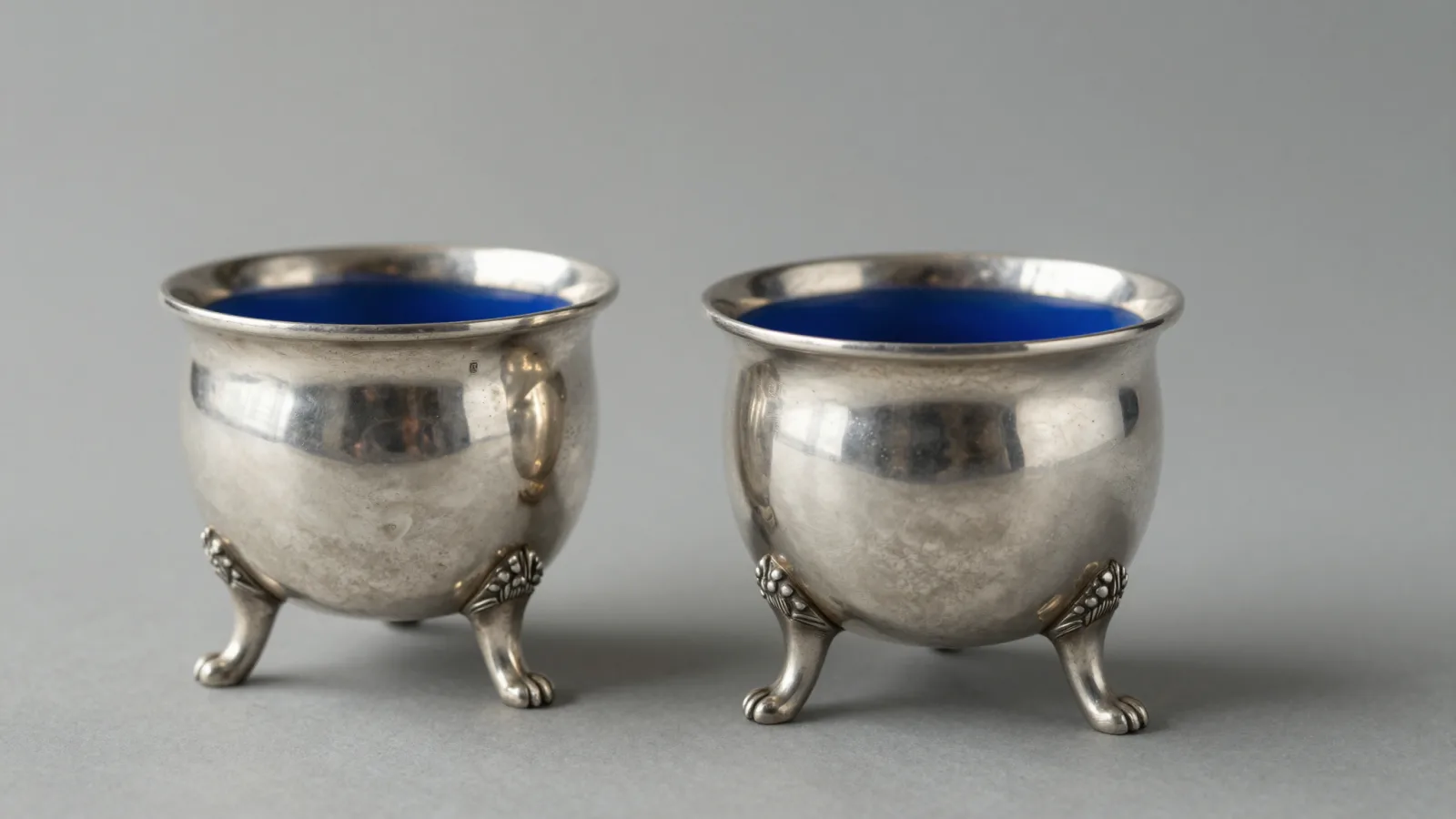
Most antique silver salt cellars sell for £30-£300 each. Pairs by named Georgian makers reach £1,000 or more. The marks decide which end you land on.
What is an antique silver salt cellar?
An antique silver salt cellar is a small open dish that held table salt at the dining table. Salt shakers only displaced them in the late 19th century. Collectors also call them open salts or salt dips.
Salt earned this treatment because it was a status good. A Tudor standing salt marked the host’s place, and guests sat above or below the salt by rank. By the Georgian period the grand ceremonial salt had shrunk into the small personal cellar you find at fairs today.
The form changed with each period, and the form is your first dating tool. Early trencher salts sit low and flat. Georgian cauldron salts stand on three hoof feet. Neoclassical salts take a pierced, boat-shaped body with a blue glass liner. The Victoria and Albert Museum holds examples of every one of these forms in its silver galleries.
| Form | Typical dates | Key features |
|---|---|---|
| Trencher salt | 1600-1730 | Low solid body, shallow oval or octagonal well |
| Cauldron salt | 1730-1785 | Round bowl on three hoof or pad feet |
| Pierced boat salt | 1770-1805 | Cut-out sides, cobalt blue glass liner, four feet |
| Rectangular salt | 1790-1830 | Plain heavy body, gilt interior |
| Victorian revival salt | 1840-1900 | Reissued Georgian shapes, novelty figures, heavier gauge |
| Edwardian reproduction | 1900-1915 | Faithful Georgian forms with correct-period hallmarks |
Most salts left the workshop in pairs or sets of four. One salt sat between each pair of diners at a formal table. This matters for value, because the market still prices complete pairs and sets far above singles.
Pick one up and check the underside before anything else. On cauldron salts, look at the three points where the feet meet the body. Two centuries of table use push the feet up into the thin bowl. Any seasoned collector checks those spots first, because pushed feet are the most common damage on Georgian salts.
How do you read the marks on a salt cellar?
You read salt cellar marks the same way you read any British silver: standard mark, town mark, date letter, maker’s mark. The difference is where they hide and how small they are.
Makers struck cauldron salts in a line under the bowl or around the outside of the rim. Pierced boat salts usually carry their marks on the base rim. The punches on a salt run smaller than on a teapot, so a loupe earns its keep here.
The marks themselves follow the national system. The lion passant confirms sterling standard on English pieces. London’s assay office stamps a leopard’s head. Birmingham’s assay office stamps an anchor. Sheffield’s assay office stamped a crown until 1975. Our UK hallmarks guide walks through each office’s full mark sequence.
Mark count gives you a fast dating shortcut. English salts assayed before December 1784 carry four marks. Salts assayed from 1784 to 1890 add the sovereign’s head duty mark, making five. A five-mark row therefore places the piece inside that 106-year window before you decode a single letter.
American salts play by different rules. Gorham marked sterling salts with a lion, an anchor, and a G. Tiffany & Co. stamped its full name with a pattern number. The word STERLING alone, with no town or date mark, points to American manufacture after about 1860.
Continental salts carry purity numbers instead. German makers stamped 800 beside a crown and crescent moon after 1888. French makers struck the Minerva head for 950 standard. Dutch and Scandinavian salts carry their own national sequences, and export pieces sometimes add British import marks on top.
If the whole system is new to you, start with our beginner silver marks guide and come back to the salt afterwards. Ten minutes with the basic sequence makes every table in this article usable.
The makers that move the price
Named makers move salt cellar prices more than age does. A plain Victorian salt from 1885 by an unrecorded maker brings less than a lighter salt made a century earlier by Hester Bateman.
| Maker | City | Active period | Mark | What their salts bring |
|---|---|---|---|---|
| Hester Bateman | London | 1761-1790 | HB in script | £400-£900 for a good pair of pierced salts |
| Paul Storr | London | 1792-1838 | PS in a rectangle | £1,000-£4,000+ for pairs, gilt examples lead |
| Robert Hennell I | London | 1763-1811 | RH, later joint marks | £250-£600 for pierced pairs |
| Matthew Boulton | Birmingham | 1773-1809 | MB | £300-£800 for pairs, scarcer than London work |
| Emes & Barnard | London | 1808-1829 | RE over EB | £200-£500 for heavy oblong pairs |
| Gorham | Providence, US | 1831-present | Lion, anchor, G | $150-$500 for figural and pierced salts |
| Tiffany & Co. | New York | 1837-present | Full name stamp | $200-$800+, more for early Moore-era work |
Hester Bateman commands her premium partly on name recognition. Her workshop produced pierced salts in volume, so supply exists, but demand from American collectors keeps prices firm. Her script HB punch is small and light, and on salts it rubs faster than the hallmarks beside it.
The Hennell family deserves more attention than it gets. Robert Hennell I registered his first mark in 1763, and the family treated salt cellars as a specialism across three generations. A Hennell pierced salt costs half the equivalent Bateman and the workmanship stands comparison.
Fakes cluster around the famous names. Later engravers added false Bateman marks to genuine period salts. Check that the maker’s mark shows the same depth and wear as the hallmarks beside it. A crisp maker’s punch next to rubbed date letters is a warning sign, not a bonus. The Smithsonian’s collections include documented American examples that make useful comparison references for Gorham and Tiffany marks.
Not sure what you’ve got?
Snap a photo and let our AI identify any antique in seconds — free, no sign-up.
Identify on iPhone →Learn MoreDating a salt cellar from its shape
Shape dates a salt cellar faster than the hallmark does, and it also catches the reproductions that the hallmark alone misses. Auction cataloguers read the form first and use the date letter to confirm.
Cauldron salts on three feet dominate from about 1730 to 1785. Gadrooned rims point to the earlier half of that run. Plain rims with engraved bands point later. Pierced boat-shaped salts with blue liners belong to the Adam taste of 1770 to 1805. Heavy rectangular salts with gilt interiors follow, roughly 1790 to 1830.
Victorian makers revived every one of these shapes. A three-footed cauldron salt with an 1875 date letter is not a fake. It is an honest revival piece, and it prices at Victorian levels, not Georgian ones. This is the most common misreading at fairs: a Georgian shape offered at a Georgian price over a Victorian date letter.
Edwardian reproductions run closest to the originals. Workshops in Chester and Birmingham produced faithful Georgian patterns from 1900 to 1915. The hallmarks are legitimate and the silver is sterling. Value sits at £40-£90 a pair, a fraction of the Georgian originals they copy.
Weight backs up the shape. Georgian salts run thin: a cauldron salt typically weighs 60 to 90 grams. Victorian revival pieces of the same size weigh 90 to 130 grams, because machine-rolled sheet made heavier gauge cheap. If a Georgian-looking salt feels heavy in the hand, read the date letter twice.
The Metropolitan Museum collection database rewards a browse here. Searching for salt cellars in British silver returns dated examples across the whole sequence, which trains your eye faster than written descriptions can.
What are antique silver salt cellars worth?
Most antique silver salt cellars sell between £30 and £300 each, and the marks decide where in that band a piece lands. Named Georgian makers, matched pairs, and original liners push prices above it. Damage and missing liners pull prices below it.
| What you have | Typical range | What moves it up or down |
|---|---|---|
| Single Victorian salt, unrecorded maker | £25-£60 | Condition and gilding, novelty forms do better |
| Single Georgian cauldron salt | £60-£150 | Crisp marks, no pushed feet |
| Pair of Georgian cauldron salts | £150-£400 | Matching date letters and maker |
| Pair of pierced boat salts with liners | £120-£350 | Original cobalt liners intact |
| Pair by Hester Bateman or an equal name | £400-£900 | Mark clarity, provenance |
| Paul Storr and top-tier makers | £1,000-£4,000+ | Gilding, armorials, documented history |
| Matched set of four | 2.5-3x the pair price | Sets outperform, do not split them |
| Continental 800-standard salts | £20-£80 a pair | Lower purity caps the ceiling |
Two pricing rules surprise sellers. First, a matched set of four brings 2.5 to 3 times the pair price, not double. Formal table settings drive the demand and complete sets are scarce. Second, salt spoons change the sum less than owners hope: an associated spoon adds £10-£20, and only original matching spoons add serious money.
The metal itself sets the floor. A 75 gram sterling salt contains about 69 grams of pure silver. At a scrap rate near £0.75 per gram for sterling, that is roughly £55 of metal. A Georgian salt in decent condition trades above its scrap figure, which is the practical difference between it and most electroplate. We covered who pays those premiums and why in what a hallmark is worth to a buyer.
Completed sale records beat asking prices for research. WorthPoint archives realized prices for thousands of salt sales, searchable by maker and form. And once you have decoded the marks on your own piece, it is worth seeing how the current hallmark reader apps stack up to get a photo-based second reading before you settle on a figure.
Condition problems that cut the price
Condition cuts salt cellar value harder than it cuts most silver, because salt destroys silver. Sodium chloride corrodes the metal on contact over time. That is why makers gilded interiors and fitted glass liners in the first place.
Look inside the bowl first. Grey-black pitting across the well means salt sat in the piece for years. Light pitting knocks 20 to 30 percent off. Deep, crusty pitting can halve the price, and no amount of polishing reverses it. Intact original gilding does the opposite and adds a clear premium, because so little of it survived two centuries of cleaning.
Missing liners hurt pierced salts most. The pierced body was never salt-tight without its cobalt glass liner. Replacement liners exist and cost £15 to £30, but they rarely fit the oval precisely. Buyers can tell. A pierced pair with original liners outsells the same pair with replacements by a comfortable margin.
Check the feet and the piercing under a raking light. Pushed feet read as bumps inside the bowl. Old solder repairs show as dull grey patches against the brighter surrounding silver. On pierced salts, run a fingertip around the cut-outs: past breaks in the fretwork feel sharp where a repairer filed them back.
Erased armorials leave a thin spot. Georgian owners engraved crests on their salts, and later dealers polished them off to make pieces look clean. Breathe on the body and a removed crest shows as a faint cloud. Tilt the piece against the light and the thinned area ripples. An honest crest, even someone else’s, is worth more than an erasure.
Where to sell and what each route pays
Match the selling route to what you have, because the spread between routes is wide on small silver.
| Your situation | Best route | Why |
|---|---|---|
| Pair or set by a named maker | Regional auction with a silver sale | Specialist bidders find it, estimates are honest |
| Single Georgian salt, good marks | Online marketplace with sharp mark photos | Collectors filling sets pay well, postage is cheap |
| Damaged or single Victorian salt | Dealer or general auction job lot | Fees eat thin margins elsewhere |
| Pitted, no liner, unrecorded maker | Scrap as a last resort | Check the collectible floor first |
| Continental 800 pair | Online marketplace | UK auctions underprice continental small silver |
Photograph the marks before anything else. Listings that lead with a sharp, well-lit hallmark photo sell faster and closer to estimate than listings showing only the whole piece. Buyers of salts buy the marks.
Auction fees change the arithmetic on cheap pieces. A £60 hammer price returns £40-£45 after a typical regional seller’s commission. On a £600 pair the same percentage stings far less. That is why single low-value salts do better on fixed-fee platforms than under the hammer.
Do not scrap borderline pieces without checking the collectible market. The gap between melt and collector price is the whole game with salts, and we walked through that calculation in melt value vs collectible value. Price guides help calibrate expectations too: Kovel’s lists open salt categories with realized ranges, and a ten-minute search there prevents the classic mistake of scrapping a £300 pair for £90 of metal.
Frequently Asked Questions
Is there an app that can read salt cellar hallmarks from a photo?
Antique Identifier – Antiqly reads the tiny mark rows on salt cellars from a photo and copes well with the curved surfaces these marks sit on. Download is free and no sign-up is needed. Photograph the marks in raking light, at a low angle, so the punches throw shadows. The app identifies the standard mark, town mark, and date letter, then suggests the maker. Salts carry some of the smallest punches in British silver, so take two or three photos at different angles and let it read the clearest one.
How do I know if my salt cellar is sterling or silver plate?
Look for a standard mark first. The lion passant means English sterling. STERLING or 925 means solid silver from other marking systems. Letters like EPNS, EP, or A1 mean electroplate with no melt value. Plated salts copy sterling shapes closely, and many carry four-punch pseudo-hallmarks laid out to look right at a glance, so read the punches, not the layout. Worn plate also gives itself away at the high points: rims and feet show a warmer, brassy tone where the silver layer has gone. A pierced plate frame with a blue liner was a common Victorian product, so the liner alone proves nothing.
Why does my salt cellar have a blue glass liner?
The cobalt glass liner protected the silver from salt corrosion. Pierced Neoclassical salts made between 1770 and 1805 could not hold salt at all without one, since their fretwork sides are full of openings. The blue colour was fashion as much as function: cobalt glass showed through the piercing and flattered the bright-cut silver. Original liners were blown and ground to fit one specific body, so they sit snug without rocking. A loose, rocking liner is usually a later replacement. Originals add a solid margin to the pair price, which is why a cracked original is still worth keeping with the piece.
Are single salt cellars worth buying, or only pairs?
Singles are worth buying at single prices, which run well below half the pair price. Salts left the workshop in pairs and fours, so the market treats a single as an incomplete set. That creates the one genuine bargain in this field: collectors reuniting sets pay strong money for the exact match to what they own. A single Hester Bateman salt bought for £150 can become part of a £900 set. Buy singles with crisp marks by named makers and be patient. Sell singles honestly as singles. The trade phrase matched pair means two similar salts married together, and it prices between a true pair and two singles.
Should I polish a salt cellar before selling it?
Light hand-polishing helps, aggressive polishing hurts. A gentle clean with a proper silver cloth lifts tarnish and lets the marks photograph well, which matters more to the sale price than overall shine. Machine buffing is the mistake: it rounds off the crisp edges of the hallmarks and softens piercing detail, and dealers spot buffed silver instantly. Never scour the inside of the bowl to remove salt pitting, because the pits sit in the metal, not on it, and scouring thins the piece for nothing. Leave original gilding untouched. Patchy interior gilding is honest wear, and buyers prefer it to a stripped or regilded surface.
Do salt spoons add value to antique salt cellars?
Matching original spoons add real value, associated spoons add little. A Georgian salt spoon by the same maker in the same year as the cellars can add 20 to 30 percent to a pair, because surviving matched sets are scarce. A random Victorian spoon dropped into a Georgian salt adds £10-£20 at best. Check the spoon’s own marks: salt spoons carry a reduced punch set, usually the lion passant, duty head, and maker’s mark on the stem. Watch for corrosion at the bowl tip, where the spoon stood in salt. Blackened, pitted spoon bowls are common, and gilt-bowl spoons survived best for the same reason gilt salt interiors did.
Identify any antique in seconds.
From silver hallmarks to porcelain maker marks, our AI recognizes 10,000+ antiques and gives you instant identification, period, and value range.
Download Free on iPhoneSee How It Works