
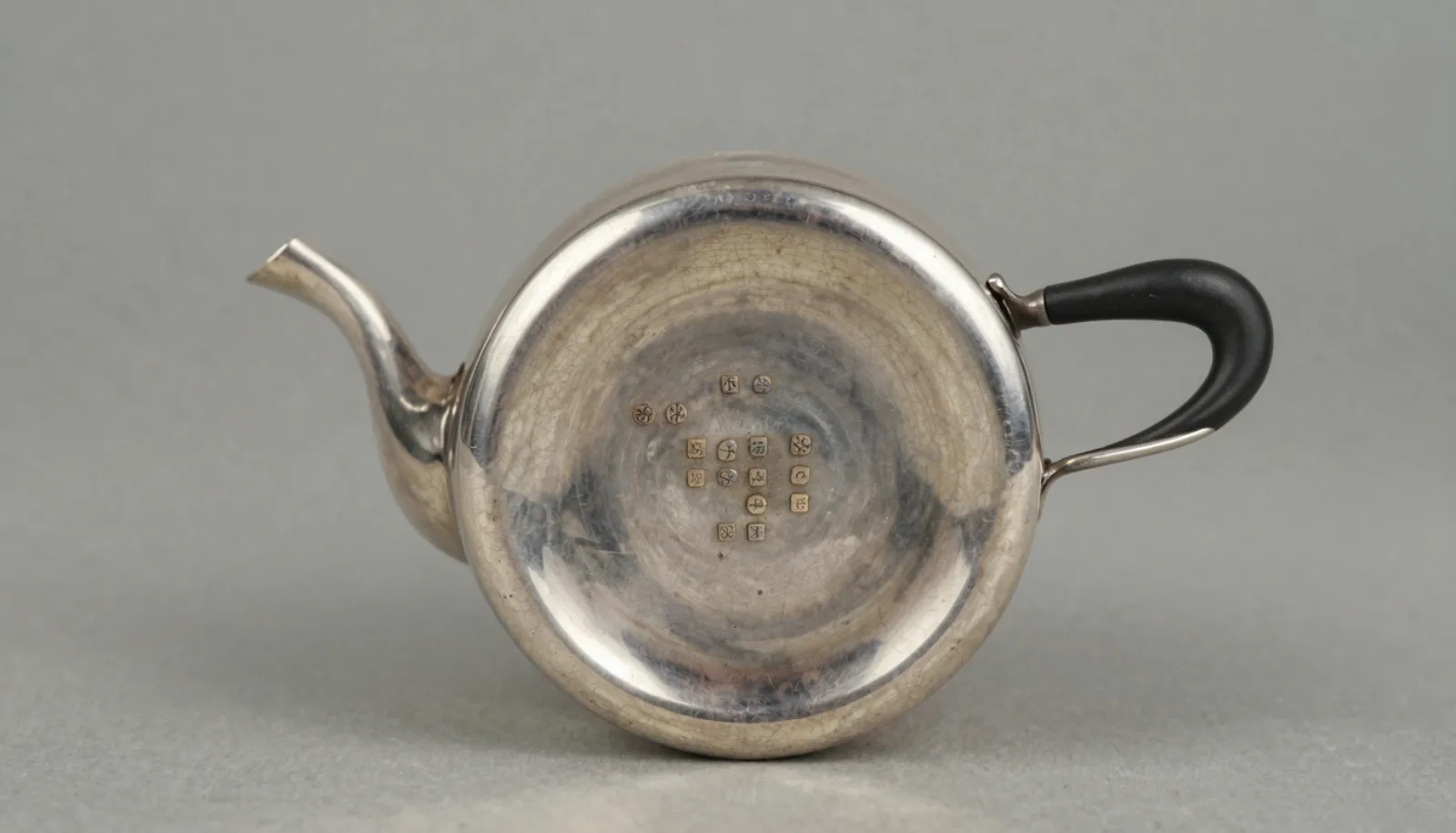
Atkin Brothers marks date from 1853 to 1958. AB with a crown and date letter means sterling. AB with EPNS means Sheffield electroplate, not solid silver.
Who were Atkin Brothers?
Atkin Brothers was a Sheffield silversmithing and electroplating firm that traded under that name from 1853 until 1958. Everything struck with the Atkin Brothers punch falls inside that 105-year window, which makes the name itself a dating tool before you read a single letter.
The business is older than the name. It descends from the Old Sheffield Plate workshop of Thomas Law, working in Sheffield from around 1758. Law’s operation passed through the partnership of Law and Atkin, then to Henry Atkin trading alone, and finally to Henry’s sons, who registered the firm as Atkin Brothers. Collectors who hunt only for the AB punch quietly skip a full century of related Sheffield output that carries earlier initials.
The works stood at Truro Works, Matilda Street, Sheffield. That address appears on trade catalogues, invoices, and occasionally stamped in full on hollowware bases. Any seasoned collector knows a full address stamp is a gift. It removes almost all ambiguity about who made the piece and roughly when, because address stamps in full were a late-Victorian and Edwardian habit rather than an early one.
Atkin Brothers ran two production lines side by side, and that duality is the single biggest source of confusion around their marks. The sterling line went through the Sheffield Assay Office and carries proper statutory hallmarks. The electroplate line never went near an assay office and carries only the firm’s own trade punches. Two objects from the same workshop, the same year, even the same pattern, can differ tenfold in value depending on which line they came from.
Sheffield in this period was the plating capital of the world. Firms such as Walker and Hall, Mappin and Webb, and James Dixon and Sons all worked within a short walk of Matilda Street, and they borrowed each other’s visual conventions freely. That is why an Atkin punch can look, at a glance, like half a dozen other Sheffield marks. The Victoria and Albert Museum holds Sheffield metalwork from exactly this cluster of firms, and comparing objects there is the fastest way to train your eye on house style rather than on isolated letters.
In 1958 C.J. Vander acquired the firm. Vander kept several Atkin patterns in production, so a spoon in a recognisably Atkin pattern carrying a Vander punch is not a fake or a marriage. It is a later run of an older design.
| Approximate period | Trading name | What the punch usually reads |
|---|---|---|
| c.1758 to c.1820s | Thomas Law | Initials only, Old Sheffield Plate era |
| c.1820s to c.1850 | Law and Atkin | Paired initials |
| c.1850 to 1853 | Henry Atkin | HA |
| 1853 to 1958 | Atkin Brothers | A above B, AB, or the name in full |
| 1958 onward | C.J. Vander | Vander punch, Atkin patterns continued |
The practical takeaway: date the name before you date the letter. If the mark reads Atkin Brothers in any form, you are already inside 1853 to 1958 before you examine anything else on the piece.
What does an Atkin Brothers mark look like?
An Atkin Brothers mark is built from the letters A and B, struck either stacked one above the other or side by side in a small shaped punch, and on plated ware it sits next to the letters EPNS. That letter pair is the anchor. Everything else in the row is context.
The firm registered several punch shapes across its life, and the outline of the punch matters as much as the letters inside it. Rectangular punches with clipped corners, oval punches, and small shield-shaped punches all appear. On flatware the punches are compressed to fit the narrow stem, so the letters look taller and thinner than they do on a tray. That distortion trips up beginners who expect the mark to look identical on every object.
On plated ware you will usually find a short row rather than a single stamp. The row typically runs: firm punch, then a device or decorative punch, then a quality indicator such as EPNS or A1, then a pattern number. Reading the row left to right in that order stops you from mistaking a catalogue number for a date.
Pattern numbers are the most common misreading of all. A three or four digit number struck beside the maker punch is a factory reference to a design, not a year and not a purity figure. A tray stamped 1276 was not made in 1276 and is not 1276 parts per thousand silver. If you want the full grammar of those plate quality codes, the breakdown in our guide to A1, A2 and quality numbers on silver plate covers what each grade actually promised the buyer.
Some later pieces carry the firm name spelled out in full, sometimes with SHEFFIELD or ENGLAND beneath. Full-name stamps are a strong dating signal in their own right. The word ENGLAND appearing on export ware generally postdates 1891, when American tariff law began requiring country-of-origin marking on imported goods.
| Mark as struck | What it indicates | Where it usually appears |
|---|---|---|
| A above B in a shaped punch, with crown, lion passant and date letter | Sterling silver, Sheffield assayed | Flatware stems, teapot bases, dish rims |
| AB punch followed by EPNS | Electroplated nickel silver | Tray undersides, cutlery backs |
| ATKIN BROTHERS or ATKIN BROS in full | Electroplate, usually later production | Hollowware bases, tray centres |
| EPNS A1 | Heaviest standard plate grade | Cutlery, cruet frames, entree dishes |
| EP on copper, or EPBM | Electroplate over copper or Britannia metal | Cheaper hollowware, teapot bodies |
| Three or four digit number alone | Pattern or catalogue number, not a date | Struck beside the maker punch |
| SHEFFIELD or ENGLAND added | Export or late production | Late Victorian onward |
One habit worth building: photograph the whole row, not the one punch you find interesting. The relationship between punches carries more information than any single stamp, and a cropped photo of the AB alone throws away the evidence that decides sterling from plate.
How do I tell Atkin sterling from Atkin plate?
An Atkin Brothers piece is sterling only if the AB punch sits in a row with a crown, a lion passant and a date letter. Anything else the firm produced is electroplate, however heavy or handsome it looks.
That test sounds crude, and it is exactly as crude as it needs to be. British hallmarking law never allowed a plating firm to strike an assay mark. The crown was Sheffield’s town mark, the lion passant certified 925 sterling, and the date letter recorded the assay year. Only the Sheffield Assay Office could apply them. So a full four-mark row on an Atkin piece is not a claim the firm made about itself. It is an independent certification, and that is why it carries so much more weight than any trade stamp.
Electroplate rows imitate the rhythm of hallmarks without the substance. A maker punch, a device, a quality letter, sometimes a small pseudo-shield: the eye reads that as official. It is not. The reference tables on our EPNS marks page set out the difference punch by punch, and the visible tells are collected in our guide to EPNS versus sterling in five differences.
Beyond the marks, three physical checks settle almost every doubtful case. First, look for copper bleed. Electroplate wears through at high points, spout tips, handle terminals, tray rims, and the base metal shows as a warm pink or brassy patch. Sterling wears evenly and stays the same colour all the way through. Second, weigh it in the hand. Sterling hollowware of the same size feels denser and rings longer when tapped at the rim. Third, look inside the foot. Plated hollowware is often seamed and filled where sterling is raised or cast in one piece.
The magnet test deserves a warning. Neither sterling nor nickel-silver base metal is magnetic, so a magnet passing cleanly proves nothing about which of the two you are holding. It only rules out steel and iron. Collectors who rely on it end up confidently misfiling plate as silver.
Acid testing is a last resort on a marked piece and rarely justified. If a genuine Sheffield hallmark row is present and legible, testing adds nothing but a scar. The American silver collections at the Smithsonian illustrate the same principle from the other side of the Atlantic: institutional cataloguing leans on marks and construction, not on destructive chemistry.
If the row is worn to the point of illegibility, work backwards from construction. Hand-raised bodies, applied cast handles and heavy gauge suggest sterling. Spun bodies, thin gauge and soldered-on trim suggest the plated line. Neither is decisive alone, but the two together usually resolve it.
Is Atkin Brothers Sheffield plate really Sheffield plate?
Almost never, in the strict sense. Nearly all Atkin Brothers plated ware is electroplate, because the firm’s plated output belongs to the decades after electroplating had displaced the older fused method entirely.
The confusion is a vocabulary problem. Old Sheffield Plate means a specific process: a sheet of silver fused to a copper ingot under heat and pressure, then rolled out and worked as one laminated metal. It ran from roughly 1743 to the 1840s. Electroplate is a different animal, silver deposited from solution onto a finished base-metal object using an electric current, commercialised after Elkington’s patents around 1840. Sellers use “Sheffield plate” loosely to mean any plated ware from Sheffield, and that habit costs buyers real money. The technical distinction is set out clearly in the Old Sheffield plate entry, and the process history sits behind our guide to Elkington silver plate marks and dating.
Three physical tells separate the two, and none needs a tool. Old Sheffield Plate shows a seam. Because the sheet was rolled, edges had to be concealed, so you find applied silver wire on rims, lapped-over borders, and sometimes a visible line where two sheets meet. Electroplate has no seam, because the object was built first and plated afterwards. Second, wear behaves differently: Old Sheffield Plate bleeds copper in broad soft patches, while electroplate wears in thin sharp lines along raised edges. Third, Old Sheffield Plate pieces almost never carry the letters EPNS, for the obvious reason that the term did not exist yet.
Why does it matter commercially? Because genuine Old Sheffield Plate is scarce and collected, while Victorian and Edwardian electroplate is abundant. A tray correctly catalogued as Old Sheffield Plate can carry several times the price of a visually similar electroplated tray of the same size. Auction descriptions that say “Sheffield plate” without qualification should always prompt the question of which process is meant. The reference tables on our silver plate marks page separate the two mark families side by side.
There is one genuine overlap worth knowing. The Thomas Law workshop that eventually became Atkin Brothers did produce Old Sheffield Plate in the late eighteenth and early nineteenth centuries. Those pieces predate the Atkin Brothers name and carry different initials, so they will not read AB. If you find a fused-plate object with an early Law mark, you are holding the ancestor of the Atkin line rather than an Atkin product.
Metropolitan Museum holdings of English plated ware, browsable through the Metropolitan Museum of Art collection, are a useful calibration exercise. Comparing a documented fused-plate object against a documented electroplated one for ten minutes teaches the seam difference better than any written description.
Not sure what you’ve got?
Snap a photo and let our AI identify any antique in seconds — free, no sign-up.
Identify on iPhone →Learn MoreHow do I date an Atkin Brothers piece?
Date sterling Atkin pieces from the Sheffield date letter, and date plated Atkin pieces from a stack of secondary features, because plate carries no date letter at all.
For the sterling line the procedure is mechanical. Find the crown, confirm Sheffield, then read the date letter and match its shape, case and surrounding shield against a Sheffield cycle chart. The letter alone is never enough, because the same letter recurs every twenty-something years. Shield outline and letterform are what separate one cycle from the next. Our Sheffield silver hallmarks guide walks the cycles in order, and the same logic applies to any Sheffield maker, not just Atkin.
The plated line needs a different method: bracket the object using features that entered or left use at known dates. No single feature dates a plated piece, but four or five of them stacked together usually narrow it to a couple of decades. This is the workhorse technique for all unhallmarked Sheffield ware.
| Feature present on the piece | Date range it brackets |
|---|---|
| Sovereign’s head duty mark in the hallmark row | 1784 to 1890 |
| Crown as the Sheffield town mark | 1773 to 1974 |
| Rose replacing the crown as town mark | 1975 onward |
| Atkin Brothers name in any form | 1853 to 1958 |
| EPNS wording in the trade row | after c.1860 |
| ENGLAND or MADE IN ENGLAND added | after 1891 |
| C.J. Vander punch on an Atkin pattern | after 1958 |
Style carries dating information too, though it is softer evidence. Heavy naturalistic chasing and bulbous forms read as 1850s to 1870s. Restrained engraved borders and geometric bright-cut work read as 1880s to 1900s. Clean planished surfaces and tubular handles read as 1920s onward. Style should confirm what the marks suggest, never overrule them.
Two mistakes recur often enough to name. The first is treating a pattern number as a year, which produces impossible dates and confident nonsense. The second is reading a worn date letter optimistically, choosing the reading that makes the piece older and dearer. Where the shield is rubbed, the honest answer is a range rather than a year, and any competent cataloguer will state it that way.
Registered design marks, where present, are the one shortcut that beats everything else. A diamond-shaped registry mark or an Rd number ties a design to a specific registration and therefore to a firm date floor. Not every Atkin object carries one, but when it does, the piece dates itself.
What is Atkin Brothers silver worth?
Atkin Brothers sterling trades on weight, form and condition, while Atkin electroplate trades almost entirely on decorative appeal, because plated ware has no recoverable bullion value worth chasing.
That split is the whole commercial story. A sterling Atkin tea service carries a floor price set by its silver content, and a ceiling set by how attractive and complete it is. A plated Atkin tea service of identical appearance has no floor at all. If nobody wants it on the shelf, it is worth what a charity shop can get for it. The full argument for why plated scrap is a dead end is laid out in our piece on whether EPNS is worth anything.
Within the plated line, three things lift a piece above the ordinary. Grade is the first: A1 stock was made with a heavier deposit and survives in better condition a century later. Form is the second: cruet frames, toast racks and entree dishes with well-cut covers sell faster than plain trays. Condition of the plating is the third and the most brutal. Copper showing at the rim of a tray typically halves what a dealer will offer, because replating costs more than the piece is worth in most cases.
| Piece | Metal | Typical retail or auction band |
|---|---|---|
| Teapot, plain form | Electroplate | 20 to 60 US dollars |
| Tray, around 24 inches | Electroplate | 60 to 150 US dollars |
| Cruet frame, complete with bottles | Electroplate | 25 to 70 US dollars |
| Entree dish with cover | Electroplate | 40 to 110 US dollars |
| Flatware, per teaspoon | Sterling | 18 to 35 US dollars |
| Entree dish with cover | Sterling | 400 to 900 US dollars |
| Three-piece tea service | Sterling | 600 to 1,400 US dollars |
Treat those bands as orientation, not valuation. Silver prices move, regional markets differ sharply, and a documented pattern in an untouched condition can sit well above the top of a band. Before committing to a number, check recent completed sales rather than asking prices. The sold archives at WorthPoint and the price research at Kovels both index results by maker, which is exactly the axis that matters for a named Sheffield firm.
Two conditions destroy value faster than anything else. A removed monogram leaves a thin, slightly dished patch that catches the light wrongly, and it is visible under any raking light. Solder repairs at handle joints signal both damage and a compromised structure. A cracked handle on an otherwise excellent sterling coffee pot can take a third off the price, and on a plated one it usually ends the conversation entirely.
Where do the marks hide, and what goes wrong?
Atkin marks sit where the object was easiest to strike during manufacture, which means the base for hollowware, the back of the stem for flatware, and the underside of the rim for trays and salvers. Knowing the habit saves you from concluding a piece is unmarked when it simply has not been turned over far enough.
Teapots and coffee pots carry the row on the base, often close to the foot ring rather than dead centre. Trays and salvers carry it on the underside, usually within an inch of the rim at one edge, occasionally near a foot. Flatware carries it on the reverse of the handle, and on plated cutlery it can be tucked so close to the shoulder that a polishing cloth has all but erased it. Cruet frames and toast racks tend to be marked on the underside of the base bar. Candlesticks are marked on the underside of the foot, and the loaded ones are frequently sealed with felt or baize that hides the row completely.
Four problems account for most failed identifications, and each has a workaround.
- Polishing wear. Decades of enthusiastic cleaning soften punch edges until letters merge. Angle a single light source almost flat across the surface and the shallow relief reappears as shadow.
- Replating over marks. When plated ware is refinished, fresh deposit fills the punches and blurs them. A suspiciously bright, uniformly perfect surface on a Victorian object usually means a modern replate.
- Monogram removal. The engraver’s burr takes metal away, and the thinned patch often sits close to a mark row. If a mark looks stretched or distorted, check whether the surface around it has been reworked.
- Marriage pieces. A lid from one service on a body from another produces two different mark rows on one object. Always check that every marked component agrees before you catalogue a piece as a single item.
Photography is where most people lose the battle before they start. Use a single light at a low angle, not an overhead room light, and not flash. Fill the frame with the whole row rather than one punch. Hold the phone parallel to the surface so the punches do not skew. If the surface is curved, take three shots at slightly different angles: one of them will read.
When a row is genuinely gone, stop guessing and start comparing. Pattern, construction, gauge and foot profile all carry maker information. Sheffield firms were consistent in their house details, and a candlestick foot profile can identify a workshop when the punch has vanished entirely.
Frequently Asked Questions
Is there an app that can read an Atkin Brothers mark from a photo?
Antique Identifier – Antiqly reads Sheffield maker punches and plate quality codes from a single photograph, which is the exact task that defeats most people looking at a worn AB stamp. Photograph the whole mark row rather than one punch, hold the phone parallel to the surface, and light it from a low angle. Antiqly is free to download and needs no sign-up, so you can test it against a piece you have already identified before trusting it on an unknown one. Its strength on Sheffield ware is separating an assayed sterling row from a trade row that only imitates one.
What years did Atkin Brothers operate?
Atkin Brothers traded under that name from 1853 until 1958, when C.J. Vander acquired the business. The underlying workshop is far older, running back to Thomas Law around 1758, through Law and Atkin, and then Henry Atkin trading alone before his sons renamed the firm. This matters practically: any object stamped Atkin Brothers, in initials or in full, is bracketed to that 105-year window before you read a date letter. Pieces from the earlier phases carry different initials and will never read AB, so a Law-era fused plate tray is an ancestor of the Atkin line rather than an Atkin product.
Does the AB mark mean my piece is solid silver?
No. The AB punch identifies the maker and says nothing about metal content. Atkin Brothers produced sterling and electroplate side by side, and both lines carry the same firm initials. The deciding evidence is what surrounds the punch. A crown, a lion passant and a date letter mean the Sheffield Assay Office certified the piece as 925 sterling. The letters EPNS, EP, EPBM, or a quality grade such as A1 mean electroplated base metal. If the row contains no assay marks at all, treat the piece as plate regardless of how heavy it feels or how convincing the pseudo-shields look.
What does the number stamped next to the Atkin mark mean?
It is almost always a pattern or catalogue number, not a year and not a purity figure. Sheffield firms numbered their designs so retailers could reorder by reference, and those numbers were struck straight into the metal beside the maker punch. A tray stamped 1276 is not from 1276 and is not 1276 parts per thousand silver. Purity figures on British silver appear as 925, 958 or occasionally 800 on continental imports, and years on British sterling appear as a date letter inside a shaped shield rather than as digits. If you see bare digits with no shield, read them as a factory reference.
Is Atkin Brothers plate the same as Old Sheffield Plate?
No, and the difference affects price substantially. Old Sheffield Plate is fused plate, a silver sheet bonded to copper under heat and rolled out as one laminated metal, produced from roughly 1743 to the 1840s. Atkin Brothers plated ware is electroplate, silver deposited onto a finished base-metal object by electric current, a process commercialised from around 1840. Fused plate shows concealing seams and applied silver wire at rims, wears in broad soft copper patches, and never carries the letters EPNS. Electroplate has no seam, wears in thin sharp lines along raised edges, and usually carries a trade quality code.
Can worn Atkin Brothers electroplate be replated economically?
Rarely, on commercial arithmetic alone. Professional replating of a medium tray or a three-piece tea service typically costs more than the finished object will fetch, because Victorian and Edwardian Sheffield electroplate is abundant and cheap. Replating also fills the maker punches with fresh deposit, which blurs the identification evidence and makes future dating harder. The exceptions are sentimental pieces, complete services in unusual patterns, and objects you intend to use rather than sell. If you do replate, photograph every mark row first at high magnification so the identification survives even when the punches no longer read clearly.
Identify any antique in seconds.
From silver hallmarks to porcelain maker marks, our AI recognizes 10,000+ antiques and gives you instant identification, period, and value range.
Download Free on iPhoneSee How It Works