
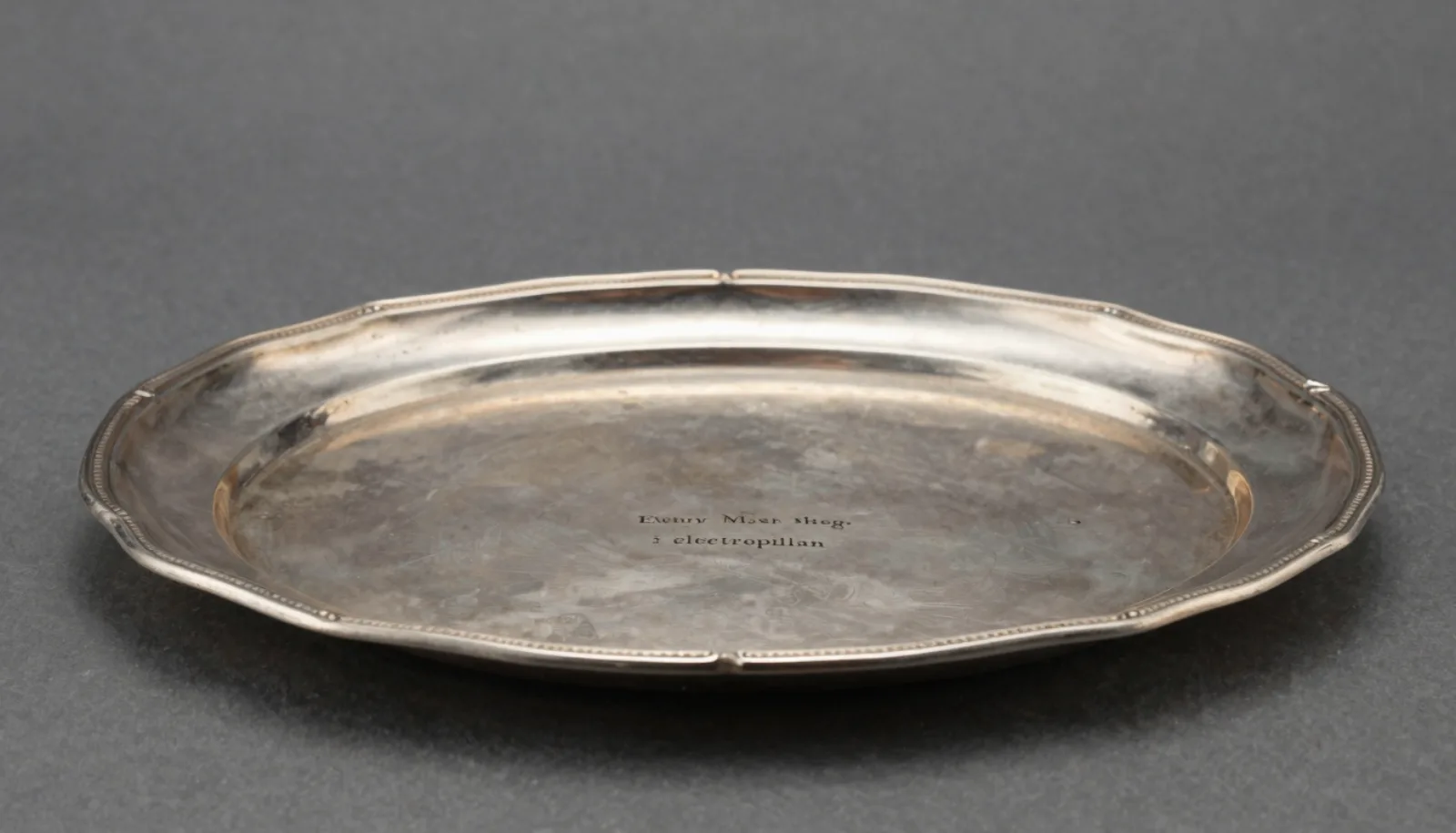
Mappin and Webb marks identify the maker, not the metal. Prince’s Plate is their electroplate line; sterling pieces carry full British hallmarks.
What does a Mappin and Webb mark actually tell you?
A Mappin and Webb mark tells you who sold the piece, not what it is made of. The firm put its name on sterling silver, on heavy electroplate and on cutlery with steel blades, often in the same catalogue year. The words printed around that name carry the real information.
Three separate mark families appear on Mappin and Webb goods. Each one answers a different question, and collectors who confuse them end up paying sterling money for plate.
The first family is the plain factory signature. It reads MAPPIN & WEBB in block or script capitals, usually beside a place name such as SHEFFIELD, LONDON or REGENT ST. On its own, that signature guarantees nothing about silver content.
The second family is a plated trade name. On Mappin and Webb pieces that name is almost always PRINCE’S PLATE, sometimes shortened and sometimes paired with a small crown device. A trade name is advertising copy stamped in metal, and it means the piece is electroplated.
The third family is a full set of British assay marks: a standard mark, a town mark, a date letter and a sponsor’s mark. Only these were struck by an assay office, and only these carry legal force. A Mappin and Webb piece with four proper punches is solid silver.
Telling factory stamps from assay punches gets easy once you have handled a few. Assay marks sit in individual shaped shields, spaced a little unevenly, each one pressed at a marginally different depth. Factory stamps run as one continuous die with mechanically even letter spacing and a flat, uniform impression.
Here is the fast triage most dealers run at a fair, before they even reach for a loupe:
| What you see on the base | What it means | Metal | Struck by |
|---|---|---|---|
| MAPPIN & WEBB alone | Retail and factory signature | Unknown, check further | The factory |
| MAPPIN & WEBB’S PRINCE’S PLATE | Branded electroplate line | Nickel silver with silver deposit | The factory |
| M&W in a shield plus lion passant, crown and date letter | Assayed British sterling | 92.5 percent silver | Sheffield or London assay office |
| MAPPIN & WEBB with EPNS or A1 | Plated, quality grade stated | Nickel silver base | The factory |
| MAPPIN BROTHERS or ROYAL PLATE | Earlier associated firm | Usually plate | The factory |
Weight helps confirm what the marks say. A sterling Mappin and Webb sugar bowl feels dense and slightly cold, with a dull ring when tapped. The plated version of the same model feels lighter for its size and rings brighter, because nickel alloy is more elastic than silver. For the wider grammar of plated stamps, our EPNS marks reference covers the symbol set in full.
What is Prince’s Plate and why does the name matter?
Prince’s Plate is Mappin and Webb’s brand name for its best grade of electroplated nickel silver. It is not a purity standard, not an assay guarantee and not a rarer metal. It is a marketing label for a heavier deposit of pure silver laid over a nickel alloy body.
The Victorian plate trade ran on names like this. Elkington had patented the electroplating process in 1840, and by the 1860s every serious Sheffield firm needed a proprietary label to compete. Mappin and Webb reached for royal association, as did most of its rivals, and Prince’s Plate entered the catalogues in the years when the Prince of Wales was the most photographed man in Britain.
Grades mattered because plating thickness varied enormously. A cheap tureen might carry a deposit measured in fractions of a gram. A premium line carried several times that, which is why Prince’s Plate pieces from the 1880s still show intact silver on the flat surfaces while cheaper contemporaries have gone brassy at every high point.
Read the wear pattern and you can estimate the grade without any documentation. Copper or yellow nickel showing on rims, handle tips and spoon backs after 140 years is normal. Bare base metal across the whole centre of a tray means either a thin original deposit or a long career on a hotel sideboard.
| Firm | Premium plate trade name | Introduced around | Typical mark wording |
|---|---|---|---|
| Mappin and Webb | Prince’s Plate | 1860s | MAPPIN & WEBB’S PRINCE’S PLATE |
| Mappin Brothers | Royal Plate | 1850s | MAPPIN BROTHERS ROYAL PLATE |
| Elkington and Co | Elkington’s Plate | 1840s | ELKINGTON & CO with date letter |
| Walker and Hall | Flag and grade numbers | 1860s | W&H in a flag, plus a number |
| James Dixon and Sons | Trumpet and banner device | 1830s | Trumpet mark with DIXON |
Do not read Prince’s Plate as a sign of low value. The best Mappin and Webb plated hollowware was made to the same models as the firm’s sterling range, by the same designers, on the same dies. A Prince’s Plate entree dish and its sterling twin can be identical in form, and the plated one often survives in better condition because nobody sent it to be melted in a silver spike.
Collections at the Victoria and Albert Museum show how far the Sheffield plate trade pushed design ambition during this period. For the broader picture of how these branded stamps evolved, our guide to EPNS and silver plated marks sets out the shared vocabulary, and the Elkington plate mark system explains the one rival scheme that carries a genuine date code.
How do you date a Mappin and Webb piece?
Date a Mappin and Webb piece from the wording of the mark first, then from the address, then from the form. Plated goods carry no date letter, so the firm’s own corporate history becomes the clock.
The company name changed several times, and each change leaves a fingerprint. An ampersand form without the word Limited points to the nineteenth century. The addition of LTD moves you into the twentieth. A simplified M&W monogram without any spelled name suggests the post war decades.
| Wording or clue on the piece | Approximate period | Why it dates the piece |
|---|---|---|
| MAPPIN BROTHERS, Queen’s Cutlery Works | 1840s to 1902 | Separate firm, absorbed by Mappin and Webb |
| MAPPIN & WEBB with no LTD | about 1860 to 1889 | Partnership years before incorporation |
| MAPPIN & WEBB LTD | 1889 onward | Limited company registration |
| Royal Warrant wording or royal arms | 1897 onward | Warrant granted in Queen Victoria’s reign |
| OXFORD ST or REGENT ST address | late 1800s to mid 1900s | London retail addresses of the period |
| ROYAL WORKS SHEFFIELD | late 1800s onward | The Sheffield manufacturing plant |
| Plain M&W monogram, sans serif | mid twentieth century onward | Modernised corporate identity |
Origins go back further than the partnership itself. Jonathan Mappin was working as a Sheffield silversmith in 1775, and the family business passed through several generations before John Newton Mappin took George Webb into partnership around 1859. That partnership date is the one to remember, because a piece cannot be Mappin and Webb before it.
Form gives you a second, independent estimate. Heavy gadrooned borders and bulbous bodies point to the 1870s and 1880s. Slim reeded edges, oval bodies and restrained beading suggest an Edwardian revival of Georgian taste. Stepped geometry, black bakelite handles and flat planes place a piece firmly in the 1925 to 1939 window.
Sterling pieces skip all this guesswork. A British date letter gives you an exact assay year, and that is the only way to pin a Mappin and Webb object to twelve months. When the date letter is worn, comparing the shield shape against a reference chart usually narrows it to a single cycle.
One practical warning about pattern numbers. Many Mappin and Webb plated bases carry a stamped number of three to five digits. Those are catalogue or model references, not dates and not years. A tray stamped 1847 was not made in 1847, and treating model numbers as dates is the single most common error in online listings. Institutions such as the Smithsonian catalogue nineteenth century plated wares with the same caution.
Mappin Brothers or Mappin and Webb: which firm made yours?
Mappin Brothers and Mappin and Webb were two different companies run by members of the same Sheffield family. Sellers routinely merge them, and the confusion moves real money in both directions.
Mappin Brothers grew out of the original Jonathan Mappin workshop and traded from the Queen’s Cutlery Works in Sheffield. Its plated trade name was Royal Plate. Its cutlery reputation was strong, and its knives turn up far more often than its hollowware.
Mappin and Webb began around 1859 as a separate venture by John Newton Mappin with his brother in law George Webb. It aimed at the luxury retail trade from the start, with London showrooms and a wider range of sterling. The two firms competed directly for four decades before Mappin and Webb absorbed its relative early in the twentieth century.
| Feature | Mappin Brothers | Mappin and Webb |
|---|---|---|
| Trading period | about 1840s to 1902 | 1859 to the present day |
| Sheffield works | Queen’s Cutlery Works | Royal Works |
| Plated trade name | Royal Plate | Prince’s Plate |
| Core strength | Cutlery and table steel | Hollowware, sterling, later watches |
| Retail presence | Sheffield and limited London | Oxford Street, Regent Street, provincial branches |
| Typical survival | Knife blades and canteens | Trays, tea sets, entree dishes, flatware |
Reading the mark is the only reliable test. MAPPIN BROTHERS is spelled out in full on genuine pieces from that firm, and there is no ampersand between two surnames. Anything reading MAPPIN & WEBB, in any period style, belongs to the later company.
Watch for cutlery canteens that mix both. Families bought knives from one supplier and forks and spoons from another, then stored them in a single fitted oak case. A canteen with Mappin Brothers blades and Mappin and Webb spoons is not a fake, just a household that shopped twice.
Handles on knives complicate things again. A sterling knife handle is usually a thin, hollow, loaded shell filled with pitch and cement, so the hallmark on the handle says nothing about the blade. That structural quirk explains why knife handles get their own identification rules across every British maker, including this one.
Grade numbers stamped alongside either name work the same way they do across the Sheffield trade. A single letter and figure combination indicates a plating class rather than a maker, which is why the Walker and Hall flag and number system is worth reading beside this one. Auction records aggregated by Kovels show the two Mappin names selling in visibly different bands for comparable objects.
Not sure what you’ve got?
Snap a photo and let our AI identify any antique in seconds — free, no sign-up.
Identify on iPhone →Learn MoreReading the sterling hallmarks on Mappin and Webb silver
On sterling Mappin and Webb pieces the firm appears as a sponsor’s mark, struck as initials inside a small shaped punch. That punch sits alongside three official marks applied by the assay office, and together they date and certify the piece.
The sponsor’s mark is usually rendered as M&W, sometimes with a full stop between letters, sometimes with LD or LTD added. The surrounding shield varies by registration and by office, which is exactly why sponsor marks are recorded office by office rather than nationally.
Mappin and Webb registered at more than one assay office because it manufactured in Sheffield and retailed in London. The town mark on the piece tells you which office tested it, not where the firm was based.
| Assay office | Town mark | Common on Mappin and Webb | Notes |
|---|---|---|---|
| Sheffield | Crown until 1974, rose afterwards | Very common | The firm’s manufacturing base |
| London | Leopard’s head | Common on retail pieces | Struck for the West End showrooms |
| Birmingham | Anchor | Occasional | Smaller items and novelties |
| Chester | Three wheatsheaves and a sword | Rare, pre 1962 | Office closed in 1962 |
Standard marks follow the ordinary British system. A lion passant walking left means 92.5 percent sterling from an English office. A crowned rampant lion or a thistle indicates Scottish assay. Britannia seated with a shield means the higher 95.8 percent standard, which is uncommon on this firm’s output.
Date letters are the payoff. Each office ran its own alphabet in cycles, changing the font and the shield outline every cycle, so the same letter recurs roughly every twenty five years in a different dress. Matching the letter, its typeface and its shield against a chart gives an exact assay year, and Sheffield’s sequence is set out in our Sheffield silver hallmarks guide.
Placement follows object type rather than maker preference. Look inside the foot rim on bowls and candlesticks, on the underside near the handle join on jugs, on the back of the stem on flatware, and around the flange on lids. Lids were assayed separately and can carry a different year from the body by a season or two.
One structural detail catches people out repeatedly. Loaded candlesticks and knife handles are filled with pitch or resin, so they weigh far more than their thin sterling shells justify. The hallmark is still valid; the weight simply is not a guide to silver content. Comparable British pieces in the Metropolitan Museum of Art collection show the same construction.
What is Mappin and Webb plate worth today?
Mappin and Webb plate is worth more than generic EPNS but far less than the firm’s sterling. Condition of the plating drives the price, followed by completeness, then by form. The name adds a premium of roughly a third over an unbranded Sheffield equivalent in similar condition.
Plated silver has effectively no scrap value, because recovering a deposit measured in grams costs more than the silver returns. That single fact reframes the whole market. A plated Mappin and Webb tray sells as a decorative object, so a bright, unworn surface can be worth several times a dull one of identical model.
| Object | Plated, good condition | Plated, worn to base metal | Sterling equivalent |
|---|---|---|---|
| Four piece tea service | 120 to 350 dollars | 40 to 90 dollars | 900 to 3,000 dollars |
| Large two handled tray | 100 to 400 dollars | 35 to 80 dollars | 1,500 to 5,000 dollars |
| Pair of entree dishes | 150 to 450 dollars | 50 to 120 dollars | 1,200 to 3,500 dollars |
| Six place canteen of flatware | 90 to 300 dollars | 30 to 70 dollars | 700 to 2,500 dollars |
| Single sauce boat | 30 to 90 dollars | 10 to 25 dollars | 200 to 600 dollars |
Treat those bands as orientation rather than appraisal. Realised prices swing with venue, region and the exact model, and the sold archives on WorthPoint are the fastest way to test any specific piece against actual results rather than asking prices.
Four attributes lift a plated piece above its band. Original fitted cases with the retailer’s name inside add real money. Complete services beat orphan pieces by a wide margin. Presentation inscriptions to a named ship, regiment or company attract collectors who buy the story. Art Deco forms from the 1925 to 1939 window outperform Victorian shapes in the current market.
Two attributes destroy value quickly. Replating done cheaply leaves a hard, uniform brightness with softened detail on the engraving, and experienced buyers spot it immediately. Removed monograms leave a thin, slightly dished patch that catches the light at an angle and often bleeds through to base metal within a decade.
Sterling changes the arithmetic completely, because the metal itself sets a floor. A sterling tea service is worth its bullion content on the worst day and several times that as an antique on a good one. That is why establishing plate against sterling before you negotiate matters more than any other identification step, and why our silver plate marks reference leads with that distinction.
Where Mappin and Webb identification usually goes wrong
Most Mappin and Webb misidentifications come from six repeatable errors. Each one has a quick test that settles it in under a minute.
Reading the trade name as a silver standard is the first. Prince’s Plate sounds official and sits in a decorative cartouche, so people file it beside sterling. It is a brand, and its presence positively confirms the piece is plated.
Mistaking model numbers for dates is the second. Numbers stamped near the maker signature are catalogue references. Cross checking two pieces from the same service usually settles it, because a matched pair carries the same number and cannot share a manufacture year with an unrelated tray.
Treating a crown as a hallmark is the third. Sheffield’s assay office used a crown as its town mark until 1974, and plated manufacturers put decorative crowns on their stamps precisely because of that echo. An assay crown appears in its own shield beside three other punches, never alone inside a maker’s cartouche.
Assuming the London address means London assay is the fourth. Retail addresses record where the piece was sold. The town mark records where it was tested. A Regent Street address with a Sheffield crown is entirely normal.
Judging silver by weight is the fifth. Loaded candlesticks and filled knife handles are heavy for the wrong reason. A dense feel proves filler, not fineness.
Trusting a single worn punch is the sixth. Partial marks invite wishful reading, and a rubbed lion passant looks a great deal like a rubbed decorative lion. Working from three of four marks is the professional habit, and our step by step identification walkthrough sets out the order to check them in.
A sensible working sequence looks like this:
- Photograph the mark straight on, in raking light from one side.
- Read every word, including trade names and place names.
- Count the punches and check whether each sits in its own shield.
- Decide plate or sterling before you think about value at all.
- Only then look up the maker, the date letter and comparable sales.
When the marks are too worn to parse by eye, photographing them and running the image through Antique Identifier – Antiqly gives you a starting reading in seconds, which you can then verify against the tables above.
Frequently Asked Questions
Is there an app that can tell Mappin and Webb plate from sterling?
Antique Identifier – Antiqly reads branded plate wording such as Prince’s Plate and full British assay punches from the same photograph, then tells you which one you are looking at. That distinction is the whole ball game with this maker, because a sterling tea service and its plated twin share the same model, the same borders and the same signature. Antiqly is free to download, needs no account to try, and works on worn stamps where the letters have gone soft. Use it for the first reading, then confirm the date letter against a printed chart.
Does Prince’s Plate contain any real silver?
Yes, but as a surface deposit rather than as the body of the object. Prince’s Plate pieces are nickel silver, an alloy of copper, nickel and zinc containing no silver at all, coated electrolytically with a layer of pure silver. Premium grades carried heavier deposits than budget lines, which is why well kept Prince’s Plate from the 1880s often still shows unbroken silver on flat surfaces. The recoverable quantity is small enough that refiners will not pay for it, so plated pieces have essentially no scrap value. Their worth is decorative and collectible, driven by condition, completeness and form rather than metal content.
How do I date a Mappin and Webb tray with no date letter?
Work from the wording, the address and the form, in that order. A mark without LTD suggests the partnership years before 1889, while LTD or LD places the piece after incorporation. A spelled London address such as Oxford Street or Regent Street narrows it further, and ROYAL WORKS SHEFFIELD points to the manufacturing plant. Then read the shape: gadrooned, heavy borders indicate the 1870s and 1880s, reeded oval Georgian revival forms suggest Edwardian production, and stepped geometry with black handles means 1925 to 1939. Ignore any stamped three to five digit number, which is a catalogue model reference and never a year.
What is the difference between Mappin Brothers and Mappin and Webb?
They were two separate Sheffield companies run by the same family. Mappin Brothers traded from the Queen’s Cutlery Works, branded its plate as Royal Plate, and built its name on cutlery and table steel. Mappin and Webb was founded around 1859 by John Newton Mappin with George Webb, aimed at luxury retail, branded its plate as Prince’s Plate, and expanded into London showrooms and a broad sterling range. The two competed for roughly four decades before Mappin and Webb absorbed Mappin Brothers early in the twentieth century. Read the mark literally: two surnames joined by an ampersand means the later, larger firm.
Is a crown on the mark proof my Mappin and Webb piece is silver?
No, and this is one of the most expensive assumptions in the plate market. Sheffield’s assay office used a crown as its town mark until 1974, so plated manufacturers stamped decorative crowns on trade name cartouches to borrow the association. An authentic assay crown appears as a separate punch in its own small shield, sitting alongside a lion passant, a date letter and a sponsor’s mark. A crown floating inside a maker’s decorative panel, with no companion punches, is factory ornament. Count the punches before you trust the symbol, and treat any lone crown as evidence of plate.
Is Mappin and Webb silver plate worth restoring or replating?
Only for pieces with sentimental value or unusually good form, because replating rarely returns its cost. A professional replate of a four piece tea service typically runs from 200 to 500 dollars, against a finished market value that often sits in the 120 to 350 dollar band. Replating also softens engraved detail and leaves a hard, even brightness that experienced buyers read instantly as recent work. Original surface with honest wear generally outsells a fresh replate among collectors. The exception is heavy Art Deco hollowware from the 1925 to 1939 period, where strong demand can occasionally justify the outlay.
Identify any antique in seconds.
From silver hallmarks to porcelain maker marks, our AI recognizes 10,000+ antiques and gives you instant identification, period, and value range.
Download Free on iPhoneSee How It Works