
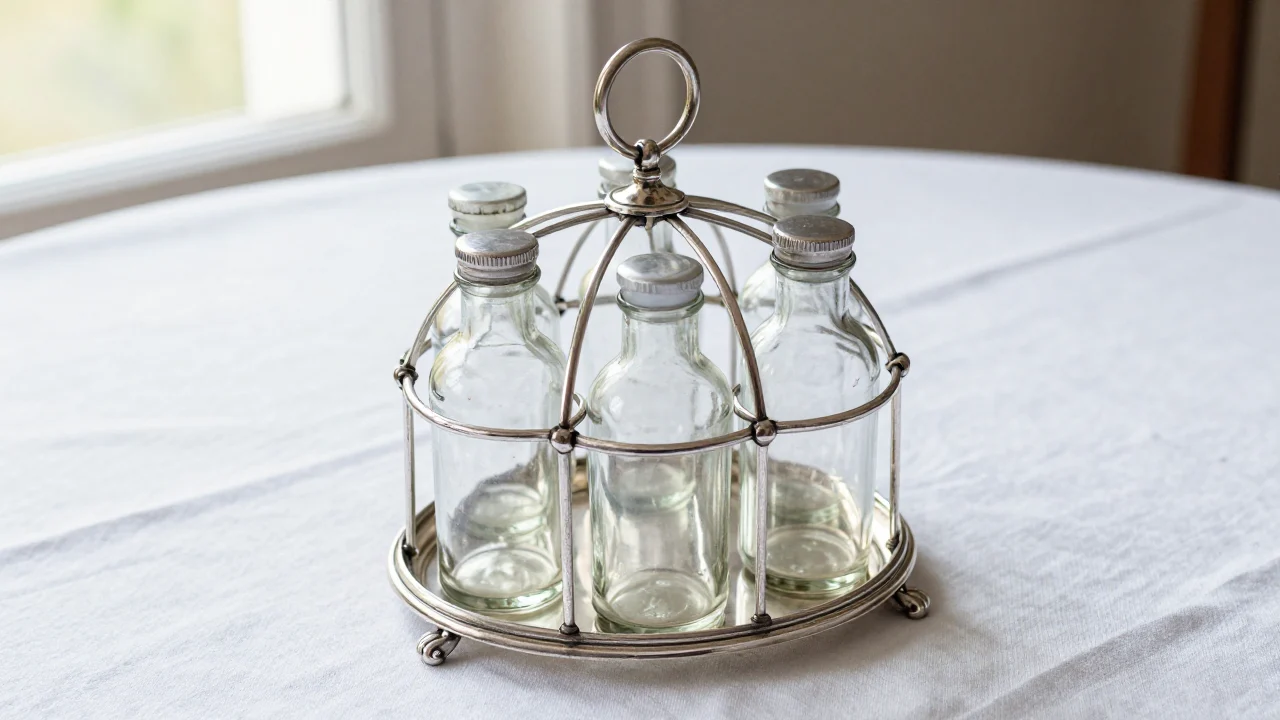
Complete Georgian silver cruet frames with their bottles made £550 and £1,300 hammer at Toovey’s in 2026; frames sold without bottles made £260 to £320.
Every figure in this guide is a published auction result with its sale date and lot page linked, so you can set your own frame beside one that actually changed hands. All results come from one saleroom, Toovey’s, which prints the hammer price on the lot page and states that all sold prices shown exclude Buyer’s Premium. Cruet frames sold on their own are scarce, so this guide also shows frames that sold inside mixed lots and says so in every row; a mixed-lot total is a price for the whole group, never for the frame alone. No figure is a dealer’s asking price, and none is the net amount a seller took home.
What is a silver cruet set?
A silver cruet set is a frame on feet, usually with a central handle, that holds a fixed number of bottles and casters for oil, vinegar, salt, pepper and mustard, and the frame and its containers together are the set. The Wikipedia article on cruet-stands puts it simply: a cruet-stand (or cruet in British English) is a small stand of metal, ceramic, or glass which holds containers for condiments, and the stand and containers form a cruet set. The V&A’s record for the Warwick cruet frame of 1763-4 by Robert Piercy describes the classic Georgian arrangement: this silver cruet frame holds two silver and glass bottles for oil and vinegar and three casters for salt, pepper and mustard, and the casters stand on a silver base plate of cinquefoil shape, supported by four scroll legs with cast shell feet, below a frame that consists of seven ring sockets. Even this museum frame is short of parts: the two smallest lack their casters and project beyond the base plate. The London dealer Bryan Douglas gives the same five-piece formula a name and a date: the earliest known examples date from the Queen Anne period in the early 18th century, and early examples, called Warwick cruets had three matching all silver casters (with one un-pierced), and two silver-mounted glass bottles for oil and vinegar, all sitting in a silver frame-work attached to a stand with a central handle.
The two-bottle frame is older and simpler. The V&A’s cruet frame by Samuel Wells of 1740-1 consists of two round sockets on four scroll legs with shell feet, scroll handle, and the museum notes that the two glass bottles with silver mounts in this cruet set held oil and vinegar. By the end of the century the frame had grown. The V&A’s Hester Bateman cruet set of 1787-8 is a circular frame with bright cut and ribbon pattern piercing, a wooden base with three applied claw and ball feet and a central handle with heart shaped loop, holding cut glass casters and cruets. Bryan Douglas describes the later run of the form: later Georgian and Victorian versions had all silver-mounted cut-crystal bottles in a frame, varying from two to eight bottles, and they were made throughout the Georgian and Victorian periods but went out of vogue in the 20th century. Toovey’s catalogue descriptions from 2025 and 2026 span that whole range: a two-bottle stand of 1919, a five-bottle stand of 1869, a six-bottle stand of 1801 and an eight-bottle stand of 1811.
What makes a cruet set complete?
A cruet set is complete when the frame has its handle and feet, every socket holds its original bottle or caster with its own mount, cover or stopper, and the silver mounts carry marks that correspond with the frame. Bryan Douglas’s collectors’ note sets the standard: because there are so many different parts to a full cruet set it is very important to make sure that every removable silver piece is hallmarked, and the stand, frame, caster bases, caster tops, and silver-mounted bottles should all have corresponding marks. The same note explains why so few sets pass that test: it is very rare now to find an 18th century cruet set with all its original glass bottles and stoppers, and replacement casters or bottles are often found which should reduce the value of the set. Museums record the same problem. The V&A’s Paris cruet set of 1763-4 by Jean-Charles Gordière is an oval frame with two glass cruets, and the record states that the glass cruets for condiments are later replacements.
Auction catalogues give you the vocabulary for what is missing. Toovey’s described a Mappin & Webb twin-bottle stand of Sheffield 1919 as lacking bottles, a George Burrows II boat-shaped stand of London 1824 as lacking handle and bottles, an Elkington five-bottle stand of Birmingham 1869 with its small bottle lacking stopper, and a William Knight II eight-bottle stand of London 1811 with minor faults even though it was fitted with two silver lidded ribbed cut glass mustards, two matching silver handled cut glass bottles and stoppers and four smaller silver handled cut glass bottles and stoppers. Read your own set against that list: count the sockets, count the bottles, count the stoppers and covers, and check that the cutting on every bottle matches its neighbours. A glass part that does not match is the cruet-frame version of the problem this site’s mustard pot guide describes for liners, and it is worth recording before you value the set.
Where are the hallmarks on a cruet frame and its mounts?
The hallmarks on a cruet frame are on the frame itself, usually on the base or a foot, and each silver mount, caster body and caster cover should carry its own marks. Toovey’s description of a miniature toy cruet stand of about 1725 by David Clayton shows how a well-marked set reads: ‘DC’ maker’s mark to three casters, two flasks unmarked and four ‘DC’ marks and two lion passant marks to stand. The V&A records that on the Warwick frame the silver casters are fully hallmarked on the bases under the foot ring, the baseplate of the stand also fully marked, with the lion passant, the leopard’s head crowned, the maker’s mark RP and the date letter, and this site’s silver marks guide explains what each of those four marks tells you. The Goldsmiths’ Company gives the office symbols to look for: a leopard for the London Assay Office, an anchor for the Birmingham Assay Office, a rose for the Sheffield Assay Office, and a castle for the Edinburgh Assay Office, and the UK hallmarks guide gives each office’s date-letter cycles.
Two dates help you read the frames in the results below. The Wikipedia hallmark article records that in 1784, the United Kingdom began charging a tax on silverware, and a further mark was added to indicate this had been paid, and that the mark was the monarch’s head and continued to be used until 1890, when the tax was abolished; the frames of 1801, 1807, 1811, 1815, 1824 and 1869 all fall inside that period and should show the head, while the frames of 1900, 1919 and 1998 should not. The Birmingham Assay Office states that it was established in 1773, so the Elkington five-bottle stand of Birmingham 1869 carries the anchor rather than the leopard. When mounts and frame show different date letters or different makers, the set has been assembled or repaired, and Bryan Douglas’s rule that all the parts should have corresponding marks is the test a buyer will apply.
Which cruet frames are plate rather than silver?
A cruet frame with no lion passant, no office mark and no date letter on the frame or its mounts is plate rather than silver, and plated frames run from Sheffield plate in the eighteenth century to electroplate afterwards. The V&A’s Sheffield plate cruet stand of the late 18th century is an oval frame on base with reeded edge and four ball feet, containing cut glass mustard pot and two pepper pots with plated tops and four bottles with stoppers, and its record dates the material: Sheffield plate originated, with the discovery in 1742, that bars of silver and copper, in unequal proportions, fused by heating under pressure, could be rolled into sheets of laminated metal and worked like silver. The same record notes four small circular dishes (liners wanting), so even a museum frame can be incomplete. This site’s silver plate marks guide explains the stamps that plated frames carry instead of hallmarks.
Plated frames rarely sell on their own at Toovey’s, and that is a fact about value in itself. Between June 2025 and May 2026 the saleroom sold a William IV Sheffield plate cruet stand inside a collection of assorted plated items at £190 hammer, a four-bottle plated cruet stand fitted with four cut glass bottles inside a group of plated items at £220, two four-bottle cruet stands each fitted with four glass bottles inside a biscuit-box lot at £160, and a cruet stand (lacking handle) inside a collection of plated items at £42. Those totals belong to whole groups of coffee pots, dishes and cutlery, so no plated frame here has a price of its own; what the lots show is that a plated cruet, complete or not, is catalogued as one item among many.
What are silver cruet sets worth, complete or not?
A complete Georgian silver cruet frame with all its bottles made £550 and £1,300 hammer at Toovey’s in 2026, while silver frames sold alone without their bottles made £260 and £320, and plated frames only reached the rostrum inside mixed lots. The table gives every result used, with the catalogue’s own words on completeness; open the lot page before you compare, because a frame’s weight, bottle count and faults decide where it lands. Hammer prices exclude the buyer’s premium, which Toovey’s states is currently set at 25% plus VAT (30% including VAT) of the hammer price on its 2026 lot pages, and the seller’s net after commission is not published. If you want the marks on your own frame and mounts read before you set a figure, the hallmark apps compared on this site include Antique Identifier – Antiqly, free to download on iPhone and Android, which reads a photographed mark and returns the maker, assay office, purity standard, and probable date range to check against the frame.
| Cruet set as catalogued | Date and maker | Hammer result | What decided it |
|---|---|---|---|
| Eight-bottle rectangular stand with gadrooned and scallop shell rim, two handles, fitted with two silver lidded mustards, two silver handled bottles and four smaller silver handled bottles, stand 1196.5g, length 37.5cm, minor faults | London 1811, William Knight II | Hammer price: £1,300, 5 August 2026 | Complete eight-bottle Georgian set with a heavy stand; sold alone, Toovey’s |
| Six-bottle oval stand with central handle and scroll feet, fitted with six cut glass bottles, frame 299.8g, sold with three silver labels for Kyan, Soy and Tarragon, another silver label and two plated labels | London 1801, John Emes | Hammer price: £550, 18 February 2026 | Complete six-bottle Georgian set; the labels in the lot weighed 12.4g, so the frame carried the price, Toovey’s |
| Miniature toy cruet stand, two-tier, three graduated casters and two glass flasks with silver covers, width 10cm | London circa 1725, David Clayton | Hammer price: £440, 9 September 2026 | Rare early toy with marks on stand and casters; collector’s provenance, Toovey’s |
| Five-bottle quatrefoil stand with beaded wirework divisions, shell salt and scroll handle, cut glass pepper and mustard with silver collars and covers, two bottles and stoppers and a small bottle, stand and one cover 249.2g, small bottle lacking stopper | Birmingham 1869, Elkington & Co | Hammer price: £260, 18 February 2026 | Victorian set nearly complete but light, one stopper missing, Toovey’s |
| Oil and vinegar bottle stand with wirework sides and ring handle, fitted with two cut glass bottles and stoppers, height 19cm | London 1998, J.A. Campbell | Hammer price: £95, 15 May 2024 | Complete but modern two-bottle stand, Toovey’s |
| Twin-bottle rectangular stand with spiral twist handle, 510.6g, length 20.7cm, lacking bottles | Sheffield 1919, Mappin & Webb | Hammer price: £320, 19 February 2025 | Empty frame; weight and maker’s name, Toovey’s |
| Egg cruet stand with seed head handle above six apertures, gadrooned rim, 543.6g, height 19cm, lacking egg cups | London 1807, John Emes | Hammer price: £260, 29 November 2023 | Empty Georgian frame by the same maker as the £550 set; weight, Toovey’s |
| Pair of silver mounted cut glass oil and vinegar bottles with reeded necks and scroll handles, partial marks, height 19.5cm, sold with a silver lidded sugar caster | Mid-18th century, partial marks | Hammer price: £100, 24 January 2024 | Orphan bottles without their frame, Toovey’s |
Three frames sold inside mixed silver lots, and their totals are shown here only so that you do not mistake them for frame prices. A George IV boat-shaped stand of London 1824 by George Burrows II, 256.8g, lacking handle and bottles, sold with Norwegian and Continental salts and casters and a specimen vase for £240 hammer on 9 July 2025. A four-bottle cruet stand of London 1815 sold inside a William Comyns salt lot with a helmet cream jug of 1794 for £220 on 11 June 2025, weighable items 382.2g. A late Victorian four-bottle condiment set of London 1900 by Goldsmiths & Silversmiths Co Ltd, fitted with a vinegar bottle and stopper, a mustard and spoon, pepper caster and salt, sold with a stamp box, napkin rings, an ashtray and dressing table jars for £170 on 19 March 2025.
The table points to three price drivers. Completeness first: the two complete Georgian frames sold alone made £550 and £1,300, while the two empty Georgian and George V frames made £260 and £320, and the Burrows frame that had lost both handle and bottles did not even reach the rostrum on its own. Weight and size second: the Knight stand weighs 1196.5g against 299.8g for the Emes frame, and its eight silver-mounted bottles are part of what a buyer paid for, so a frame that is both complete and heavy sits at the top. Period third, read with the sale date: the two complete sets were both Georgian, and this site’s Georgian silver guide explains why 1714-1830 silver commands a premium, but the Elkington stand of 1869 at £260 was also nearly complete and simply lighter and later, so period alone did not set the price. With only two complete Georgian results in the window, treat £550 to £1,300 as two data points rather than a band, and treat any set with replaced bottles as sitting below the complete results until a comparable sale shows otherwise.
What should you do with your cruet set now?
Start by lifting every bottle and caster out of the frame and laying them in a row, then photograph the marks on the frame’s base, on each mount, collar and cover, in low side light, and write down the office mark, date letter and maker for each part so that you can see at once whether they correspond. Then count the sockets against the bottles and stoppers, compare the cutting and the shape of the glass from bottle to bottle, and note any missing handle, feet, stopper or cover in the catalogue’s words, because the buyer’s description will use them. Finally, weigh the frame without its glass, find the row in the table whose bottle count, period and completeness are closest to yours, open the lot page and read the full description against your own set before you set a reserve, an insurance figure or a bid.
Method and limits. Toovey’s results are hammer prices printed on lot pages between November 2023 and September 2026, read on 27 September 2026, with the buyer’s premium statement quoted from those pages; weights are the catalogue’s figures for the stand or frame only, and where a lot held labels, a caster or other items the figure is for the whole lot. Cruet frames sold alone are scarce in this window, so the guide includes one saleroom only and shows every mixed-lot result with that caveat; no dealer, online-marketplace, private-sale or other saleroom prices are used, and no set described here was examined in hand. Object history and completeness rules follow the V&A records, Wikipedia and the Bryan Douglas collectors’ note; a mark on its own does not prove date, maker or metal, corresponding marks show that the parts belong together rather than that the glass is original, and no result here is a valuation of your set.