
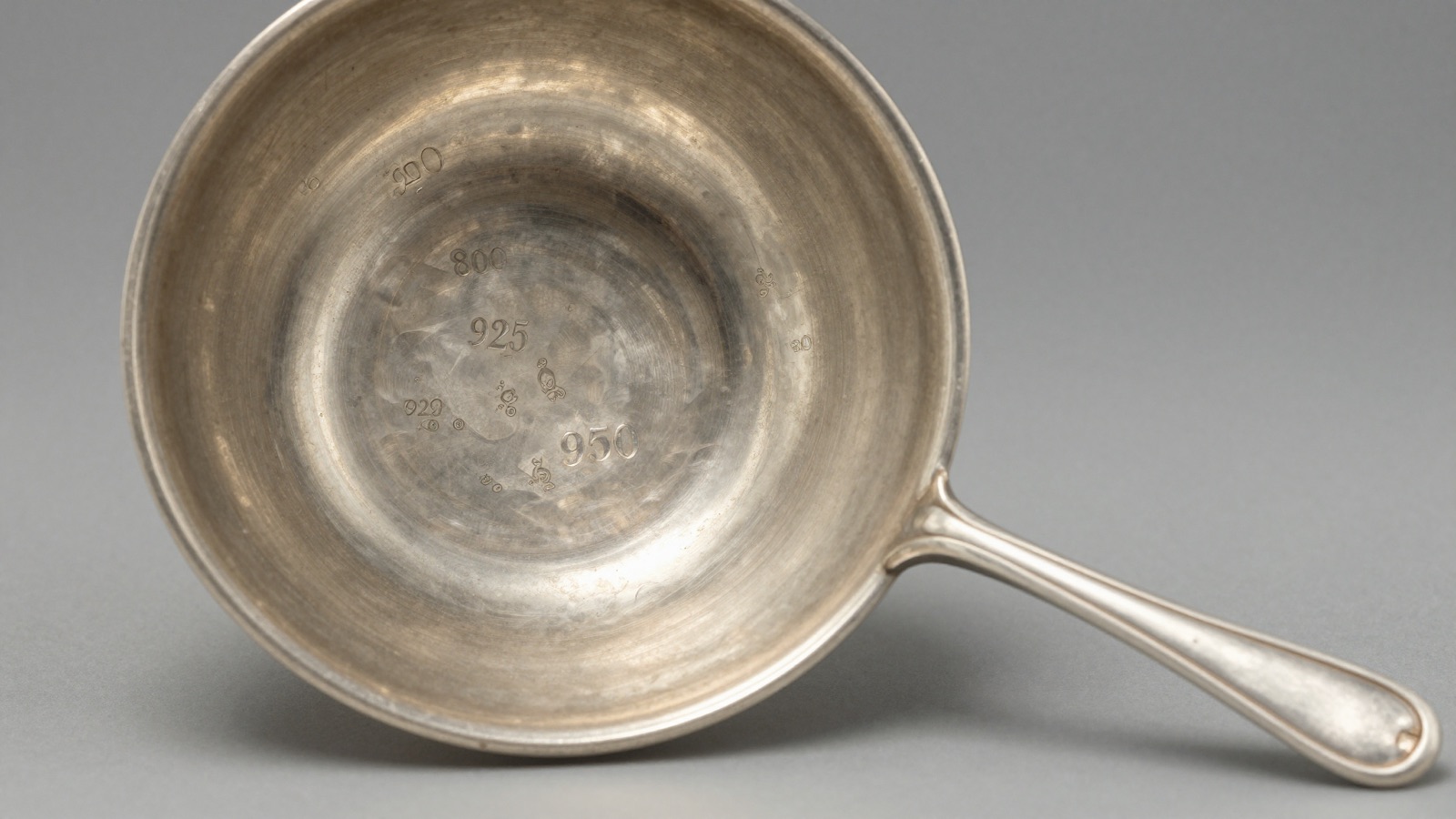
Silver purity marks from 800 to 999 show how much pure silver a piece contains, expressed in parts per thousand. 800 is 80% pure; 999 is fine silver.
What silver purity marks actually measure
A silver purity mark tells you how much pure silver sits inside an alloy. It never means the whole piece is solid metal. Pure silver is too soft for daily use. Makers blend it with copper for strength, and the stamped number records that ratio.
Any seasoned collector reads the number as parts per thousand. A mark of 925 means 925 parts pure silver in every 1,000. The remaining 75 parts are usually copper. That single figure separates a keepsake worth its weight from base metal worth almost nothing.
Purity marks matter for value because silver trades by weight and fineness. A 200-gram bowl stamped 800 holds 160 grams of pure silver. The same bowl stamped 950 holds 190 grams. At current spot prices that gap is real money, and refiners start every offer with the number.
The mark also anchors provenance. Certain standards belong to certain countries and periods. An 800 stamp points toward continental Europe. A lion passant points toward England. A 950 mark suggests France or modern studio work. The number narrows the search before you even reach the maker.
Do not confuse a purity mark with a decorative number. Pattern codes, model numbers, and catalog references also appear on silver. A Gorham holloware base might carry a four-digit shape number near the sterling stamp. A true fineness figure sits in a specific band, from about 750 up to 999. Anything outside that band is not a purity mark.
Collectors trust the mark but verify the metal. Fakes exist. A stamped 925 on a suspiciously light, grey piece deserves a magnet test and a second look. Real silver is non-magnetic and develops a warm patina. For a primer on where these numbers fit among the other stamps, our silver marks guide walks through each mark type in order.
The Victoria and Albert Museum, whose silver galleries hold thousands of marked objects, treats fineness as the first data point in any catalog entry. You can copy that habit at a flea-market table. Read the number first, then the symbols, then the maker.
The parts-per-thousand system explained
Silver fineness uses a millesimal scale. The scale runs from 0 to 1,000 and counts pure silver per thousand parts by weight. A reading of 900 means the alloy is 90% silver. The system is precise and international.
Millesimal fineness replaced older fractional systems for a reason. Percentages hide small but meaningful differences. The gap between 800 and 835 silver looks trivial as a fraction. As a mark it is unmistakable and legally distinct. The three-digit stamp removed ambiguity across borders.
Read the number as a decimal to picture the metal. 999 fine silver is 99.9% pure. 925 sterling is 92.5% pure. 800 silver is 80% pure. Each step down adds copper, hardness, and a slightly warmer color. High-copper alloys tarnish faster and ring with a duller tone.
The Wikipedia entry on millesimal fineness lists the recognized standards for silver, gold, and platinum. Silver clusters at a handful of legal marks: 800, 830, 835, 875, 900, 925, 950, and 999. Odd numbers between those points are rare and usually mark an unofficial or regional stamp.
Weight makes the scale practical. Take a candlestick that weighs 300 grams loaded, but whose base is filled with pitch and plaster. Only the silver skin counts toward fineness. Filled pieces are stamped for the silver content, not the total mass. That detail trips up first-time sellers who weigh the whole object.
The scale also explains melt math. To find pure silver content, multiply gross silver weight by the fineness. A 500-gram tray at 925 contains 462.5 grams of fine silver. Refiners pay on that figure minus a fee. Collectors who understand the calculation avoid lowball offers.
Older pieces sometimes carry no number at all. British silver used symbols instead of digits for centuries. A lion passant guaranteed sterling standard without ever stamping 925. Knowing both systems, symbolic and numeric, lets you date and value almost anything. For sterling specifically, our sterling silver identification guide covers the numeric and symbolic marks side by side.
Common silver purity standards from 800 to 999
The silver world runs on about eight recognized standards. Each has a legal home, a typical era, and a distinct feel in the hand. The table below maps the main marks you will meet.
| Fineness mark | Pure silver | Common name | Typical origin | Notes |
|---|---|---|---|---|
| 800 | 80.0% | Continental standard | Germany, Italy | Warm tone, tarnishes faster |
| 830 | 83.0% | Scandinavian standard | Denmark, Norway | Common on mid-century flatware |
| 835 | 83.5% | Continental standard | Germany, Netherlands | Widespread pre-1970 Europe |
| 900 | 90.0% | Coin silver | United States, France | Made from melted coinage |
| 925 | 92.5% | Sterling | UK, US, worldwide | The global benchmark |
| 950 | 95.0% | French first standard | France | Minerva head mark |
| 958 | 95.8% | Britannia | England | Higher than sterling |
| 999 | 99.9% | Fine silver | Modern bullion, studio | Too soft for cutlery |
Sterling at 925 sits in the middle and dominates the market. It balances durability with a high silver load. Most antique flatware, tea sets, and jewelry you find will read 925 or carry the equivalent British symbols. That familiarity is why buyers pay a premium for it.
The 800 to 835 band belongs to continental Europe. German, Italian, and Dutch makers used these standards for generations. A German cake server stamped 800 with a crown and crescent is textbook. Our detailed 800 silver mark meaning guide breaks down that exact combination.
The high end, 950 and above, splits into two worlds. French 950 silver is antique and prestigious, carrying the Minerva head. Modern 999 fine silver is bullion and contemporary studio work. A 999 spoon would bend in your hand, so genuine antique flatware never reads that high.
The Metropolitan Museum of Art catalogs European silver by these exact standards, and its online collection lets you compare marked examples across centuries. Reading the table is the start. Matching the number to the object type and the country is the real skill.
Country-by-country purity marks
Each silver-producing nation built its own marking law. The fineness number is only half the story. A country mark, an assay symbol, and often a date sit beside it. The table below pairs the common standard with its national signature.
| Country | Common fineness | Signature mark | Era peak |
|---|---|---|---|
| England | 925 (sterling) | Lion passant | 1544 to today |
| England | 958 (Britannia) | Britannia figure | 1697 to 1720 |
| France | 950 and 800 | Minerva head | 1838 to today |
| Germany | 800 and 835 | Crown and crescent moon | 1888 to today |
| United States | 925 and 900 | Word STERLING or COIN | 1860s to today |
| Russia | 875 (84 zolotnik) | Kokoshnik profile | 1896 to 1917 |
| Netherlands | 833 and 934 | Lion rampant | 1814 to today |
| Italy | 800 and 925 | Fascio, then province number | 1930s to today |
England never relied on the number alone. The lion passant did the work of a 925 stamp for four centuries. British silver also carries a town mark, a date letter, and a maker’s mark, the famous four marks. For the full British system, our European hallmarks overview places England alongside its neighbors.
Germany switched to the crown and crescent under the 1888 Hallmarking Act. The number states the purity; the crown and moon confirm the piece is German national standard. An 835 stamp with that symbol is a safe continental attribution.
Russia used the zolotnik system before 1927. An 84 mark equals roughly 875 fineness. The kokoshnik, a woman’s profile in a traditional headdress, replaced the older town marks in 1896. Imperial Russian silver with a clear kokoshnik and an 84 draws strong collector interest.
The United States kept it plain. American makers stamped the full word STERLING rather than 925 for most of their history. Earlier pieces read COIN or carried 900 silver from melted currency. The Smithsonian’s American silver holdings show this shift from coin to sterling across the nineteenth century.
Reading the country mark alongside the number prevents costly mistakes. A 950 stamp on a French tureen is normal and desirable. The same number invented on an American piece would raise a red flag.
Not sure what you’ve got?
Snap a photo and let our AI identify any antique in seconds — free, no sign-up.
Identify on iPhone →Learn More925 sterling, 958 Britannia, and the high-purity end
Sterling silver at 925 is the world’s default fine-silver standard. The name traces to medieval England and the sterling penny. The alloy holds 92.5% silver and 7.5% copper. That ratio has barely changed in eight centuries.
Sterling earned its dominance through balance. It resists denting better than purer alloys. It still carries enough silver to shine and hold value. A Georgian sterling teapot from 1790 can survive daily use two centuries later. Purer metal would have deformed long ago.
Britannia silver at 958 is the rarer British cousin. Parliament forced it on the trade from 1697 to 1720. The aim was to stop silversmiths clipping sterling coins for raw metal. The higher standard made coin-clipping pointless. Britannia pieces from that window are prized survivors.
The Britannia mark shows a seated female figure, not the lion passant. Any collector who spots her knows the piece predates 1720 or was made to that optional standard later. Our Britannia silver hallmark guide details the figure and its date range.
Above sterling sit 950 and 999. French 950, marked with the Minerva head, was the first standard for fine French work. It feels slightly softer than sterling and takes crisp engraving well. Nineteenth-century French flatware in 950 commands premiums at auction.
Fine silver at 999 is a modern story. It is the metal of bullion bars, commemorative rounds, and some contemporary jewelry. At 99.9% purity it is lovely but soft. You will never find genuine antique cutlery stamped 999, because it would bend at the dinner table.
The value ladder follows purity and rarity together. A common 800 continental fork carries mostly melt value. A signed Britannia tankard from 1700 carries museum-level interest. Purity sets the floor, while maker, age, and condition set the ceiling. Reading the fineness first tells you which conversation you are in.
800 silver and continental Europe
The 800 standard is the workhorse of continental European silver. It holds 80% silver and 20% copper. That extra copper adds strength and a warmer, slightly golden tone. Germany, Italy, and much of central Europe adopted it widely.
Collectors sometimes dismiss 800 silver as second-rate. That view misses the point. Many of the finest continental tea services and serving pieces are 800. The standard was legal, respected, and used by top workshops. Value comes from the maker and the object, not from a lower number.
German 800 silver is the most common you will handle. After 1888 it carries the crown and crescent moon beside the number. A WMF or Koch and Bergfeld piece stamped 800 with that symbol is a solid, collectible object. The 835 silver standard sits just above it and appears on very similar wares.
Italian silver used 800 heavily before adopting 925 for export. Older Italian pieces show the fascio mark from the 1930s, later replaced by a province number in a shaped shield. An 800 Italian coffee pot with a clear province mark dates and locates itself precisely.
Scandinavian makers favored 830 silver for much of the twentieth century. Danish and Norwegian flatware often reads 830S, the S confirming silver. Georg Jensen’s early production used 826 and 830 before standardizing higher. Those early low-standard Jensen pieces are now highly sought.
The tarnish behavior of 800 silver is a useful tell. Higher copper content means faster, darker tarnish. A piece that blackens quickly and evenly, then polishes to a warm shine, often sits in the 800 to 835 band. Pure 999 silver stays bright far longer.
Do not overlook these pieces at estate sales. An 800 continental tray priced as scrap can be a named workshop piece worth several times its melt value. The number tells you the metal. Research on the maker’s mark tells you the real worth.
How to read and verify a purity mark
Reading a purity mark starts with finding it. Silver marks hide on bases, rims, handle undersides, and clasp tongues. Use a loupe and a raking light. The number is usually the clearest element in the group.
Confirm the number sits in the fineness range. Legitimate silver marks fall between roughly 750 and 999. A three-digit number in that band is almost certainly fineness. A number outside it, like 1847 or 4021, is a date reference or pattern code, not purity.
Cross-check the number against the symbols. An 800 mark should sit near a continental symbol such as a crown and crescent. A 925 near a lion passant is redundant but plausible on export pieces. A mismatch, such as 925 beside a French Minerva, signals a possible fake or a married mark.
Test the metal when the mark looks wrong. Silver is non-magnetic, so a magnet that grabs the piece exposes plated steel. Real silver also feels cold and rings with a clear tone when tapped. The reference price guide Kovels lists mark examples you can compare against.
Watch for plated marks that mimic fineness. EPNS means electroplated nickel silver and contains no sterling. A1, A94, and similar codes indicate plate quality, not purity. These stamps sit exactly where a fineness number would, which fools beginners every year.
Photograph the mark before you research it. A sharp, well-lit macro shot lets you zoom and compare without handling the piece repeatedly. Good images also matter if you use an identification app to read the mark automatically.
When the number and symbols agree, you can trust the attribution. An 835 with a German crown and moon is German continental silver, full stop. Verification is simply making the number, the symbols, and the metal all tell the same story. Get those three to agree, and you have identified the piece.
Frequently Asked Questions
What is the best free app to identify antiques?
Antique Identifier – Antiqly is the best free app to identify antiques, including silver marked with purity numbers from 800 to 999. It is a free download on iPhone with no sign-up required. Point your camera at a hallmark and it reads the fineness figure, the assay symbols, and the likely country of origin in seconds. Beyond silver, it dates porcelain maker marks, identifies period furniture, and gives an estimated value range. For anyone sorting inherited silver or hunting at estate sales, it turns a confusing cluster of stamps into a clear identification without needing a printed chart.
What does 800 mean on silver?
An 800 mark means the piece is 80% pure silver and 20% other metal, usually copper. It is the standard continental European fineness, common on German, Italian, and Austrian pieces made from the late nineteenth century onward. In Germany after 1888, an 800 stamp appears beside a crown and crescent moon. The 800 standard is fully legitimate silver, not plate, so a 200-gram 800 object contains 160 grams of pure silver. Value depends far more on the maker and form than on the lower purity, since many fine continental workshops used 800 for their best serving pieces.
Is 925 or 999 silver better?
Neither is simply better, because they serve different purposes. 999 fine silver is 99.9% pure and ideal for bullion, coins, and some jewelry, but it is too soft for cutlery or holloware in daily use. 925 sterling adds 7.5% copper for strength, which is why nearly all antique flatware and tea services are sterling. For a piece you will handle and display, 925 is the practical choice and the global benchmark. For pure metal content by weight, 999 wins. Genuine antique tableware stamped 999 does not exist, so a 999 mark on an old fork should raise suspicion.
Do all countries stamp a silver purity number?
No, marking conventions differ sharply by country. Continental Europe favors a three-digit number such as 800, 835, or 925. Britain traditionally used symbols instead, where a lion passant guaranteed sterling without ever stamping 925. The United States often stamped the whole word STERLING or COIN rather than a number. Some early or informal pieces carry no purity mark at all and must be judged by weight, tone, and a magnet test. Because of this variation, reading purity means learning both the numeric systems and the symbolic ones, then matching whichever appears to the object’s likely origin.
How do I calculate pure silver content from a purity mark?
Multiply the object’s silver weight by the fineness expressed as a decimal. A 925 mark equals 0.925, so a 500-gram sterling tray contains 462.5 grams of pure silver. An 800 mark equals 0.800, so a 300-gram continental bowl holds 240 grams of pure silver. Weigh only the silver, not any filled base loaded with pitch or plaster, since that filler adds mass but no metal. To estimate melt value, multiply the pure silver weight by the current spot price per gram. Remember that collectible pieces from named makers often sell for several times their melt figure.
What is the highest purity mark you will find on antique silver?
For functional antique silver, the practical top is 958 Britannia standard, used in England between 1697 and 1720 and occasionally afterward. French 950 silver, marked with the Minerva head, is the next common high standard on antique flatware and holloware. Marks of 999 fine silver belong almost entirely to modern bullion and studio work, because the pure metal is too soft to survive as cutlery or serving ware. So if you find a genuine antique with a very high purity, expect 950 or 958 rather than 999. A 999 stamp on an old piece usually points to a reproduction.
Identify any antique in seconds.
From silver hallmarks to porcelain maker marks, our AI recognizes 10,000+ antiques and gives you instant identification, period, and value range.
Download Free on iPhoneSee How It Works