
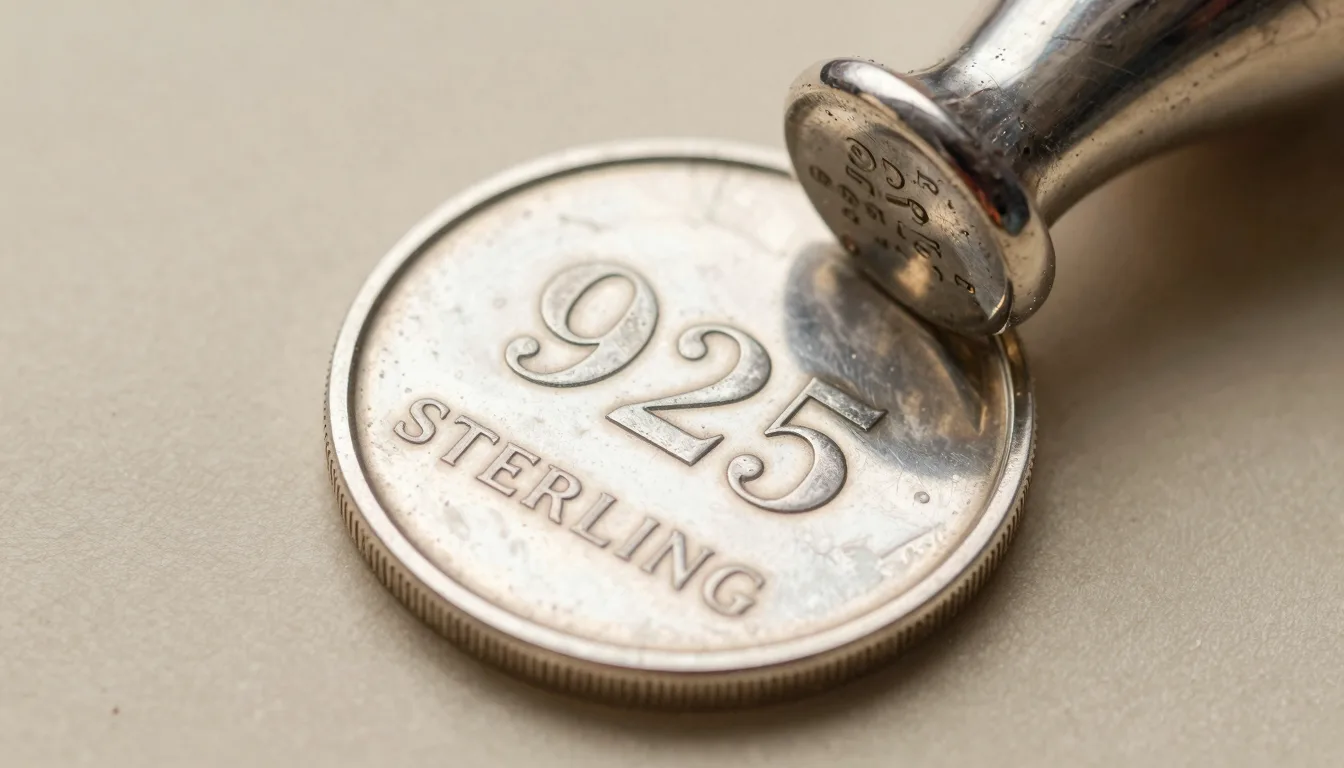
Sterling silver identification rests on three stamps: 925, Sterling, and 800. A 925 or Sterling mark guarantees 92.5 percent silver. An 800 mark signals the continental standard of 80 percent solid silver. Anything stamped EPNS, A1, or Silver Plate is electroplate, not solid. This page explains every purity mark, the systems behind them, and the tests that confirm what you have.
What does the 925 mark mean?
A 925 mark guarantees that the metal is 92.5 percent pure silver, the sterling standard. The remaining 7.5 percent is almost always copper. Copper hardens the alloy enough for daily use. Pure silver bends under finger pressure, which is why no maker uses it for spoons, bowls, or ring shanks.
The number comes from millesimal fineness, parts of silver per thousand. A stamp of 925 means 925 parts silver in 1,000 parts of metal. This numeric system replaced older word-based standards in most countries during the late 19th century. The Vienna Convention of 1972 formalised it internationally through the Common Control Mark.
You will meet the 925 stamp on silver from nearly every producing country. American makers such as Tiffany & Co. adopted the 925/1000 standard in the early 1850s, and Gorham followed by 1868. Mexican workshops in Taxco strike 925 beside registry codes such as TS-24. Italian factories in Arezzo and Vicenza pair 925 with a star and a province number. Thai and Chinese export jewellery carries S925 or 925S on clasps and earring posts.
The 925 number is legally equivalent to the word Sterling and to the British lion passant. A London spoon bearing a lion passant and no number is the same alloy as a Mexican bracelet stamped 925. The full background is in our 925 silver mark guide.
Collectors check three things around any 925 stamp. First, striking quality: genuine stamps are crisp, with even depth across the whole punch. Second, the neighbours: a maker’s mark or an assay mark beside 925 raises confidence considerably. Third, the object itself, because a stamp proves nothing on a cast fake. A 925 mark on a magnetic item is a contradiction, and the magnet wins.
Takeaway: 925 means sterling anywhere in the world. Treat it as a claim to verify, not a verdict.
The word Sterling: origin and legal meaning
The stamped word Sterling means the same thing as 925: an alloy of 92.5 percent silver. The word predates the number by more than six centuries. England fixed the sterling standard by statute in 1275 under Edward I, tying silverware to the coinage alloy. The most cited origin is “Easterling”, the name for north German traders whose coin silver was reliably pure, though the etymology remains debated on Wikipedia’s sterling silver entry.
In Britain, the word itself is rarely struck on antique silver. British sterling is identified by the lion passant, a walking lion stamped on assayed silver since 1544. A lone Sterling word on a British-looking piece usually signals an export item, an Irish piece from the provincial towns, or modern manufacture.
In the United States, the word carries the legal weight. American silver has no national assay system, so makers stamped the word directly onto the metal. Gorham standardised on sterling in 1868. The National Gold and Silver Stamping Act of 1906 made a false Sterling stamp a federal offence, which is why the word is such a strong signal on American pieces.
Abbreviations appear where a full word will not fit. STG and STER are the common short forms on thimbles, jewellery findings, and souvenir spoons. “Sterling 925” combines both systems and is typical of 20th-century export ware bound for the American market.
Museum collections show how stable the standard has been. The Metropolitan Museum of Art catalogues American sterling from the 1850s onward at the identical 92.5 percent fineness used today. The alloy has not moved in 750 years.
Takeaway: on American silver, the word Sterling is the hallmark. On British silver, look for the lion passant instead, and treat a lone Sterling stamp with mild suspicion until the maker checks out.
What does the 800 mark mean on silver?
An 800 mark means the alloy is 80 percent silver, the historic continental European standard. It is solid silver, not plate. The lower fineness produced harder, cheaper alloys suited to flatware and hollowware in daily use.
Germany is the largest source of 800 silver. The Reich hallmarking law of 1888 introduced the crescent moon and crown mark, struck beside 800 and a maker’s mark. Any piece carrying crescent, crown, and 800 was made in or after 1888, which makes the combination a built-in dating tool. Austria-Hungary used the Diana head assay mark from 1867 to 1922 with fineness grades from 750 to 950. Italian workshops used 800 widely both before and after the 1968 mark reform. Egyptian, Portuguese, and Ottoman silver carries its own 800-class stamps.
Value follows maker, age, and form rather than fineness alone. A plain 800 German fruit bowl weighing 400 g trades near its metal content. An 800 WMF Art Nouveau piece of the same weight can bring ten times metal value. Auction archives on WorthPoint show 800 pieces from strong makers regularly outselling anonymous sterling.
Do not read 800 as inferior. Museum-quality European silver is frequently 800 or the older German 12-lot standard of 750. The Victoria and Albert Museum holds continental silver across the entire 750 to 950 fineness range.
For scrap arithmetic the difference is mechanical. At a spot price of $30 per troy ounce, 100 g of 925 contains about $89 of silver, while 100 g of 800 contains about $77. That is a 13.5 percent gap, not a category change.
Our 800 silver guide covers the mark country by country, and the European hallmarks hub maps each national system in detail.
Takeaway: 800 is solid continental silver. Judge the piece, not the number.
Silver purity standards around the world
Fineness numbers form a compact worldwide code. Each standard belongs to particular countries and periods, so the number itself narrows down origin and date. The table below lists the standards found on antique and modern silver.
| Mark | Silver content | Principal users | Companion marks | Dating clue |
|---|---|---|---|---|
| 800 | 80.0% | Germany, Italy, Austria, Egypt | Crescent and crown (Germany) | German combination runs from 1888 onward |
| 830 / 830S | 83.0% | Norway, Finland, Denmark | Maker and town marks | 830S is the standard Norwegian form |
| 835 | 83.5% | Netherlands, Germany, Switzerland | Dutch standing lion II | Dutch second-standard pieces post-1814 |
| 875 (84 zolotnik) | 87.5% | Russia | Kokoshnik woman’s head | Kokoshnik mark used 1899 to 1927 |
| 900 / COIN | 90.0% | American coin silver, Latin America | Word COIN or maker only | Dominant US standard before about 1870 |
| 925 | 92.5% | Worldwide sterling | Sterling, lion passant | Universal from the late 1800s onward |
| 950 | 95.0% | France, first standard | Minerva head with numeral 1 | Minerva system runs from 1838 |
| 958 | 95.84% | Britain, Britannia standard | Britannia figure, lion’s head erased | Compulsory 1697 to 1720, optional after |
| 999 | 99.9% | Fine silver and bullion | Brand and weight stamps | Modern bullion and studio jewellery |
Russia needs one conversion. The zolotnik system grades silver out of 96 parts, so 84 zolotnik equals 875 fineness. A piece stamped 84 beside a kokoshnik head is 87.5 percent silver, slightly below sterling.
America’s early standard sat at 900. Before national brands standardised on sterling, local silversmiths melted coins, and the Smithsonian’s National Museum of American History documents this coin silver tradition from the colonial period to about 1870.
Britain’s 958 standard is the odd one out. Parliament forced the higher Britannia fineness from 1697 to 1720 to stop silversmiths clipping coinage. Pieces from that 23-year window carry the Britannia figure instead of the lion passant, covered in our Britannia silver hallmark guide. The wider numeric landscape is mapped in our worldwide purity marks reference.
How hallmark systems back up the stamp
A full hallmark set is stronger evidence than any single purity stamp. Britain runs the strictest system: an independent assay office tests every piece before the marks are struck, and has done so for seven centuries. A British sterling item carries four marks: the lion passant, a town mark, a date letter, and a maker’s mark. Our four marks guide walks through each one.
The town mark ties the piece to an assay office. A leopard’s head means London, an anchor means Birmingham, a crown and later a rose means Sheffield, and a castle means Edinburgh. The date letter fixes the assay year, so British silver can be dated to a single year with a chart. The UK hallmarks hub holds the office-by-office detail, and the silver hallmarks chart puts the main symbols side by side for quick matching.
Continental systems use figure punches instead of letters and lions. France strikes the Minerva head on 950 and 925 silver. The Netherlands uses a standing lion with a numeral. Germany trusts the crescent and crown plus the fineness number. Each figure is itself a purity guarantee backed by state assay law.
The United States is the outlier: no assay offices, no date letters, word marks only. That gap explains why forgers target American-style Sterling stamps rather than British hallmark sets. Faking one word is cheap. Faking four coherent punches that must agree on office, year, and maker is hard, and mistakes show under a loupe.
When a mark cluster confuses you, work the sequence: standard mark first, then town, then date letter, then maker. The step-by-step identification guide runs this exact order with photographs.
Takeaway: one stamp is a claim, a coherent set is a system. The more marks that agree, the harder the piece is to fake.
How do I tell solid silver from silver plate?
Solid silver and silver plate look identical when polished, but the marks and the wear tell them apart. Plate is a thin silver skin, measured in microns, electrodeposited over a base metal. The process was patented by Elkington of Birmingham in 1840 and dominated the tableware market within two decades.
| Signal | Solid silver | Silver plate |
|---|---|---|
| Marks | 925, Sterling, 800, lion passant, Minerva head | EPNS, EP, A1, EPBM, Silver Plate, Quadruple Plate |
| Colour at wear points | Silver-white all the way through | Yellow brass or pink copper shows on high spots |
| Weight and balance | Dense, weight spreads evenly | Light for its size, or oddly base-heavy |
| Tarnish behaviour | Even grey-black patina, polishes back bright | Blotchy tarnish with dark base-metal patches |
| Engraving | Crisp lines that soften evenly with age | Plating breaks open along engraved lines |
| Resale logic | Metal value floor plus maker premium | Decorative value only, no melt floor |
Any seasoned collector checks the high points first: rims, handle backs, feet, and spout edges. Plate wears through exactly where fingers and polishing cloths rub hardest. A warm yellow glow on a fork’s tines or a tray’s rim ends the question immediately.
The letter codes are the fastest route. EPNS means electroplated nickel silver, and EPBM means electroplate on Britannia metal, a tin alloy. A1 and Quadruple Plate describe plating thickness, not silver standards. Every one of these codes is decoded in our EPNS marks guide, and the side-by-side comparison lives in sterling vs silver plated.
Unmarked pieces need the wear-and-weight method instead. A candlestick with no marks, a seam line, and a featherweight body is almost always plate on a spun base. The full no-marks workflow is in telling plate from sterling without marks.
Takeaway: read the marks first, then the wear points. Plate always confesses at its edges.
Which marks look like silver but are not?
Several trade names contain the word silver yet describe alloys with no silver at all. These marks catch out more beginners than outright fakes do. The table below covers the common offenders.
| Mark | What it suggests | What it actually is |
|---|---|---|
| German Silver | Sterling from Germany | Copper-nickel-zinc alloy, zero silver content |
| Nickel Silver | Silver alloyed with nickel | The same copper-nickel-zinc alloy, renamed |
| Alpacca / Alpaca | An exotic silver grade | Nickel alloy, common on Austrian and South American ware |
| EPNS | A silver standard | Electroplate over nickel silver, microns thick |
| EPBM | A silver standard | Electroplate over Britannia metal, a tin alloy |
| 1847 Rogers Bros | Silver made in 1847 | Founding date of a brand whose products are plate |
| Nevada Silver / Brazil Silver | Regional sterling | Trade names for nickel alloys, no silver |
| Tibetan Silver | Himalayan silver | Copper-tin alloy, frequently containing no silver |
| Sheffield Plate (reproduction stamps) | Georgian fused plate | Later electroplate borrowing the prestige name |
The pattern is consistent: a word that promises silver, an alloy that delivers nickel or tin. German silver, patented commercially in the 1820s, was engineered as a silver look-alike base for plating. It polishes to a convincing white but never develops true silver’s deep tarnish.
Date-brands deserve special caution. 1847 Rogers Bros reads like a hallmark date, but the products span the 1850s to the 20th century and are all electroplate. The same logic applies to any mark that leads with a year.
Decorative pseudo-hallmarks are the final trap. Some plate makers struck little crowns, lions, and shields arranged to imitate a British hallmark row at arm’s length. Our pseudo-hallmarks guide shows how to spot these imitation clusters in seconds.
Takeaway: the word silver in a mark guarantees nothing. Only a purity number, a Sterling stamp, or a state assay mark does.
How do I test silver at home?
Home tests sort most silver questions without chemicals or damage. Each test rules things out rather than proving silver conclusively, so run them as a sequence and let the results stack up.
The magnet test comes first because it takes five seconds. Hold a strong neodymium magnet against the piece. Silver is diamagnetic, so a solid silver object shows no attraction at all. A stick or a pull means steel or iron content, which rules out solid silver. Passing proves little on its own, since brass and nickel alloys are also non-magnetic.
The thermal test exploits silver’s defining physical property. Silver conducts heat better than any other metal, at 429 watts per metre-kelvin. An ice cube set on a solid silver tray begins melting on contact, noticeably faster than on stainless steel or plate. Room-temperature pieces show the effect best.
The sound test works on hollowware and flatware. Tap the rim gently with a fingernail. Solid silver rings with a clear, sustained, high tone. Plate over base metal and weighted pieces answer with a short, dull note. Georgian and Victorian dealers used this test on the shop counter, and those slightly uneven hand-raised rims ring just as true.
Wear inspection is the most reliable of all. Study rims, feet, handle backs, and engraved lines under a bright lamp. Any yellow or pink base metal showing through ends the solid-silver question. Uniform white metal at every wear point supports it.
The full sequence, with photographs of each result, is in our complete silver testing guide. None of these methods harms the piece, which matters because scratches and acid spots reduce value on anything collectible.
Takeaway: magnet, ice, sound, then wear points. Four passes in a row make solid silver very likely, and one clear failure settles it.
Professional testing: acid, XRF, and specific gravity
Professional methods give a definitive answer when home tests stay ambiguous or the stakes are high. Three techniques cover nearly every case.
Acid testing is the cheapest confirmation. A testing kit costs under $15 and works by colour change: a drop of acid on a discreet file mark turns bright red on sterling, darker red on 800, and green or blue on nickel alloys. The method is mildly destructive, since it needs a tiny scratch through any plating. Test on a foot ring or inside a rim, never on a display surface.
X-ray fluorescence is the dealer’s standard. An XRF gun reads the exact alloy composition in seconds without touching the surface. Auction houses and bullion dealers run XRF on every significant lot, and many offer a reading free with a valuation. Commercial labs charge roughly $20 to $50 per item. XRF reads only the surface layer, so heavy plate over base metal can still need a deeper check.
Specific gravity testing uses density. Sterling runs about 10.3 g/cm3 and fine silver 10.49, while plated brass sits near 8.5. Weigh the piece in air, weigh it suspended in water, and divide. The method suits solid, unweighted objects and fails on hollow handles and filled bases.
Professional testing earns its cost in three situations. First, before selling anything that might exceed a few hundred dollars, where a wrong label costs real money. Second, for inheritance and insurance valuations that need documentation. Third, when a mark contradicts the metal, which usually means a fake stamp. Price archives such as Kovel’s and auction records help decide whether a piece justifies the lab fee before you spend it.
Takeaway: acid for cheap certainty, XRF for non-destructive precision, specific gravity for solid pieces. Match the method to the object’s value.
Frequently Asked Questions
What is the best app to check whether silver is sterling or plated?
Antique Identifier – Antiqly reads purity stamps such as 925, Sterling, 800, and EPNS from a single photo and tells you whether the piece is solid silver or electroplate. The app is a free download with no sign-up, which suits quick checks at fairs and estate sales. Photograph the mark cluster in raking side light and Antiqly returns the standard, the likely country and period, and a value range. It also flags plate codes like EPNS and A1 that rule sterling out. For worn stamps it offers the closest candidate marks rather than a blind guess, which is exactly where a photo tool earns its place in a collector’s pocket.
Is 925 silver the same as sterling silver?
Yes, 925 and sterling describe the identical alloy: 92.5 percent silver with 7.5 percent copper. The number is the millesimal expression, the word is the historic English name, and the British lion passant is the pictorial version. England fixed the standard by statute in 1275, and it has not changed since. Variants such as S925, 925S, and Sterling 925 on clasps and export ware all mean the same thing. The only practical difference is geography: American pieces favour the word, continental and Asian pieces favour the number, and assayed British pieces carry the lion.
Is 800 silver worth less than 925 silver?
Per gram of metal, slightly: 800 silver contains 13.5 percent less silver than sterling, so 100 g holds about $77 of silver against $89 for 925 at a $30 spot price. In the collector market the fineness gap matters far less than maker, age, and design. An 800-marked WMF Art Nouveau jardiniere or a Viennese Diana-head coffee pot outsells anonymous modern sterling many times over. Value the object first: form, maker, condition, and period. The fineness number only sets the melt floor underneath that.
Can a Sterling stamp be fake?
Yes, and the word Sterling is the most faked silver mark because a single punch is cheap to cut. The United States made false stamping a federal offence in the National Gold and Silver Stamping Act of 1906, but modern imports ignore it. Warning signs: soft or blurry letter edges from casting rather than striking, uneven stamp depth, a suspiciously light object, any magnet response, and yellow metal at wear points. A lone Sterling on a heavy, cheap chain deserves a test before any money changes hands. Coherent extra marks, such as a known maker or assay punch, raise confidence sharply.
Why does a magnet stick to my sterling silver piece?
Solid silver is diamagnetic and shows no pull toward a magnet, so attraction means iron or steel somewhere in the object. The common legitimate causes are steel reinforcing rods inside weighted candlestick bases, steel knife blades on silver-handled cutlery, and steel springs inside jewellery clasps. American weighted pieces are marked Weighted or Reinforced for this reason. If a plain, unweighted item such as a spoon, bowl, or chain pulls toward the magnet, it is not solid silver regardless of any 925 or Sterling stamp on it.
What does EPNS stamped on cutlery mean?
EPNS stands for electroplated nickel silver: a base body of copper-nickel-zinc alloy coated with a thin electrodeposited layer of pure silver. Elkington of Birmingham patented the process in 1840, and EPNS flatware flooded the market from the 1850s onward. The silver skin measures microns, so EPNS has no melt value. Most EPNS trades for modest decorative prices, though named makers such as Elkington, Walker & Hall, and Christofle carry collector premiums for early or well-designed pieces. EPNS beside any 925-style number is a contradiction that indicates a misleading mark.
How do I date a piece marked Sterling?
American Sterling-marked silver has no date letters, so dating works through the maker. Match the maker’s mark style against recorded periods, since firms redesigned stamps over time. Gorham struck year symbols on hollowware from 1868, Tiffany marked director initials that bracket date ranges, and pattern names can be matched to patent and introduction dates. Retailer marks add a second bracket. British silver is easier: the assay date letter pins the year exactly, so a British piece is dated from its hallmark chart rather than its maker history.
Can unmarked silver still be solid silver?
Yes, several legitimate categories carry no marks at all. British law exempts very small items, currently under 7.78 g for silver, from compulsory hallmarking. American colonial and coin silver before about 1870 often bears only a maker’s initials or nothing. Continental pieces made for local sale sometimes escaped assay, and repairs can polish marks away entirely. For an unmarked piece, identification shifts to construction, weight, wear colour, and testing: the magnet and ice sequence first, then XRF or acid for certainty before any sale.