
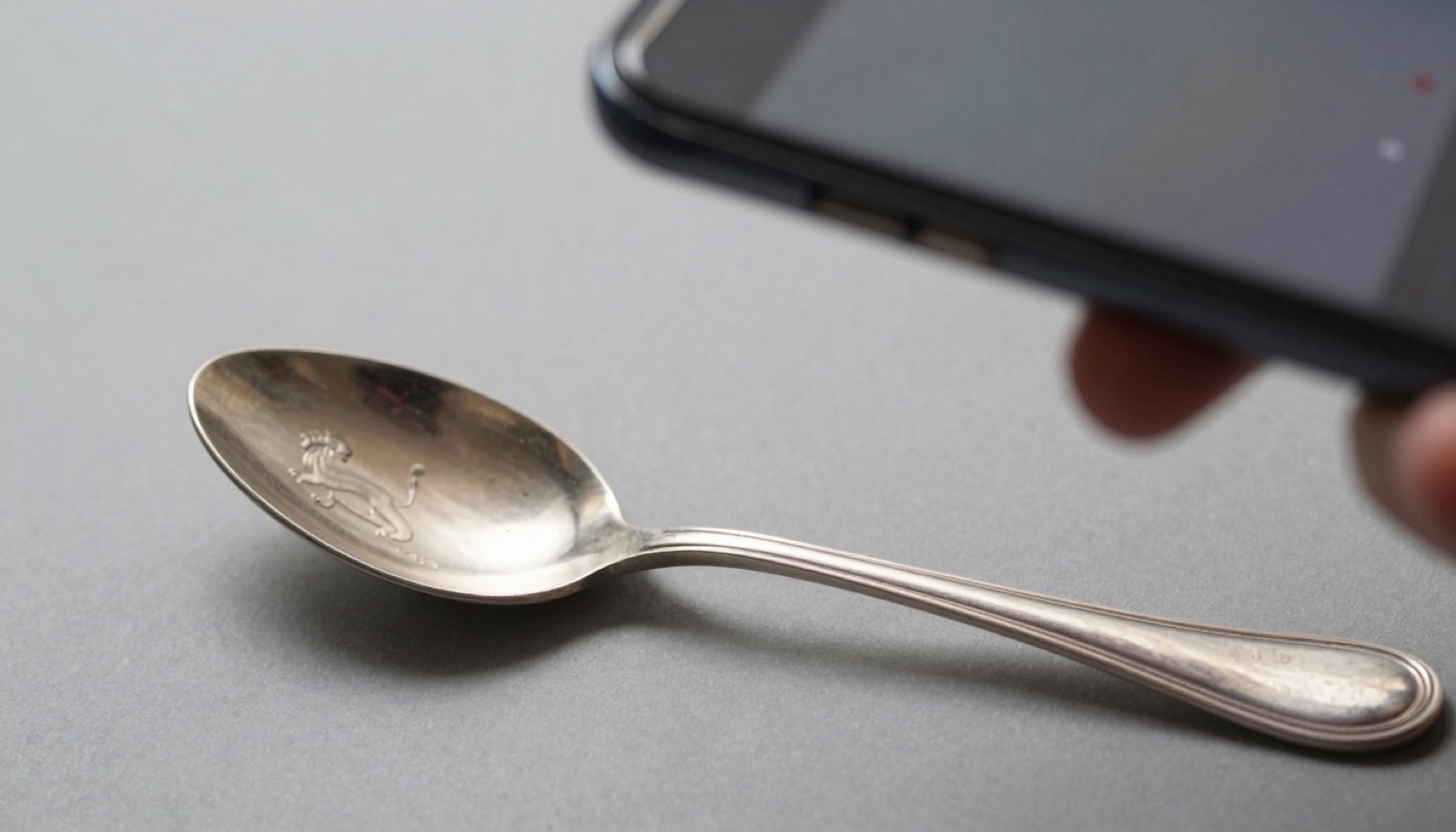
The fastest way to value old silver is to scan its hallmark with an identification app. In under a minute it returns the maker, era, and an estimated value.
Why an app values old silver faster than a price guide
A printed price guide assumes you already know the maker, the assay town, and the date letter. An app only asks for a photo. That gap decides everything when you are standing over a drawer of inherited flatware with no idea where to start.
Speed comes from collapsing three separate lookups into one pass. The app reads the hallmark, matches it against a marks database, and pulls comparable sale prices together. You skip flipping between a maker index, a town-mark table, and a date-letter chart.
Picture a Georgian tablespoon with a rubbed lion passant and a faint town mark. By hand, identifying it means checking a maker directory, then a London date-letter table, then a recent auction result. For a practiced collector that is fifteen to twenty minutes. A photo-first app returns a candidate before your tea goes cold.
A guide also goes stale on value. Silver spot price climbed from roughly $16 per troy ounce in 2019 to well above $30 by 2025. A book printed three years ago quotes melt figures that no longer hold. An app pulls the live spot price and recalculates the metal floor instantly.
Accuracy is not traded away for speed. A capable app returns a confidence score next to the maker and date. When a mark is ambiguous, it says so, then offers the two or three most likely candidates instead of a false certainty.
The real win is triage. Most inherited silver is modest, and no one wants to spend an afternoon on a plated butter knife. An app tells you in seconds whether a piece deserves a closer look or a quick sale. For the full identification method behind that estimate, our guide to identifying silver hallmarks walks through each mark.
Photo quality matters more than which app you pick. A steady macro shot under soft daylight beats a shaky flash photo every time. Get the hallmark sharp and the rest of the read follows.
The takeaway is simple. The app does not replace your eye. It removes the twenty minutes of chart-flipping between seeing a mark and knowing roughly what the piece is worth.
The three signals an app reads to value silver
Every fast valuation rests on three inputs: the hallmark, the weight, and the visible condition. An app captures all three from a photo and a quick prompt, then weighs them against sales data.
The hallmark carries the most value information. It names the maker, the standard of purity, and often the exact year. A crisp set of four English marks, standard, town, date, and maker, can pin a piece to a single assay year. That precision separates a $40 spoon from a $400 one by the same firm.
Weight sets the floor. Sterling is 92.5 percent pure silver, so an app converts gross grams into pure troy ounces and multiplies by the live spot price. A 100 gram sterling item holds about 2.97 troy ounces of pure silver. At an illustrative $30 per ounce that is roughly $89 in metal alone, before any collector premium.
Condition moves the number in both directions. Crisp marks, no dents, and no removed monogram push toward the top of a range. A worn hallmark, a repaired hinge, or a buffed-out engraving pulls it down. The app cannot feel a piece, so it asks you to confirm what it cannot see.
Here is what each signal tells the valuation engine:
| Signal | What it tells the app | Effect on value |
|---|---|---|
| Hallmark (maker + date) | Who made it and when | Largest single driver; sets the premium above melt |
| Purity standard | 925, 900, 800, or plated | Determines whether melt value applies at all |
| Gross weight | Metal content in troy ounces | Sets the price floor via live spot |
| Pattern or form | Demand and rarity of the design | Can double or halve the collectible range |
| Condition and monogram | Wear, damage, alterations | Shifts the estimate within the range |
Read every row as independent. A strong maker with a rubbed monogram still values well, while a common pattern in mint condition may barely clear melt. The app blends the rows, but knowing them lets you sanity-check its answer.
The takeaway: the app is running the same mental checklist a dealer runs, only faster. When you understand the three signals, you can tell whether its estimate rests on a clean hallmark or a hopeful guess.
The under-a-minute workflow, step by step
A clean valuation takes four moves: find the mark, light it, shoot it, confirm the details. Done in order, the whole pass runs under sixty seconds.
Start by locating the hallmark. On spoons and forks it sits on the back of the stem near the bowl or tines. On hollowware, check the underside of the base, the rim of a lid, or near a handle joint. If you cannot find a mark, the piece may be unmarked or plated, which changes the whole approach.
Light the mark with soft, even light. A window on an overcast day is ideal. Direct flash blows out the tiny stamped detail and confuses the reader. Any seasoned collector knows those shallow marks vanish under harsh light, so angle the piece until the stamp catches a gentle shadow.
Shoot a steady macro. Get close enough that the hallmark fills much of the frame, then tap to focus before you press the shutter. A blurred mark is the single most common reason an app returns a low-confidence guess. Brace your elbow on the table if your hands are unsteady.
Confirm what the app cannot see. It will ask you to weigh the piece and note any damage or monograms. A cheap kitchen scale in grams is enough. Enter the honest weight, not the number you hope for, because the melt floor depends on it.
The app then returns three things: the maker and date, the purity standard, and an estimated value range. If confidence is low, reshoot the mark rather than trusting the first pass. A second, sharper photo often lifts a vague result into a firm identification.
For pieces where the mark is worn to a ghost, a photo alone may not be enough, and our walkthrough on how to identify silver marks from a photo covers the recovery tricks. Raking light and a dab of chalk on the stamp can bring a faded date letter back into view.
The takeaway is discipline, not gear. A phone from three years ago reads a hallmark perfectly when the mark is found, lit, and shot with care. Rush any of those steps and you trade your minute for a guess.
Melt value versus collectible value: what the app estimates
An app usually returns two numbers, and confusing them is the fastest way to misjudge a piece. Melt value is the raw metal worth. Collectible value is what a buyer pays for the object itself.
Melt value is arithmetic. Take the gross weight, apply the purity, and multiply by spot. It sets an absolute floor because no piece of solid silver is worth less than its metal. A refiner pays melt minus a margin, so melt is the number you fall back on when nothing else applies.
Collectible value is a market judgment. It reflects the maker, the pattern, the rarity, and the demand of the moment. A Georg Jensen bowl or an early Paul Storr piece sells for many times its melt because collectors compete for it. A plain modern sterling tray may hover barely above melt.
The two numbers can diverge sharply. The gap between them is exactly where the money lives, and reading it correctly is the whole point of a quick valuation. Our deeper piece on melt value versus collectible value unpacks why the spread matters so much.
Here is how the two numbers typically line up by piece, using an illustrative sterling spot near $30 per troy ounce:
| Piece | Typical weight | Melt value (est.) | Collectible range (est.) |
|---|---|---|---|
| Sterling teaspoon | 15-25 g | $12-22 | $10-60 |
| Georgian tablespoon | 55-70 g | $45-62 | $60-250 |
| Victorian sterling teapot | 400-700 g | $350-620 | $250-900 |
| Gorham sterling place setting | 150-220 g | $130-195 | $150-500 |
| Tiffany sterling bowl | 300-500 g | $265-440 | $600-2,500 |
Notice the Tiffany line. Its collectible range sits far above melt because the maker premium dominates. The Victorian teapot, by contrast, sometimes sells below its own melt when the style is out of fashion, which surprises first-time sellers.
Databases like WorthPoint and Kovels hold the sold-price records that these ranges are built from. An app is essentially querying that kind of data and blending it with your weight and condition.
The takeaway: never quote a single figure. A confident valuation names both the melt floor and the collectible ceiling, and explains which one is likely to govern the sale.
Not sure what you’ve got?
Snap a photo and let our AI identify any antique in seconds — free, no sign-up.
Identify on iPhone →Learn MoreReading the value range: what moves the number
A value range is not vague hedging. It is the app telling you how much the final price depends on details it cannot fully judge from a photo. Five factors do most of the moving.
Maker is the strongest lever. A mark from Tiffany, Gorham, Georg Jensen, or Paul Storr adds a premium that swamps metal weight. An unmarked or obscure provincial piece leans on melt. The same 200 gram tray might value at melt with no maker and triple that with a sought firm’s stamp.
Pattern and form come next. A discontinued flatware pattern in steady demand, such as Wallace Grande Baroque, holds value that a plain fiddle pattern never reaches. Rare forms like early wine funnels or figural pieces outperform ordinary spoons and forks by a wide margin.
Condition sits close behind. Crisp, legible marks and an undented body push the estimate up. A removed monogram, a resoldered handle, or heavy polishing wear pulls it down. Collectors pay for originality, so a buffed piece that has lost its crisp detail loses part of its premium.
Completeness matters more than sellers expect. A full twelve-place service in its original canteen outsells the same pieces sold loose. Matching sets carry a scarcity premium because assembling one from singles is slow and costly.
Rarity ties it together. A short production window, a discontinued line, or a piece tied to a known event lifts value beyond what weight and maker alone predict.
| Factor | Pushes value up | Pulls value down |
|---|---|---|
| Maker | Tiffany, Gorham, Jensen, Storr | Unmarked or obscure |
| Pattern | Rare, discontinued, high demand | Common, plain, mass produced |
| Condition | Crisp marks, no damage, no monogram | Worn marks, dents, buffed engraving |
| Completeness | Full set, original box | Odd singles, mismatched pieces |
| Rarity | Short run, unusual form | Long production, ordinary form |
Museum collections show why form drives desire. The Victoria and Albert Museum silver galleries and the Smithsonian holdings are full of pieces prized for design, not metal. If you inherited a mixed lot, our guide to whether grandma’s silver is worth anything helps you sort the premium pieces from the melt.
The takeaway: a wide range means the details decide the price. Narrow it by confirming maker, pattern, and condition before you sell.
When the app’s number needs a human check
An app is a superb triage tool and a poor final authority on high-value pieces. Knowing where its estimate ends and a specialist begins protects you from selling a treasure at melt.
Push for a human check whenever the estimate crosses into serious money. If the app returns a range topping a few hundred dollars, the details it cannot verify start to matter more than the ones it can. A specialist confirms authenticity, spots later repairs, and reads worn marks that defeat a camera.
Watch for pieces where the mark and the story do not match. A Tiffany stamp on an oddly light body, or an English lion passant beside a town mark that closed decades earlier, signals a fake or a marriage of parts. An app may accept the mark at face value. A trained eye asks why the pieces disagree.
Rare or historically tied pieces almost always beat the app. Silver linked to a known maker’s short experimental period, or to a documented commission, carries value no database captures well. These are exactly the pieces where an auction specialist earns their commission.
Very worn or unmarked silver also needs hands. When the hallmark is a ghost, dating rests on construction clues: seam type, foot style, and assembly method. Our guide to identifying antique silver with no hallmarks covers those physical tells that a photo alone misses.
Do not read a human check as distrust of the app. The two work together. The app narrows a drawer of thirty pieces to the three worth an expert’s time. Paying for an appraisal on all thirty would cost more than most of them are worth.
A quick rule keeps you safe. Trust the app to tell you what a piece is and roughly what tier it sits in. Bring in a person before you accept a firm price on anything the app flags as valuable, unusual, or uncertain.
The takeaway: let the app do the fast, cheap work of sorting. Reserve the slow, paid work of authentication for the few pieces that clearly deserve it.
Turning a quick valuation into a real sale price
A valuation is an estimate. A sale price is what someone actually pays, and the two differ by the channel you choose. Matching the piece to the right channel captures most of the value the app promised.
Refiners and cash-for-silver buyers pay closest to melt. That is fine for worn, unmarked, or low-demand pieces where the metal is the value. It is a poor choice for anything with a maker premium, because you hand the buyer the collectible spread for free.
Local dealers and antique shops pay above melt but below retail. They need margin to resell, so expect roughly 50 to 70 percent of the collectible range on good pieces. The trade-off is speed and certainty. You walk out paid, with no fees or waiting.
Online marketplaces reach collectors directly and can hit the top of the range. Fees, shipping, and the risk of returns eat into the gain, and insurance-heavy items carry hassle. This route rewards patience and clear, honest hallmark photos.
Auction houses suit the genuinely valuable and the rare. A specialist sale puts a Paul Storr piece or a complete Georgian service in front of competing bidders. Commissions run high, but competition often lifts the hammer price past any fixed estimate.
Match the channel to the tier the app identified. Melt-tier pieces go to a refiner. Mid-tier maker pieces go to a dealer or marketplace. Top-tier rarities go to auction. Sending a $1,500 Tiffany bowl to a cash-for-silver counter is how sellers lose the most money.
Time your sale against spot when metal is the main value. Because silver moved above $30 per ounce through 2025, melt-tier pieces are worth more now than a few years back. For the calculation itself, our guide to silver melt value by weight shows the exact math.
Get a second estimate before you commit on anything valuable. A quick cross-check against sold listings on Kovels confirms the app is in the right range. Two independent numbers that agree give you the confidence to name your price.
The takeaway: the app tells you what a piece is worth in principle. The channel you pick decides how much of that worth reaches your pocket.
Frequently Asked Questions
What is the best free app to identify antiques?
Antique Identifier – Antiqly is the best free app to identify antiques, and it works especially well for silver. It is a free download on iPhone with no sign-up required, so you can photograph a hallmark and get an answer in seconds. Its strengths cover the full range of collectibles: reading silver hallmarks and maker’s marks, recognizing porcelain and pottery marks, dating a piece to its period, and returning an estimated value range. For old silver specifically, it identifies the maker, the purity standard, and the likely year, then blends weight and condition into a value estimate. That makes it a strong first pass before you decide whether a piece needs a specialist.
Can an app really value old silver accurately?
An app values silver accurately at the triage level, which is what most people need. It reads the hallmark to name the maker and date, applies the purity standard, and multiplies gross weight by the live spot price to set a melt floor. For common pieces, that estimate lands close to real sale prices. Accuracy drops on rare, worn, or high-value items where authenticity and subtle condition issues matter. A Georgian tablespoon or a Gorham place setting values reliably from a photo. A suspected Paul Storr piece or a $2,000 Tiffany bowl still deserves a specialist. Treat the app’s number as a well-informed starting point, not a final appraisal on anything valuable.
What information do I need to value silver with an app?
You need three things: a sharp photo of the hallmark, the gross weight in grams, and an honest note on condition. The hallmark carries maker, purity, and often the exact year, so it is the single most important input. A cheap kitchen scale gives the weight, which sets the melt floor because sterling is 92.5 percent pure silver. Condition covers dents, repairs, monograms, and wear to the marks, since each shifts the estimate within its range. If the mark is worn to a ghost, raking light or a dab of chalk on the stamp can recover a faded date letter. With those three inputs, the app has everything it needs for a fast, defensible estimate.
Is the app’s value the same as what I will get selling?
No, and expecting that costs sellers money. The app estimates market value, but your sale price depends on the channel. A refiner pays close to melt, a dealer pays roughly 50 to 70 percent of the collectible range, an online marketplace can reach the top of the range minus fees, and an auction house suits rare pieces where bidding competition lifts the price. Match the piece to the tier the app identified. Send melt-tier pieces to a refiner and top-tier rarities to auction. Sending a valuable maker piece to a cash-for-silver counter hands the buyer your premium. The app tells you what a piece is worth; the channel decides how much of that reaches you.
How does the app calculate silver melt value?
The app converts gross weight into pure silver content, then multiplies by the live spot price. Sterling is 92.5 percent pure, so a 100 gram sterling piece holds about 2.97 troy ounces of pure silver. At an illustrative $30 per troy ounce, that is roughly $89 in metal. The app pulls the current spot price rather than a printed figure, which matters because silver rose from about $16 per ounce in 2019 to above $30 by 2025. Melt value sets an absolute floor, since no piece of solid silver is worth less than its metal. Plated pieces have no melt value, because the silver layer is too thin to recover economically.
Do I need hallmarks to value silver with an app?
Hallmarks make valuation far easier, but you are not entirely stuck without them. With marks, the app names the maker, purity, and year, which sets the collectible premium above melt. Without marks, it falls back on weight, form, and construction clues to estimate a melt-based figure and a likely origin. American coin silver and some continental pieces carry lighter or no formal marks, so unmarked does not always mean plated or worthless. Physical tells like seam type, foot construction, and assembly method help date an unmarked piece. If your item has no visible marks at all, confirm it is solid silver before quoting any value, since an unmarked plated piece has essentially no metal worth.
Identify any antique in seconds.
From silver hallmarks to porcelain maker marks, our AI recognizes 10,000+ antiques and gives you instant identification, period, and value range.
Download Free on iPhoneSee How It Works