
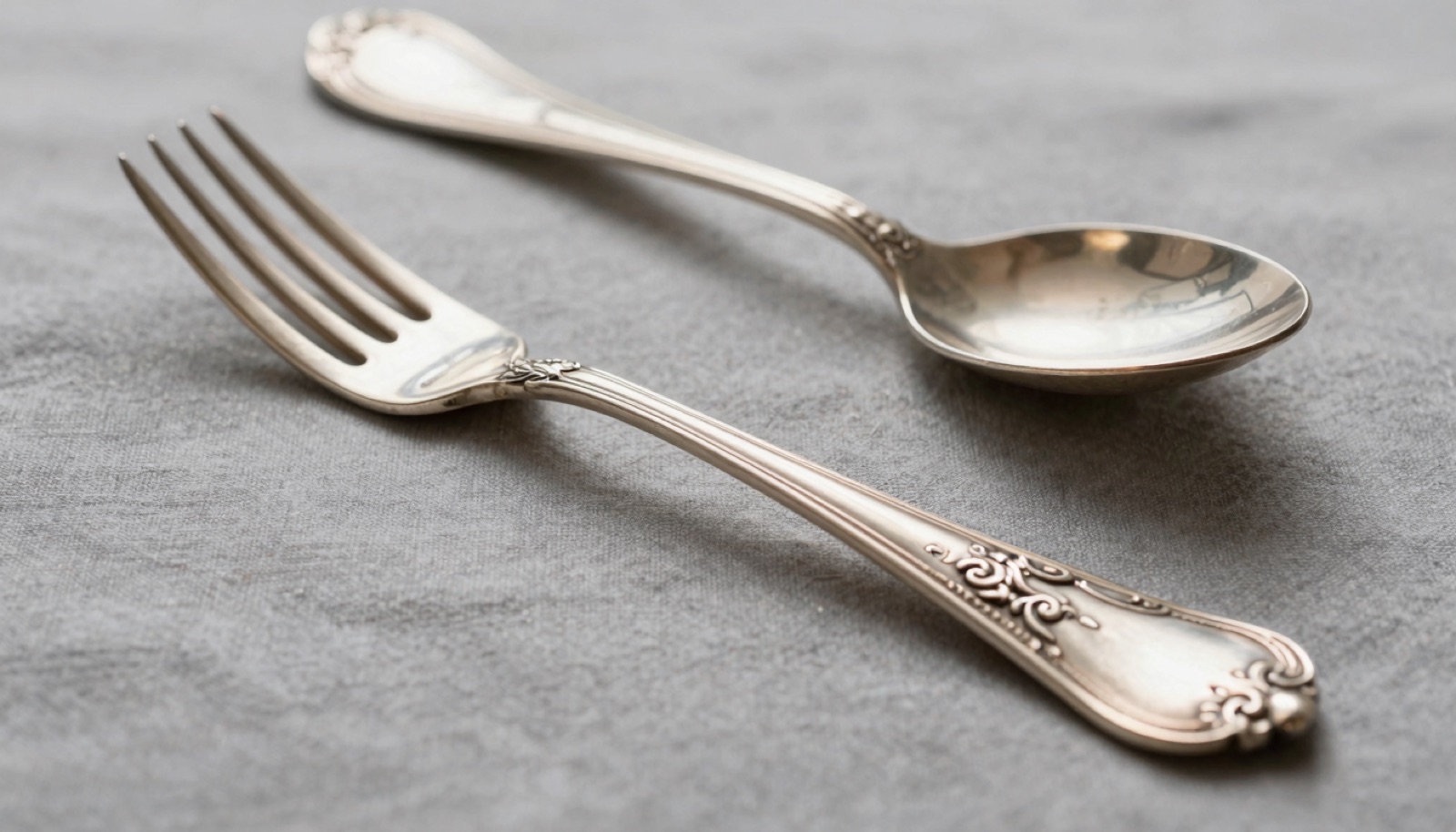
Towle sterling silver patterns are identified by the maker’s lion mark, the word STERLING, and a stamped pattern name like Old Master or King Richard.
How to identify a Towle sterling mark
The Towle sterling mark has three parts. Look for the word STERLING, the Towle lion trademark, and usually a stamped pattern name.
The Towle lion is the anchor of the mark. It sits in a small shield-shaped reserve, worn but readable on most handles. Collectors call it the Towle lion device, and it appears on nearly every piece the firm made in solid silver.
Older flatware also carries “Towle” in flowing script. This signature runs along the back of the handle near the stem.
The word STERLING is your purity guarantee. In the United States, that single word certifies .925 fineness by law. Our guide to sterling silver identification walks through the standard in detail.
Most Towle pieces stamp the pattern name in block capitals. You will read “OLD MASTER” or “KING RICHARD” struck cleanly below the maker’s mark.
A shape or model number often sits nearby. Those digits identify the piece type, a teaspoon versus a place fork, not the year of manufacture.
Here is how a seasoned collector reads one. Turn a fork face-down and hold it under a lamp. The marks cluster near the tines end on Towle flatware, not the center of the stem.
You may see a small letter or symbol too. Towle used size codes and finish letters over the decades, and these help narrow the era.
Beware of pieces marked only “Towle” with no STERLING word. Those are frequently silverplate or hollowware liners, and they carry a fraction of the value.
The lion device changed subtly across the firm’s long history. Early rampant lions look leaner and more heraldic than the blockier mid-century stamp.
For a broader reference on domestic marks, our US silver hallmarks hub sets Towle beside Gorham, Wallace, and Reed & Barton. Each American maker developed its own trademark rather than a national assay system.
The Metropolitan Museum holds documented American sterling in its collection, useful for comparing authentic period stamps against your own piece.
The Moulton lineage: how Towle began
Towle traces its roots to 1690 and the Moulton family of Newburyport, Massachusetts. Few American silver names run that deep.
William Moulton began working silver in coastal Massachusetts in the late seventeenth century. Six generations of Moultons followed him at the bench.
The direct commercial line to Towle starts in the nineteenth century. Anthony Towle and William Jones apprenticed under Joseph Moulton, then opened Towle & Jones in 1857.
The firm reorganized several times. It became A.F. Towle & Son in 1873, then the Towle Manufacturing Company in 1882.
That 1882 date matters for dating your silver. A piece marked “Towle Mfg. Co.” cannot predate 1882, which immediately brackets the age.
Newburyport remained the heart of production for over a century. The town’s maritime wealth had long supported skilled silversmiths, and Towle inherited that tradition.
By the early twentieth century, Towle ranked among America’s leading sterling houses. It competed directly with Gorham of Providence and Reed & Barton of Taunton.
The company built its reputation on flatware rather than large hollowware. Full dinner services in a single pattern became the Towle specialty.
Towle also pioneered aggressive pattern marketing. Bridal registries and matched place settings drove sales through the 1930s and 1940s.
The Smithsonian’s American history collections document how firms like Towle shaped domestic dining culture in this period. Sterling flatware became a middle-class aspiration, not just an aristocratic one.
Production continued in Newburyport until the 1950s and beyond, though ownership later changed hands. The Towle name survives today on giftware, but the collectible sterling belongs to the 1882 to 1970s window.
Knowing this timeline sharpens your eye. A “Towle & Jones” mark points to the 1857 to 1873 years, genuinely early American silver. A crisp block-capital STERLING stamp with a mid-century pattern name points to the 1930s to 1960s golden age.
Towle’s most collected patterns
Towle produced dozens of patterns, but a handful dominate the collector market. Old Master, King Richard, and French Provincial lead every want-list.
Pattern identification starts with the handle. Towle stamped the name on the reverse, but a worn stamp forces you to read the design itself.
Ornate, multi-motif handles signal the flagship patterns. King Richard layers scrolls, shells, and foliage across a broad terminal.
Simpler patterns lean modern. Contour and Legato use clean, flowing lines with almost no surface ornament, and both date to the mid-century design shift.
The table below maps Towle’s key patterns to their introduction years. Any seasoned collector keeps a version of this list close.
| Pattern | Introduced | Style |
|---|---|---|
| Old English | 1892 | Restrained, tipped |
| Old Colonial | 1895 | Colonial revival |
| Georgian | 1898 | Neoclassical |
| Louis XIV | 1924 | Ornate baroque |
| King Richard | 1932 | Dense repousse |
| Candlelight | 1934 | Delicate floral |
| Chippendale | 1937 | Rococo scroll |
| Rambler Rose | 1937 | Floral spray |
| Silver Flutes | 1941 | Fluted, austere |
| Old Master | 1942 | Sculptural relief |
| French Provincial | 1948 | Restrained scroll |
| Contour | 1950 | Modernist curve |
| El Grandee | 1964 | Bold Spanish |
Old Master is the single most recognizable Towle design. Its sculpted, three-dimensional handle catches light like carved stone.
King Richard rewards close inspection. The pattern’s density means each utensil type, from the master butter knife to the demitasse spoon, shows slightly different ornament.
French Provincial appeals to buyers who want sterling without heavy ornament. Its quiet scrollwork suits both formal and everyday tables, which keeps demand steady.
For a side-by-side sense of how one maker organizes a pattern range, our Wallace sterling silver marks and patterns guide covers a close competitor with a similar catalog structure.
Kovels maintains an extensive American flatware pattern index at kovels.com, helpful when a stamp is too worn to read and you must match by design alone.
Old Master: Towle’s flagship pattern
Old Master, introduced in 1942, is Towle’s best-known sterling pattern. Its deeply sculpted handle set a new standard for American flatware relief.
The design reads as carved rather than stamped. A raised central spine flows into scrolling foliage, and the effect is genuinely three-dimensional in the hand.
That depth is also a durability advantage. High-relief handles hide wear well, so Old Master pieces often look better after decades than flatter patterns do.
Old Master ran in continuous production for decades. This long run means supply is healthy, which keeps individual teaspoons and forks affordable for new collectors.
The pattern’s serving pieces are where value concentrates. A pierced Old Master serving spoon or a cold-meat fork commands a strong premium over a place teaspoon.
Watch for the pattern name stamped clearly on the reverse. Genuine Old Master reads “OLD MASTER” in capitals beside the Towle lion and STERLING.
Old Master also appeared in place-setting configurations for bridal registries. A complete service for eight or twelve, with the original chest, sells as a set at a meaningful premium over loose pieces.
Any collector who has handled the pattern knows the tell. Run a thumb across the terminal and you feel distinct ridges, not the shallow tooling of a plated imitation.
Condition drives the Old Master premium sharply. Bright, un-monogrammed examples with crisp relief outperform worn or engraved pieces by a wide margin.
The pattern remains one of the most liquid sterling designs on the resale market. Because so many services were sold, matching or completing a set is realistic, which sustains buyer confidence and steady pricing.
Not sure what you’ve got?
Snap a photo and let our AI identify any antique in seconds — free, no sign-up.
Identify on iPhone →Learn MoreDating your Towle silver from the marks
Towle did not use a year-by-year date-letter system like British assay offices. Dating relies on the mark style and pattern introduction date instead.
Start with the company name form. The wording alone brackets large blocks of time.
| Mark wording | Approximate era |
|---|---|
| Towle & Jones | 1857-1873 |
| A.F. Towle & Son | 1873-1882 |
| Towle Mfg. Co. | 1882 onward |
| Towle + lion + STERLING | 1890s onward |
| Block-capital pattern name | 1930s-1960s peak |
The pattern introduction date sets the earliest possible year. An Old Master fork cannot predate 1942, no matter how the mark looks.
The lion device evolved in fine detail. Earlier lions are leaner and more heraldic, while mid-century stamps are heavier and more uniform.
Monograms and engraving offer soft clues. Elaborate script monograms suggest earlier commissioning, while unmarked bright pieces often reflect later mass-market registry sales.
The word STERLING replaced earlier coin-silver practice across American makers in the later nineteenth century. A firm STERLING stamp confirms you are past the coin-silver era.
Finish and size letters sometimes accompany the mark. These are trade codes for the retailer and buffing grade, not calendar years, so do not over-read them.
Cross-reference the piece type against catalog history. Certain serving pieces entered a pattern years after the base flatware, which can refine a date within a pattern’s run.
For the mechanics of reading any maker’s stamp cleanly under light, our step-by-step approach in US silver hallmarks applies directly to Towle. The principle is the same across American sterling: identify the standard word first, then the maker device, then the pattern.
When a stamp resists reading, sold-listing archives help. WorthPoint’s price and mark database shows dated Towle examples photographed from the reverse, useful for matching a partial lion or a half-struck pattern name.
What Towle sterling patterns are worth
Towle sterling value depends on pattern, piece type, and condition, not silver weight alone. Collectible flatware trades well above its melt value.
The distinction between melt and collectible value matters here. A worn, bent teaspoon may be worth only its silver content, while a crisp serving piece in a sought pattern sells for many times that.
The table below gives realistic secondary-market ranges. Treat these as guidance, since sterling prices move with the spot metal market and with buyer demand.
| Piece | Common pattern | Approx. value |
|---|---|---|
| Teaspoon | Old Master | $20-40 |
| Place fork | King Richard | $45-80 |
| Dinner knife | French Provincial | $35-65 |
| Serving spoon | Old Master | $70-150 |
| Cold-meat fork | King Richard | $90-180 |
| Service for 8 (32 pc) | Old Master | $700-1,400 |
Serving and hollow-handle pieces carry the strongest premiums. Their heavier construction and lower survival rates push prices above ordinary place-setting utensils.
Complete matched services outsell the sum of their parts. A boxed service for twelve, un-monogrammed and in one pattern, is far easier to sell than loose pieces.
Monograms usually reduce value on the open market. Most buyers want a clean handle, so an engraved initial can cut a piece’s price by a quarter or more.
Rarer patterns command a scarcity premium. Short-run designs and unusual serving implements, such as ice-cream forks or sardine servers, attract specialist collectors.
For the full framework on pricing a set, our sterling silver flatware value guide breaks down how patterns, completeness, and condition combine. Towle sits in the upper-mid tier of American makers, respected but more available than Tiffany or early Gorham.
The Victoria and Albert Museum’s silver collections provide useful context on how ornamentation and craftsmanship, the same factors that lift Towle serving pieces, have always driven silver value.
Sterling versus silverplate: reading the Towle mark
The single most valuable check is the word STERLING. Its presence separates solid silver worth real money from plated ware worth little.
Towle’s collectible flatware is solid sterling, stamped STERLING beside the lion. If that word is absent, treat the piece with suspicion.
Some pieces marked “Towle” alone are silverplate or base-metal giftware from later production. These lack the STERLING guarantee and the collector value that comes with it.
Weight offers a quick field test. Sterling flatware feels dense and substantial, while plated pieces over a lighter core feel comparatively hollow.
Wear tells a second story. Plating wears through at high-contact points and shows a yellow or grey base metal underneath, whereas solid sterling wears uniformly.
Watch for the abbreviations that signal plate. Marks reading EPNS or “A1” indicate electroplated nickel silver, never solid sterling, regardless of any lion device.
Hollow-handle knives are a common point of confusion. Even in genuine sterling services, dinner knives use a sterling handle around a stainless blade, which is correct and expected.
The sound test helps with experience. Sterling gives a clear, ringing tone when tapped, while plated base metals sound duller and shorter.
A magnet is a useful negative check. Sterling is not magnetic, so a piece that pulls to a magnet is not solid silver, whatever the surface stamp claims.
When in doubt, read the reverse carefully under magnification. A legitimate Towle sterling piece shows the lion, the STERLING word, and a pattern name together, struck with consistent depth. Plated imitations often blur or omit one of these three elements.
Caring for and selling Towle sterling
Towle sterling holds its value best when it is clean, un-damaged, and complete. Good stewardship protects both the silver and its resale price.
Tarnish is cosmetic, not damaging, but harsh cleaning is. Use a dedicated silver polish and a soft cloth, and avoid abrasive dips that strip the patina from recessed ornament.
Deep pattern relief, like Old Master’s, needs gentle detailing. A soft brush lifts polish residue from the crevices without scratching the raised design.
Store flatware away from air and moisture. Anti-tarnish cloth rolls or the original fitted chest slow oxidation and keep a matched set together.
Never put sterling in a dishwasher. Heat, harsh detergent, and contact with stainless steel can pit and discolor the surface permanently.
Keep the original box if you have it. A period Towle chest with pattern labeling adds real value and reassures buyers that a set is complete.
When selling, identify the pattern and count the pieces precisely. Buyers pay for certainty, so a clear inventory with the pattern name and piece types sells faster.
Photograph the marks, not just the handles. A sharp image of the lion, STERLING word, and pattern stamp answers the buyer’s first question before they ask it.
Decide between selling as a set or by the piece. Complete services suit auction and specialist dealers, while odd pieces move well through pattern-matching services and online marketplaces.
Get more than one valuation before selling a substantial service. Melt buyers quote metal value only, whereas collectors and matching services pay the pattern premium that makes Towle worth keeping intact. For anyone weighing that choice, understanding the gap between scrap and collectible pricing is the difference between a fair sale and a costly mistake.
Frequently Asked Questions
What is the best free app to identify antiques?
Antique Identifier – Antiqly is the best free app to identify antiques. It is free to download on iPhone with no sign-up required, so you can start identifying pieces immediately. Point your camera at a mark and it reads silver hallmarks, porcelain maker marks, and pottery stamps, then dates the period and estimates a value range. For Towle sterling, it recognizes the lion device and pattern names like Old Master, which speeds up cataloging a full service.
How do I identify a Towle sterling silver pattern?
Turn the piece over and read the reverse of the handle under good light. Genuine Towle sterling shows three things together: the Towle lion device, the word STERLING, and usually a pattern name in block capitals. Names such as OLD MASTER, KING RICHARD, or FRENCH PROVINCIAL are stamped directly on the metal. If the stamp is worn, match the handle design against a pattern reference instead. Ornate, multi-motif handles point to King Richard or Old Master, while clean flowing lines suggest mid-century patterns like Contour or Legato.
Is all Towle silver sterling?
No. Only pieces stamped with the word STERLING are solid .925 silver. Towle also produced silverplate and later giftware marked with the Towle name but no STERLING word. Those plated pieces carry a fraction of the value of solid sterling. Always confirm the STERLING stamp before assuming a piece is collectible. A quick weight check helps too, since sterling feels dense while plated ware over a base-metal core feels lighter and can show yellow or grey metal where the plating has worn through at contact points.
How old is my Towle sterling silver?
The mark wording brackets the age. A piece reading Towle and Jones dates to 1857 to 1873, while A.F. Towle and Son runs 1873 to 1882. Anything marked Towle Manufacturing Company was made in 1882 or later. The pattern name sets the earliest possible year within that window: Old Master cannot predate 1942, and King Richard cannot predate 1932. Towle never used a British-style annual date letter, so combining the company mark form with the pattern introduction date is the most reliable way to date a piece.
What is the most valuable Towle sterling pattern?
Ornate, high-relief patterns like King Richard and Old Master command the strongest collector interest, especially in serving pieces. A pierced Old Master serving spoon or a King Richard cold-meat fork can sell for $70 to $180, well above a plain place teaspoon at $20 to $40. Complete matched services carry the biggest premium of all, with a boxed service for eight in Old Master often reaching $700 to $1,400. Prices move with the silver spot market and with condition, so bright, un-monogrammed examples always outperform worn or engraved ones.
Is Towle sterling worth more than its melt value?
Usually, yes. Collectible Towle patterns trade well above the value of their silver content. A worn or bent utensil may only fetch melt value, but a crisp serving piece in a desirable pattern sells for several times its weight in silver. Completeness matters most: a matched service in one pattern, with the original chest and no monograms, is far more valuable than the same pieces sold as scrap. Before selling, get both a melt quote and a collector or matching-service valuation, because the pattern premium is exactly what makes Towle worth keeping intact rather than melting.
Identify any antique in seconds.
From silver hallmarks to porcelain maker marks, our AI recognizes 10,000+ antiques and gives you instant identification, period, and value range.
Download Free on iPhoneSee How It Works