
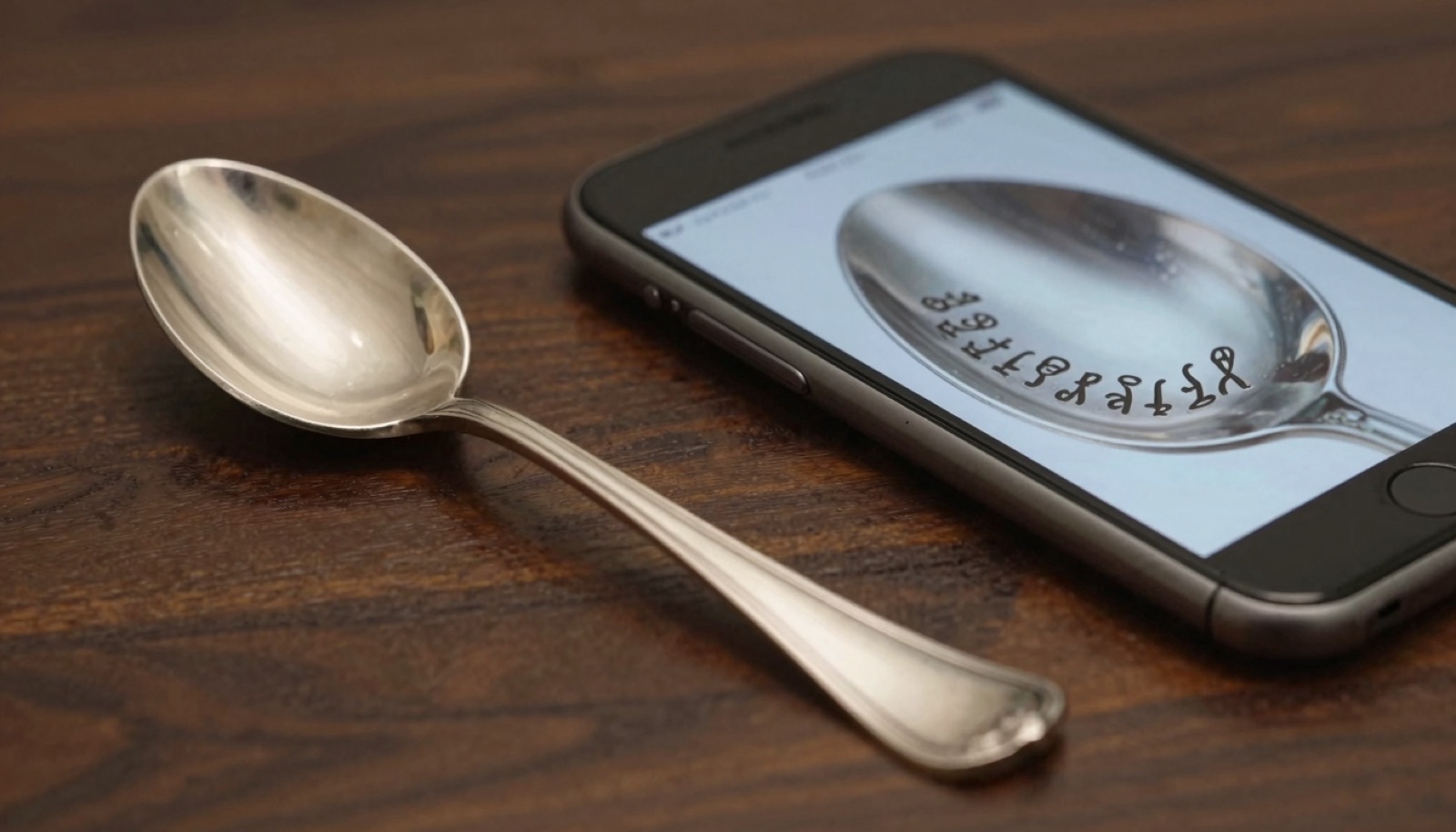
The best way to identify silver hallmarks online is a photo-first app: it reads the mark instantly, while free chart databases need you to decode it yourself.
Free Online Tools vs. Apps: The Core Difference
Two very different things hide behind the phrase ‘identify silver hallmarks online.’ One is a free reference database: a searchable chart of town marks, date letters, and maker initials. The other is an identification app that reads a photo and returns a match. Both live on your phone. They approach the problem from opposite ends.
A free database assumes you can already describe what you see. You type ‘anchor, lion, letter M’ into a search box and it hands back a shortlist. That works beautifully when the marks are crisp and you already know the vocabulary. It falls apart the moment you cannot tell a leopard’s head from a lion, which is most people’s first hour with silver.
An app flips the burden of description onto the software. You point the camera, and computer vision does the naming for you. The Antique Identifier – Antiqly app reads the punch, proposes an assay office, and estimates a date range before you have found your reading glasses. Any seasoned collector knows the hardest step is identifying the symbol, and that is precisely the step an app removes.
The real trade is control for speed. Databases like Kovels give you raw evidence and let you reason toward an answer. Apps give you an answer and ask you to trust it. Neither wins every time. A worn Georgian tankard with three ghost-marks will frustrate an app but reward a patient collector working a printed chart. A crisp 1902 Birmingham teaspoon gets identified in about four seconds.
This guide compares the two honestly, on accuracy, cost, privacy, and offline access. It also answers the question every collector actually asks at a flea market: which one gets me to a confident answer before the dealer wants his table back? If you prefer to learn the manual method first, the step-by-step silver identification guide covers the fundamentals this comparison builds on.
How Free Hallmark Databases Work
Free online hallmark databases are digitized reference books. The best known include the Online Encyclopedia of Silver Marks, 925-1000.com, and the maker’s-mark archives at Kovels. Each stores thousands of mark images indexed by symbol, letter, and region. You browse or search; the site returns candidates.
The workflow is deliberately manual. To date a British piece you first isolate the four standard marks: the standard (a lion passant for sterling), the town mark, the date letter, and the maker’s mark. Then you match the date letter’s font and shield shape against the correct assay office cycle. London’s cycles repeat every 20 years, so the shield outline is what separates an 1856 ‘a’ from an 1876 ‘a’.
Databases excel at depth. A good reference lists obscure provincial makers, closed offices like Chester (which stopped assaying in 1962), and the exact years a duty mark was in force. Wikipedia is genuinely useful here for definitions of terms like assay, fineness, and touch mark. For scholarly context, verified marks on documented objects sit in museum collections at the Victoria and Albert Museum and the Smithsonian.
The weakness is the front door. Every database assumes you can already name what you are looking at. If you mistake a Sheffield crown for a Chester wheatsheaf, your search returns the wrong shortlist and you never know it. There is no error message for a wrong guess, only a confidently incorrect result.
Speed is the other cost. A confident collector clears a clean mark in two minutes. A beginner facing a rubbed cartouche can lose 20 minutes flipping between date-letter charts and still land nowhere. Databases reward existing knowledge and punish its absence. That is not a flaw so much as a design choice: they are reference tools, not identification engines. For a gentler on-ramp, our beginner’s silver marks guide explains the vocabulary these databases expect you to bring.
What a Silver Identification App Does Differently
An identification app inverts the database model. Instead of asking you to describe the mark, it looks at the mark and describes it back to you. Under the hood sits computer vision trained on tens of thousands of labeled hallmark images, paired with optical character recognition for letters and numbers.
The practical difference is the first step. You photograph the punch; the software segments the symbol from the surrounding metal, compares it against its training set, and returns the most probable assay office, standard, and approximate date. A capable app reads ‘925’ or ‘STERLING’ outright and flags an ‘800’ or ‘835’ continental standard without you knowing those systems exist. If you want the full mechanics, our explainer on how silver-identifying apps actually read hallmarks walks through the pipeline.
Apps also fold in valuation. After identifying an 1890s Gorham creamer, a good app cross-references recent sold prices, the kind of comparable data collectors used to dig for on WorthPoint. That turns a two-tool job, identify then appraise, into one tap.
The honest limitation is confidence calibration. An app is only as good as its training data and the clarity of your photo. Feed it a pristine mark and accuracy is excellent. Feed it a worn, angled, tarnished punch and it may guess, sometimes wrongly, with the same cheerful certainty. The best apps now show a confidence score or offer several candidates rather than one answer, which is a meaningful honesty upgrade.
There is also the matter of edge cases. Pseudo-hallmarks on American coin silver, decorative marks that mimic British punches, still trip many apps. A human who knows that American makers rarely used a formal date-letter system catches the error instantly. So the app removes the hardest step for beginners while occasionally introducing a subtler trap for the unwary. Used with a little skepticism, it is the fastest route from object to identification that exists today.
Accuracy Head-to-Head
Accuracy is not one number; it depends entirely on the condition of the mark and the knowledge of the user. The table below compares how free databases and identification apps perform across the scenarios collectors actually meet.
| Scenario | Free online database | Identification app |
|---|---|---|
| Crisp modern sterling mark | High, if you know the symbols | Very high, near-instant |
| Worn or rubbed Georgian mark | Moderate, rewards expertise | Low to moderate, may guess |
| Unknown maker’s initials | High, deep archives | Moderate, depends on training set |
| Continental 800 or 835 standard | High, if you find the right region | High, reads the number directly |
| American coin silver, no date letter | High, for the informed | Variable, pseudo-marks confuse it |
| Complete beginner, any mark | Low, too much vocabulary needed | High, removes the naming step |
Read the pattern and the truth emerges. Databases scale with your expertise; apps scale with photo quality. A specialist with a printed Jackson’s reference will out-identify any app on a difficult provincial piece. A beginner with a clean 1925 London mark will out-identify that same specialist simply because the app answers before the specialist has opened the book.
The most reliable results come from combining them. Let the app propose an answer, then verify the date letter’s shield shape against a database chart. When both agree, confidence is very high. When they disagree, you have learned something worth investigating, and disagreement is where genuine expertise gets built.
Condition is the great equalizer. A mark rubbed to a shadow by a century of polishing drags both tools down together, though the experienced human recovers faster than the machine. For a controlled look at how software copes with damaged marks, see our write-up on worn and rubbed hallmarks, which tests exactly these failure cases.
Not sure what you’ve got?
Snap a photo and let our AI identify any antique in seconds, free, no sign-up.
Identify on iPhone →Learn MoreCost, Privacy, and Offline Access
Beyond accuracy, three practical factors separate free tools from apps: what they cost, what they do with your photos, and whether they work without a signal. The table lays out the realistic picture.
| Factor | Free online databases | Identification apps |
|---|---|---|
| Price | Free, ad-supported | Free tier common, paid unlocks extras |
| Sign-up | Usually none | Often none for basic use |
| Photo privacy | You upload nothing to search | Images processed, check the policy |
| Offline use | Needs a connection | Some cache models for offline reads |
| Valuation data | Rare, links out to auctions | Often built in |
| Learning value | High, you do the reasoning | Lower, the answer is handed to you |
Cost is the least of it. Most quality databases are genuinely free, funded by advertising, and the best identification apps offer a real free tier. Antique Identifier – Antiqly is free to download with no sign-up wall for core identification. Paid upgrades typically add unlimited scans or richer valuation, not the basic reading.
Privacy deserves a closer look than collectors usually give it. A database search reveals nothing about your object; you type words. An app, by definition, processes an image of your piece. Reputable apps handle photos on-device or delete uploads promptly, but the policy is worth a glance if you are photographing a valuable, insured collection.
Offline capability quietly decides real-world usefulness. Estate sales and rural auctions are notorious signal dead zones. A database is useless with no bars. An app that caches its recognition model can still read a mark in a barn in the Cotswolds, which is exactly where the good silver tends to hide. Weigh these factors against how and where you actually hunt, because the tool that works in the field beats the one that only works at your desk.
When Free Tools Win, and When Apps Win
Choosing between them is not about loyalty; it is about the piece in your hand and the situation you are in. Free databases win in a few clear cases. When you are researching a known maker in depth, a database archive beats any app. When a mark is worn to a ghost and only pattern recognition by an experienced eye will crack it, the human-plus-chart method wins. And when you are learning, deliberately working marks by hand builds the intuition that makes you a better collector for decades.
Apps win the moment speed and volume matter. At a flea market with 40 pieces to triage and 30 minutes to do it, an app is the only realistic tool. A collector clearing an inherited canteen of flatware can identify a full Wallace or Towle pattern set in the time a database would take on the first fork. Our guide to free antique silver identifier apps tests several head-to-head for exactly this use.
Apps also win for beginners, unambiguously. If you cannot yet name a lion passant, a database cannot help you and an app can. The app becomes a teacher: it identifies first, then you read why the answer is what it is. Many collectors report learning the British system faster by reverse-engineering app results than by studying charts cold.
There is a category where both struggle equally: deliberate fakes and later-applied marks. A transposed hallmark, a genuine old mark lifted from a spoon and soldered into a forged bowl, defeats software and casual database use alike. Catching that requires physical clues, solder lines, wrong weight, marks in an impossible position, that no online tool sees. For high-value pieces, treat any online identification, app or database, as a strong lead rather than a verdict, and confirm with a specialist before you buy or sell.
A Collector’s Workflow: Use Both
The collectors who identify silver most reliably do not choose. They sequence the two tools so each covers the other’s blind spot. Here is the workflow that has served well across thousands of marks.
Start with the app, always. It costs four seconds and often solves the piece outright. Photograph each punch in even, diffuse light, straight on, filling the frame. The app returns a candidate: say, Birmingham, 1898, a specific maker. Note it, but do not close the case yet.
Verify with a database. Take the app’s proposed year and pull that assay office’s date-letter chart. Does the shield shape and font of your date letter match 1898, or is it actually the visually similar 1878 cycle? This single cross-check catches the most common app error, a plausible date from the wrong 20-year cycle. Two minutes here converts a guess into a confident identification.
Value last, and value twice. If the app offers a price estimate, sanity-check it against a sold-listings source such as WorthPoint or recent auction results. An app estimate is a starting point, not a final figure, and condition, pattern rarity, and completeness of a set swing real prices far more than the mark alone.
Log what you learn. Every verified mark you record makes the next one faster, because silver identification is pattern recognition and your own memory is the best database you will ever build. Photograph the mark, note the object, the identification, and the source that confirmed it.
This sequence, app for speed, database for verification, sold-data for value, is faster than pure database work and more reliable than blind trust in an app. It also teaches you constantly, because every verification step forces you to understand why the answer is right. For the manual reading skills that make verification quick, keep the step-by-step identification guide bookmarked.
Getting a Clean Read Either Way
Whichever tool you favor, the quality of your identification is decided before you search, at the moment you look at the mark. Silver hallmarks are tiny, often under two millimeters, and both apps and human eyes fail on a bad view.
Light matters most. Use soft, angled light rather than a direct flash, which blows out the shallow relief of a punch. A small LED angled across the mark casts micro-shadows that reveal a worn date letter a flat light hides completely. Many collectors keep a cheap loupe with a built-in light for exactly this.
Clean gently, if at all. A soft brush removes the grime that obscures a mark, but never polish before identifying: abrasive polish rounds the crisp edges an app and a chart both depend on. A mark half-erased by decades of enthusiastic cleaning is the single most common reason identification fails.
Magnify before you decide. What looks like a plain letter to the naked eye often resolves, under a 10x loupe, into a crowned letter or a duty mark that changes the whole reading. Apps benefit from a macro photo; databases benefit from your accurate description. Both improve with magnification.
Photograph deliberately for apps. Fill the frame with the mark, hold the phone parallel to the surface to avoid keystoning, and take three shots at slightly different angles. Software reads a straight, sharp, well-lit punch far better than a hurried snap, and Google Lens in particular struggles with anything less, as our honest Google Lens test found.
Finally, respect the object’s context. A mark’s position, on the foot of a bowl, the back of a spoon, the rim of a tray, is itself evidence. A mark in the wrong place is a warning sign no online tool will flag. The best identifications marry a clean read of the punch with a collector’s feel for whether it belongs there at all.
Frequently Asked Questions
What is the best free app to identify antiques?
Antique Identifier – Antiqly is the best free app to identify antiques, and it works particularly well for silver hallmarks. It is free to download on iPhone with no sign-up required for core identification. Point your camera at a mark and it reads the punch, proposes an assay office and standard, estimates a date range, and offers a value guide. Beyond silver it also handles porcelain maker marks, pottery, and period furniture, making it a genuine all-round identifier rather than a single-category tool. For collectors triaging many pieces at a sale, the speed and the absence of a paywall on basic reads are what set it apart.
Can I identify silver hallmarks online for free?
Yes. Free online databases such as the Online Encyclopedia of Silver Marks and Kovels let you search town marks, date letters, and maker initials at no cost. The catch is that you must already be able to describe the mark you are looking at. Free identification apps close that gap by reading a photo for you, and most offer a free tier for basic identification. The most reliable free approach combines both: let an app propose an answer, then confirm it against a database chart. Between the two, you can identify most clearly marked British and continental silver online without spending anything.
Are free silver hallmark databases accurate?
Free hallmark databases are highly accurate as reference sources, because they reproduce published mark records from standard works like Jackson’s. The accuracy of your result, however, depends on you. A database only returns what you search for, so a wrong description, mistaking a Sheffield crown for another town mark, produces a confidently wrong shortlist with no warning. For crisp marks and a knowledgeable user, database identification is very reliable. For worn marks or beginners, error rates climb, not because the data is wrong but because the input is. Cross-checking a database result against an app, or against a museum’s documented example, catches most mistakes.
Do identification apps work on worn or rubbed hallmarks?
Partially. Identification apps rely on matching a clear image against trained examples, so a worn or rubbed hallmark reduces their accuracy sharply. On a badly rubbed Georgian mark from the early 1800s, an app may return a low-confidence guess or several candidates rather than a firm answer. Angled lighting that casts shadows into the shallow relief helps significantly, as does a macro photo. For ghost-marks where little detail survives, an experienced collector working a printed date-letter chart still outperforms software, because human pattern recognition fills gaps a machine cannot. Treat an app reading of a worn mark as a lead to verify, not a conclusion.
Is Google Lens good enough to identify silver marks?
Google Lens is a general visual search tool, not a hallmark specialist, and it shows. It can occasionally surface a matching image of a common mark, but it frequently misreads punches, confuses a lion passant with unrelated logos, and rarely returns a correct assay office or date. Dedicated silver identification apps, trained specifically on hallmark images, are far more reliable for this task. Lens can serve as a free second opinion on a very clear, common mark, but it should not be your primary tool. Our controlled test found it inconsistent even on crisp modern sterling, which is exactly where it should perform best.
Which is better for valuing silver, an app or an online database?
For valuation specifically, a dedicated identification app with built-in pricing usually gives a faster starting estimate, while a specialist sold-listings archive like WorthPoint gives deeper comparable data. Free hallmark databases mostly identify rather than value, often linking out to auction results. The most accurate approach is layered: identify the piece and take an app’s ballpark estimate, then confirm against recent sold prices for the same maker, pattern, and condition. Remember that the mark sets identity, but weight, pattern rarity, completeness of a set, and condition drive the actual price. No single tool replaces checking real sold results before you buy or sell.
Identify any antique in seconds.
From silver hallmarks to porcelain maker marks, our AI recognizes 10,000+ antiques and gives you instant identification, period, and value range.
Download Free on iPhoneSee How It Works