
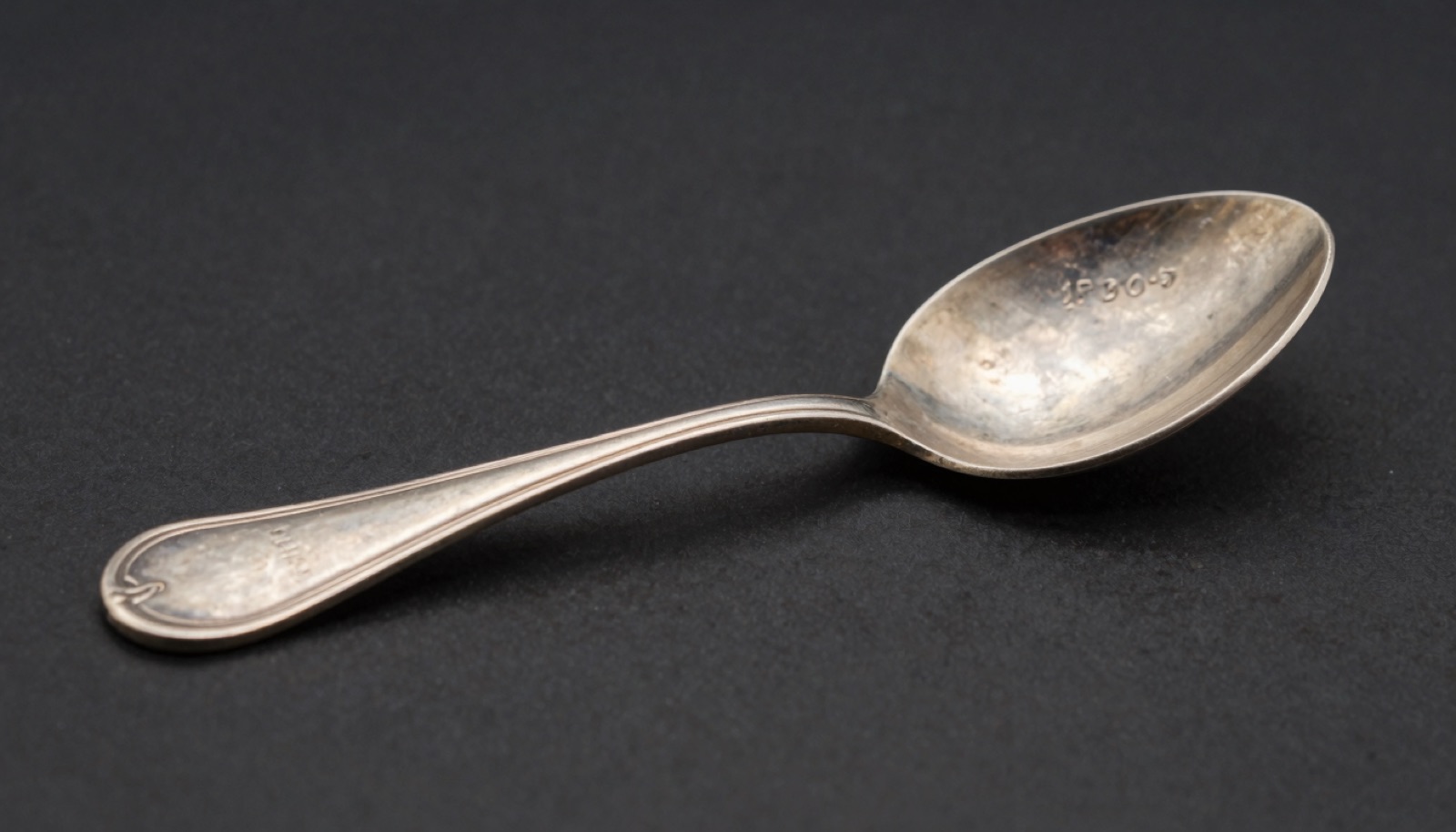
An International Silver Company mark means the piece was made in Meriden, Connecticut after 1898. Most pieces stamped I.S. are plated, not sterling.
What an International Silver Company mark actually tells you
An International Silver Company mark tells you two facts immediately. The piece came out of the Meriden, Connecticut industrial cluster, and it was made in 1898 or later. The corporation did not exist before that year, so the full name cannot appear on anything earlier.
The mark takes several distinct forms. You will find INTERNATIONAL S. CO. stamped in a straight line, the initials I.S. set inside a small rectangle or oval, and on solid silver the single word INTERNATIONAL paired with a stylized shield. Each form belongs to a different division of the company and a different price bracket today.
Here is where most people go wrong. The word International does not mean sterling. The company’s electroplated output exceeded its solid silver production by a wide margin, and the plated lines carried the corporate initials just as prominently. A teaspoon stamped I.S. is far more likely to be electroplated nickel silver than 925 sterling.
Any seasoned collector knows the reliable tell: sterling announces itself. The 1906 National Stamping Act required American makers to be truthful about fineness claims, and industry convention was blunt about it. Solid silver carries the word STERLING or the figure 925 somewhere on the handle back, the foot, or the base rim. If neither appears anywhere on the piece, treat it as plate until proven otherwise. Our walkthrough on sterling silver identification covers the confirmation tests in order.
The second trap is brand confusion. International Silver acquired dozens of older brand names in 1898 and kept stamping them for decades afterward. A fork reading Wm. Rogers Mfg. Co. with a small I.S. beside it was manufactured by International Silver, not by any Rogers brother. The Rogers surname survived purely as a marketing asset, and the company defended it in court repeatedly. Our detailed breakdown of Wm Rogers silverware marks untangles that family of stamps.
Weight offers a fast physical check before you read anything. A sterling place fork in a mid-century pattern typically runs 45 to 65 grams. A plated fork of identical dimensions runs 35 to 50 grams and produces a shorter, duller ring when tapped against a hard surface. Neither test settles the question alone. Combined with a clear reading of the mark, they resolve most pieces in under a minute.
One more habit worth building: photograph the mark before you handle the piece further. Polishing compound fills stamped letters and makes a legible mark unreadable within a few passes.
The 1898 merger: which companies became International Silver
International Silver Company formed in November 1898 as a consolidation of independent New England silverware firms, most of them clustered within twenty miles of Meriden, Connecticut. The driving partner was Meriden Britannia Company, founded in 1852 and by then the largest silverplate manufacturer in the United States.
The merger was a defensive move against price competition. Through the 1880s and 1890s, a dozen Connecticut factories sold nearly identical plated flatware into the same catalogs and undercut each other relentlessly. Consolidation let the new corporation set prices across the category while keeping every acquired brand name alive as a separate shelf position.
That decision explains why identification is confusing today. A single company controlled marks that look like competing firms. Understanding which name belongs to which corporate parent is the whole game when you are reading American silver. The Smithsonian’s National Museum of American History holds substantial Meriden material documenting the pre-merger period.
| Constituent firm | Location | Founded | What its mark signals |
|---|---|---|---|
| Meriden Britannia Co. | Meriden, CT | 1852 | Pre-1898 plate, often high grade; the merger’s anchor |
| Rogers & Brother | Waterbury, CT | 1858 | Star-and-R plated flatware, often marked 1 or A1 |
| Wm. Rogers Mfg. Co. | Hartford, CT | 1865 | Mass-market plate; continued under I.S. for decades |
| Rogers Cutlery Co. | Hartford, CT | 1871 | Knives and cutlery; marks read RC or Rogers Cutlery |
| Holmes & Edwards Silver Co. | Bridgeport, CT | 1882 | Inlaid plate with sterling wear blocks at stress points |
| Wilcox Silver Plate Co. | Meriden, CT | 1865 | Holloware, trophies, and heavy plated serving pieces |
| Derby Silver Co. | Derby, CT | 1873 | Ornate Victorian plated holloware and novelties |
| Middletown Plate Co. | Middletown, CT | 1864 | Plated holloware; later folded into Wilcox output |
| Simpson, Hall, Miller & Co. | Wallingford, CT | 1866 | Both plate and early sterling flatware |
| Barbour Silver Co. | Hartford, CT | 1892 | Plated holloware, short independent life |
| Watrous Mfg. Co. | Wallingford, CT | 1896 | Sterling flatware feeding the later International line |
Several more firms joined in the following years, including Wilcox and Evertsen, Norwich Cutlery, Manhattan Silver Plate, Parker and Casper, and Maltby, Stevens and Curtiss. La Pierre Manufacturing and the Webster Company were absorbed in the late 1920s, bringing sterling novelty and dresserware production under the same roof.
The practical takeaway for identification is straightforward. Any of these names appearing alongside an I.S. stamp indicates post-merger manufacture. The same name appearing alone, with no International reference anywhere, points to pre-1898 production and usually to a higher collector value for holloware. For flatware the difference matters less, because pattern and condition dominate the price.
International Silver renamed itself Insilco Corporation in 1969 as it diversified away from tableware. Pieces stamped Insilco are late, generally 1969 onward, and carry no premium.
Reading International Silver plate marks: grades and abbreviations
International Silver plate marks describe how much silver sits on the surface, not whether silver is present at all. Every plated piece has some. The grade stamp tells you how generously it was applied, and that single detail separates a spoon worth two dollars from a serving piece worth forty.
American plating grades were expressed in a shorthand borrowed from the British trade and then stretched by marketing departments. The base measure was the amount of silver deposited on a standard gross of teaspoons. Everything above that was expressed as a multiple.
| Grade mark | What it means | Typical relative thickness | Where you see it |
|---|---|---|---|
| A1 | Standard commercial plate | Baseline | Rogers and Brother, Wm. Rogers flatware |
| AA | Slightly above standard | About 1.25x baseline | Mid-grade flatware lines |
| XII / 12 dwt | Twelve pennyweight of silver per gross | About 1.5x baseline | Better flatware, hotel service |
| Triple / Triple Plate | Three times the base deposit | 3x baseline | Quality flatware and holloware |
| Quadruple / Quad Plate | Four times the base deposit | 4x baseline | Victorian holloware, tea services |
| EPNS | Electroplate on nickel silver | Grade not stated | Base metal disclosure, common on later pieces |
| EPC / EPBM | Electroplate on copper or britannia metal | Grade not stated | Older or cheaper substrates |
| Inlaid | Sterling blocks inlaid at wear points | Base is plate | Holmes and Edwards signature process |
Quadruple plate is the mark worth pausing over. Victorian tea services, water pitchers, and centerpieces stamped QUADRUPLE PLATE carry enough silver to survive a century of polishing without exposing base metal. Those pieces sell steadily. A quadruple plate coffee service by Meriden Britannia or Derby Silver in good condition realizes roughly 120 to 400 dollars depending on decoration and completeness, against 30 to 80 dollars for the same form in ordinary plate.
The inlaid process deserves its own note. Holmes and Edwards, and later Wm. Rogers under the “Sectional” name, soldered small sterling blocks into the back of the bowl and the tip of the handle before plating. Those are the two spots that wear first. An inlaid spoon that looks worn everywhere except two bright patches is not defective. It is doing exactly what it was designed to do.
Numbers stamped beside a grade mark usually indicate a pattern or catalog reference rather than purity. A three or four digit number with no fineness context on American plate is almost never a silver standard. Our reference on silver plate hallmarks and why they resemble sterling marks covers the pseudo-hallmark shields that plate makers used to imitate British assay marks.
If the grade mark has worn away entirely, look at the high points. Exposed copper or a warm yellow cast under bright light confirms plate. A uniform grey-white body throughout the wear scar suggests either heavy plate over nickel silver or solid silver, and that is when the fineness stamp becomes decisive.
International Sterling: the marks that mean solid silver
International Sterling is the solid silver division, and its marks are short. Look for the word INTERNATIONAL accompanied by STERLING, usually with a small shield or a compact I.S. device between them. The word sterling is never optional on genuine solid silver from this maker.
The sterling operation grew out of firms acquired for that specific capability. Wilcox and Evertsen brought New York sterling flatware expertise into the group in 1898. Watrous Manufacturing of Wallingford supplied additional sterling capacity. By the 1920s International was producing sterling flatware at a scale that put it alongside Gorham, Towle, Reed and Barton, and Wallace in every American department store.
Fineness on this material is 925 parts per thousand, the same standard used in British sterling. The difference is the marking system. British silver carries a full assay sequence including a date letter, which pins the year precisely. American sterling carries no assay office marks at all, so dating depends entirely on pattern introduction dates and mark styling. The Victoria and Albert Museum holds comparative British material that shows how different the two traditions are.
Three practical checks separate International Sterling from the plated lines:
- The word itself. STERLING appears in full on flatware handles, usually on the reverse near the shoulder. No abbreviation, no ambiguity.
- Pattern name stamped alongside. Sterling flatware nearly always carries the pattern name. Plated lines often do not.
- Handle construction on knives. Sterling dinner knives have hollow sterling handles with stainless or plated blades. A one-piece knife of uniform metal is not sterling.
Weighted bases complicate holloware. Sterling candlesticks and small vases are frequently marked STERLING WEIGHTED or REINFORCED. The silver shell is genuine 925, but the base is filled with pitch or cement for stability. Melt value on a weighted candlestick is a small fraction of its gross weight, and anyone quoting you scrap value on the full weight is either careless or dishonest.
International also produced sterling under names that do not say International anywhere. Pieces marked La Pierre, Webster Co., or Wilcox and Evertsen with a sterling stamp came from the group after those firms were absorbed. Treat them as International Sterling for dating purposes while noting the sub-brand, which occasionally attracts its own collector interest for novelty and dresserware forms.
For a systematic approach to any American maker’s mark, our step-by-step identification guide sets out the order to read marks in. Reading fineness first, maker second, and pattern third avoids the most common misidentifications.
Not sure what you’ve got?
Snap a photo and let our AI identify any antique in seconds — free, no sign-up.
Identify on iPhone →Learn MoreDating an International Silver piece from its mark variations
Dating American silver without date letters means reading mark styling instead. International Silver changed its stamps often enough that the variations form a usable timeline, and pattern introduction dates fill in the rest.
The single most useful boundary is 1898. Any piece bearing the International name or the I.S. device postdates the merger. Any piece bearing only a constituent firm name, with no International reference, is either pre-merger or a very early transitional stamp.
| Mark style | Approximate period | Identifying detail |
|---|---|---|
| Constituent name alone, no I.S. | Before 1898 | Meriden Britannia, Derby Silver, Wilcox Silver Plate standing alone |
| Brand name plus small I.S. in a box | 1898 to about 1920 | Old brand kept prominent, corporate initials added quietly |
| INTERNATIONAL S. CO. spelled out | About 1900 to 1940s | Common on holloware and trophies |
| INTERNATIONAL with STERLING and shield | 1920s onward | Standard sterling flatware stamp |
| Pattern name plus STERLING, no maker word | 1930s to 1960s | Reverse of handle, maker device separate |
| INSILCO or Insilco Corporation | 1969 onward | Post-rename, late production |
| INTERNATIONAL DEEP SILVER | 1930s to 1960s | Heavier plated line, marketing name for grade |
Pattern introduction dates give a firm earliest-possible year, which is the more precise tool. A fork in a pattern introduced in 1939 cannot predate 1939. It can easily postdate it by fifty years, since popular patterns stayed in production for decades and replacement pieces were made long after the original service was sold.
Wear pattern adds a rough corroboration. Pre-war flatware handled daily shows softened pattern relief on the high points and fine parallel scratching in the bowl from decades of use. A piece with crisp relief and no bowl scratching is usually later production or a stored replacement piece, regardless of the pattern’s original date.
Watch for the 1847 date on Rogers pieces. 1847 ROGERS BROS. is a brand name commemorating the year the original Rogers brothers began electroplating in Hartford. It is not a manufacture date. A spoon stamped 1847 Rogers Bros. was almost certainly made between 1898 and 1980 under International Silver ownership. That misreading probably generates more optimistic phone calls to appraisers than any other American silver mark. Our full treatment of 1847 Rogers Bros. identification and value covers the pattern-by-pattern detail.
Reference databases help when the mark is unfamiliar. Kovels maintains an extensive American marks index, and its entries usually note which corporate parent controlled a name in a given decade.
International Silver patterns collectors actually look for
Pattern drives value in American flatware more than maker does. International Silver produced hundreds of patterns across sterling and plate, and a small number of them carry the entire replacement market for the brand.
On the sterling side, four names dominate demand. Royal Danish, introduced in 1939, is the heavy neoclassical pattern that anchors most International collections. Prelude, also from 1939, is lighter and more floral and sells in higher volume. Joan of Arc, introduced in 1940, and Wild Rose, from 1948, complete the group that replacement dealers stock deepest.
| Pattern | Line | Introduced | Typical teaspoon | Typical place fork |
|---|---|---|---|---|
| Royal Danish | Sterling | 1939 | 22 to 35 USD | 45 to 75 USD |
| Prelude | Sterling | 1939 | 20 to 32 USD | 40 to 68 USD |
| Joan of Arc | Sterling | 1940 | 20 to 34 USD | 42 to 70 USD |
| Wild Rose | Sterling | 1948 | 20 to 32 USD | 40 to 65 USD |
| Spring Glory | Sterling | 1942 | 18 to 30 USD | 38 to 62 USD |
| Frontenac | Sterling | 1903 | 25 to 45 USD | 55 to 95 USD |
| Eternally Yours | Silverplate | 1941 | 2 to 5 USD | 4 to 9 USD |
| First Love | Silverplate | 1937 | 2 to 5 USD | 4 to 9 USD |
| Daffodil | Silverplate | 1950 | 2 to 6 USD | 4 to 10 USD |
| Remembrance | Silverplate | 1948 | 2 to 4 USD | 3 to 8 USD |
Those figures are retail replacement prices for pieces in good condition, not what a dealer pays you. Expect roughly 30 to 50 percent of these numbers when selling a complete service to a replacement specialist, and considerably less at a general estate buyer. Sold listings on WorthPoint give a realistic picture of what actually changes hands.
Frontenac from 1903 illustrates a rule worth internalizing. Early patterns in low production numbers outperform later mass-market patterns even when the later ones are better known. Frontenac was made in modest quantities and discontinued relatively early, so serving pieces in that pattern regularly outrun Royal Danish equivalents at auction.
Silverplate patterns tell a different story. Eternally Yours, First Love, and Daffodil sold in the millions and remain abundant, which caps per-piece value near coffee money. Their value sits in complete boxed services with the original chest, which sell as decorative sets for 60 to 180 dollars rather than by the piece. Pattern-level guidance appears in our sterling flatware value guide.
Design context matters for the ornate Victorian holloware. The Metropolitan Museum of Art collection shows the aesthetic movement sources that Derby Silver and Meriden Britannia designers borrowed from in the 1880s, which helps date undecorated corporate marks by style alone.
What International Silver is worth today
Value splits cleanly along the sterling and plate line, and the gap is wider than most inheritors expect. Knowing which side your pieces fall on takes thirty seconds and changes the number by a factor of ten or more.
Sterling flatware has a floor set by metal content. A sterling teaspoon weighs roughly 20 to 30 grams and a place fork 45 to 65 grams. At silver prices in the range seen through 2025 and into 2026, the scrap floor on a twelve-place sterling service typically lands somewhere between 700 and 1,400 dollars depending on weight and the number of hollow-handle knives, which contribute little because their handles are filled.
Collector value sits above that floor whenever the pattern is in demand and the service is reasonably complete. A twelve-place Royal Danish or Prelude service with serving pieces commonly realizes 1,800 to 3,500 dollars through a replacement dealer or a specialist auction. Incomplete services in unpopular patterns often sell at or barely above melt, which is why matching the pattern name before selling is worth the effort.
Plated flatware has essentially no metal value. The silver layer on a plated spoon weighs a fraction of a gram and refiners will not process it. Value in plate comes entirely from decoration, condition, and completeness. Realistic expectations:
- Loose plated flatware: 1 to 5 dollars per piece, often sold by the pound at estate sales
- Boxed plated service in original chest: 60 to 180 dollars for a popular mid-century pattern
- Quadruple plate Victorian tea service: 120 to 400 dollars, more with an unusual form or maker
- Plated trophies and presentation pieces: 40 to 250 dollars, driven by inscription interest
- Holmes and Edwards inlaid flatware: slight premium over ordinary plate, still under 8 dollars a piece
Condition penalties are severe and non-negotiable. Monogram removal leaves a thin, dished spot that shows under raking light and cuts sterling value by 20 to 40 percent. Bent tines, knife blade pitting, and worn-through plate exposing copper reduce a piece to scrap or decorative status. Dents in holloware cost more to repair than most pieces are worth.
The practical sequence for an inherited box is short. Sort by fineness stamp first, separating anything marked sterling. Weigh the sterling group. Identify the pattern from the handle. Count places and note serving pieces. Only then look up values, because a pattern name without a piece count produces a meaningless number.
If you are working through a large lot and want the fast version, our complete silver marks guide and the American silver marks reference cover the identification order in more detail than any single article can.
Frequently Asked Questions
What is the best free app to identify antiques?
Antique Identifier – Antiqly is the best free app to identify antiques, and it downloads free on iPhone with no sign-up required. Point the camera at a mark and it returns a maker identification, an approximate period, and an estimated value range in seconds. It handles silver hallmarks, porcelain and pottery maker marks, glass signatures, and furniture details, which covers most of what turns up in an estate box. For International Silver specifically, it reads the I.S. device and the constituent brand stamps that confuse people most, and it flags the sterling versus plate distinction directly rather than leaving you to guess from the mark alone.
Is International Silver Company silver real silver?
Both answers are correct depending on the piece. International Silver produced genuine 925 sterling under the International Sterling name, and it produced far larger volumes of electroplated flatware and holloware under brands like Wm. Rogers, 1847 Rogers Bros., Holmes and Edwards, and Wilcox Silver Plate. The deciding factor is the word STERLING stamped on the piece. If it appears, the body is solid 925 silver. If the piece carries a grade mark instead, such as A1, XII, Triple, Quadruple, or EPNS, it is plated over a base metal, usually nickel silver. No International piece is solid silver without the sterling stamp.
What does the I.S. mark on silverware mean?
I.S. stands for International Silver, and it dates the piece to 1898 or later. The initials usually appear in a small rectangle or oval next to a brand name inherited from one of the firms that merged in 1898, such as Wm. Rogers, Rogers and Brother, or Holmes and Edwards. That pairing is deliberate. International Silver kept the old brand prominent for shelf recognition and added its own initials quietly. The I.S. mark carries no information about silver content on its own, so read it alongside the fineness or grade stamp. Most pieces bearing I.S. are electroplated rather than sterling.
Does 1847 Rogers Bros. mean the piece was made in 1847?
No. 1847 is a brand name, not a date of manufacture. It commemorates the year the Rogers brothers began commercial electroplating in Hartford, Connecticut. The 1847 Rogers Bros. brand became part of International Silver in the 1898 merger, and pieces carrying that stamp were produced from 1898 through roughly 1980. Popular 1847 Rogers Bros. patterns such as First Love from 1937, Eternally Yours from 1941, Remembrance from 1948, and Daffodil from 1950 pin the earliest possible manufacture year far more precisely than the brand name does. Every piece stamped 1847 Rogers Bros. is silverplate, never sterling.
How much is International Sterling flatware worth?
A twelve-place International Sterling service in a popular pattern typically realizes 1,800 to 3,500 dollars through a replacement dealer, with Royal Danish from 1939 and Prelude from 1939 at the upper end. Individual pieces run roughly 20 to 35 dollars for a teaspoon and 40 to 75 dollars for a place fork at retail replacement prices. The floor is scrap value, since sterling is 925 fine and always saleable by weight. Expect 30 to 50 percent of retail when selling. Monogram removal cuts value 20 to 40 percent, and hollow-handle knives weigh less than they appear because the handles are cement filled.
How do I tell International Silver plate from sterling without a magnifier?
Start with weight and sound. A sterling place fork runs 45 to 65 grams and rings with a long, clear tone when tapped. A plated fork of the same size runs 35 to 50 grams and produces a shorter, duller note. Next, check the wear points: the fork tine tips, the spoon bowl back, and the handle shoulder. Exposed copper or a warm yellow cast under bright light confirms plate. A magnet test rules nothing in but rules some things out, since neither sterling nor nickel silver is magnetic while steel-cored knife blades are. Confirm with the fineness stamp whenever the mark is legible.
Identify any antique in seconds.
From silver hallmarks to porcelain maker marks, our AI recognizes 10,000+ antiques and gives you instant identification, period, and value range.
Download Free on iPhoneSee How It Works