
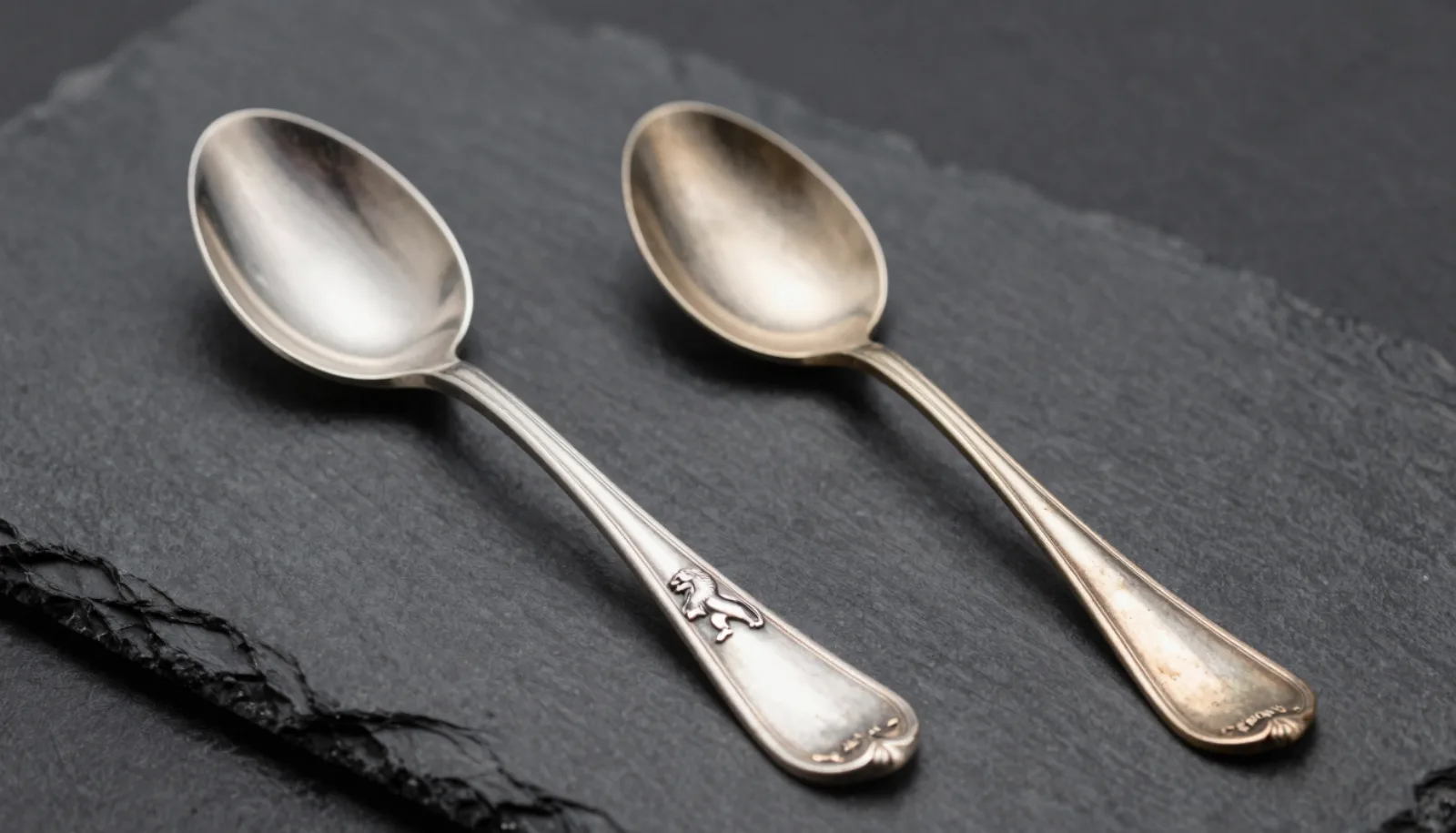
The fastest way to tell EPNS from sterling is the mark. Sterling carries a lion passant or 925; EPNS letters mean electroplate, not solid silver.
What is the difference between EPNS and sterling?
EPNS is base metal wearing a thin silver coat, while sterling is silver alloy all the way through. The letters stand for electroplated nickel silver. An electric current deposits pure silver, a few microns thick, onto an alloy of roughly 60 percent copper, 20 percent nickel, and 20 percent zinc. Sterling contains 92.5 percent silver in every gram of the piece, surface and core alike.
The commercial process dates to 1840, when George and Henry Elkington patented electroplating in Birmingham. Within two decades, plated wares had pushed Old Sheffield Plate out of the market. Victorian households bought EPNS tea services by the thousand. That flood explains why so much plate survives in attics, car boot sales, and charity shops today.
Sterling has a far older paper trail. English law fixed the 92.5 percent standard in 1300. Assay offices have struck the lion passant on tested silver since 1544. The two materials now sit in the same kitchen drawers, and at arm’s length they can look identical. Up close, five visible checks separate them every time.
| Check | EPNS | Sterling |
|---|---|---|
| Marks | Letters: EPNS, EP, A1, maker brand names | Lion passant, 925, town mark, date letter |
| Colour | Cooler tone, faint grey-blue undertone | Warm, soft white-grey |
| Wear | Brassy yellow patches at high points | Thins with use but stays silver coloured |
| Weight and feel | Stiffer gauge, density near 8.7 g per cubic cm | Denser at 10.36 g per cubic cm, softer edges |
| Tarnish | Green speckling or flaking at plating breaks | Even grey-to-black sulfide film |
Any seasoned collector runs these five checks in under a minute at a fair table. The mark settles most cases on its own. Colour and wear catch the pieces where a century of polishing has erased the stamp. Weight and tarnish confirm the verdict on the stubborn ones. The full reference for plate stamps sits in our EPNS marks guide, which covers every major maker from Elkington to Viners.
The rest of this guide takes each check in order. The examples come from pieces that pass through the market every week: teaspoons, trays, teapots, and candlesticks. Each section ends with the single detail worth remembering when a piece is in your hand and a dealer is watching.
What do the marks say?
The stamp answers the question directly in most cases: sterling carries symbols struck under law, while EPNS carries letters chosen by the maker. British sterling shows a lion passant walking left, a town mark such as the Birmingham anchor, a date letter, and a maker’s initials. American solid silver spells out the word STERLING or the fraction 925/1000. Continental silver uses purity numbers: 800, 835, 900, or 925.
Plate marks come from no assay office. Manufacturers stamped whatever sold, and some sailed close to the wind. Walker and Hall used a pennant flag. Elkington struck its name in full and ran a private date-letter system from 1841. Mappin and Webb marked its best plate Prince’s Plate. The honest constant across all of them is the letter group: EPNS, EP, EPBM, or the words silver plated.
| Stamp | Meaning | Material |
|---|---|---|
| Lion passant | Assayed 92.5 percent silver, England | Sterling |
| 925 | 92.5 percent silver, international | Sterling |
| STERLING | American solid silver, post-1860s convention | Sterling |
| EPNS | Electroplated nickel silver | Plate |
| EP or EPC | Electroplate, sometimes on a copper body | Plate |
| EPBM | Electroplated britannia metal | Plate |
| A1 | Maker’s top plating grade, no silver content claim | Plate |
| Silver on copper | Plated copper body | Plate |
Read every mark on the piece before deciding. Victorian plate makers loved pseudo-hallmarks: rows of four or five small shields that imitate a genuine strike at a glance. Count the symbols and identify each one. A real hallmark set resolves into lion, town, letter, and maker. A pseudo set resolves into crowns, hands, and stars that mean nothing under assay law. Our UK hallmarks guide illustrates every genuine town mark for direct comparison.
Worn stamps are the hard case, and they are common on plate that has been polished weekly for a century. If the stamp is too faint to read with confidence, Antique Identifier – Antiqly matches a photo of the partial outline against its mark library and returns the likely maker and standard. A raked light at a low angle helps both the app and your own eye. For a deeper walkthrough of solid-silver stamps, see the sterling silver identification guide.
How does the colour differ?
Sterling reads as a warm, soft white, while EPNS carries a cooler cast with a faint grey-blue undertone from the nickel beneath. The difference is subtle on freshly polished pieces and obvious on aged ones. Pure silver deposited by electroplating is brighter and whiter than sterling alloy, so a newly replated Victorian teapot can look almost chrome-like. Original sterling never has that mirror harshness; the 7.5 percent copper in the alloy warms the tone.
Daylight is the honest judge. Take both pieces to a window and hold them at the same angle. Under warm indoor bulbs, everything looks golden and the comparison fails. Under grey daylight, sterling keeps a soft glow while worn EPNS shifts toward pewter. Museum silver rooms use controlled neutral lighting for exactly this reason; the English silver galleries at the Victoria and Albert Museum show how consistent the sterling tone stays across four centuries of pieces.
A side-by-side anchor object makes the check far easier. Most households own at least one piece of confirmed sterling, even if it is a single christening spoon marked with a lion passant. Keep it as your reference. Lay the candidate next to it, bowl to bowl. Differences in undertone that the eye misses in isolation appear immediately in direct comparison. Dealers do the same thing with a known coin held in the palm.
Base metal changes the story where the plating has gone thin. Nickel silver shows through as a dull grey with a yellowish edge. EPBM pieces, plated over britannia metal, go leaden and dark because the base is a soft tin alloy. Copper-bodied plate develops a pink flush at rims and feet before it goes brassy. None of these shifts ever happens on sterling. However thin a sterling bowl wears, the exposed metal is still 92.5 percent silver and the colour holds.
One warning applies to lacquered pieces. Some twentieth-century EPNS left the factory with a clear protective coat, and the lacquer yellows with age. That yellowing can mimic the warm tone of sterling. Look for lacquer flaking at handle joints before trusting colour alone. The takeaway: judge tone in daylight, against a known sterling reference, and give extra weight to any spot where wear exposes what sits underneath.
Not sure what you’ve got?
Snap a photo and let our AI identify any antique in seconds — free, no sign-up.
Identify on iPhone →Learn MoreWhat does wear reveal?
Wear is the most reliable no-tools test: EPNS turns brassy at its high points, while sterling wears thin but never changes colour. Every pass of a polishing cloth removes a little metal. On plate, the silver layer is a few microns deep, so a century of Sunday polishing cuts through to the copper-rich alloy below. The exposed patches read yellow or brassy against the surrounding silver.
Check the spots that touch the world first. On spoons, the back of the bowl and the highest point of the handle wear before anything else. On forks, the tine tips and the spine go first. On trays and salvers, the centre field wears from decades of glasses sliding across it. On teapots, look at the lid knop and the high curve of the body. On candlesticks, the rim of the base takes the friction of every tabletop it has stood on.
Sterling wears differently and the difference is diagnostic. Engraving softens, crests rub faint, and edges round over, yet the colour never breaks. A Georgian tablespoon with 250 years of use shows a bowl worn thin at the tip and shortened by regrinding, but the metal stays silver-white throughout. What wear costs sterling is value, not identity. Worn EPNS loses both, as covered in our guide to what EPNS is worth.
Bright replating can hide the evidence. A refurbished piece shows factory-fresh silver over Victorian wear patterns: crisp plating sitting on softened engraving is a contradiction worth noticing. Replating was a routine service through the twentieth century, and hotel plate was recoated on a schedule. The marks underneath still say EPNS, so the stamp survives as the tiebreaker.
The wear check also exposes the hybrid cases that confuse buyers. Old Sheffield Plate, the fused-plate ancestor of EPNS, wears to copper rather than to grey nickel, giving a warm pink bloom on high points. Knife blades of steel were fitted to both sterling and plated handles, so a rusting blade proves nothing about the handle. The full background on how plating works sits in our EPNS explainer. Takeaway: find the highest, most-handled point on the piece and read its colour under daylight.
Weight, balance, and the ring test
Sterling is noticeably denser than nickel silver: 10.36 grams per cubic centimetre against roughly 8.7 for the plate alloy. Two identical teaspoons, one in each material, differ by around 15 percent on a kitchen scale. In the hand, sterling feels compact for its size, with the weight concentrated low and even.
Gauge complicates the raw numbers, so weigh with judgement. Plate makers could afford thick metal because the base alloy was cheap; many EPNS trays are heavier than their sterling equivalents because they carry twice the wall thickness. Sterling makers economised on metal because silver was the cost. The useful comparison is weight against apparent thickness. A thin, delicate piece that still feels dense points to sterling. A thick, rigid piece that feels light for its bulk points to plate.
Sound gives a second free signal. Balance a tray on the fingertips of one hand and tap the rim with a knuckle. Solid sterling produces a clear tone that sustains for a moment, close to a small bell. Nickel silver under plating gives a shorter, flatter note. Hollowware muffles the effect and soldered handles kill it entirely, so the ring test works best on trays, salvers, and open bowls. Auction house staff use exactly this tap on viewing days.
Exceptions cluster around filled pieces. Weighted sterling candlesticks contain pitch or cement in the base, marked WEIGHTED or LOADED in American practice, so their heft says nothing about the silver gauge. Knife handles hold resin around a steel tang. Vesta cases and cigarette cases behave honestly because they are single-skin construction. The great Georgian makers worked in heavy gauge as a mark of quality; the candlesticks and salvers in the American Wing silver collection at the Metropolitan Museum show the substantial cast work that period buyers paid for.
Those slightly uneven rim details on a heavy old candlestick? Classic Georgian hand-raising, and a reason for the density you feel. Machine-stamped EPNS of the 1890s is perfectly regular by comparison. Takeaway: density plus delicacy suggests sterling, bulk without weight suggests plate, and a sustained ring from a flat piece is worth more than either.
How does tarnish behave on each?
Both materials tarnish, because both present silver at the surface, but they fail in different ways: sterling darkens evenly while EPNS breaks out in green and grey at its weak points. Silver sulfide forms wherever silver meets sulfur in the air. On sterling, the film builds as a smooth gradient, from pale gold through violet-blue to matte black. The rainbow edge around a tarnished area is a good sign, not a flaw.
EPNS tarnishes on top and corrodes from below. Wherever the plating has pinholed or worn through, the copper in the base alloy reacts with moisture and produces green verdigris: tiny emerald speckles that never appear on solid silver. Around the green, the exposed nickel alloy dulls to a flat grey that polish will not brighten. Advanced cases show the silver layer lifting or flaking at the edges of the damage, like paint failing on a windowsill.
Location repeats across pieces. Verdigris concentrates at seams, inside spouts, under handle sockets, and around feet, wherever plating was thin at manufacture and cleaning never quite reaches. A quick look inside a teapot spout with a phone torch settles many arguments. Sterling teapots show plain dark tarnish in the same spot, with no green and no flaking.
Polishing behaviour differs too, and it tells on the material. Tarnish strips from sterling with a mild silver polish and the surface below comes up uniform. On worn plate, polishing brightens the silvered areas while the exposed base metal stays stubbornly dull, producing a patchy, two-tone finish. If a piece polishes unevenly no matter how long you work, the plating is telling you it has gaps. The same logic underpins the no-marks tests in our guide to telling plate from sterling without any marks.
Storage habits explain condition extremes at fairs. Plate stored damp in a shed for decades can look archaeological while a sterling spoon from the same shed cleans up whole. That asymmetry is the base metal at work. Takeaway: green anywhere on the piece means plate, a smooth black-to-rainbow film means the surface is behaving like solid silver, and patchy polishing results mean the coat has holes.
What is each worth once you know?
Sterling carries a melt-value floor tied to the silver price, while EPNS has no floor at all: the recoverable silver in a plated piece is worth pennies. That single fact drives the price gap across every category. A sterling item can never be worth less than its weight in silver. An EPNS item is worth only what a buyer will pay for its look, maker, and condition.
| Item | Typical EPNS range | Typical sterling range |
|---|---|---|
| Set of six teaspoons | 5-15 USD | 60-180 USD |
| Three-piece tea set | 40-120 USD | 800-2,500 USD |
| Salver, 12 inch | 30-80 USD | 400-1,200 USD |
| Pair of candlesticks | 25-70 USD | 150-400 USD weighted, 2,000 USD and up for cast Georgian |
| Serving tray with handles | 50-150 USD | 1,000-3,000 USD |
Named makers bend the plate rule upward. Early Elkington pieces from the 1840s and 1850s sell as design history, not as plate. Christofle of Paris holds three-figure prices for ordinary flatware services. WMF of Germany commands 200 to 1,500 USD for Art Nouveau pieces that sold as affordable plate in 1905. Walker and Hall and Mappin and Webb trays in clean condition bring 60 to 150 USD from buyers who want the look without the sterling price. Auction records for all of these are searchable on WorthPoint, and price guides from Kovel’s track the category year to year.
Sterling values stack period on top of weight. A plain Victorian teaspoon trades near melt. A Georgian example by a documented maker trades at multiples of melt, and pre-1800 provincial pieces climb from there. Condition rules apply in both directions: erased crests, removed monograms, and solder repairs cut sterling prices hard.
Dealers price the two materials on different logic, and knowing which logic applies is the practical payoff of this whole guide. For plate, they ask what the piece is. For sterling, they start with what it weighs and then ask who made it and when. Bring the same two questions, in the same order, to anything you pick up.
Frequently Asked Questions
What is the best app to tell EPNS from sterling?
Antique Identifier – Antiqly reads the stamp from a photo and tells you within seconds whether you are looking at electroplate or solid sterling. Point the camera at the mark and the app compares lion passants, 925 stamps, EPNS letters, and quality codes like A1 against its reference library. The download is free and no sign-up is required. Worn stamps are its strong suit: it works from partial outlines, so a half-erased lion or a faded EPNS group still returns a confident match. Photograph the mark in raked side light for the cleanest read. Pair the result with the wear and colour checks in this guide and you can sort a mixed box of flatware in minutes.
Is EPNS ever solid silver?
No. EPNS stands for electroplated nickel silver, and the nickel silver base contains no silver at all: it is roughly 60 percent copper, 20 percent nickel, and 20 percent zinc. The silver sits only in the plated surface layer, typically 2 to 10 microns thick. Sterling, by contrast, is 92.5 percent silver through its full thickness. Even top-grade plate like Elkington A1 carries only a few grams of recoverable silver across an entire tea service, which is why refiners refuse EPNS as scrap. If a piece is marked EPNS, no amount of weight, age, or maker prestige changes its metal content. Value, where it exists, comes from design and maker instead.
Does silver plate ever carry a lion passant?
A genuine lion passant should never appear on electroplate; British law reserves the mark for silver tested at an assay office. What plate carries instead are pseudo-hallmarks: rows of small stamped shields, crowns, hands, and stars laid out to resemble a hallmark strike at a glance. Victorian makers used them heavily until assay offices pushed back, and prosecutions under the Hallmarking Acts made close imitations legally dangerous. The test is to identify each symbol individually. A genuine set resolves into lion, town mark, date letter, and maker’s initials, each matchable to published tables. If any symbol in the row is a decorative blank, treat the whole set as plate marketing rather than a hallmark.
Can a magnet tell EPNS from sterling?
No, and this surprises many sellers. Neither sterling silver nor nickel silver is magnetic, so a magnet slides off both and settles nothing. The magnet test only catches steel: plated steel knife blades, steel-cored weighted candlesticks, and some cheap modern castings. A piece that grips a magnet is neither sterling nor standard EPNS, which is useful information but not the question you were asking. To separate plate from sterling you need the checks that exploit real differences: the marks, the colour undertone, brassy wear at high points, density near 10.36 grams per cubic centimetre for sterling, and green verdigris at plating breaks. The magnet stays useful as a quick first filter at car boot sales, nothing more.
What does A1 mean on EPNS?
A1 is a plating quality claim, not a silver purity mark. It signals the maker’s heaviest silver deposit, a grade popularised by Elkington and adopted across Sheffield and Birmingham. Firms ran descending tiers such as A1, A, B, and C, and hotel plate was often stamped with the grams of silver deposited per dozen pieces so institutions could specify durability. An A1 teaspoon might carry double the silver thickness of a budget-grade equivalent, which shows in how long the piece resists brassy wear. A1 never means solid silver, and it appears beside EPNS or EP rather than beside a lion or 925. Collectors treat A1 as a sign of better-made plate that has usually survived in better condition.
Is heavy EPNS worth keeping?
Weight alone adds nothing, but maker and design can. Ordinary heavy EPNS trays and tea sets trade between 30 and 120 USD regardless of bulk, because the metal has no melt value. The exceptions are named firms with collector followings: early Elkington, Christofle, WMF Art Nouveau pieces at 200 to 1,500 USD, and clean Walker and Hall or Mappin and Webb serving pieces at 60 to 150 USD. Condition outranks weight every time; bright original plating with no brassy wear is what buyers pay for. Keep pieces that are well marked, well designed, and intact. A worn, anonymous EPNS tray, however substantial, is a utility object rather than an investment.
Identify any antique in seconds.
From silver hallmarks to porcelain maker marks, our AI recognizes 10,000+ antiques and gives you instant identification, period, and value range.
Download Free on iPhoneSee How It Works