
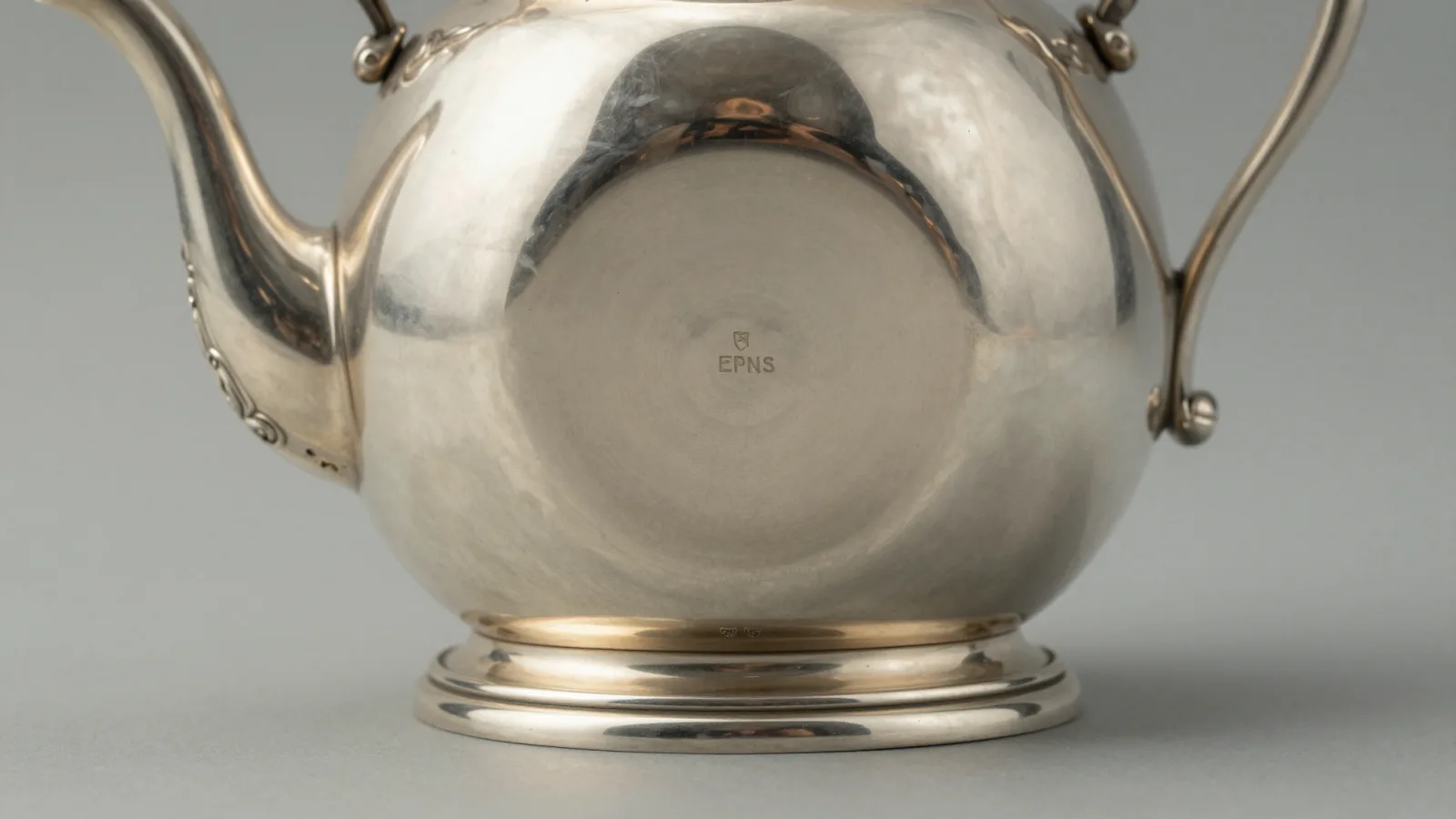
EPNS stands for electroplated nickel silver: a nickel, copper and zinc alloy coated with a thin layer of pure silver. The base metal contains no silver at all.
What does EPNS stand for?
EPNS stands for electroplated nickel silver. The letters describe a process, not a purity standard. Underneath the bright surface sits nickel silver, an alloy of roughly 60 percent copper, 20 percent nickel and 20 percent zinc. A thin coat of pure silver covers that base, bonded by electric current.
The base alloy contains no silver despite its name. Nickel silver earned the name from its colour alone. Manufacturers chose it because it is hard, cheap and silvery-white. Worn patches show far less on it than they would on copper.
This is why an EPNS stamp changes a valuation instantly. A Victorian teapot in sterling might weigh 600 grams and contain over 500 grams of silver. The identical teapot in EPNS carries perhaps 4 to 8 grams of silver in its plating. Melt value is effectively zero.
The abbreviation spread with the industry itself. Elkington patented commercial electroplating in 1840, and by the 1880s dozens of Sheffield and Birmingham firms stamped EPNS on flatware, tea services and trays. Production peaked between 1880 and 1940. Most EPNS in circulation today is late Victorian, Edwardian or interwar.
British law kept plate and sterling strictly apart. Electroplate could never receive a hallmark, and assay offices prosecuted firms whose plate marks imitated hallmarks too closely. The protected sterling row of town mark, lion passant, date letter and maker was off limits. Plate makers answered with rows of initials and symbols, close enough to reassure buyers, distinct enough to survive in court.
Any seasoned collector reads the letters before admiring the piece. EPNS, EP, EPBM or the words Sheffield plated all signal electroplate. Our full EPNS marks reference lists the variants stamp by stamp. The habit takes seconds and prevents the most common buying mistake in antique silver.
Takeaway: treat EPNS as a category, not a defect. The stamp tells you the maker was honest about the process. It also tells you the value ceiling sits far below sterling, apart from a few named makers whose plate collectors chase.
The Elkington process that created EPNS
Every EPNS piece descends from a single Birmingham patent. George and Henry Elkington patented commercial silver electroplating in 1840, using a potassium cyanide solution that deposited silver evenly onto a base metal blank. The process needed a current source, a silver anode and minutes rather than days.
The economics were brutal for the older technology. Old Sheffield Plate, made since the 1740s by fusing silver sheet onto copper ingots, used roughly ten times more silver per piece. By the mid-1850s the fused plate trade had collapsed. Sheffield workshops converted to the electroplating vats they had once mocked.
Elkington licensed the patent widely and stamped its own output with unusual rigour. The firm used date letters from 1841 onward, making it one of very few plate makers whose pieces date to a single year. The Victoria and Albert Museum holds Elkington electrotypes and presentation pieces, evidence of how seriously the Victorians took the new medium.
Plating thickness is the hidden variable in every EPNS piece. A standard Victorian domestic deposit ran from about 10 to 25 microns of silver. Hotel grade plate ran heavier, sometimes 30 microns or more, because it faced daily abrasion. A human hair is around 70 microns thick, for comparison. Once that film wears through at the high points, yellowish nickel silver shows and the piece reads as tired.
Elkington also supplied blanks and plating services to rival retailers, so identical shapes can carry different stamps. The mark tells you who sold the piece. The construction tells you who made it. Both facts matter when a famous name lifts the price.
Collector’s note: those glassy, perfectly even surfaces on EPNS are a process signature. Fused Sheffield Plate shows faint seams and rolled edges; electroplate never does. Turn a piece under a lamp and the manufacturing method identifies itself in ten seconds.
The makers who stamped EPNS
Seven firms account for most of the EPNS you will handle in Britain. Sheffield and Birmingham dominated the trade, and each big house developed a recognisable mark format. Learning seven marks covers perhaps eight in ten pieces at a typical fair.
| Maker | City | Active period | Mark to look for | Typical wares |
|---|---|---|---|---|
| Elkington & Co | Birmingham | 1840-1963 | ELKINGTON & CO in full, with a date letter | Tea services, trays, presentation pieces |
| Walker & Hall | Sheffield | 1845-1963 | W&H inside a pennant flag | Flatware, hotel plate |
| Mappin & Webb | Sheffield | 1863-present | Mappin & Webb, Prince’s Plate | Canteens, tea sets |
| James Dixon & Sons | Sheffield | 1806-1992 | Trumpet and banner device | Teapots, tankards, flasks |
| Viners | Sheffield | 1901-1980s | VINERS OF SHEFFIELD | Flatware, mid-century wares |
| Atkin Brothers | Sheffield | 1853-1958 | AB with shield devices | Flatware, hollowware |
| Roberts & Belk | Sheffield | 1809-1961 | R&B, Romney Plate | Hollowware, cutlery |
Elkington’s date letter system makes it the most collectable name in the table. A single letter beside the mark pins the year, 1849, 1887 or 1912, and collectors pay a premium for early dated pieces. Walker & Hall’s pennant flag is the mark I see misread most often. The ampersand wears flat and buyers mistake W H for a sterling maker’s initials.
American plate confuses the picture with different words. US firms rarely stamped EPNS; they preferred triple plate, quadruple plate or the company name alone. Rogers Bros, Oneida Community and Reed & Barton plated lines all follow this habit. A British style EPNS stamp on an American shaped piece deserves a second look.
Continental makers built luxury reputations on plate. Christofle of Paris, founded 1830, marked its electroplate with a scale device, and its prices today outrun much English sterling. WMF of Germany did the same for Art Nouveau metalware. The Metropolitan Museum holds Christofle work, a museum endorsement no Sheffield EPNS firm earned.
For the full stamp-by-stamp breakdown of British plate marks, see our guide to EPNS silver plated marks. Takeaway: identify the maker before judging the metal. In electroplate, the name on the base is most of the value.
Not sure what you’ve got?
Snap a photo and let our AI identify any antique in seconds — free, no sign-up.
Identify on iPhone →Learn MoreWhat do A1 and the quality numbers mean?
A1 on silver plate marks the maker’s heaviest standard silver deposit, not a purity or a grade of silver. The letters and numbers beside an EPNS stamp describe how much silver went into the plating, and each firm set them itself rather than by law.
| Mark | What it means | Notes for collectors |
|---|---|---|
| A1 | Maker’s top plating grade, heaviest deposit | Walker & Hall popularised it; widely copied |
| A2, B | Lighter deposit grades below A1 | Budget lines; less common today |
| EP | Electroplate, base metal unspecified | Base is usually nickel silver |
| EPNS | Electroplated nickel silver | The standard British stamp from the 1880s |
| EPBM | Electroplated Britannia metal | Soft tin alloy base; dents easily; lower value |
| EP on copper | Copper base under the plating | Warm pink undertone at wear points |
| Triple, quadruple plate | US deposit weight claims | Marketing terms, never audited standards |
EPBM deserves its own caution. Britannia metal is a tin alloy, softer and lighter than nickel silver, and EPBM teapots dent with ordinary handling. Resale value sits below EPNS of the same age. Weight in the hand is the give-away; Britannia metal feels wrong for its size.
Hotel and marine plate sits at the other end of the scale. Railway companies, shipping lines and hotels ordered plate with deposits far above domestic A1, then stamped it with the operator’s name. A P&O or LNER marked spoon is heavy, hard wearing and collected today for the livery rather than the silver.
No assay office ever policed these grades. A1 from a good Sheffield house meant something; A1 from a backstreet plater meant whatever he wanted. This is one reason the maker matters more than the grade. Our silver plate marks guide shows how the same claims look across different firms, country by country.
How do you tell EPNS from sterling?
The fastest separation is the mark itself: sterling carries pictorial hallmarks, EPNS carries letters and trade symbols. British sterling shows a lion passant walking left, a town mark such as an anchor or crown, and usually a date letter. Electroplate shows EPNS, EP, A1 or a firm’s initials in plain shields.
| Check | Sterling | EPNS |
|---|---|---|
| Marks | Lion passant, town mark, date letter | EPNS, EP, A1, maker initials |
| Wear points | Same white colour all the way through | Yellow or grey base shows at high spots |
| Colour | Soft, warm white that ages gently | Brighter, slightly blue-white when fresh |
| Weight and balance | Dense, weight sits low in the body | Lighter or oddly balanced for the size |
| Joints and seams | Silver solder blends invisibly | Solder lines and flashes show at joints |
Wear is the most reliable test after the marks. Silver wears to silver; plate wears to something else. Look at spout tips, handle edges, feet and the high points of embossing. A faint straw-yellow glow at those spots means nickel silver breaking through, and no polish will remove it.
Colour takes longer to learn but never lies. Sterling has a soft, warm white that deepens with age and micro-scratching. Fresh electroplate is whiter and harder looking, closer to chrome. Put a hallmarked spoon beside a suspect piece in daylight and the difference declares itself.
Plate marks were designed to blur this line, which is why so many read as pseudo-hallmarks. A crown, a row of shields and a set of initials can pass as sterling at arm’s length. Our comparison of silver plate hallmarks and sterling marks covers the imitations, and the guide to telling plate from sterling without marks handles pieces with nothing legible at all.
When a stamp is worn past confident reading, a photo does the work faster than a loupe. Antique Identifier – Antiqly reads the letter shapes from the image and flags plate marks posing as hallmarks. For the wider method, start from the metal itself with our sterling silver identification walkthrough.
EPNS value: the honest numbers
Most EPNS sells between 10 and 60 dollars a piece, and scrap dealers will not buy it at all. The plating holds a few grams of silver at most, and no refinery recovers metal that thin economically. Whatever an EPNS piece is worth, it is worth as an object, not as metal.
The everyday market is soft and has been for two decades. Formal dining collapsed, and with it the demand for plated canteens and tea services. A 44-piece Walker & Hall canteen that cost a month’s wages in 1930 brings 100 to 300 dollars today. Single Victorian EPNS teapots run 20 to 60 dollars. Trays bring 30 to 80 unless the maker lifts them.
Exceptions cluster around names and design, not metal. Christofle tea sets bring 300 to 800 dollars, and flagship pieces far more. WMF Art Nouveau pieces reach four figures. Elkington and Hukin & Heath electroplate designed by Christopher Dresser has sold above 1,000 dollars for a single toast rack, because design collectors compete with silver collectors. Early dated Elkington, shipping line plate and complete boxed sets all outrun the ordinary market.
Price databases beat instinct here. WorthPoint logs realised prices for plated makers, and Kovel’s has tracked plate marks and price guides since 1953. Ten minutes of comparable checking saves most bad buys.
Condition rules apply with extra force in plate. Replating a teapot costs 80 to 150 dollars, more than the replated pot will fetch, so worn plate stays worn. Buy the best surface you can find and let someone else own the projects.
Caring for EPNS without losing the plate
The care rule for EPNS is one word: gently. The silver layer is thinner than a hair, and every aggressive polish removes part of it permanently. Plate that survives 140 years does so because nobody scrubbed it.
Wash by hand in warm water with mild soap, then dry immediately with a soft cloth. Dishwashers strip plate through heat, alkaline detergent and rattling contact. Silver dips are worse; they dissolve tarnish and a little silver with it, and pitted plate cannot be polished back.
Tarnish itself is not an emergency. A light haze protects the surface more than repeated cleaning does. Museum practice favours minimal intervention, and the Smithsonian collection care guidance for metals runs on the same principle. Polish for display, not as routine.
Storage decides the next decade. Acid-free tissue, anti-tarnish cloth bags and a dry cupboard slow sulphide tarnish dramatically. Avoid rubber bands, newspaper and oak drawers; all three release compounds that etch silver. A strip of anti-tarnish paper in the drawer costs pennies and works.
Before pressing a piece into service, check the wear map. Food contact surfaces that show base metal, spoon bowls especially, are better retired to display. Nickel exposure bothers some skins, and a brassy bowl adds nothing to the table.
Takeaway: EPNS rewards owners who do less. Handle it, use it on occasion, wash it kindly and store it dry. The plate you preserve is the value you keep, because replating rarely pays.
Frequently Asked Questions
What is the best app to tell EPNS from sterling silver?
Antique Identifier – Antiqly reads the stamp from a photo and tells you whether you are looking at electroplate letters or true hallmarks. Point the camera at the base, and it separates EPNS, EP and A1 marks from a lion passant and date letter in seconds. The app is a free download with no sign-up, and it handles worn stamps better than a loupe because it matches letter shapes rather than expecting a clean strike. For mixed job lots at fairs, it turns a slow sorting task into a fast one.
Does EPNS contain any real silver?
Yes, but only in the surface layer. The plating on a typical EPNS piece is 10 to 25 microns of pure silver, which works out to a few grams on a full-size teapot. The body underneath is nickel silver, an alloy of copper, nickel and zinc with no silver content despite the name. This is why scrap dealers refuse electroplate: recovering such a thin film costs more than the silver is worth. The 1840 Elkington process put silver exactly where the eye sees it and nowhere else, which was the entire commercial point.
How old is a piece marked EPNS?
Marked EPNS pieces date after 1840, when Elkington patented commercial electroplating, and the abbreviation became standard from the 1880s. Most EPNS in circulation was made between 1880 and 1940, the industry’s peak. Some firms allow tighter dating: Elkington used date letters from 1841, so a single letter can pin the exact year. Style helps elsewhere; heavy Victorian embossing suggests 1870-1900, plain Art Deco lines suggest 1925-1940. British registration numbers beginning Rd can also be looked up for a design date, which sets the earliest possible year of manufacture.
Can EPNS be replated, and is it worth the cost?
Any EPNS piece can be replated, and specialist firms strip, re-polish and re-silver to better than factory thickness. The economics rarely work. Replating a teapot runs 80 to 150 dollars and a full canteen several hundred, while ordinary replated pieces still sell in the tens of dollars. Replating makes sense in three cases: family pieces kept for sentiment, high value names such as Christofle or Dresser designed Elkington, and hard used items like hotel style flatware you intend to use daily. For everything else, buying another example in better condition costs less than restoring the one you have.
Why has my EPNS turned yellow or brassy?
A yellow or brassy tone means the silver layer has worn through and the nickel silver base is showing. It appears first at high points: spout tips, handle shoulders, feet and the crowns of embossed decoration. No polish will fix it, because polishing removes more silver and enlarges the patch. Distinguish this from tarnish, which is grey to black and sits on top of the silver; tarnish washes or polishes away, exposed base metal does not. Widespread brassiness signals a piece near the end of its display life, priced at 10 to 20 dollars in most markets.
Is EPNS the same as nickel silver, alpacca or German silver?
No. Nickel silver, alpacca and German silver are three names for the same bare alloy of copper, nickel and zinc, with no silver in it or on it. EPNS is that alloy after electroplating with a layer of pure silver. The stamp shows the difference: alpacca or German silver alone means unplated white metal, while EPNS means silver surfaced. Unplated nickel silver was popular for flatware in central Europe from the 1820s and polishes to a greyish white that never matches silver’s warmth. Value for unplated alpacca is minimal, under 15 dollars a piece in most cases.
Identify any antique in seconds.
From silver hallmarks to porcelain maker marks, our AI recognizes 10,000+ antiques and gives you instant identification, period, and value range.
Download Free on iPhoneSee How It Works