
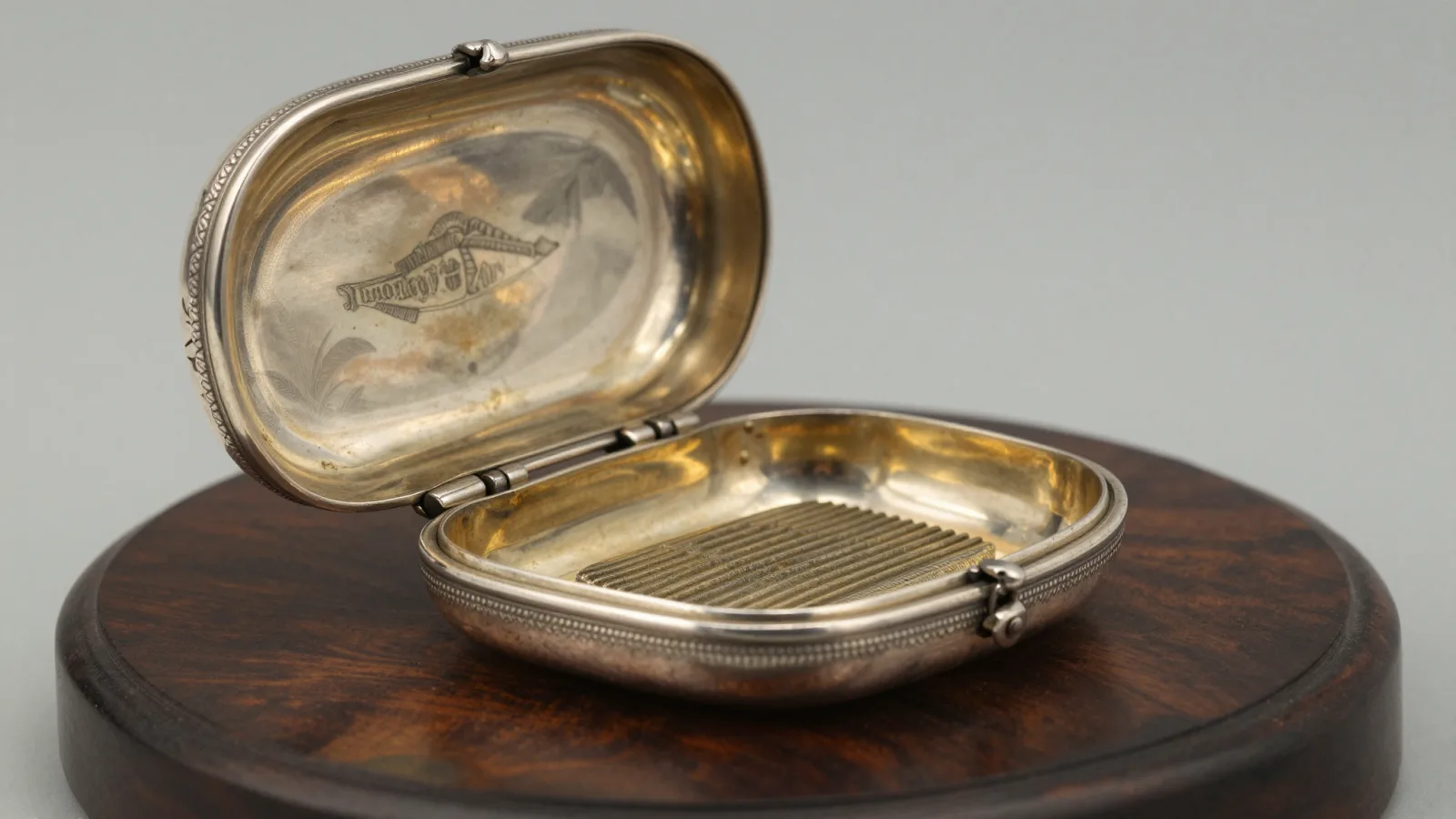
Most silver vesta cases sell for £40 to £150, but Sampson Mordan novelty shapes pass £2,000. The hallmark, the maker, and the form decide the band.
What is a silver vesta case?
A silver vesta case is a small pocket box built to carry friction matches, and British makers produced them in huge numbers between roughly 1840 and 1930. The name comes from Vesta, the Roman goddess of the hearth. Match firms sold short wax-stemmed matches under the vesta name, and the box that held them took the same word.
Early friction matches ignited against almost any rough surface. A loose match in a trouser pocket could catch against a coin or a key. The vesta case solved that hazard with a tight sprung lid and a ribbed striking panel, most often on the base. American collectors call the same object a match safe, and US auction listings use that term.
A typical case measures 4 to 6 centimetres tall and weighs 20 to 40 grams. Most are rectangular with rounded corners. Makers also produced ovals, curved shapes that hug the thigh, and hundreds of novelty forms. A suspension ring on one corner let owners hang the case from a watch chain beside a sovereign holder.
Production peaked between 1880 and 1910, and Birmingham workshops dominated the trade. The city’s assay office marked tens of thousands of cases each year through the 1890s. Petrol lighters and safety matchboxes then killed the market; by 1930 the vesta case was obsolete.
That production history drives value today. Plain rectangular cases survive in enormous quantities, so scarcity lives in the shapes, the enamels, and the named makers rather than in the object type itself. If the marks themselves are new territory, start with our beginner’s guide to silver marks and come back with the case in hand.
One collector habit worth copying: pick the case up before reading anything. An honest Victorian case feels dense for its size, the lid snaps shut with an audible click, and the striker ribs show even wear from decades of matches. A case that feels light and sharp-edged deserves a harder look at its marks.
How do I read the hallmarks on a vesta case?
A British silver vesta case carries four standard marks: the maker’s initials, the town mark, the lion passant, and a date letter. Makers stamped them inside the lid, across the base, or in a row along the bottom edge of the body. On small cases the punches sit close together and can crowd into the decoration.
The table below covers the marks you will meet on nine cases out of ten.
| Mark | What it looks like | What it tells you |
|---|---|---|
| Lion passant | Walking lion facing left | Sterling standard, 925 parts per 1,000 |
| Anchor | Upright anchor in a shaped shield | Birmingham assay office |
| Leopard’s head | Uncrowned feline head | London assay office |
| Date letter | Single letter in a shield | The assay year, read against that office’s cycle |
| Maker’s mark | Two or three initials | The registering firm, for example S.M. for Sampson Mordan |
| Sovereign’s head | Monarch’s profile in relief | Duty mark, struck until 1890 |
The duty mark gives you a fast dating shortcut. Parliament abolished the silver duty in 1890, so a case with the sovereign’s head predates that year. A case without it, on a Victorian form, sits between 1890 and 1901.
Two traps catch new readers. First, a diamond-shaped lozenge or a number after “Rd” is a design registration, not a hallmark. It protects the pattern and says nothing about silver content. Second, continental cases imported into Britain carry an import mark alongside a purity number such as 925 or 800, and the town mark identifies the British import office rather than the place of making.
Chester marked many vesta cases too, and its three-wheatsheaves shield is easy to confuse with worn Birmingham punches at arm’s length. The office outline is the separator: Chester used an upright shield with the sheaves stacked around a sword. Our full UK hallmarks guide walks through each office’s date letter cycles in order, which is the part you need next once the town mark is settled.
The makers that bring the strongest prices
Sampson Mordan & Co. of London leads the vesta case market by a wide margin. The firm patented the first propelling pencil in 1822 and applied the same inventive streak to smokers’ requisites. Mordan novelty cases, shaped as owls, pigs, sentry boxes, hearts, and violins, set the auction records for the whole category.
Birmingham supplied the volume trade, and several of its firms built strong reputations that still carry a premium over anonymous makers.
| Maker | Mark | City | Active period | Known for | Market position |
|---|---|---|---|---|---|
| Sampson Mordan & Co. | S.M. or S.M.&Co | London | 1815-1941 | Novelty and enamel cases | Top of the market |
| George Unite | GU | Birmingham | 1825-1920s | Engraved rectangular cases | Solid mid-market |
| Hilliard & Thomason | H&T | Birmingham | 1850s-1902 | Pierced and embossed work | Mid-market |
| William Neale | WN | Birmingham | 1860s-1920s | Curved and shaped cases | Mid-market |
| Joseph Gloster | JG | Birmingham | 1890s-1930s | Plain and engine-turned cases | Entry level |
| Crisford & Norris | C&N | Birmingham | 1890s-1930s | Small stamped cases | Entry level |
| Gorham | Lion, anchor, G | Providence, USA | 1831 onward | Cast figural match safes | Strong in US sales |
| Unger Brothers | UB conjoined | Newark, USA | 1872-1919 | Art Nouveau repousse | Strong and rising |
The maker’s mark changes the price more than the date does. A plain 1895 Birmingham case by Crisford & Norris and a plain 1895 case by George Unite look nearly identical across a room. The Unite case brings perhaps a third more because collectors chase the name and the heavier gauge the firm favoured.
American match safes run on a separate track. Gorham cast its figural safes rather than stamping them, so the relief detail runs deeper, and the Metropolitan Museum holds Gorham smokers’ silver in its American Wing collection. Unger Brothers’ flowing Art Nouveau maidens have climbed steadily as Newark silver gains scholarly attention. Check the marks on an American case against a maker index rather than a hallmark chart, because the US had no assay office system and firms marked purity themselves.
Not sure what you’ve got?
Snap a photo and let our AI identify any antique in seconds. Free, no sign-up.
Identify on iPhone →Learn MoreWhat are silver vesta cases worth?
Most plain sterling vesta cases sell for £40 to £150, and the exceptional novelty and enamel examples pass £2,000. Form decides the band; condition and maker move you up or down within it.
| Case type | Typical range | Main value driver |
|---|---|---|
| Plain rectangular, Birmingham | £40-£120 | Weight and condition |
| Engine-turned or engraved | £60-£180 | Crispness of the decoration |
| Curved and shaped plain forms | £80-£200 | Shape scarcity |
| Enamel-fronted | £300-£1,500 | Enamel subject and condition |
| Sampson Mordan novelty figural | £800-£5,000+ | Form rarity and condition |
| American cast figural safes | £150-£1,200 | Maker and casting quality |
| Split, dented, or erased | £20-£40 | Scrap weight only |
These are auction hammer bands, not dealer retail. A dealer’s ticket price often doubles the auction figure for the same case, which is normal margin rather than sharp practice. Sold listings on WorthPoint show both channels side by side and are worth checking before you set a reserve.
Scrap value puts a hard floor under every band. A 30-gram sterling case contains 27.75 grams of fine silver, which is 0.89 troy ounces. Multiply that by the day’s spot price: at £20 per troy ounce the metal is worth about £18. Any intact hallmarked case beats its own melt figure, so never weigh in a case that still opens and closes.
Within a band, three factors move the needle most. A crisp full set of hallmarks adds money; smoothed marks subtract it. An original gilt interior in good order signals light use. And a period monogram cuts the price on plain cases by 10 to 20 percent, while an erased monogram cuts it far more, a point covered in our guide to what a hallmark is worth to a buyer.
To place your own case, read its marks first: maker, town, date letter, in that order. Photographing the punches and running them through one of the tools in our comparison of hallmark identifier apps settles the maker and year in a minute, and the table above then gives you the band.
Novelty and enamel cases: where prices jump
Novelty shapes and enamelled fronts are where vesta case prices leave the ordinary bands behind. The logic is simple supply and demand. Workshops stamped plain rectangles by the thousand, but a case shaped as a crouching pig or painted with a racing scene was a short production run, and survivors are few.
Sampson Mordan built this end of the market. The firm registered design after design through the 1880s and 1890s: owls with glass eyes, fish with hinged heads, sentry boxes, champagne bottles, hearts, and horseshoes. Condition rules here even more than rarity. A Mordan owl with its original glass eyes intact brings multiples of the same owl with replacements.
Enamel cases form the second premium group. Birmingham and London firms fitted plain cases with enamelled panels showing hunting scenes, yachts, dogs, soldiers in uniform, and music-hall subjects. Sporting and military subjects sell well; named regiments add buyers. The Victorian trade also produced risque enamels for the pocket of the discreet gentleman, and those now bring some of the strongest prices in the whole category.
Enamel condition is binary in a way metal condition is not. A dent can be raised, but a chipped or crazed enamel panel resists honest repair, and buyers discount hard: a visible chip can halve the price, and restored enamel must be declared. Examine the panel edge under magnification, because that is where losses start.
Period matters less than collectors expect. Nearly all vesta cases are Victorian or Edwardian, so the era premium that separates Georgian silver from later work barely applies inside this category. A dated 1885 case and a dated 1905 case of the same form sit in the same band. The Victoria & Albert Museum holds enamelled and novelty examples in its metalwork collection, and browsing them is a fast education in what the top of the market looks like.
How do I check condition before buying or selling?
Check four things on any vesta case: the hinge spring, the seams, the surface, and the striker. Each takes seconds, and together they explain most of the gap between a £40 case and a £150 case of the same pattern.
Work through the checks with this table in hand.
| What you find | What it means | What to do |
|---|---|---|
| Lid no longer snaps shut | Weakened or broken hinge spring | Budget for repair; deduct 30 to 50 percent |
| Thin dished patch on the front | An erased monogram | Treat as damage; the value drops sharply |
| Striker ribs worn smooth | Decades of genuine use | Normal wear; price barely affected |
| Split along a body seam | Solder joint failure | Buy at scrap value only |
| Bright white interior, no gilding | Later refinishing or heavy polishing | Check the hallmarks for softening |
The dished monogram patch is the one sellers miss most. Hold the case flat to a window and tilt it. Original flat silver throws back an even reflection; an erased area shows as a shallow hollow that catches the light differently. Engravers removed initials by grinding the surface down, and the thinned metal cannot be put back.
Striker wear tells the opposite story. Even, silky wear across the ribs is the fingerprint of a case that lived in a pocket for thirty years, and collectors read it as character rather than damage. Ribs that look factory-sharp on a supposedly Victorian case invite a second look at everything else.
On polishing: once, gently, with a soft cloth before sale is fine. Repeated machine buffing rounds the hallmark edges and erases the crisp engraving that carries the price. If the marks already look soft and smeared, stop; every further pass costs money.
Marriages appear in this category too. A lid from one case soldered to the body of another shows mismatched date letters between lid and base, or fresh solder colour at the hinge. Both parts may be honest silver, but a married case trades at the bottom of its band.
Frequently Asked Questions
Is there an app that reads vesta case hallmarks?
Antique Identifier – Antiqly reads the maker’s initials, town mark, lion passant, and date letter on a vesta case from a single photo. The app is a free download with no sign-up required, and it handles small punches well because you can shoot close and crop before scanning. For a worn mark, take the photo in raking light from a window so the shadows lift the punch outline. Antiqly then returns the assay office, the year, and a value band for the form, which you can check against the tables in this guide.
How much is a plain silver vesta case worth?
A plain hallmarked sterling case in sound condition brings £40 to £120 at auction, with most landing between £50 and £80. Weight helps: a heavy 35-gram case outsells a thin 20-gram one of the same date. A named Birmingham maker such as George Unite pushes toward the top of the band, and a crisp full set of hallmarks matters more than the exact year. Dealer retail runs higher, often £90 to £180 for the same case, because the dealer absorbs the risk and the waiting. If the lid still snaps shut and the marks read clearly, the case sits comfortably above scrap no matter how plain it is.
Are brass and plated vesta cases worth anything?
Yes, but at a different level. Brass, nickel, and EPNS vesta cases trade between £5 and £40, with figural and advertising examples at the top. Cases stamped with brewery, tobacco, or shipping-line advertising have their own collector base and can beat plain silver cases despite the base metal. An EPNS case carries no hallmarks, only maker and plate marks, so nothing on it guarantees silver content. The quick separations: sterling cases carry a lion passant, continental silver carries a number such as 925 or 800, and plated cases carry neither. Check the marks before assuming either way, because worn plating can look convincingly like tarnished silver.
Why is it called a vesta case?
The name traces to Vesta, the Roman goddess of the hearth and its sacred flame. Nineteenth-century match makers borrowed the name for short wax-stemmed matches, which the public called vestas, and the box that carried them became the vesta case. The word stayed British. Americans called the same object a match safe, and that term still rules US auction catalogues, so search both names when researching prices. You may also meet ‘go-to-bed’ for a small stand that held one vesta upright as a night light. All describe the same era of pocket fire-carrying, roughly 1840 to 1930, before petrol lighters ended it.
How do I date a Birmingham vesta case?
Find the anchor first, which confirms Birmingham assay, then read the date letter beside it against Birmingham’s cycle. The office changed the letter every July and redesigned the font and shield outline with each new alphabet, so the letter shape narrows the year to one. A sovereign’s head duty mark beside the others places the case before 1890, which is a useful cross-check. Birmingham’s cycles are fully tabulated, so the lookup is mechanical once you can see the punch clearly. Photograph the marks in angled light if they are shallow. Most Birmingham vesta cases fall between 1880 and 1915, so expect letters from those alphabets.
Should I polish a vesta case before selling it?
One gentle pass with a soft silver cloth is enough to lift the grime and show the metal; anything more aggressive risks the price. Machine buffing rounds hallmark edges, drags the crisp lines out of engraving, and leaves a mirror shine that collectors read as interference. Deep black tarnish in the crevices of engraved decoration is expected and even attractive, so leave it. Never polish an enamelled panel with abrasive paste, because it scratches the glass surface permanently. If the case has its original gilt interior, keep polish away from it entirely. Sellers lose more money to over-polishing than to tarnish in this category.
Identify any antique in seconds.
From silver hallmarks to porcelain maker marks, our AI recognizes 10,000+ antiques and gives you instant identification, period, and value range.
Download Free on iPhoneSee How It Works