
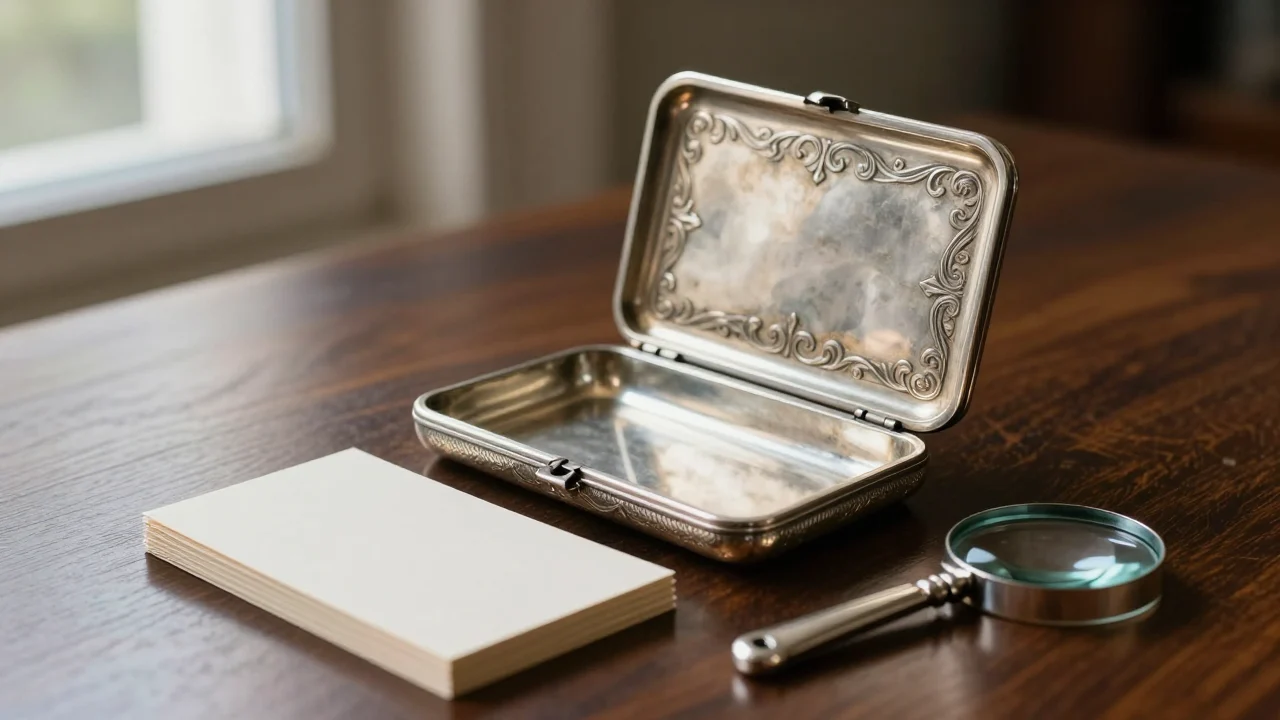
Typical silver card cases sold for £60 to £400 at UK auction in 2019-2026; Nathaniel Mills castle-tops made £550 to £950. Scene and condition set the band.
Every figure in this guide is a published result from one saleroom, Cheffins of Cambridge, with the sale date and the lot page linked, so you can compare the case in your hand with a case that actually changed hands. The results are the figures the auction house published for each lot. They are not dealer retail prices, and they are not the net amount a seller took home.
What is a silver card case?
A silver card case is a slim hinged box, usually about 9.5 by 7 cm, made to hold the printed visiting cards that callers left at a house. Cheffins’ cataloguers describe the custom in one line: calling cards were left behind by a visitor at the premises if the required person was not available. They served as both an introductory letter and a symbol of manners and social standing, and the custom of leaving visiting cards lasted throughout the 19th and into the early 20th century. The Wikipedia overview of the visiting card adds that visiting cards were kept in highly decorated card cases, which is why so many survive in silver.
Most British examples are rectangular, with a piano hinged cover along one short edge that lifts to show a plain interior. Size and weight vary less than you might expect. A Smith & Bartlam case of 1904 is catalogued at 9.5 x 7cm and 63g, and a Taylor & Perry case of 1834 at 10 x 6.5cm and 83g, so weight alone tells you little about age or quality. Dance card cases with a suspension ring and small card purses are related but separate types, and they are catalogued and priced separately.
Where are the hallmarks on a silver card case?
The hallmarks sit in a short row of small punches on the body or inside the cover, and reading that row is the fastest way to date a case. Look for four or five marks: the sponsor’s initials, the town mark, the lion passant standard mark, the date letter and, on older pieces, a monarch’s head.
The anchor is the Birmingham Assay Office mark, and almost every case in the table below carries it, because the Birmingham box trade made them. The Goldsmiths’ Company hallmarking page lists the four current office marks: a leopard for the London Assay Office, an anchor for the Birmingham Assay Office, a rose for the Sheffield Assay Office, and a castle for the Edinburgh Assay Office.
The date letter tells you when an item was hallmarked. The Goldsmiths’ Company explains that the font, case, and shield shape around the letter change once the alphabet has been completed so each letter is unique to a specific year. Read the shield as carefully as the letter; the Birmingham hallmark guide lays out the cycles year by year, and the beginner’s guide to silver marks walks through the whole row if the sequence is new to you.
The sponsor’s mark, usually called the maker’s mark, is composed of their initials inside a shield shape. On a card case those initials name the workshop that submitted it, which is not always the shop that sold it. A Nathaniel Mills castle-top of 1850 sold at Cheffins in 2024 was retailer signed opposite side to the hallmark (ROE & JACOB * LIVERPOOL), so the Liverpool retailer’s name and the Birmingham maker’s mark sit on the same case.
A monarch’s head beside the other marks is the duty mark. The Wikipedia article on hallmarks summarises the rule: in 1784, the United Kingdom began charging a tax on silverware, and a further mark was added to indicate this had been paid. The mark was the monarch’s head and continued to be used until 1890, when the tax was abolished. Two Birmingham cases of 1837 in the table, by Joseph Willmore and Nathaniel Mills, are each catalogued with William IV duty mark, which is how a cataloguer separates an 1837 date letter from the Victorian years that follow.
Expect wear on the marks. Condition reports on the cases below range from hallmarks and engraving clear and readable, through hallmarks a little rubbed but still easily identifiable, to date letter rubbed, possibly 1846. A rubbed date letter widens the date range a cataloguer can give, which is why two Mills cases in the table carry a qualified year.
Which makers matter on a silver card case?
Nathaniel Mills of Birmingham is the name that lifts a card case out of the general run. The Wikipedia entry on Nathaniel Mills & Sons records that in 1825, he registered his well-known now punch mark ‘N.M’ within a rectangle at the Birmingham Assay Office, and that he became one of the most prolific Birmingham box makers at the time. The Silver Makers’ Marks index for Birmingham lists the NM mark on baskets, boxes, card cases, decanter labels and vinaigrettes with dates seen from 1826 to 1857, and notes that the punch is seen with and without central pellet. Check the pellet before you assume a plain NM is a different maker.
The firm continued under his sons Nathaniel II, William and Thomas, who adopted innovations such as engine-turning, stamping and casting, and most of the collectibles were made between 1840 and 1853. That window is why so many castle-top cases carry date letters for the 1840s.
Other Birmingham names recur in the results: Taylor & Perry (1834), Joseph Willmore (1837), George Unite (1881), Hilliard & Thomason (1890), John Millward Banks (1897), Smith & Bartlam (1904) and Joseph Gloster (1905). Their cases are well made, but without a scene or a celebrated mark they sold in the two-figure and low three-figure range in the table. Liberty & Co. is the exception among later makers: a silver and enamel card case, Birmingham 1909, sold for £320 in February 2026, above every plain Edwardian case from the same saleroom.
The same workshops made vesta cases and snuff boxes, so the maker hierarchy repeats across small silver. The silver vesta case value guide and the antique silver snuff box value guide show how the same names price on other boxes, and the snuff box results run higher than the card case results for the same maker.
What makes a castle-top card case?
A castle-top card case carries a view of a British landmark on its cover, most often raised from behind by die stamping. Cheffins’ cataloguers put the type in one sentence: ‘Castle Top’ silver, decorated with British landmarks and sold as souvenirs to tourists, was at the height of fashion between 1840 to 1860. Most ‘Castle Top’ silver is made by die stamping (pushing the metal out from behind, using a stamp), and the greater the decoration stands clear from the front of the cover, the harder it is to make. High relief is therefore a price driver in its own right.
The subject matters as much as the relief. Cheffins notes that some scenes are quite common, such as Windsor Castle, and that the rarer the scene, the more valuable the item. Scenes in the results below include the Walter Scott Monument, Edinburgh; Robert Burns’ monument in Alloway with Alloway Kirk and the Brig O’ Doon; Windsor Castle paired with Kenilworth Castle on a double-sided case; and Salisbury cathedral on an Edwardian case.
Not every castle-top is stamped. The 1850 Mills case sold in April 2024 has engine turned decoration around an engraved scene, probably of the Old Bridge at Perth, and it made almost as much as the high-relief Burns case. Cheffins’ lot notes cite a £9,800 record for a castle-top card case showing the Post Office, Dublin; that figure is the auction house’s own note, and this guide has not traced that sale independently.
What are silver card cases worth?
A silver card case is worth £60 to £400 in most cases and £550 to £950 when it is a Nathaniel Mills castle-top, on the published results of one UK saleroom between 2019 and 2026. The table lists single-case lots sold by Cheffins, Cambridge, in descending order of price. Each result links to the lot page, where the full description and condition report can be read.
Cheffins publishes one figure per lot and does not state on the lot page whether the buyer’s premium is included. A buyer pays a premium on top of the hammer price, and a seller receives the hammer price less commission, so treat every figure below as the auction house’s published number rather than the cash a seller received.
| Card case | Maker, assay office and year | Result at Cheffins | Price driver |
|---|---|---|---|
| Castle-top, Robert Burns’ monument in high relief | Nathaniel Mills, Birmingham, date letter indistinct | Sold for £950 on 1 August 2019 | Rare scene, unusually high relief |
| Engraved castle-top, Old Bridge at Perth | Nathaniel Mills, Birmingham 1850 | Sold for £900 on 25 April 2024 | Engraved scene, retailer signature, readable marks |
| Double-sided castle-top, Windsor and Kenilworth | Nathaniel Mills, Birmingham 1838 | Sold for £800 on 2 December 2021 | Two scenes, early date |
| Castle-top, Walter Scott Monument | Nathaniel Mills, Birmingham 1844 | Sold for £550 on 2 December 2021 | Common subject, rubbed marks, loose hinge |
| Pierced scrolls and foliage | Nathaniel Mills, Birmingham 1837 | Sold for £400 on 17 August 2023 | Mills mark without a scene |
| Silver and enamel | Liberty & Co., Birmingham 1909 | Sold for £320 on 26 February 2026 | Design-house name, enamel |
| Scroll-engraved, vacant cartouche | Nathaniel Mills, Birmingham, date letter rubbed | Sold for £300 on 15 April 2021 | Mills mark, rubbed date letter |
| Castle-top, Salisbury cathedral | Joseph Gloster, Birmingham 1905 | Sold for £240 on 12 December 2019 | Edwardian castle-top, later maker |
| Repoussé foliage | Taylor & Perry, Birmingham 1834 | Sold for £200 on 1 May 2025 | Early date, dented corners, loose hinge |
| Castle-top, Windsor Castle | Mark not traced, London 1999 | Sold for £180 on 17 August 2023 | Modern case in the Mills manner |
| Engine-turned stripes | Joseph Willmore, Birmingham 1837 | Sold for £150 on 17 August 2023 | Good maker, plain decoration |
| Engine-turned, monogram | George Unite, Birmingham 1881 | Sold for £90 on 17 August 2023 | Standard Victorian case |
| Floral engraving | Smith & Bartlam, Birmingham 1904 | Sold for £80 on 20 November 2025 | Standard Edwardian case |
| Foliage and scrolls, monogram | Hilliard & Thomason, Birmingham 1890 | Sold for £60 on 17 August 2023 | Dents to corners, dishing to both sides |
Three patterns stand out. First, the Mills name alone lifts a plain case: the pierced 1837 case and the scroll-engraved case made more than any other maker’s plain case in the set. Second, a scene adds more than a name: the four Mills castle-tops sit above every other lot, and the double-sided and engraved examples sit above the common Scott Monument view. Third, later castle-tops are priced as decorative silver, not as Mills: the 1905 Gloster and the 1999 London case sold in the same band as good plain Victorian cases.
One saleroom over seven years is a narrow window. A London sale, a specialist boxes sale or a rare Irish view can move a case well outside these bands, and a single dented example can fall below them. Before you compare, confirm the maker’s mark and date letter on your own case; the hallmark app comparison explains which tools read a rubbed Birmingham row well enough to place a case in the right row of this table.
Which condition faults do auction reports record?
Auction condition reports on card cases record four faults again and again: dishing, dented corners, loose hinges and rubbed marks. The cases in the table show all four. The Hilliard & Thomason case carries some minor denting to each corner as well as some minor dishing to both sides. The Taylor & Perry case reports that the hinge is very loose but intact, and the cover closes well. The Scott Monument castle-top has a hinge a little loose but does not appear strained, together with the rubbed hallmarks noted above.
Dishing means the flat sides have bowed inward from years in a pocket. Press a case flat on a table and look for daylight under the edges. Dented corners are the next most common fault because the corners strike first when a case is dropped. Hinge wear shows as side play or a cover that no longer snaps shut. None of these faults is unusual on a case that was carried for decades, and none proves a case is a poor one, but each one is a reason to bid at the lower end of the band rather than the upper.
Repairs matter more than wear. A resoldered hinge or a re-engraved cartouche where a monogram was polished out changes the surface, and cataloguers flag them. Each report quoted above notes the absence of obvious repair, so the bands in the table describe honest, worn cases, not restored ones.
How do I tell a Victorian castle-top from a later one?
The date letter decides, not the scene. Castle-top views were revived in the Edwardian years and are still produced, so a landmark on the cover proves nothing about age on its own. The 1905 Joseph Gloster case in the table shows Salisbury cathedral in the same die-stamped manner as the 1840s cases, and the Windsor Castle case with mark not traced (RC), London 1999 was catalogued as a ‘Castle Top’ card case in the manner of Nathaniel Mills. Both carry clear hallmarks; the letter and the town mark placed them in their true decades.
Work through three checks. Read the town mark first: a London leopard’s head or a modern Sheffield rose on a castle-top rules out the Birmingham trade of the 1840s. Read the date letter against its shield shape, because the letter alone repeats every cycle. Then read the sponsor’s mark and compare it with the NM punch described above, remembering that it is seen with and without central pellet. If any of the three is rubbed beyond reading, the case belongs in a broader date band and a lower price band until a specialist has seen it.
A castle-top also cannot be authenticated as Mills by its scene or its relief. Cheffins’ own catalogue uses the phrase in the manner of Nathaniel Mills for the 1999 case, and that is the correct language for any case whose sponsor’s mark is missing, rubbed or untraced.