
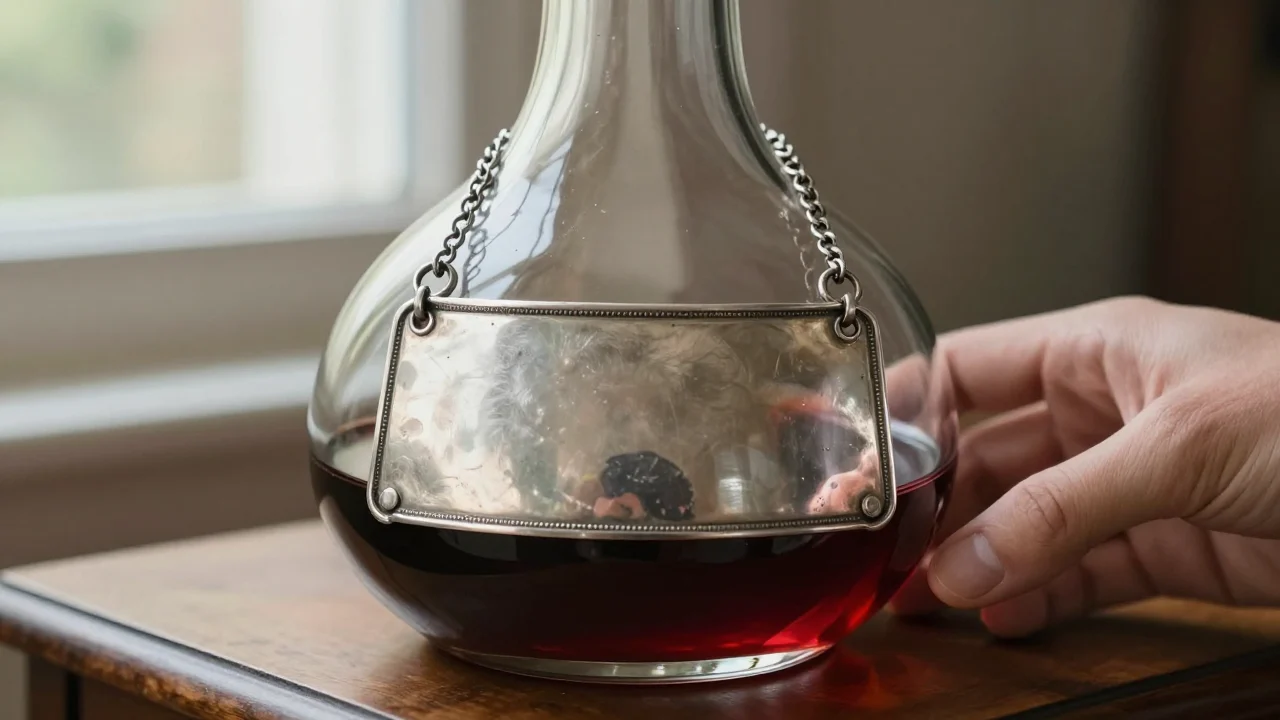
Antique silver wine labels in groups of two to eight made £40 to £200 hammer at Toovey’s in 2024-2026; single Scottish provincial labels made £275 and £286.80.
Every figure in this guide is a published auction result with its sale date and lot page linked, so you can set your own label beside one that actually changed hands. Most results come from one saleroom, Toovey’s, which prints the hammer price and states its buyer’s premium beside it. Results from Bonhams and Lyon & Turnbull are added for the single provincial labels, the larger collections and the plated groups that Toovey’s did not offer in this period. No figure is a dealer’s asking price, and none is the net amount a seller took home.
What is a silver wine label?
A silver wine label is a small silver plaque on a chain, made to hang round the neck of a decanter or bottle and name what is inside, and the same object is called a bottle ticket or a decanter label. The Wikipedia article on decanter labels records that the first decanter labels were probably produced in the mid-1730s in England, and that the ledger of goldsmith George Wickes noted that he charged a customer £1.10d for ‘six Bottle Ticketts’ in May 1736/37. From the 1790s on, the main terms to refer to the objects are wine label and decanter label, though bottle ticket is still a term sometimes used.
The names on labels reach far beyond wine. The same article, citing the Wine Label Circle, states that the Wine Label Circle had counted 2875 names of which 80% were connected with alcoholic drinks, that a large proportion of the rest are connected with sauces, and that a final group covers medicinal or boudoir labels. The V&A record for a Sandylands Drinkwater Madeira ticket explains that bottle tickets identified the contents of a bottle or decanter, which might alternatively contain spirits, sauces, toilet waters or cordials, and that contemporary gazettes begin to refer to ‘labels for bottles’ in the 1770s but it was not until the 1790s that they were established as wine or decanter labels.
Silver is the main material but not the only one. Wikipedia states that sterling silver (92.5% silver) is the dominant material in decanter labels, that from around 1750, and until 1840, labels were also produced in the cheaper material known as Old Sheffield Plate, and that from the 1840s, electroplating replaced Old Sheffield Plate in this role. Enamel labels on copper came from the short-lived Battersea factory at York House, which operated circa 1753-56, and shortly afterwards from Bilston. A label that is not silver can still be old and collectable, but it belongs in a different price band, as the plate section below shows.
How do you date a silver wine label?
You date a silver wine label from its marks first and its shape second, because a full set of hallmarks gives a year while the shape gives only a period. The Wine Label Circle, the collectors’ society formed in 1952, sets out the sequence on its labels page. Early labels (1735 – 1770) showed the rococo influence, with scrolls, festoons and cherubs, alongside plainer narrow rectangles, crescents and escutcheons. In the neo-classical decades (1770-1800) labels were produced in a vast abundance of elegant shapes. The Regency (1800-1830) favoured ornate pieces, often heavy cast items of fine workmanship. In Victoria’s reign labels in the shape of vine leaves, both single and with several leaves, became tremendously popular, and the number of labels produced fell off markedly after the 1860s when wine in bottles with paper labels displaced decanters from many dining tables and sideboards.
| Period | Typical silver forms | Marks to expect on the reverse |
|---|---|---|
| Early, c.1735-1770 | Escutcheons chased with vines and grapes, crescents, narrow rectangles, rococo scrolls and cherubs | Maker’s mark alone, or maker’s mark with the lion passant; often nothing else |
| Neo-classical, 1770-1800 | Crescents with reeded or feathered edges, plain and bright-cut rectangles, ovals and navettes | Maker’s mark and lion before 1790; from 1790 usually a full set, often without the leopard’s head on London labels |
| Regency, 1800-1830 | Heavy cast escutcheons and shells, gadrooned oblongs, Birmingham die-stamped shells and leaves | Full hallmarks with the sovereign’s head duty mark; the anchor on Birmingham die-stamped work |
| Victorian, 1830-1900 | Single and multiple vine leaves, pierced cartouches, pierced lettering, fruiting-vine relief | Full hallmarks with the duty head until 1890; fewer labels made after the 1860s |
| Modern, 1900 onwards | Rectangles with shell and scroll rims, enamelled titles, cast novelty forms, commemorative labels | Full modern hallmarks and no duty mark |
Two rules govern the marks. The Wine Label Circle states that in the early years of silver labels, before 1790, the majority of labels were stamped (on the reverse) with only the maker’s mark or with the maker’s mark accompanied by the lion to indicate that the item was silver, and that from 1790 the majority of labels, at least those from the major centres, bear a full set of hallmarks. It adds that the town mark of a leopard’s head for London was often not applied to small articles like wine labels. A Georgian label with two marks is therefore normal rather than suspect, the same exemption logic this site explains for small silver without a date letter; the silver marks guide sets out the full mark row that larger pieces carry.
The duty mark dates any label that carries it. The Wikipedia hallmark article records that in 1784, the United Kingdom began charging a tax on silverware, and a further mark was added to indicate this had been paid, and that the mark was the monarch’s head and continued to be used until 1890, when the tax was abolished. A label with a sovereign’s head sits between 1784 and 1890; a label without one is earlier, later, or one of the many small pieces that never received the full set. The Goldsmiths’ Company lists the office marks you then read the date letter against: a leopard for the London Assay Office, an anchor for the Birmingham Assay Office, a rose for the Sheffield Assay Office, and a castle for the Edinburgh Assay Office, and the UK hallmarks guide sets out each office’s letter cycles.
Museum records show what the exceptions look like. The V&A catalogues a Drinkwater Burgundy ticket of about 1755 as silver, no hallmarks, London ca.1755, mark of Sandylands Drinkwater. Its Hester Bateman crescent of about 1775 lists the mark of HB for Hester Bateman, the engraved crest and the word MADEIRA, and no hallmarks. Its Matthew Linwood shell label shows the other side of 1790: Birmingham hallmarks for 1810-11 on a die-stamped Port label. Auction catalogues repeat the pattern. Toovey’s described a pair of Hester Bateman labels as London, no date but circa 1780, and Bonhams described a Perth label as carrying a small maker’s mark only struck twice.
Which makers and features lift a wine label?
Provincial marks lift a wine label more than a London name does on these results, and the only single labels in this set to pass £250 are Scottish provincial. A Perth label by William Ritchie, marked W.R twice, of simple rectangular form inscribed RUM, shows £275 on its Lyon & Turnbull lot page from 17 August 2016. A plain narrow rectangular Lisbon label, probably by Robert Keay (I) of Perth, circa 1795, sold for £286.80 inc. premium at Bonhams on 8 February 2005. Neither label is decorated; the price is in the town mark that is not there and the maker’s punch that is.
A London name adds less on these results. Four labels headed by two Hester Bateman rectangles of circa 1780 made £200 hammer at Toovey’s on 3 December 2025, the highest Toovey’s figure for Georgian labels here, but for four labels rather than one. This site’s Georgian silver guide notes that Hester Bateman’s bright-cut domestic silver carries a dependable premium over anonymous equivalents; on labels that premium is real but spread across a group lot. At the top of the trade stands Paul Storr: the V&A holds a Storr oblong label with London hallmarks for 1812-13, engraved with the Royal Crown and the Prince of Wales feathers, probably for the Prince Regent, with the word ‘PORT’, re-engraved over the word, ‘MOUNTAIN’. No Storr label result is included below because none with a published sale figure was found in the sources used for this guide.
Cast and pierced work sells above flat engraved rectangles. Three Elizabeth II labels cast as standing horses, by John Henry Odell in 1975 and 1976 with a matched Mappin & Webb Whisky label, made £260 hammer at Toovey’s on 30 October 2024, more than any Georgian group in the table. A set of four pierced George III labels by Thomas Phipps & Edward Robinson, London 1809 and 1811, made £160 hammer on 2 October 2024. Wikipedia notes that names were sometimes obliterated and replaced with other names when a particular type of wine fell out of fashion, so a re-engraved title, like the Storr label’s Port over Mountain, is a known alteration to describe in a sale listing rather than a reason to reject the label.
How do you tell a silver label from plate or enamel?
You tell a silver label from a plated one by the marks and by the edge, because Old Sheffield Plate and electroplate labels copy silver shapes exactly and carry no hallmarks. The V&A catalogues an Old Sheffield Plate BEER ticket of about 1760 as Sheffield plate (one side only), a fancy escutcheon with no marks, and an electroplate SHERRY label of about 1850 with the word SHERRY in pierced lettering and no marks. Wikipedia adds that early Old Sheffield labels may have copper backs, but later the backs were either covered with tin, or plated on both sides, so a copper-coloured back or a worn edge showing copper points to a plated label. The EPNS marks reference explains the plated mark rows that imitate hallmarks on later pieces. Enamel labels on copper carry no silver hallmarks.
Plated labels have a market of their own, in bulk. At the Bonhams Harveys Wine Museum Silver sale on 1 October 2003, a collection of forty-six electroplated wine labels, principally Victorian, sold for £501.90 inc. premium; twenty-five Victorian electroplated wine labels sold for £430.20 inc. premium; and an interesting group of Old Sheffield Plate wine labels principally 18th Century sold for £478 inc. premium. Those figures are lot totals for large collections, not per-label prices, and they are more than twenty years old.
What are antique silver wine labels worth?
Antique silver wine labels are worth £40 to £200 hammer in groups of two to four at Toovey’s in 2024-2025, £85 to £190 hammer in mixed groups of five to eight in 2024-2026, £275 to £286.80 for single Scottish provincial labels, and £250 to £312.50 inc. premium for eight-to-ten-label collections with Irish or Scottish pieces at Bonhams, on the results below. Most labels reach auction in groups that mix Georgian, Victorian and modern pieces, so the lot total reflects the count and the best label in it rather than a per-label rate; the 1975-76 cast horses at £260 are modern and sit outside the antique bands. The first table gives the bands and what set the price inside them; the second lists every lot behind those bands in descending order, with a link to the page where the full description can be read.
Salerooms publish the figure in different ways. Toovey’s prints the hammer price and states beside it that buyer’s premium is an additional charge on each lot sold, currently this is set at 25% plus VAT (30% including VAT) of the hammer price; its 2024 and mid-2025 lot pages show the earlier rate of 24.5% plus VAT (29.4% including VAT) of the hammer price. Bonhams prints its figure as inc. premium. Lyon & Turnbull shows a single figure on the lot page without a label. A seller receives the hammer price less the seller’s commission, so treat every figure as the saleroom’s published number rather than cash in hand. To read the marks on your own label before you compare, photograph its reverse in raking light with the free hallmark identifier for iPhone and Android and match the reading against the rows below.
| Type | Result band | What set the price |
|---|---|---|
| Two to four Georgian and Victorian labels: pairs, small groups and one matched set | £40 to £200 hammer at Toovey’s, 2024-2025 | Two Willmore and Rawlings & Summers labels of 1839-41 made £40; four labels headed by two Hester Bateman rectangles made £200 |
| Mixed group of five to eight labels, Georgian to modern | £85 to £190 hammer at Toovey’s, 2024-2026 | The Georgian labels carry the lot; modern Sherry and Whisky labels add little |
| Single Scottish provincial label | £275 shown at Lyon & Turnbull (2016); £286.80 inc. premium at Bonhams (2005) | Perth maker’s marks with no assay marks |
| Collection of eight to ten labels with Irish or Scottish pieces | £250 to £312.50 inc. premium at Bonhams, 2013-2017 | Dublin 1789 with dated London rectangles in one lot; Glasgow 1823 and Edinburgh c.1800-1820 in the other |
| Modern cast novelty labels | £260 hammer for three at Toovey’s, 2024 | Standing horses cast by John Henry Odell, 1975-76 |
| Plated collections | £430.20 to £501.90 inc. premium at Bonhams, 2003 | Twenty-five and forty-six electroplated labels sold as single lots |
| Lot | Marks and makers | Result | Price driver |
|---|---|---|---|
| A Madeira label by John Reily, London 1822, with a set of seven silver-gilt labels by R. Comyns 1932-33, four Hester Bateman condiment spoons of 1784 and a caddy spoon (12) | London 1822; London 1932-33; London 1784 | Sold for £775 inc. premium, 13 December 2011 | Twelve pieces; the Bateman spoons and the gilt set carry the lot, not the single Georgian label, Bonhams Knowle |
| Collection of ten: Phipps & Robinson Whiskey, Elizabeth Morley 1801 Madeira, 1797 Port, 1802 Sherry, JW Birmingham 1820 Burgundy, John Townsend Dublin 1789 Hock, a Dublin Claret, two Harvey & Sons 1960-61 and a plated soda label | London 1797-1802 and 1960-61; Birmingham 1820; Dublin 1789 | Sold for £312.50 inc. premium, 12 June 2013 | Irish labels and a run of dated Georgian rectangles, Bonhams Knightsbridge |
| Lisbon label, plain narrow rectangular with rounded ends | Probably Robert Keay (I) of Perth, circa 1795, small maker’s mark only struck twice | Sold for £286.80 inc. premium, 8 February 2005 | Scottish provincial single, Bonhams Knightsbridge |
| RUM label, simple rectangular form, 8.6g | William Ritchie of Perth, marked W.R twice | £275 shown on the lot page, 17 August 2016 | Scottish provincial single, Lyon & Turnbull |
| Pair of labels cast as standing horses, Brandy and Sherry, with a matched Whisky, 99.8g | John Henry Odell, London 1975 and 1976; Mappin & Webb, London 1975 | Hammer price: £260, 30 October 2024 | Cast novelty form, Toovey’s |
| Grierson ‘S’ form label, Glasgow 1823, a Grierson pair for Port and Sherry c.1820, a Hollands label, three JM Edinburgh rectangles c.1820 and an oval MK Edinburgh label c.1800 (8) | Glasgow 1823; Edinburgh c.1800-1820 | Sold for £250 inc. premium, 26 July 2017 | Scottish group, Bonhams Knightsbridge |
| Pair of Hester Bateman rectangles for Port and Madeira, another Bateman Sherry, and a John Reily Sherry of 1815, 34.9g | Hester Bateman, London, no date, circa 1780; London 1815 | Hammer price: £200, 3 December 2025 | Bateman name on three of four labels, Toovey’s |
| Pair by Elizabeth Morley 1814, a Mayfield Port 1806, a Peter & William Bateman Sherry 1812 and three Elizabeth II labels, 66.8g | London 1806-1814 and modern | Hammer price: £190, 10 June 2026 | Seven labels, four of them Georgian, Toovey’s |
| Pair by Edward Mayfield 1805 for Hollands and Brandy, two Sherry labels and a Rum label, Edinburgh 1818 by William Cunningham, 39.1g | London 1805; Edinburgh 1818 | Hammer price: £160, 18 March 2026 | Five labels with an Edinburgh piece, Toovey’s |
| Vine-leaf Port by Rawlings & Summers 1829, 8.5cm, a Port of 1834, Sweet Wine Sheffield 1846, Madeira 1851 and Brandy by George Unite 1850, 93.9g | London 1829-1851; Sheffield 1846; Birmingham 1850 | Hammer price: £160, 6 August 2025 | Pierced vine leaf and 93.9g of silver, Toovey’s |
| Set of four pierced labels: Champagne, Vin de Grave, Maderia and Claret, 51.7g | Thomas Phipps & Edward Robinson, London 1809 and 1811 | Hammer price: £160, 2 October 2024 | Matched pierced set by one maker, Toovey’s |
| Phipps & Robinson Port 1801, Thomas & James Phipps Sherry 1818, Charles Rawlings Port 1821 and a Collingwood pair of 1955, 53.2g | London 1801-1821 and 1955 | Hammer price: £130, 2 October 2024 | Three Georgian labels with a modern pair, Toovey’s |
| Victorian Madeira with fruiting vines by John Gilbert & Co, a Sampson Mordan Whisky and four others, 70.8g | Birmingham 1879; Chester 1909 | Hammer price: £110, 18 February 2026 | Six labels, mostly later, Toovey’s |
| Rum with scallop shell and scroll rim by Taylor & Perry, a Port by Hayne & Cater, 30.4g, with two Crown Staffordshire porcelain labels | Birmingham 1838; London 1857 | Hammer price: £100, 8 October 2025 | Two early Victorian silver labels plus porcelain, Toovey’s |
| Three shaped labels of 1986, five other silver labels, 84.2g, with plated and bone china labels | London 1986 and various | Hammer price: £95, 6 August 2025 | Modern group with plate and china, Toovey’s |
| Bucellas by Edward Mayfield 1802, a Snatt pair for Rum and Hollands 1802-03, a Willmore Sherry 1835 and a Vander pair 1959-60, 49g | London 1802-1803; Birmingham 1835; London 1959-60 | Hammer price: £85, 8 July 2026 | Six labels, three Georgian, 49g, Toovey’s |
| Madeira by Joseph Willmore and Sherry by Charles Rawlings & William Summers, 17g | Birmingham 1841; London 1839 | Hammer price: £40, 5 November 2025 | Two early Victorian labels, 17g, Toovey’s |
The table points to four price drivers. Origin first: the two Perth singles are the only lone labels above £250, and the Bonhams collections with Dublin, Glasgow and Edinburgh pieces sit above every Toovey’s group. Count and weight second: the £190 lot holds seven labels and 66.8g, the £40 lot two labels and 17g. Form third: cast horses at £260 and the pierced Phipps & Robinson set at £160 beat flat engraved rectangles of the same or earlier date. Maker last: the Bateman group at £200 is the best Toovey’s result for Georgian labels, but the single Reily of 1822 rode with spoons and a gilt set to £775, so a mixed lot total says little about the label alone.
What should you do with your wine label now?
Start by turning the label over and photographing the reverse in low side light, then record every punch you see and count them: a maker’s mark alone or with a lion passant fits a label made before 1790, and a sovereign’s head puts it between 1784 and 1890, so note which marks are missing as carefully as which are present. Then check the metal at the edge and on the back for a copper tone or a tinned surface, and match the shape to the period table above, remembering that an escutcheon or crescent with two marks is the normal early state. Finally, weigh the label, find the row in the results table that matches its origin, form and grouping, open the lot page, and compare the catalogue description with the piece in your hand before you set a reserve, an insurance figure or a bid.
Method and limits. Toovey’s results are hammer prices printed on lot pages between October 2024 and July 2026, read on 23 September 2026, with the buyer’s premium statement quoted from those pages; most of those labels sold in groups whose total is not a per-label price. The Bonhams figures are stated inc. premium and date from 2003 to 2017; the Lyon & Turnbull figure is the unlabelled number shown on its lot page. Figures from different salerooms are shown with the house named and are not merged into one band. No dealer, online-marketplace or private-sale prices are used. Dating follows the Wine Label Circle, the V&A and Wikipedia, and a shape or a maker’s mark gives a period rather than a year; a mark on its own does not prove date, maker or metal, and no label described here was examined in hand.