
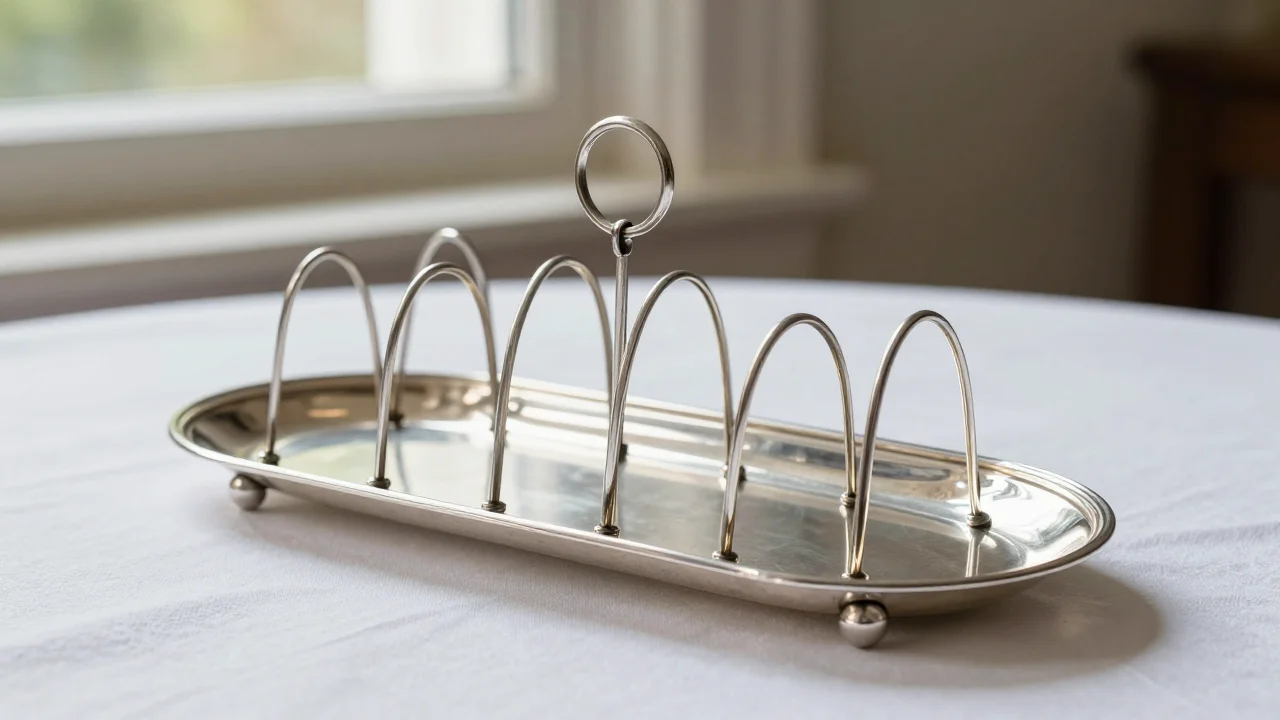
Single Georgian silver toast racks made £100 to £440 hammer at Toovey’s in 2025-2026; pairs of small four-division racks made £130 to £380.
Every figure in this guide is a published auction result with its sale date and lot page linked, so you can set your own rack beside one that actually changed hands. All results come from one saleroom, Toovey’s, which prints the hammer price and states its buyer’s premium on the lot page. Only lots in which the rack was the sole item, a pair, or two racks together are used; mixed lots that bundled a rack with napkin rings, spoons or dressing-table silver are left out because their totals say nothing about the rack alone. No figure is a dealer’s asking price, and none is the net amount a seller took home.
What is an antique silver toast rack?
An antique silver toast rack is a row of wire or flat divisions fixed to a base on four feet, usually with a central ring or loop handle, made from the 1780s onwards to hold slices of toast apart on the breakfast table. The V&A’s record for a Hester Bateman toast rack of 1787-8 states that toast racks were an elegant way of serving toast at the breakfast table, that they first appeared in the 1780s as part of the general refinement of dining customs among the middle classes, and that silversmiths initially explored a variety of designs, including articulated racks, before the simple arrangement of parallel arches became standard. The Bateman rack itself has an openwork oval base on four feet, nine graduated wire partitions, the central with loop handle. The Wikipedia article on toast racks explains the gaps: by maintaining air gaps between the slices, the toast rack allows water vapor to escape from hot toast instead of condensing into adjacent slices and making them soggy, and racks often have a central ring handle for carrying and passing round the table.
The Regency and Victorian rack is heavier and sits on a solid base. The V&A’s Barnard toast rack of 1833-4 has seven arched and reeded divisions, the centre surmounted by a ring handle with shell and leaf decoration, on an oblong base with gadrooned borders. Toovey’s descriptions from 2025-2026 show the same progression: an oval rack with ring handle on scroll feet of 1788, an oval wirework rack of 1791, a rack on a rectangular gadrooned base and cast foliate feet of 1829, and small four-division racks on ball or bun feet from 1888 to 1933. The V&A’s record for an electroplated Deykin rack of 1892-5 adds that in the eighteenth century the phrase toast machine was another name for the toast rack, which is the term you will meet in early inventories and advertisements.
Where are the hallmarks on a silver toast rack?
The hallmarks on a silver toast rack are usually on the base, and you read them as you would any British silver: maker, standard, office and date letter, with a sovereign’s head between 1784 and 1890. The V&A lists the marks of its Barnard rack on the base as Edward Barnard, Edward Barnard Jnr, John and William Barnard, leopard, duty, date, sterling. The silver marks guide explains what each of the four marks tells you. The Goldsmiths’ Company gives the office symbols: a leopard for the London Assay Office, an anchor for the Birmingham Assay Office, a rose for the Sheffield Assay Office, and a castle for the Edinburgh Assay Office, and the UK hallmarks guide gives each office’s date-letter cycles. The Wikipedia hallmark article records that in 1784, the United Kingdom began charging a tax on silverware, and a further mark was added to indicate this had been paid, and that the mark was the monarch’s head and continued to be used until 1890, when the tax was abolished. Every rack in the results below hallmarked between 1788 and 1888 falls inside that duty period and should show the head; the racks of 1899 and later should not.
Birmingham marks appear early on toast racks because Matthew Boulton made them. The Birmingham Assay Office states that it was established in 1773, and Toovey’s sold a George III six-division rack with central wirework handle by Matthew Boulton, Birmingham 1810, in September 2026. Three catalogue details are worth copying when you record your own marks. A retailer can stamp the piece beside the hallmarks: the Richard Sibley rack of London 1826 is stamped Makepeace London as a retailer’s mark, so the shop name is not the maker. A maker’s mark can be missing: the oval wirework rack of London 1791 was catalogued with no maker’s mark and a base split to one side. A pair need not share a date: the pair of four-division racks by Martin Hall & Co is hallmarked Sheffield 1899 and 1902, so read both racks of a pair before you call them a matched set.
Which toast racks are silver plate rather than silver?
A toast rack with no lion passant, no office mark and no date letter is plate rather than silver, and plated racks run through the whole history of the form, from Sheffield plate wire racks of the 1780s to electroplate from the 1840s. The V&A’s Sheffield plate wire rack of about 1790-1795 is a laminate of sterling silver fused on to a copper core; its record states that from the 1760s fused plate wire of varying diameters was made in the rolling mills and that many of their pieces are made almost entirely of sections of wire soldered together. The museum’s folding Sheffield plate rack has a base formed of three long hinged rods, and its record dates the material: Sheffield plate originated with the discovery in about 1742 by a working cutler of Sheffield, Thomas Boulsover (1704-88), and the industry flourished for approximately one hundred years until superseded by electroplating in the 1840s. A wire rack with copper showing at the solder joints or along the edges of the base is plate of this kind.
Electroplate made the toast rack cheap. The Deykin record notes that a similar example can be found in the Elkington & Co. catalogue of 1869, and that for a seven bar toast rack in electroplate, the price is £1 4s. The exception in plate is design: the V&A’s Christopher Dresser rack for Hukin and Heath is electroplated nickel silver, and the design of this toast rack was registered by Hukin and Heath in May 1881 under the Designs Act (no. 2554); its marks are H&H with a bird and the registration number, not hallmarks. This site’s EPNS value guide states that a plain electroplated toast rack, worth £10 from any other maker, brings £400-800 when it matches a documented Dresser design. The word documented carries the price: Toovey’s sold a plated six-division toast rack in the style of Dr Christopher Dresser for £70 hammer in December 2025 and a Christopher Dresser style plated six-division toast rack for £70 hammer in August 2026, and neither is catalogued with a Hukin and Heath mark.
| Period | Forms in the records used here | Marks to expect on the base |
|---|---|---|
| 1780-1800 | Openwork oval base with graduated wire partitions (Bateman 1787-8), oval rack with ring handle on scroll feet (Plummer 1788), canted-corner rectangular rack on scroll feet (Daniell 1790), oval wirework rack on reeded scroll legs (1791); Sheffield plate wire racks of the same shapes | Full London hallmarks with the sovereign’s head; maker’s mark such as HB; no hallmarks on Sheffield plate |
| 1800-1840 | Six-division rack with central wirework handle on ball feet (Boulton, Birmingham 1810), rack on cast scallop shell and scroll feet (Sibley 1826), rectangular gadrooned base with foliate loop handle and cast feet (Barnard 1829, 1833-4, 1837); folding Sheffield plate racks on hinged rods | Full hallmarks with the duty head; Birmingham anchor on Boulton pieces; retailer stamps such as Makepeace London beside the hallmarks |
| 1840-1900 | Four-division rack with ring handle on bun feet (London 1888), pairs of small four-division racks with loop handles on ball or faceted feet (Hutton 1899, Martin Hall 1899 and 1902); electroplate by Hukin and Heath (Dresser 1881) and Deykin (1892-5) | Full hallmarks; duty head until 1890 and not after; H&H and a registration number on Dresser plate |
| 1900 onwards | Four-division rack on a boat-shaped stand (Smith 1901), pairs of four-division racks (Harrison 1909, Atkin 1913), six-division racks with integral stand (Unite 1911) or angular handle (Mappin & Webb 1912), small four-division rack (Birmingham 1933), Viking longboat rack (Birmingham 1952), Viner’s rack (Sheffield 1957) | Full hallmarks with no duty mark; Sheffield rose and Birmingham anchor as common as the London leopard |
What are antique silver toast racks worth?
Antique silver toast racks are worth £100 to £440 hammer as single Georgian racks, £220 to £340 as single Edwardian and George V racks, and £130 to £380 as pairs of small four-division racks at Toovey’s between May 2025 and September 2026, on the results below, while plated racks in the style of Christopher Dresser made £70. The first table gives the bands and what sat behind them; the second lists every lot behind those bands in descending order, with a link to the page where the full description can be read.
Toovey’s prints the hammer price and states beside it that buyer’s premium is an additional charge on each lot sold, currently this is set at 25% plus VAT (30% including VAT) of the hammer price; its May to September 2025 lot pages show the earlier rate of 24.5% plus VAT (29.4% including VAT) of the hammer price. A seller receives the hammer price less the seller’s commission, so treat every figure as the saleroom’s published number rather than cash in hand. To read the marks on the base of your own rack before you compare, photograph them in raking light and confirm the reading with the hallmark scanner for iPhone and Android, then match the rack against the rows below.
| Type | Result band | What sat behind the price |
|---|---|---|
| Single Georgian or early Victorian six- or eight-division rack, 1788-1837, sold alone | £100 to £440 hammer at Toovey’s, May 2025 to September 2026 | Five racks of 199.6g to 373.5g sold in January and September 2026 at £300 to £440; the Daniell rack of 1790 made £110 in May 2025 and the 1791 wirework rack with a split base and no maker’s mark £100 |
| Single Edwardian or George V rack sold alone | £220 to £340 hammer at Toovey’s, August 2025 to June 2026 | Unite rack of 1911 with integral stand, 193.8g, £340; Mappin & Webb rack of 1912, 333.5g, £340; Smith four-division rack of 1901 on a boat-shaped stand, 103.7g, £220 |
| Pair of small four-division racks, 1899-1913 | £130 to £380 hammer at Toovey’s, September 2025 to July 2026 | Martin Hall pair of 1899 and 1902, 222.4g, £380; Harrison Brothers & Howson pair of 1909, 226.2g, £200; Hutton pair of 1899, 183g, £190; Atkin Brothers pair of 1913, 178.3g, £130 |
| Two unmatched racks in one lot | £140 to £320 hammer at Toovey’s, October 2025 and April 2026 | Viner’s rack of 1957 with a Viking longboat rack of 1952, 263g, £320; a London 1888 rack with a smaller Birmingham 1933 rack, 159.6g, £140 |
| Plated rack in the style of Christopher Dresser | £70 hammer at Toovey’s, December 2025 and August 2026 | Style copies without a Hukin and Heath mark; one sold with a small plated watering can |
| Lot | Marks and makers | Result | Price driver |
|---|---|---|---|
| Six-division rack with central foliate loop handle on a rectangular gadrooned base and cast foliate feet, 336g | Edward, Edward Jr, John & William Barnard, London 1829 | Hammer price: £440, 9 September 2026 | Heavy Barnard rack on a cast base, Toovey’s |
| Six-division rack with scallop shell and foliate handle on a rectangular base with floral motifs, 373.5g | Edward, Edward Jr, John & William Barnard, London 1837 | Hammer price: £420, 9 September 2026 | Heaviest rack in the set, Toovey’s |
| Six-division rack of oval form with ring handle on scroll feet, 199.6g | William Plummer, London 1788 | Hammer price: £380, 21 January 2026 | Early date on a light rack, Toovey’s |
| Pair of four-division racks on faceted feet, 222.4g | Martin Hall & Co, Sheffield 1899 and 1902 | Hammer price: £380, 21 January 2026 | Pair, top of the pairs band, Toovey’s |
| Six-division rack on cast scallop shell and scroll feet, retailer stamp, 328.8g | Richard Sibley, London 1826, stamped Makepeace London | Hammer price: £360, 9 September 2026 | Cast feet and named retailer, Toovey’s |
| Oval six-division rack with integral stand on screw ball feet, 193.8g | George Unite, Birmingham 1911 | Hammer price: £340, 21 January 2026 | Integral stand, sole item, Toovey’s |
| Six-division rack with central angular handle on bun feet, 333.5g | Mappin & Webb Ltd, Sheffield 1912 | Hammer price: £340, 10 June 2026 | Weight and a known firm, Toovey’s |
| Six-division rack in a Viking longboat design with a Viner’s six-division rack, 263g | AHA, Birmingham 1952; Viner’s Ltd, Sheffield 1957 | Hammer price: £320, 15 April 2026 | Two mid-century racks, novelty form, Toovey’s |
| Six-division rack with central wirework handle on ball feet, 264.8g | Matthew Boulton, Birmingham 1810 | Hammer price: £300, 9 September 2026 | Boulton name and Birmingham anchor, Toovey’s |
| Four-division rack on a boat-shaped stand with ball feet, 103.7g | S.W. Smith & Co, London 1901 | Hammer price: £220, 6 August 2025 | Light Edwardian rack with stand, Toovey’s |
| Pair of four-division racks of arched form with matching handles, 226.2g | Harrison Brothers & Howson, Sheffield 1909 | Hammer price: £200, 8 October 2025 | Pair, Toovey’s |
| Pair of four-division racks with central loop handles and arched divisions, 183g | William Hutton & Sons Ltd, London 1899 | Hammer price: £190, 8 July 2026 | Pair, Toovey’s |
| Four-division rack with ring handle on bun feet and a smaller four-division rack on ball feet, 159.6g | London 1888; Birmingham 1933 | Hammer price: £140, 8 October 2025 | Two small racks, no makers named, Toovey’s |
| Pair of four-division racks with ring handles on ball feet, 178.3g | Atkin Brothers, Sheffield 1913 | Hammer price: £130, 10 September 2025 | Lightest pair, Toovey’s |
| Six-division rack of canted-corner rectangular form with central handle on scroll feet, 219.1g | Thomas Daniell, London 1790 | Hammer price: £110, 14 May 2025 | Georgian rack at the bottom of its band, May 2025, Toovey’s |
| Eight-division rack of oval wirework form with ring handle on reeded scroll legs, no maker’s mark, base split, 139.5g | London 1791 | Hammer price: £100, 5 November 2025 | Damage and no maker’s mark, Toovey’s |
| Plated six-division rack in the style of Dr Christopher Dresser, seven bars with ball joints, with a French plated watering can | Plated, unmarked in the description | Hammer price: £70, 3 December 2025 | Style copy, not a documented Dresser, Toovey’s |
| Christopher Dresser style plated six-division rack with central triangular handle on ball feet, detailed 3293 to base | Plated, no Hukin and Heath mark catalogued | Hammer price: £70, 5 August 2026 | Style copy, not a documented Dresser, Toovey’s |
The tables point to four price drivers. Weight first: the four heaviest Georgian and early Victorian single racks, 264.8g to 373.5g, made £300 to £440, while the Plummer rack of 1788 made £380 at 199.6g on its date and the 1791 wirework rack at 139.5g with a split base made £100. Period second, but read with the sale date: the Daniell rack of 1790 made £110 in May 2025 while comparable Georgian racks made £300 to £440 in 2026, so one result from one sale is not a rule for the type. Name third: the Boulton rack made £300, the lowest of the four September 2026 racks despite its maker; this site’s Georgian silver guide records that Matthew Boulton campaigned for the Birmingham assay office, which opened in 1773, and that his pieces attract Midlands collectors, and on this rack that interest did not outbid a heavier Barnard base. Pairs last: the four pairs of small four-division racks made £130 to £380 with weights between 178.3g and 226.2g, and the top result went to the Martin Hall pair hallmarked in two different years, so matching dates did not decide the price.
What should you do with your toast rack now?
Start by turning the rack over and photographing the marks on the base in low side light, then read the standard mark, the office mark, the date letter and any sovereign’s head, and note any second stamp such as a retailer’s name so you do not record the shop as the maker. Then check every division and the base for copper at the solder joints or the edges, which points to Sheffield plate or electroplate rather than silver, and on a plated rack look for a maker’s stamp and a registration number before assuming a designer. Finally, weigh the rack, find the row in the results table that matches its period, weight and whether it is a single or a pair, open the lot page, and compare the catalogue description with the piece in your hand before you set a reserve, an insurance figure or a bid.
Method and limits. Toovey’s results are hammer prices printed on lot pages between May 2025 and September 2026, read on 25 September 2026, with the buyer’s premium statement quoted from those pages; where a lot held two racks or a pair, the figure is not a per-rack price, and weights are the catalogue’s totals for the lot. Lots that bundled a rack with unrelated silver were excluded, so a rack sold inside a mixed group could have made more or less than the bands here. All figures come from one saleroom and are shown with the house named; no dealer, online-marketplace, private-sale or other saleroom prices are used. Object history and plate facts follow the V&A records and Wikipedia; a shape or a maker’s mark gives a period rather than a year, a mark on its own does not prove date, maker or metal, a Dresser style without a Hukin and Heath mark is not a Dresser, and no rack described here was examined in hand.