
Antique silver photo frames sold alone made £75 to £320 hammer at Toovey’s from January 2024 to July 2026; enamel sold highest, plain engine turning lowest.
Every figure in this guide is a published auction result with its sale date and lot page linked, so you can set your own frame beside one that actually changed hands. All results come from one saleroom, Toovey’s, which prints the hammer price on the lot page and states that all sold prices shown exclude Buyer’s Premium. Silver photograph frames are common at auction, but most sell in mixed groups, so this guide separates the ten antique frames that sold on their own from the group lots, and says which is which in every case. No figure is a dealer’s asking price, and none is the net amount a seller took home.
What is a silver photograph frame?
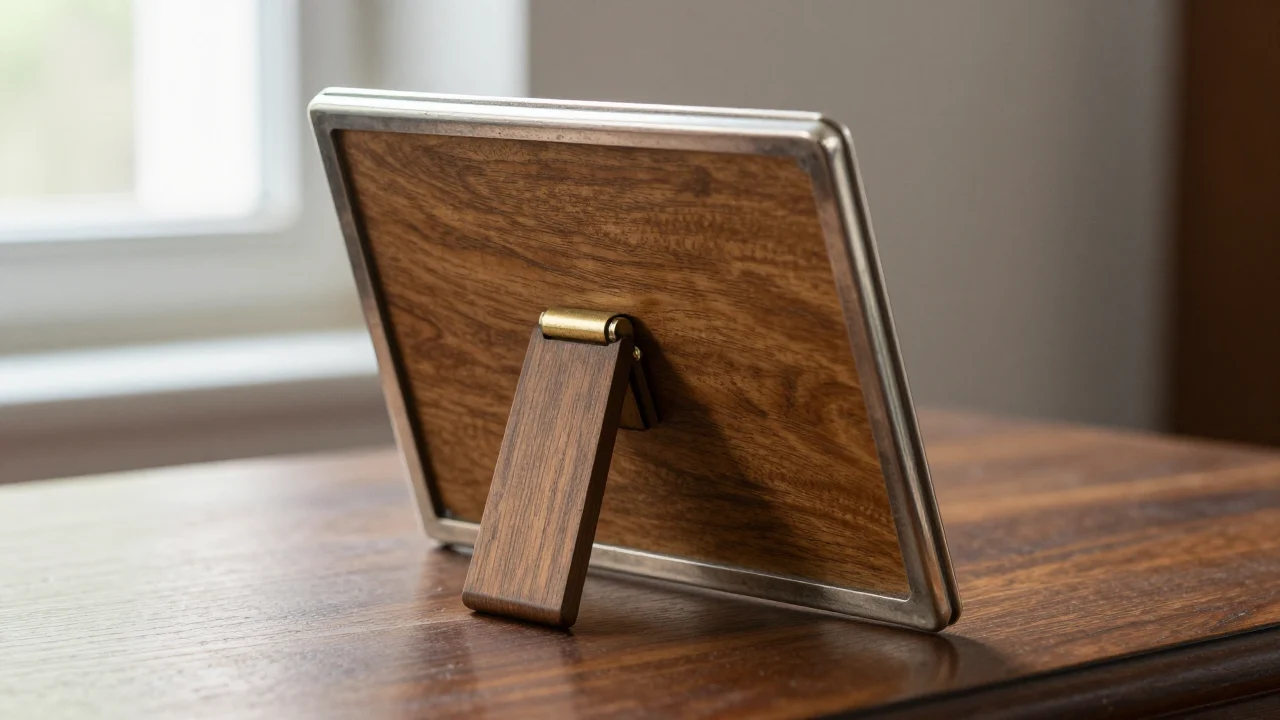
A silver photograph frame is normally a thin sheet of silver, called the mount, fixed over a wooden or board back with a strut, so the silver is a skin on the front rather than a solid body. The V&A’s record for a Liberty Cymric photograph frame of 1902-03 describes the construction exactly: the frame is mahogany with a mount of beaten silver, decorated with enamel, and the hinged support at the back is made of silver. The record lists the mark of L & Co. and ‘CYMRIC’ with the Birmingham hallmark for 1902-03, and names W. H. Haseler as the maker and Liberty & Co. as the retailer. That is why Toovey’s catalogues most frames as “silver mounted”, and why a silver front sold without its back is catalogued as a “photograph frame mount”.
The silver in a frame weighs very little. A George V arched frame of 17cm by Lawrence Emanuel, Birmingham 1922, is catalogued at 56.1g; an Edwardian silver gilt frame of 18.5cm by Goldsmiths & Silversmiths Co Ltd, London 1905, lacking backing and glass, at 89.5g; and two William Comyns and London 1909 frame mounts of 17.5cm and 23.6cm at a total weight of 154.6g. A frame is therefore never a melt-value object, and this site’s guide to melt value against collectible value explains why the metal price is the wrong starting point for thin silver. The back is usually oak or another hardwood: Toovey’s catalogues a Blanckensee frame of 1910 and a William Aitken frame of 1911 as having an oak easel back, and describes the Sanders & Mackenzie frame of 1925 as oak backed.
Where are the hallmarks on a silver photo frame?
The hallmarks are struck on the silver mount itself, because wood, glass and velvet cannot be hallmarked, so you read them on the silver front or on a silver strut rather than on the back board. This site’s silver marks guide sets out the pattern: a full British hallmark carries four marks: the maker’s mark, the standard mark, the assay office mark, and the date letter. The Goldsmiths’ Company hallmarking page describes the same components on a modern mark: the first mark is the Sponsor’s or Maker’s Mark, the fourth mark tells you which Assay Office tested and hallmarked an item, and the fifth mark is the date letter; the office symbols are a leopard for the London Assay Office, an anchor for the Birmingham Assay Office, a rose for the Sheffield Assay Office, and a castle for the Edinburgh Assay Office.
A retailer’s name on a frame is not the maker’s mark. Toovey’s catalogues a George V silver and blue enamelled circular frame as Birmingham 1921 by Henry Matthews, retailed by A. Barrett & Sons, 63-64 Piccadilly, London, so the maker’s punch and the retailer’s name are two different things on the same object. The V&A Liberty frame shows the same split between W. H. Haseler as maker and Liberty as retailer. Photograph the marks in raking light so the punch throws a shadow, as the UK hallmarks hub advises, and note the usual mark positions by object type before you compare the date letter against a chart.
Which assay offices and makers made antique silver frames?
Birmingham struck most of the antique frames in the Toovey’s results, with London and Chester behind it. The Birmingham makers named on frames sold between January 2024 and September 2026 include Lawrence Emanuel (1896 and 1922), Henry Matthews (1901, 1908 and 1921), A. & J. Zimmerman (1903), Sydney & Co (1903), Synyer & Beddoes (1904), William Neale (1907), S. Blanckensee & Son Ltd (1910 and 1920), William Aitken (1911), E.S. Barnsley & Co (1913), Herbert Scott Murdoch (1919), Sanders & Mackenzie (1925) and W.G. Sothers Ltd (1928). The London names are William Comyns & Sons (1889, 1891 and 1900), Henry Charles Freeman (1899), Mappin & Webb (1905 and 1915) and Goldsmiths & Silversmiths Co Ltd (1905). Chester appears as a William Neale circular mount of 1903, a square frame of 1901 and a gadrooned frame of 1909, and Sheffield as a pair of tapering frames of 1912.
The office mark fixes the earliest and latest possible dates. The Birmingham Assay Office was established in 1773, and the UK hallmarks hub records that Birmingham and Sheffield arrived together in 1773 after Matthew Boulton’s campaign for local assaying, so a genuine anchor places a frame after that year. The Chester assay office ran from 1701 until its closing date in 1962, as this site’s Chester hallmarks post explains, so a Chester wheatsheaf mark places a frame before that closure. The date letter then gives the year within the office’s cycle.
What are antique silver photo frames worth?
Ten antique silver photograph frames hallmarked between 1903 and 1928 sold on their own at Toovey’s for £75 to £320 hammer, and eight of the ten fell between £120 and £190. The top result was the smallest frame, a 9.8cm enamelled circular frame with a Piccadilly retailer’s name; the bottom result was one of the largest, a plain engine-turned frame of 36cm. Hammer prices exclude the buyer’s premium, which is currently set at 25% plus VAT (30% including VAT) of the hammer price on Toovey’s 2026 lot pages, and the seller’s net after commission is not published. If you want the marks on your own frame read before you set a figure, the hallmark apps compared on this site include Antique Identifier – Antiqly, free to download on iPhone and Android, which reads a photographed mark and returns the maker, assay office, purity standard, and probable date range to check against your frame.
| Frame as catalogued | Office, year and maker | Hammer result | What decided it |
|---|---|---|---|
| Silver and blue enamelled circular frame, retailed by A. Barrett & Sons, 63-64 Piccadilly, diameter 9.8cm | Birmingham 1921, Henry Matthews | Hammer price: £320, 8 July 2026 | Enamel and a named retailer on a small frame; top single result |
| Rectangular frame, London 1915, height 28cm | London 1915, Mappin & Webb | Hammer price: £190, 24 January 2024 | Plain large frame from a known retailer-maker |
| Arts and Crafts shaped rectangular frame with pierced decoration, front later applied with Egyptianesque motifs including two scarab beetles and a blister pearl mounted model of a turtle, height 18cm, faults | Birmingham 1913, E.S. Barnsley & Co | Hammer price: £170, 3 October 2024 | Arts and Crafts design held the price despite later additions and faults |
| Rectangular frame, height 37cm | London 1905, Mappin & Webb | Hammer price: £160, 30 October 2024 | Largest frame in the table; size did not beat the enamel frame |
| Rectangular frame embossed with flowers and scrolling tendrils against a textured ground, height 19.7cm | Birmingham 1907, William Neale | Hammer price: £150, 24 January 2024 | Embossed Edwardian decoration, mid-size |
| Oak backed rectangular engine turned frame with arched top, height 35.5cm | Birmingham 1925, Sanders & Mackenzie | Hammer price: £150, 22 January 2025 | Large plain frame with its oak back |
| Rectangular frame with arched top and engine turned decoration, height 35.5cm | Birmingham 1925, maker not named | Hammer price: £150, 8 July 2026 | Same size, style and result as the row above, eighteen months later |
| Shaped rectangular frame with an oak easel back, height 18.5cm | Birmingham 1910, S. Blanckensee & Son Ltd | Hammer price: £140, 8 October 2025 | Complete with easel back, mid-size |
| Art Nouveau frame embossed with irises and scrolling tendrils against a textured wave ground, height 18.7cm | Birmingham 1903, A. & J. Zimmerman | Hammer price: £120, 10 September 2025 | Art Nouveau design, mid-size |
| Rectangular frame with engine turned decoration, height 36cm | Birmingham 1928, W.G. Sothers Ltd | Hammer price: £75, 11 June 2025 | Plain late frame; lowest single result |
Group lots show what a frame is worth when it is one of many. Seven silver frames with four plated frames made £340 on 2 October 2024; a Sanders & Mackenzie frame of 1925 with a Kitney & Co frame of 1993 and eight others made £300 on 30 October 2024; twelve circular frames headed by a Sydney & Co frame of 1903 made £170 on 30 October 2024, and nine oval frames headed by a Blanckensee frame of 1920 made £180 on 30 October 2024. A William Comyns frame of 1891 with seven other frames made £160 on 14 May 2025, and the Goldsmiths & Silversmiths silver gilt frame of 1905, lacking backing and glass, with eight other frames made £260 on 5 November 2025. Each of those totals is a price for the whole group, never for one frame.
Modern frames set the floor and, with a designer name, the ceiling. A Carrs of Sheffield frame of 2009 with its box made £50 on 19 March 2025; a pair of Carrs frames of 1994 made £100 on 18 February 2026; a London 1987 frame embossed with a japonaiserie pagoda made £150 on 21 January 2026; a sterling mounted plain frame of 43.3cm with no office or year in the catalogue made £240 on 10 June 2026; a pair of Tiffany & Co sterling frames of 29.2cm made £400 on 11 June 2025; and a pair of Gianni Versace .925 circular frames of 25.5cm made £550 on 21 February 2024. The designer pairs beat every antique single frame in the window.
What raises or lowers a frame’s value?
Decoration and a name raised the price more than size or age in these results, and missing parts lowered it. The enamelled Matthews frame at 9.8cm made £320, while the plain 37cm Mappin & Webb frame of 1905 made £160 and the plain 36cm Sothers frame of 1928 made £75, so a large plain frame is not worth more than a small decorated one. Art Nouveau and Arts and Crafts work sold in the middle of the table at £120 and £170, and the Barnsley frame kept £170 even though the catalogue records later applied motifs and faults, which shows that a distinctive period design carries a frame through condition problems that would sink a plain one.
Catalogue wording tells you what buyers discounted. Toovey’s writes “lacking backing and glass” for the silver gilt Goldsmiths & Silversmiths frame, “lacking easel stand” for a Henry Matthews square frame of 1901 that then sold inside a group of five, and “(faults)” for the Barnsley frame; a mount with no back at all is sold as a mount, by weight, in a group. Read your frame against those words: a split at the corner, a missing strut, a replaced back or a lost glass moves it from the single-frame table into the group lots.
Is it silver, sterling-marked or plate?
A full British hallmark with an office mark and a date letter is what puts a frame in the table above; a frame marked only with a word needs a second look. Toovey’s catalogued the 43.3cm plain frame simply as “sterling mounted” with no office or year, and a .925 frame marked ‘Heeramaneck 925’, weight 221g, with an oak easel back sold inside a mixed lot; a Continental .800 silver mounted oval frame sold in another group. Plated frames appear only as extras in the same lots, for example the four plated frames sold with the seven silver ones. If your frame shows “sterling”, “925” or “800” with no office mark, use the silver marks guide linked above to separate a foreign standard mark from a British hallmark before you compare prices, and treat a frame with no mark at all as plate until a test says otherwise.
What should you do with your frame now?
Start by photographing every mark on the silver front and on the strut in raking light, then write down the office symbol, the date letter and the maker’s initials, and note separately any retailer’s name. Next check the back and the glass: confirm the strut is present and hinged, the back board is original to the frame rather than a replacement, and the glass and any velvet are in place, because those are the words a cataloguer will use against you. Finally, find the row in the table whose office, decade and decoration are closest to yours, open the lot page and read the full description and dimensions against your own frame before you set a reserve, an insurance figure or a bid.
Method and limits. Toovey’s results are hammer prices printed on lot pages between January 2024 and September 2026, read on 28 September 2026, with the buyer’s premium statement quoted from those pages; all dimensions, weights, makers and condition words are the catalogue’s own, and where a lot held several frames or other items the figure is for the whole lot and is shown outside the table. The single-frame table holds only lots whose sole item was one antique silver frame; no dealer, online-marketplace, private-sale or other saleroom prices are used, and no frame described here was examined in hand. Construction and mark positions follow the V&A record and the Goldsmiths’ Company page; a hallmark on its own does not prove that the back, strut or glass are original, and no result here is a valuation of your frame.