
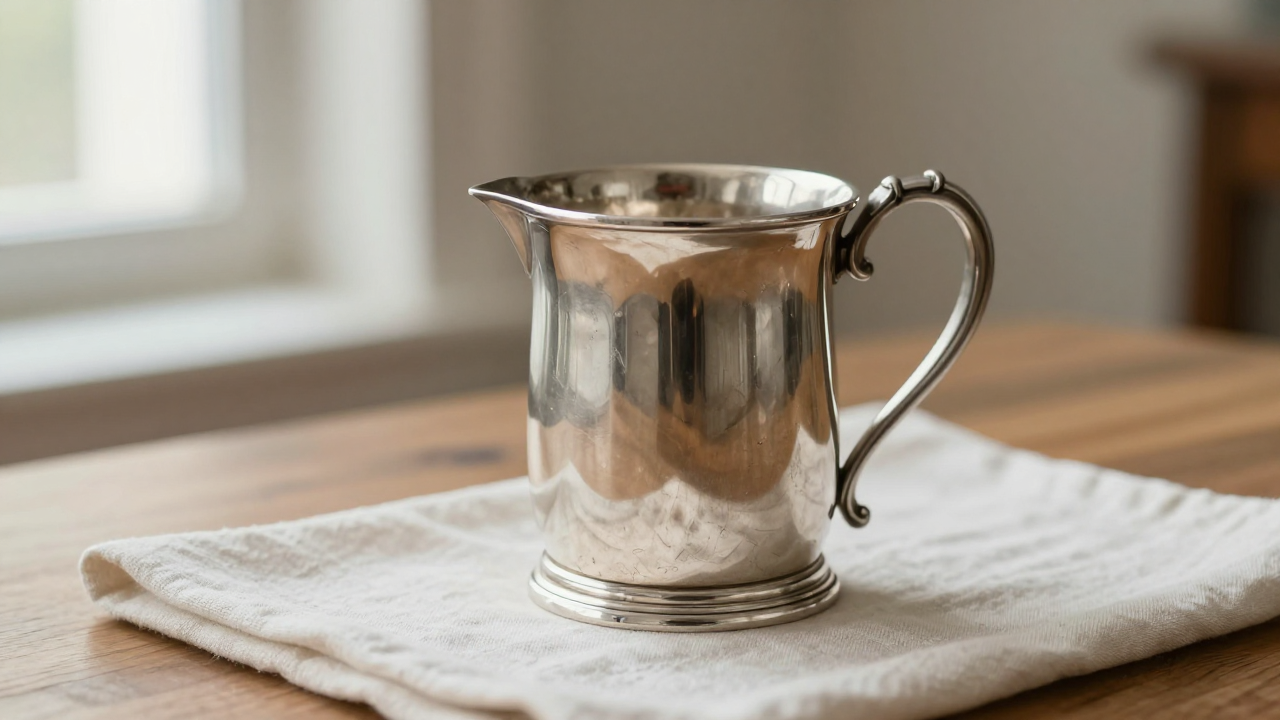
Christening mug marks sit near the rim: read the lion, town mark, date letter, then sponsor. Single mugs made £229.50 to £875 with premium at Bonhams, 2018-21.
This guide reads the marks on British silver christening mugs and cups, then sets them beside dated results. The museum examples come from the Victoria and Albert Museum, which records where the marks sit on two of its mugs. Prices come from lot pages at Bonhams (2018 to 2025) and Woolley & Wallis (2015), each linked with its sale date. Bonhams figures include the buyer’s premium; the Woolley & Wallis figure is the hammer price, so it’s lower than what the buyer paid.
Lots mixing a mug with unrelated silver are left out, because the mug’s share of the price can’t be separated. Dealer asking prices are left out too, since an asking price isn’t a sale. None of the mugs was handled for this guide. Everything about marks and condition comes from the catalogue or museum record.
Where are the marks on a silver christening mug?
On the christening mugs the V&A records, the hallmarks sit in a row on the outside wall close to the rim, while the base carries engraving. The V&A record for a Hunt & Roskell mug made in London in 1864-5 lists its marks on the rim: the crowned ISH sponsor’s mark of John Samuel Hunt, the date letter I, the duty head, the lion and the leopard’s head.
That mug’s base holds something else. It’s engraved “HUNT & ROSKELL LATE STORR & MORTIMER” with the stock number 2920, a retailer’s line rather than a hallmark. The V&A’s guardian angel christening mug follows the same split: the maker’s mark of Thomas Henry Francis and Frederick Francis is on the outside rim, and the base is inscribed “HARY EMANUEL Manufacturer London 1865”.
Check three places before you decide a mug is unmarked: the outer wall just below the rim, the wall either side of the handle, and the underside. Bonhams catalogued a small George III mug of 1810 with presentation initials under the base. On that mug and both V&A mugs, engraving underneath sits alongside hallmarks struck elsewhere, so an engraved base doesn’t mean the mug is unmarked. If you’re unsure where a punch would land on other shapes, the piece-by-piece hallmark locator covers hollowware in general.
How do you read the marks on a christening mug, step by step?
Read the marks in a fixed order and write each one down before you look anything up. Start with the marks that narrow the search most and finish with the one that needs the most care.
- Photograph the row of marks in low, side-on light, one sharp picture per punch. According to the Goldsmiths’ Company tracing guide, identification relies on the finer details of the marks, and a written description won’t be enough.
- Find the standard mark. The Goldsmiths’ Company’s list of marks calls it the traditional fineness mark, and on English sterling it’s the lion passant, as a table of English silver hallmarks shows.
- Identify the town mark. Four current offices are named by symbol on the Goldsmiths’ Company page: leopard for London, anchor for Birmingham, rose for Sheffield and castle for Edinburgh.
- Read the date letter together with its shield shape, and only against the table for the office you found in step 3.
- Look for a sovereign’s head. On English silver the duty mark was struck from 1 December 1784 to 30 April 1890, according to the silvercollection.it duty mark entry.
- Read the sponsor’s mark last, the initials in a shaped punch, and check it against the office and the date you already have.
Two habits lead to misreadings on mugs. The first is using a London date table for a mug with an anchor or a rose. Before 1975 each assay office ran its own letters, as the Goldsmiths’ tracing guide notes, so the same letter means different years in different towns.
The second is expecting a calendar year. At London the date letter changed at the end of May: the same hallmark table, drawn from Jackson and Britten, gives 29 or 30 May, so one letter covers parts of two years.
Other offices changed on their own dates, and the same table puts Birmingham’s change in July. On the London side, the V&A dates the Hunt & Roskell mug’s letter I from 29 May 1864 to 28 May 1865, which is why its record reads “1864-5”. Our silver marks guide explains the reading order and points to the office date charts, and the sovereign’s head explainer shows the duty heads reign by reign.
To read the marks on your own piece, Antique Identifier - Antiqly identifies a hallmark from a photo, on iPhone and Android.
Does the engraved christening date match the hallmark?
An engraved christening date should fall in the hallmark year or later, never clearly before it. That check can flag a misread date letter before you open a single table.
Bonhams sold two silver-gilt christening mugs in November 2025, one by George Ivory, London 1851. Its underside was later engraved “From/A.W.Robarts/to his Godson/Ernest Farquhar/1854”. The mug was hallmarked about three years before the gift date, which fits a piece bought from a shop’s stock or engraved some time after it was made.
Now reverse the case. If your mug says 1840 in the engraving but you’ve read the date letter as 1846, one of the two readings is wrong. Recheck the letter’s shield shape and the town mark before trusting either date.
Names matter as well as dates. The V&A christening cup by Barnard & Sons, London 1868-69, is inscribed “Nesta Mary Platt from her GODFATHER”. An inscription like this gives a researcher a named child and godparent to search for. It doesn’t prove the cup’s history on its own.
Who made the mug: sponsor, retailer or importer?
The sponsor’s mark names whoever sent the mug for assay, which isn’t always the name engraved under the base. In the Goldsmiths’ Company’s words, the sponsor’s mark “tells you who sent an item in to be assayed.”
The V&A guardian angel mug shows the gap. The base names the designer Richard Redgrave, Felix Summerly’s Art Manufactures, the manufacturer Harry Emanuel and the chaser Chesneau, while the rim carries the maker’s mark of Thomas Henry Francis and Frederick Francis. Of all those names, only the Francis mark is the hallmark’s sponsor.
Some mugs came from a manufacturer rather than the shop that sold them. The V&A notes that Barnard & Sons, a London manufacturing silversmith, supplied retailers across England and in markets including America and India.
Import marks add one more name. Bonhams sold a pair of Irish christening cups by the Royal Irish Silver Co, Dublin 1971, carrying London import marks for 1971 and 1972. One pair, two import years: read every piece separately rather than assuming a pair shares a date.
Which marks point to a problem?
Marks that sit on a patch, a missing lion, and letters such as EPNS in place of a hallmark all need a second look. None of them settles the question alone, but each one changes what you can claim about the mug.
Transposed marks are a recorded fraud on British silver. The silvercollection.it entry on duty dodgers describes makers who avoided the 1784 to 1890 silver tax by cutting hallmarks from older pieces and setting them into new ones. It notes that a darker line can show around a let-in mark because solder oxidises faster, and suggests breathing on the hallmark to bring that outline up.
A rubbed sponsor’s mark is a smaller problem, and it comes from wear rather than fraud. Bonhams catalogued the 1810 London mug with the maker’s mark rubbed; the London date still reads, but the mug can’t be tied to a named silversmith.
Plated mugs can carry marks laid out like a hallmark row. Letters such as EPNS, A1 or a maker’s trade name in shields mean electroplate, not sterling, and the five visible differences from sterling help you separate the two. An American mug marked STERLING has no British date letter at all, so the British reading order above won’t date it.
What are silver christening mugs worth?
Single small silver mugs at Bonhams made £229.50 to £875 including premium between 2018 and 2021, and the result per ounce ranged from £19 to £159 across the Bonhams lots. The table lists every christening mug or small named cup found with a readable lot page; the price per ounce is the result divided by the stated weight.
| Mug and marks | Weight | Result | Per oz |
|---|---|---|---|
| Paul Storr, London 1838, fluted and chased | 5.5oz | £875 with premium, Bonhams, 13 June 2018 | £159 |
| Named cup (not catalogued as christening), John Pringle, Perth, circa 1830 | 4.9oz | £1,000 hammer, Woolley & Wallis, 29 April 2015 | £204 |
| Two silver-gilt mugs, George Ivory London 1851 and J S Hunt London 1872 | 16.9oz both | £896 with premium, Bonhams, 19 November 2025 | £53 |
| Small mug, London 1810, maker’s mark rubbed | 3.5oz | £229.50 with premium, Bonhams, 28 July 2021 | £66 |
| Pair of christening cups, Dublin 1971, London import marks | 13.31oz both | £256 with premium, Bonhams online sale closing 3 June 2025 | £19 |
For the two pairs, the weight and the per-ounce figure cover both pieces together, not one mug.
The per-ounce column shows how far a result moves away from the silver’s weight. Storr’s mug made about £159 an ounce. That’s the highest per-ounce figure among the Bonhams lots, and it’s the only single Bonhams mug with a legible maker’s mark. John Samuel Hunt’s mug in the 2025 pair has a known maker too, but its per-ounce figure is shared with the George Ivory mug. At the other end, the plain 1971 Irish cups made about £19 an ounce, the lowest figure in the table.
Perth’s cup sits apart. Woolley & Wallis catalogued it as a Scottish provincial silver cup, not as a christening cup, and dated it circa 1830 rather than to a single year. It carries the engraved name “Euphemia Scott”, so its result may reflect a provincial maker and a named owner more than weight. Its £1,000 is a hammer figure, so the buyer paid more once the premium was added.
Many mugs sell for less than these. The site’s christening set value guide lists single mugs and cups at Cheffins from £30 to £160 between 2014 and 2026. If you’d like a phone to read the mark before you compare, the site keeps a page to compare hallmark reading apps.
What should you do with your christening mug now?
Three steps turn a mark you can’t read into a record you can check later.
- Photograph the full row of marks, the handle sides and the underside, and note the height and weight on a kitchen scale in grams and ounces.
- Write your reading in order: standard, town, date letter, duty head, sponsor. Add the engraved name and date, and check that the engraving isn’t earlier than the date letter.
- Compare your mug with the lots above by maker and weight, not by look. If the sponsor is a known name or the marks look let in, ask an auction house silver department to see the photographs before you clean or sell it.
Don’t polish the marks hard while you wait. Polishing wears the punch edges that tell one office’s letter from another.
Method and limits. Mark positions and the 1864-5 date range come from Victoria and Albert Museum records; mark rules come from the Goldsmiths’ Company and silvercollection.it, and the offices’ changeover months from a table drawn from Jackson and Britten. Values are Bonhams lots from 2018 to 2025 and one Woolley & Wallis lot from 2015, read on the lot pages. No mug was handled for this guide, and nothing here is a valuation of your piece.
Can a phone app help read a mug?
If a maker’s mark is visible, Antique Identifier - Antiqly on iOS and Android describes it and gives its interpretation with a confidence level, which is a lead to check against the right office table rather than a final answer.
Frequently asked questions
Frequently asked questions
What marks should a silver christening mug have?
An English sterling christening mug normally has a sponsor’s mark, the lion passant, a town mark and a date letter, and English mugs marked between 1784 and 1890 usually add the sovereign’s head duty mark. Scottish and Irish offices used their own standard and town marks, so read those mugs against that office’s tables. A mug made abroad and sold in Britain may carry import marks instead.
Why does my christening mug have a date that doesn’t match the hallmark?
A mug could be bought from stock and engraved later: a George Ivory mug hallmarked in London in 1851 carries a godson’s gift date of 1854, so a gap of a few years is no warning sign. When the gift date falls clearly before the hallmark year, the date letter or office has probably been misread; check the shield shape and town mark again.
Is a christening mug with only EPNS or A1 on it silver?
No. Those letters mark electroplate, a thin silver coating over base metal. Sterling mugs from English offices carry a lion passant, other offices use their own standard marks, and modern pieces may carry a 925 mark alongside the town mark.