
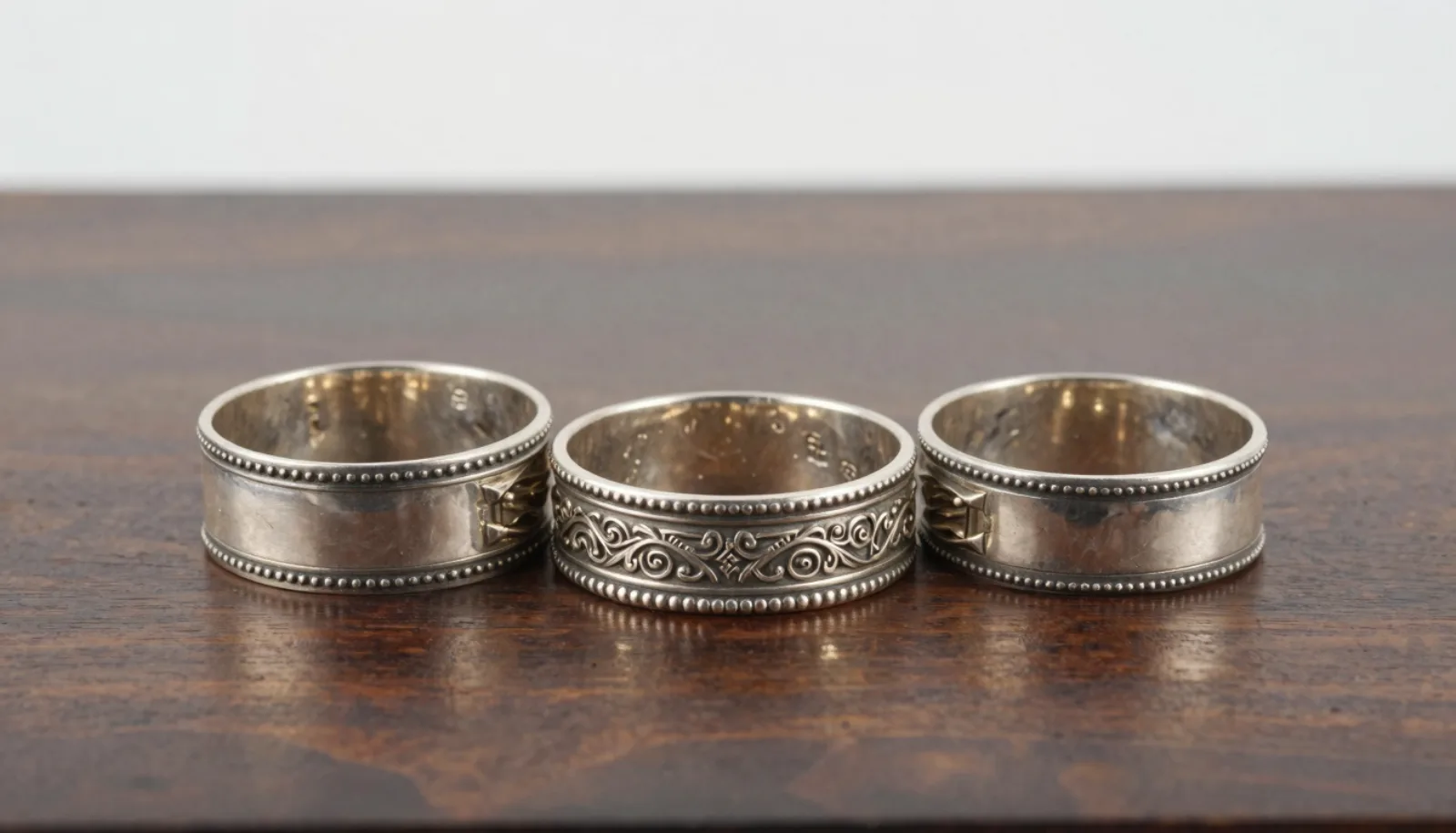
Most antique sterling silver napkin rings sell for £20 to £150 each. Named makers, cased sets of six, and pre-1900 hallmarks push prices past £400.
How do you identify the marks on a silver napkin ring?
Check the inside of the band first. British makers struck hallmarks on the inner surface or along the outer rim, close to the join. A full British set contains four punches: the maker’s mark, the standard mark, the town mark, and the date letter.
The lion passant matters most. This walking lion guarantees 92.5 percent silver, the sterling standard. Birmingham’s assay office stamps an anchor. Sheffield stamped a crown until 1974, then switched to a rose. London stamps a leopard’s head, and Chester used three wheatsheaves around a sword until the office closed in 1962. The date letter changes each year and ties the ring to a twelve-month assay window.
American rings follow a different system. United States makers stamped the word STERLING or the number 925, with no assay mark and no date letter. Gorham struck a lion, an anchor, and a G. Tiffany & Co stamped its full name with a pattern number and a director’s letter.
Watch for one extra punch on British rings: an F in an oval cartouche. That import mark shows a foreign-made ring assayed in Britain, and it changes which reference tables apply. Continental rings sold in Britain after 1904 needed it by law.
Napkin rings test your eyes more than most silver does. The band curves, so punches often sit half-struck, deep at one end and shallow at the other. A 10x loupe solves most of it. Tilt the ring under one light source until a shadow falls across the punch; the shield outline appears before the letter inside it, and shield shape alone can narrow the date cycle.
Expect wear on the details. These rings survived daily handling and a century of polishing. On heavily buffed examples the date letter fades first, then the town mark. The lion passant, usually struck deepest, outlives them all.
No marks at all does not automatically mean plate. Small continental silver escaped compulsory marking in several countries, and some lightweight British pieces slipped through under exemption weights. Our silver marks guide walks through the full reading order, from standard mark to maker’s punch, if you want the system end to end.
Which napkin ring makers bring the most value
A recognised maker moves the price more than age does. A plain Birmingham ring hallmarked 1895 trades in the £20 to £60 band. The same date under a Georg Jensen or Omar Ramsden mark multiplies that figure five to twenty times.
| Maker | City | Active period | Mark to look for | Typical single-ring range |
|---|---|---|---|---|
| Georg Jensen | Copenhagen | 1904 onward | GJ in a dotted oval, 925S | £150-£600 |
| Omar Ramsden | London | 1898-1939 | OR punch, some pieces signed “Omar Ramsden me fecit” | £300-£1,200 |
| Tiffany & Co | New York | 1837 onward | TIFFANY & CO, STERLING, pattern number | £80-£350 |
| Gorham | Providence | 1831 onward | Lion, anchor, letter G | £40-£200 |
| Mappin & Webb | Sheffield and London | 1863 onward | M&W with trident | £30-£120 |
| Walker & Hall | Sheffield | 1845-1971 | W&H inside a flag | £25-£90 |
| Nathan & Hayes | Chester and Birmingham | 1885-1920 | N&H | £30-£100 |
| Unattributed Victorian makers | Various | 1860-1901 | Assorted initials | £20-£60 |
These ranges assume honest hallmarked sterling in sound condition. Solder repairs, splits at the seam, and aggressive monogram removal push a ring below its band.
Elkington & Co deserves a separate note. Elkington patented the commercial electroplating process in 1840, and most Elkington napkin rings are plate rather than sterling. The firm also ran sterling lines, so check for the lion passant before assuming either way. The Victoria and Albert Museum holds a large Elkington archive, which shows how wide the firm’s output ran.
Arts and Crafts workshops punch above their weight in this market. Omar Ramsden’s hand-raised rings carry visible hammer marks and applied wirework, and collectors pay for that hand labour. A. E. Jones of Birmingham and Liberty’s Cymric line sit a step below Ramsden but still clear £150 with ease when the marks read cleanly.
American factory silver rewards pattern knowledge. Gorham, Whiting, and Kirk produced napkin rings to match flatware patterns, and a ring that completes a set fetches more from that pattern’s collectors than from a general buyer. The Metropolitan Museum of Art catalogues Gorham and Tiffany holloware that shows these marks in high resolution.
How do you date a napkin ring from its marks?
Read the date letter against the assay office’s own cycle, not against a generic chart. Each office ran its own alphabet, font, and shield shape, and the same letter repeats every 20 to 26 years. The shield outline and the letter’s case separate one cycle from another. A lowercase b in a shield with a pointed base means a different year than a lowercase b with a rounded base, even from the same office.
Here is the trap specific to napkin rings: the form barely existed before about 1860. Table napkins rolled into rings entered middle-class British and American dining rooms in the mid-Victorian years, and production peaked between 1880 and 1910. A napkin ring bearing a Georgian date letter from the 1780s should stop you cold. Either the chart reading is wrong, or the marks were transposed, cut from a period spoon and let into a newer band. Run a fingertip around the inside; a let-in section telegraphs itself as a faint ridge or a rectangle of slightly different colour.
The sovereign’s head duty mark rarely appears on napkin rings, since duty marks ended in 1890 and most rings postdate the 1860s. Its absence means little. A Jubilee mark for 1935 or 1977, though, dates a ring precisely to those commemorative windows, and the millennium mark pins one to 1999 or 2000.
For American rings, dating runs through the maker. Gorham stamped year symbols on holloware from 1868 to 1933, a different pictogram each year. Tiffany’s director letters tie production to a management era rather than a single year. Factory pattern numbers help too; pattern books survive, and a number places a design’s introduction even when the ring itself came later.
Continental rings carry purity numbers instead of date letters. A German ring marked 800 beside a crown and crescent dates after 1888, when that national mark became law. A French ring with the Minerva head guarantees 950 or 800 standard, and small differences in the surrounding punch narrow the period further.
Not sure what you’ve got?
Snap a photo and let our AI identify any antique in seconds. Free, no sign-up.
Identify on iPhone →Learn MoreEPNS napkin rings: telling plate from sterling
EPNS stands for electroplated nickel silver: a nickel alloy body coated with a thin layer of pure silver by electroplating. No part of an EPNS mark promises solid silver, yet the letter groups imitate hallmark layouts closely enough to fool a quick glance.
| What the band says | What it means | What to do next |
|---|---|---|
| Lion passant plus town mark and date letter | British sterling | Read the date letter and maker |
| STERLING or 925 | Solid silver, usually American or modern | Identify the maker’s stamp |
| EPNS, EP, or A1 | Electroplate | Value on decorative appeal, not metal |
| EPBM | Electroplated Britannia metal, a softer base | Lowest tier of plate |
| Crown or shield shapes with initials, no lion | Probable plate imitating hallmarks | Check for brassy wear on high points |
| No marks at all | Unresolved | Use weight, wear, and colour checks |
Wear tells its own story. Plate rubs through at the points a thumb touches for decades: the rim edges and the high spots of engraving. Worn plate shows a warm brassy or grey undertone where the nickel body breaks through. Sterling wears too, but it stays white all the way down.
Weight gives a second signal. Sterling napkin rings feel dense for their size, commonly 25 to 35 grams. Plated rings on Britannia metal run lighter and dent more easily, and a band that flexes under thumb pressure is not sterling.
Skip the acid kit for now. Scratching a collectible ring destroys more value than the answer is worth in most cases. The mark, the wear pattern, and the weight settle the question nine times out of ten, and the exceptions deserve a professional eye rather than home chemistry.
What are antique silver napkin rings worth?
A single hallmarked sterling napkin ring sells for £20 to £60 in the current market. Pairs, cased sets, big-name makers, and novelty forms climb from there, and the table below shows how far.
| Type of ring | Typical range | What moves the price |
|---|---|---|
| Single Victorian or Edwardian sterling | £20-£60 | Assay office, maker, crispness of marks |
| Matched sterling pair | £50-£140 | Same maker and date letter on both |
| Cased set of six, Victorian or Edwardian | £200-£600 | Original box, engraved numbers 1 to 6 intact |
| Novelty or figural Victorian sterling | £80-£400 | Subject matter and undamaged detail |
| American figural silverplate, 1870s-1890s | £150-£1,000 and up | Maker, figure, condition |
| Georg Jensen sterling | £150-£600 | Design number and period |
| Plain EPNS single | £2-£15 | Decorative appeal only |
Two lines in that table need explaining. Cased sets of six earn a premium far beyond six times the single price, because Victorian families bought rings as christening and wedding gifts and full numbered sets rarely survived intact. Check the backs for tiny engraved numbers, 1 through 6; a set with all six numbers present and matching date letters is the strongest configuration this market offers.
The figural silverplate line is the category’s great exception. American makers such as Meriden Britannia and Pairpoint mounted plated rings with cast birds, dogs, cherubs, and wheeled stands in the 1870s and 1880s. These are plate, not sterling, yet dedicated collectors pay several hundred pounds for good examples, and rare figures clear four figures at specialist sales. It is the one corner of the napkin ring market where plate outsells solid silver. Sold listings on WorthPoint document the spread, and Kovel’s price guides have tracked the category for decades.
Melt value sets the absolute floor for sterling. A 30 gram sterling ring contains 27.75 grams of fine silver, about 0.89 troy ounces; multiply that by the day’s spot price for the scrap figure. That floor sits well below the collector price of anything with a decent maker, which is why breaking napkin rings for scrap almost never makes sense.
The same set-and-case premium drives antique silver salt cellar values, where pairs with original liners lead their market. To read the punches on your own ring from a photo and turn them into a range, our tested rundown of hallmark reader apps compares the free tools that do it.
Do monograms and inscriptions change the value?
A period monogram trims 10 to 30 percent off a comparable clean ring, and that is the mild outcome. Buyers of napkin rings frequently want a blank cartouche for their own initials, so engraved examples sit longer and sell lower.
Removal hurts more than the monogram does. Polishing out an engraving thins the band, and the thin spot betrays itself: breathe on the ring and the erased patch mists differently, or hold it to the light and watch for a shallow dish in the reflection. Dealers check for exactly this, and a ring with a skimmed cartouche drops below an honestly engraved one.
Dated presentation inscriptions run the other way. A ring engraved with a name and a Victorian date carries its own provenance, and buyers of dated silver pay for the story. Christening rings with full names and dates do well in this niche. The inscription that kills value is the recent one: modern script cut into a Victorian ring reads as damage, not history.
Condition problems compound. A split seam needs solder, solder leaves a visible line and a soft patch, and repaired rings trade at roughly half the band for their maker. Dents come out, but only a silversmith should press them; amateur work leaves ripples that cost more to fix than the dent did. Do the maths honestly: on a £40 ring, a £35 professional repair makes no sense, while on a £400 Ramsden it clearly does.
Tarnish, by contrast, costs nothing. Light tarnish washes off with warm water and a silver cloth, and buyers ignore it. Dip cleaners strip the oxidised shading out of engraved decoration and flatten the design’s contrast, so keep dips away from anything with chased or bright-cut work. Crisp, shaded engraving is part of what the next buyer pays for.
Where do silver napkin rings sell best?
Match the venue to the ring. Ordinary single rings do best on general online marketplaces, where £20 to £60 pieces find buyers without auction commission eating the margin. Cased sets, named makers, and figural rings justify a specialist saleroom, where the right two bidders decide the outcome.
Auction houses cost sellers roughly 15 to 25 percent all-in once commission, photography, and fees stack up. On a £300 cased set that cost is worth paying, because catalogued silver sales attract the collectors who pay set premiums. On a £30 single it is not, and the maths pushes small pieces toward direct listing.
Photograph the marks, not only the ring. A listing that shows the lion passant, date letter, and maker’s punch in sharp focus outsells an identical listing with pretty beauty shots and no mark photo. Buyers of silver bid on what they can verify, a point that holds across the whole category, as covered in what a hallmark is worth to a buyer.
Scrap dealers are the venue of last resort. They pay melt minus a margin, which prices a 30 gram ring at a fraction of even its modest collector value. Sell damaged, unmarked, or monogram-skimmed rings for scrap if you must, but let hallmarked pieces find a collector first.
Timing matters less than presentation, with one exception: boxed sets sell strongest in the run-up to Christmas, when gift buyers enter the market. The same seasonal lift shows up across small silver, spoons included; our guide to old silver spoon values covers that parallel market.
Group wisely at the low end. Six mismatched singles listed together as a harlequin set sell better than six separate listings, and a mixed lot clears faster than the sum of its parts. Keep any numbered, cased, or single-maker group intact; splitting one destroys the premium that took a century to accumulate.
Frequently Asked Questions
Is there an app that can identify and value silver napkin rings?
Antique Identifier – Antiqly reads the punches on a napkin ring from a single photo and returns the maker, assay office, year, and a value range. The app downloads free on iPhone and asks for no sign-up. Curved bands photograph badly, so shoot the marks straight on with the ring propped against something solid and the light raking across the punches. Photo-based reading suits napkin rings well, because the four-punch British system leaves little ambiguity once the date letter resolves. Where marks have worn smooth, Antiqly flags low confidence rather than guessing, and at that point a dealer’s loupe or a paid appraisal earns its fee.
Are old silver napkin rings worth anything?
Most hallmarked sterling napkin rings hold value between £20 and £60 each, so a drawer of six unremarkable singles represents £120 to £360 before any maker premium. Cased sets of six climb to £200-£600, Georg Jensen and Omar Ramsden examples run £150 to £1,200, and American figural silverplate rings from the 1870s reach several hundred pounds despite containing almost no silver. The floor under any sterling ring is its metal: a 30 gram ring holds about 0.89 troy ounces of fine silver, worth the day’s spot price. Plain EPNS rings without figural interest are the exception, trading for £2 to £15 as tableware rather than as silver.
How can I tell if my napkin ring is solid silver or plated?
Look for a standard mark first. A lion passant, the word STERLING, or a 925 stamp confirms solid silver, while EPNS, EP, A1, or EPBM confirms electroplate. If the marks have worn away, read the wear itself: plate breaks through to a brassy or grey base metal on rim edges and high points, whereas sterling stays white however deep the wear goes. Weight helps as a second check, since sterling rings commonly weigh 25 to 35 grams and feel dense for their size. Avoid acid testing a ring you might sell; the scratch it requires costs more in value than the answer provides on most napkin rings.
Why does my sterling napkin ring have no date letter?
It is almost certainly American or continental. The British four-punch system with its annual date letter applied only to silver assayed in Britain and Ireland. United States makers marked STERLING or 925 beside a maker’s stamp and nothing else, because no federal assay system existed. German, French, and Scandinavian rings carry purity numbers such as 800, 830, or 925 with national symbols instead. Dating those rings runs through the maker: Gorham used year pictograms from 1868 to 1933, and factory pattern numbers place a design’s introduction. A British-looking ring with a town mark but no visible date letter more likely has a worn or half-struck letter than a missing one.
Do engraved initials lower a napkin ring’s value?
A period monogram typically costs 10 to 30 percent against a clean example, because many buyers want an empty cartouche for their own engraving. Removal makes it worse: polishing out initials thins the band and leaves a detectable dished spot that dealers check for, dropping the ring below an honestly engraved one. Dated presentation inscriptions are the exception that adds value. A ring engraved with a name and a Victorian date carries built-in provenance, and christening rings with full inscriptions do well with collectors of dated silver. Leave period engraving alone; the only engraving that reads as damage is modern script added to an old ring.
Which antique napkin rings sell for the most money?
American figural silverplate rings from the 1870s and 1880s top the category, despite being plate. Meriden Britannia, Pairpoint, and their rivals mounted rings with cast birds, dogs, cherubs, and wheeled stands, and strong examples bring several hundred pounds, with rare figures clearing four figures at specialist auctions. Among sterling, Omar Ramsden’s hand-made London rings lead at £300 to £1,200, followed by Georg Jensen designs at £150 to £600. Cased Victorian sets of six with matching numbers and date letters round out the top tier at £200 to £600. Condition rules every one of these numbers, and a damaged rarity sells like an ordinary ring.
Identify any antique in seconds.
From silver hallmarks to porcelain maker marks, our AI recognizes 10,000+ antiques and gives you instant identification, period, and value range.
Download Free on iPhoneSee How It Works