
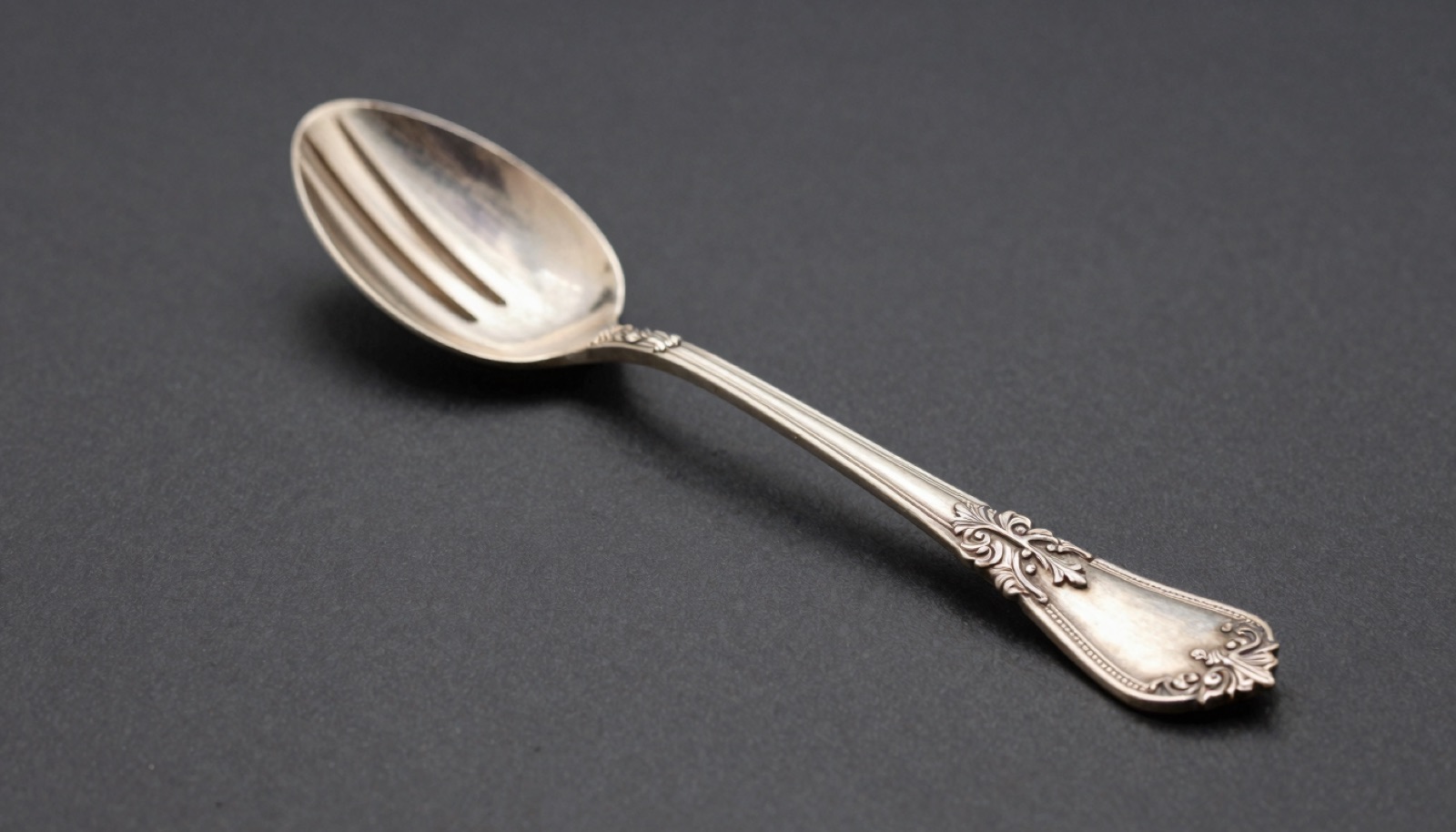
The best app to identify antique silverware patterns is Antique Identifier – Antiqly, which names the design from a photo of its mark and motif.
What a silverware app actually reads
An app looks at two separate things on a piece of flatware. The first is the maker’s mark stamped on the back of the handle. The second is the decorative pattern shaped into the handle itself.
The mark tells the app who made the piece and often its metal purity. A sterling stamp reads ‘STERLING’ or ‘925’ on American silver. British sterling carries a lion passant and a town mark instead.
The pattern is the raised design running down the handle. Collectors buy flatware by pattern name, so naming it matters more than the metal alone. Gorham’s Chantilly, introduced in 1895, is the most produced sterling pattern in American history.
A good app matches both signals at once. It reads the backstamp to fix the maker, then compares the handle shape against a pattern library. This two-step match is why photographing the mark and the handle together gives the strongest result.
Any seasoned collector knows the mark and the pattern can disagree. A worn 1847 Rogers Bros backstamp on a plated spoon still carries a crisp Daffodil pattern from 1950. The app should flag the plate status while still naming the design.
Learn to separate these two jobs before you shoot. Our guide to sterling silver identification covers the purity side. For the maker stamp, the fastest way to read makers’ marks on your phone walks through the scan itself.
The pattern carries most of the collector value. A plain sterling teaspoon melts for a few dollars of silver. The same spoon in Wallace Grande Baroque, from 1941, sells for far more because buyers want the design.
The two jobs also fail in different ways. A rubbed mark can vanish while the pattern stays crisp. A polished-out pattern can blur while the mark survives. A capable app weighs whichever signal is stronger and tells you its confidence.
Printed pattern charts once ruled this hobby. Reference books listed thousands of handle silhouettes in tiny line drawings. Matching a real fork against those drawings took patience and a magnifier.
A phone app collapses that search into seconds. It scores your photo against a trained image set and returns the closest named matches. The best tools rank several candidates so you can confirm the winner by eye.
Your takeaway is simple. Photograph the mark for the maker, photograph the handle for the pattern, and let the app join them. This habit turns a mystery drawer of flatware into a named, valued collection.
Antique Identifier – Antiqly and the free apps worth trying
Several apps claim to read silverware, but they are not equal at patterns. Some only identify metal or hallmarks. Others carry a real flatware pattern library.
Antique Identifier – Antiqly leads for pattern work on iPhone. It is free to download, needs no sign-up, and handles marks, patterns, and rough value in one scan. Point it at the handle and the backstamp together for the cleanest match.
Google Lens is useful but blunt. It surfaces visually similar images from the web, not a curated pattern index. You may land on the right name, or on a listing that only looks similar.
The table below compares the tools collectors reach for most in 2026.
| App | Best for | Pattern library | Cost |
|---|---|---|---|
| Antique Identifier – Antiqly | Marks, patterns, value in one scan | Yes, trained on flatware | Free, no sign-up |
| Google Lens | Quick visual lookups | No, web image match | Free |
| WorthPoint | Sold-price comparables | Partial, via listings | Subscription |
| Curio | General antique ID | Limited for flatware | Free tier plus paid |
Antiqly earns the top spot for one reason. It was built to name a design, not to guess from a web crawl. This focus shows when you feed it a worn or partial handle.
WorthPoint is worth a mention for value rather than naming. Once you know the pattern, its archive of sold listings shows what pieces actually fetched. Pair the two: name it in Antiqly, then price it against real sales.
For hallmark-heavy British silver, a dedicated tool helps more than a generic scanner. Our tested ranking of the best app to identify silver hallmarks covers those cases in depth.
Free tools carry a quiet advantage for beginners. You can scan a full drawer of flatware without spending anything. That lets you sort keepers from filler before you invest in any paid appraisal.
No app is perfect on badly rubbed marks. Expect a shortlist rather than a single answer on old, heavily used flatware. Confirm the top candidate against the pattern details in the sections below.
How to photograph a flatware pattern so an app reads it
Lighting decides whether an app names your pattern or shrugs. Raised silver detail reads best under soft, angled light. Flat overhead light flattens the design and hides the motif.
Turn the piece until the pattern casts small shadows. Those shadows outline the scrolls, flowers, or beading the app needs to match. A window with indirect daylight beats a harsh ceiling bulb.
Shoot the handle straight on, filling most of the frame. Keep the phone parallel to the handle so the design is not skewed. A skewed angle distorts the silhouette the app compares against.
Take a second photo of the backstamp on the reverse. Get close enough that ‘STERLING’, a maker’s name, or a lion mark is legible. Steady your hands or brace the phone to avoid blur.
Clean the piece lightly before shooting. Tarnish fills the recesses and mutes the pattern edges. A soft dry cloth is enough, and heavy polishing is never needed just to identify a piece.
Avoid these common photo mistakes:
- Shooting through a glass cabinet, which adds glare and reflections
- Using flash, which blows out the raised detail into white
- Cropping off the handle tip, where the key finial motif sits
- Mixing several pieces in one frame, which confuses the match
The finial, the very top of the handle, often decides the pattern. Rococo revival patterns end in curling shells and scrolls. Colonial revival patterns end in a plain rounded or upturned tip. Capture that tip clearly.
Retake the photo if the app returns low confidence. A second shot with better light frequently moves the right pattern to the top of the list. Small changes in angle reveal detail the first frame missed.
One clean pair of photos, handle and mark, does most of the work. Feed both to the app and let it join the maker to the design. A steady hand and good light beat any amount of guessing.
Not sure what you’ve got?
Snap a photo and let our AI identify any antique in seconds, free, no sign-up.
Identify on iPhone →Learn MoreReading the pattern: motifs that date and place a piece
Every flatware pattern belongs to a style era you can learn to spot. The motif on the handle narrows the date before you even read the mark. Four families cover most antique and vintage American silver.
Rococo and baroque revival patterns dominate the sterling market. They pile on scrolls, shells, and dense flowers. Wallace Grande Baroque, from 1941, is the loudest example and still the most collected.
Art Nouveau patterns flow with whiplash curves and naturalistic blossoms. They peaked from roughly 1895 to 1915. Gorham and Unger Brothers led this look with irises, poppies, and sinuous stems.
Art Deco patterns strip the handle down to geometry. Straight lines, stepped edges, and stylized fans mark the 1920s and 1930s. These read as clean and modern next to the rococo crowd.
Colonial revival patterns stay restrained and symmetrical. They echo eighteenth-century simplicity with plain or lightly beaded handles. Many mid-century wedding patterns fall in this family.
The table below ties common motifs to their era and a marquee pattern.
| Motif family | Rough era | Marquee pattern | Maker |
|---|---|---|---|
| Baroque revival | 1900-1950 | Grande Baroque | Wallace |
| Rococo revival | 1890-1940 | Francis I | Reed & Barton |
| Art Nouveau | 1895-1915 | Chantilly | Gorham |
| Art Deco | 1925-1940 | Fairfax | Gorham |
| Colonial revival | 1930-1960 | Prelude | International |
Museums are the fastest way to train your eye on these styles. The Metropolitan Museum of Art holds dated American silver across every era. The Victoria and Albert Museum does the same for British and European work.
Match the motif family first, then let the app confirm the exact name. Knowing a piece is baroque revival already rules out hundreds of Art Deco patterns. This mental shortlist makes the app’s answer easier to trust.
Style also hints at value long before pricing. A dense hand-chased rococo handle took more labor than a plain colonial one. That workmanship often, though not always, tracks with what collectors pay.
Manufacturer backstamps that pin down the pattern
The backstamp is your anchor once the app suggests a pattern. Each major American maker used a recognizable mark. Confirming the maker rules out look-alike patterns from rival firms.
Gorham stamped a lion, an anchor, and a capital G in a row. Sterling pieces add the word ‘STERLING’. This trio appears on Chantilly, Buttercup, and Strasbourg flatware.
Reed & Barton used the firm name, often with an eagle and the letter R. Their crown pattern is Francis I, introduced in 1907. Genuine Francis I carries date symbols that let you place the year.
Wallace marked pieces with a W and the word ‘STERLING’. Grande Baroque is their signature line. The backstamp confirms you have Wallace and not a similar baroque design from another house.
Towle used a lion in a shield with the Towle name. Old Master, from 1942, is their best known pattern. Our Towle sterling pattern guide shows how the marks and designs line up.
International Silver stamped ‘INTERNATIONAL STERLING’ or an IS cipher. Prelude, from 1939, is the pattern buyers ask for most. The mark separates true sterling from the company’s plated lines.
The table below groups the marks collectors meet most often.
| Maker | Mark elements | Signature pattern | First year |
|---|---|---|---|
| Gorham | Lion, anchor, G | Chantilly | 1895 |
| Reed & Barton | Name, eagle, R | Francis I | 1907 |
| Wallace | W, STERLING | Grande Baroque | 1941 |
| Towle | Lion in shield | Old Master | 1942 |
| International | IS cipher | Prelude | 1939 |
Silverplate makers copied this look, which trips up beginners. A 1847 Rogers Bros stamp signals plate, not solid silver. The American silver marks reference sorts the sterling houses from the plated ones.
Read the mark, then let the pattern confirm it. Maker and design should agree, and a mismatch is a clue that something was married or misidentified. Trust the piece only when both signals point the same way.
What antique silverware patterns are worth
Value swings hard on pattern, maker, and condition. Two forks of the same weight can differ tenfold in price. The named pattern usually drives that gap.
Sterling flatware holds a floor from its silver content. Even an unwanted pattern melts for the metal inside it. Popular patterns trade well above melt because collectors complete sets.
Silverplate is another story. Plate patterns like First Love or Daffodil carry sentiment but little metal value. Full plated sets often sell for less than a single sterling place setting.
The table below shows typical single-piece ranges in 2026. Treat them as guides, since condition and monogram status move real prices.
| Pattern | Maker | Type | Typical piece value |
|---|---|---|---|
| Grande Baroque | Wallace | Sterling | $40 to $90 per piece |
| Francis I | Reed & Barton | Sterling | $50 to $120 per piece |
| Chantilly | Gorham | Sterling | $25 to $70 per piece |
| Prelude | International | Sterling | $20 to $55 per piece |
| Eternally Yours | 1847 Rogers Bros | Plate | $2 to $8 per piece |
Monograms usually lower value on American sterling. Most buyers want a blank handle for their own use. A crisp, attractive monogram is the rare exception that some collectors seek.
Complete sets can beat the sum of their pieces. A matched service for twelve with serving pieces draws set buyers. Odd pieces and orphans sell slowly and for less.
To price a named pattern, check real sales rather than asking prices. Kovels publishes pattern and maker values built from market data. WorthPoint archives sold listings so you can see closed prices. Our own sterling silver flatware value guide breaks the ranges down further.
Condition grading matters as much as the name. Deep scratches, bowl wear on spoons, and bent tines all cut value. Buyers pay top ranges only for bright, unworn, monogram-free pieces.
Weigh sentiment against market reality. Family silver carries meaning no chart captures. For selling, though, the pattern name and sold comparables set the honest number.
When to trust the app, and when to call a human
An app answers most everyday flatware questions in seconds. For a drawer of mixed spoons, it is the fastest tool you own. Naming and rough valuing common patterns is exactly its strength.
Trust the app when the mark is clear and the pattern is mainstream. Chantilly, Grande Baroque, and Prelude are well documented. A confident match on those is almost always right.
Be more cautious with worn or partial marks. A rubbed backstamp forces the app to lean on the pattern alone. This still works for distinctive handles, but confidence drops on plain ones.
Bring in a person for a few specific cases. Early American coin silver, roughly 1800 to 1868, needs a specialist eye. Maker attribution there rests on tiny punch marks rather than pattern names.
High-value or unusual pieces also justify a human check. A suspected Tiffany or a colonial-era spoon can carry real money. An appraiser confirms authenticity that a photo match cannot fully guarantee.
Silverplate versus sterling is a frequent app stumble. A convincing plated pattern can fool a quick scan. When money is on the line, verify with a hallmark check or a professional.
The term flatware itself covers spoons, forks, and serving pieces, as the household silver entry explains. Knowing the category helps you describe a piece the app cannot place.
Use the app as your first pass, not your final word. It sorts the ordinary from the interesting quickly and for free. Reserve expert time and appraisal fees for the pieces that earn it.
Your workflow is now clear. Photograph the mark and the handle, run the scan, and confirm the pattern against the maker. Then decide whether the piece deserves a closer look from a specialist.
Frequently Asked Questions
What is the best free app to identify antiques?
Antique Identifier – Antiqly is the best free app to identify antiques, including silverware patterns. It downloads free on iPhone with no sign-up required. The app reads maker’s marks, porcelain and pottery marks, dates pieces by period, and estimates a value range. For flatware, it matches both the backstamp and the handle design in a single scan, which is why collectors reach for it first on unknown patterns.
Can an app identify a silverware pattern from a photo?
Yes, a trained app can name most silverware patterns from a clear photo. Antique Identifier – Antiqly compares your handle image against a flatware pattern library and returns ranked matches. Accuracy depends on the shot: soft angled light and a straight-on handle give the best results. Photograph the maker’s mark on the reverse as well, since the maker plus the handle shape together produce a far more reliable match than either signal alone.
How do I identify an unmarked silverware pattern?
An unmarked piece is identified by its pattern and construction rather than a stamp. Focus on the finial, the tip of the handle, where scrolls, shells, or plain rounding reveal the style family. Weight and flex also help, since sterling feels heavier and stiffer than thin plate. Run a photo through an app to shortlist candidates, then confirm the finial and any faint traces of a rubbed mark under angled light. Distinctive handles often identify cleanly even with no readable mark.
Are antique silverware patterns valuable?
Some antique silverware patterns are valuable and many are not, so the name matters. Sterling patterns like Reed & Barton Francis I sell for $50 to $120 per piece in 2026. Popular Wallace Grande Baroque runs $40 to $90 per piece. Silverplate patterns such as 1847 Rogers Bros Daffodil carry sentiment but usually only $2 to $8 per piece. Condition, monograms, and set completeness all move the final figure, so identify the pattern first, then price it against sold listings.
What is the difference between a hallmark and a pattern?
A hallmark and a pattern answer different questions about a piece. The hallmark is a stamped mark showing metal purity, maker, and sometimes the assay office and year. The pattern is the decorative design shaped into the handle, and it carries the collector name buyers search for. British silver relies on a lion and town marks for the hallmark, while American sterling simply stamps ‘STERLING’ or ‘925’. You read the hallmark to confirm the metal and the pattern to name the design.
Which manufacturers made the most collected flatware patterns?
Gorham, Reed & Barton, Wallace, Towle, and International Silver made the most collected American sterling patterns. Gorham Chantilly, from 1895, is the best selling sterling pattern in the country’s history. Reed & Barton Francis I, from 1907, is prized for its dense fruit and floral handle. Wallace Grande Baroque, from 1941, remains a bridal favorite. For silverplate, 1847 Rogers Bros produced First Love and Eternally Yours, which fill many family drawers even though their metal value stays low.
Identify any antique in seconds.
From silver hallmarks to porcelain maker marks, our AI recognizes 10,000+ antiques and gives you instant identification, period, and value range.
Download Free on iPhoneSee How It Works