
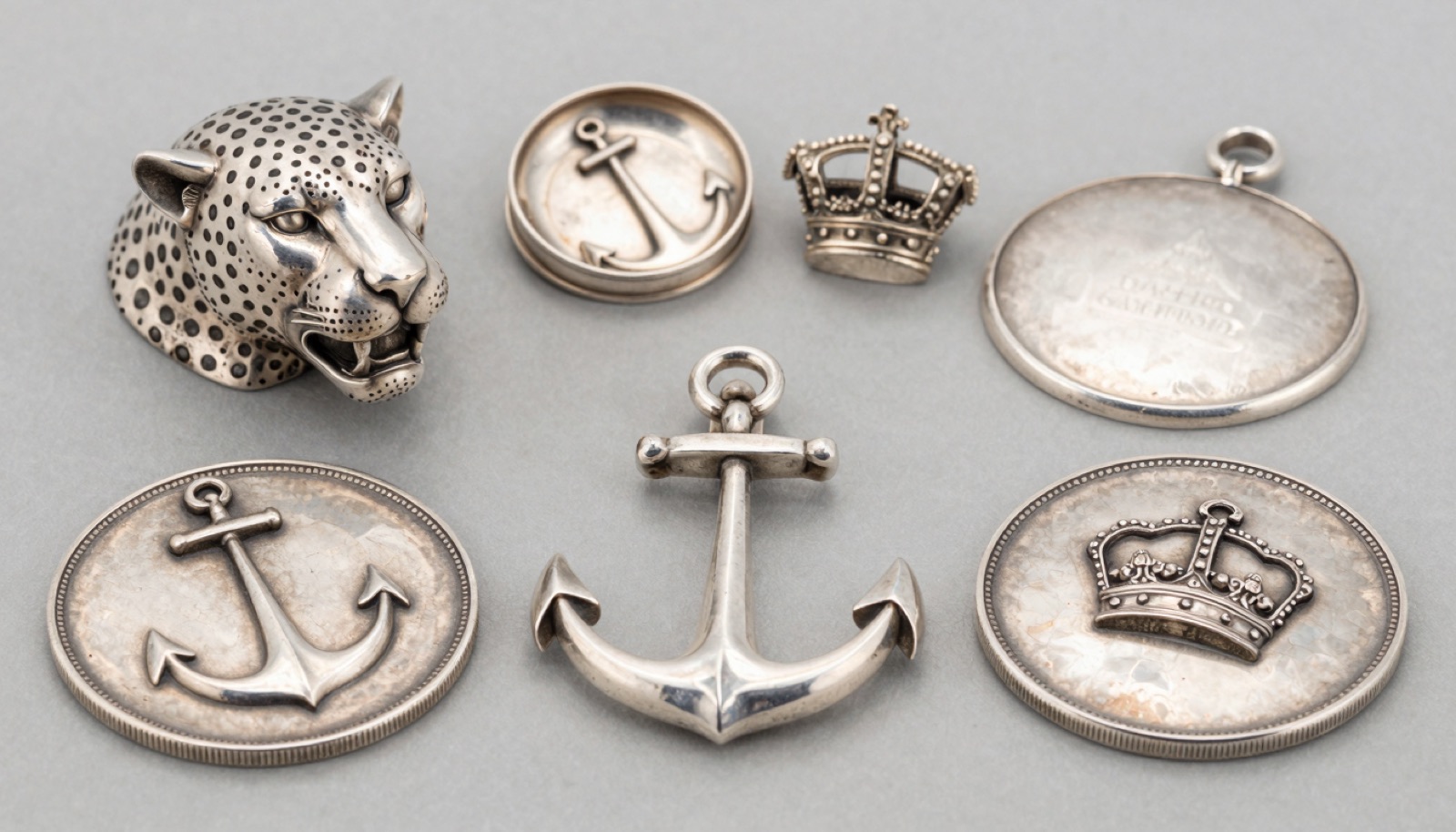
English silver hallmarks identify the assay town: London used a leopard’s head, Birmingham an anchor, Sheffield a crown. The town mark maps a piece to its region.
Why English silver carries a town mark
English silver hallmarks begin as a legal promise about purity. The Crown wanted buyers protected from debased metal. Parliament answered by ordering independent testing at official assay offices.
Each office pressed its own symbol into every piece it passed. That symbol is the town mark. It records where the silver was tested, not always where it was made.
The system traces to London in 1300, under a statute of Edward I. The leopard’s head became the mark of the King’s standard. Regional offices opened later to serve silversmiths working far from the capital.
A seasoned collector reads the town mark first. It fixes the origin before the maker is even studied. The date letter and standard mark then complete the picture.
Testing mattered because sterling had to reach 92.5 percent pure silver. Anything weaker failed and could be defaced. The lion passant confirmed a piece met that English sterling standard, a rule explained in our UK hallmarks guide.
Not every English town held an assay office. Makers in unserved regions shipped work to the nearest one. A Cornish spoonmaker often used Exeter, so a town mark can trace a trade route as much as a birthplace.
The Victoria and Albert Museum displays thousands of marked English pieces in its silver galleries. That collection shows how little the core system changed across centuries. The same four-part logic still governs a British hallmark struck today.
Understanding the town mark unlocks everything else. It is the anchor of regional identification. Learn the eight English symbols, and most mystery pieces resolve in seconds.
London: the leopard’s head, the oldest mark of all
London is the founding English assay office and the busiest by far. Its town mark is the leopard’s head. For collectors, it is the most encountered English town mark of all.
The leopard’s head wore a crown from 1478 until 1821. In 1821 the crown was removed, leaving a bare leopard’s face. That single change helps date a piece to before or after 1821.
Early leopard’s heads look fierce and finely detailed. Later versions grew stylised and neat. The surrounding shield shape shifted too, a progression our leopard’s head guide tracks across the centuries.
London silver also carries the highest concentration of famous makers. Paul de Lamerie, Hester Bateman, and Paul Storr all registered there. A London mark therefore raises the odds of a collectable maker.
A Georgian London teapot by a named maker can bring several thousand pounds at auction. The same form from a provincial office often sells for less. Prestige of origin drives much of that gap.
Between 1697 and 1720, London silver used the higher Britannia standard, not sterling. The leopard’s head gave way to a lion’s head erased and a seated Britannia figure. That period signals 95.8 percent purity, above ordinary sterling.
The Metropolitan Museum of Art holds superb London silver, and its collection database lets you compare marks against dated examples. Cross-checking a museum piece is the fastest way to confirm a reading.
When you see a leopard’s head, start with the crown. Crowned means before 1821. Then read the date letter, covered fully in our London hallmarks guide, to pin the exact year.
Birmingham and Sheffield: the 1773 offices
Birmingham and Sheffield opened together by Act of Parliament in 1773. Both cities had booming silver trades and no local office. Matthew Boulton led the campaign for Birmingham.
Birmingham’s town mark is an anchor. Sheffield’s was a crown until the mid-1970s. Tradition says the two towns settled their symbols at a London pub, the Crown and Anchor.
Birmingham became the centre of small silver and mass production. Think buckles, boxes, buttons, and later novelty wares. An anchor mark often signals a smaller, everyday object.
The anchor confuses beginners, especially when worn. Our Birmingham anchor guide separates it from genuine look-alikes. The related anchor mark confusions on import and plate marks trip up even careful readers.
Sheffield built its name on candlesticks and fine holloware. The crown town mark also sat on Old Sheffield Plate, which causes endless mix-ups. Our crown mark guide untangles plate from sterling.
In 1975 Sheffield replaced its crown with a Tudor rose. This followed the 1973 Hallmarking Act. A rose town mark therefore dates a Sheffield piece firmly to 1975 or later.
A Sheffield candlestick with a crown and an 1899 date letter places the piece in the late Victorian boom. Filled candlesticks from that era are common. They stay modestly valued because so many survive.
Both offices remain open today and assay most new British silver. For antique hunters, an anchor or a crown quickly rules London out. The mark then points to the industrial Midlands or the north.
The provincial offices: Chester, Exeter, Newcastle, York, Norwich
Beyond the big three sit the older provincial offices. Most have closed, which makes their marks especially useful for dating. A closed office gives you a hard end date.
Chester served Wales, the north-west, and its own silver trade. Its mark shows the city arms: three wheatsheaves and a sword. The office closed in 1962, so no genuine Chester mark postdates that year.
Exeter served the West Country with a three-towered castle mark. It closed in 1883. A castle mark on a West Country spoon usually means Exeter, not a foreign symbol.
Newcastle used three separate castles and closed in 1884. York settled on five lions passant on a cross and closed around 1858. Norwich, the earliest to fall silent, closed near 1701.
| Assay office | Town mark | Opened | Closed |
|---|---|---|---|
| London | Leopard’s head | 1300 | Open |
| Birmingham | Anchor | 1773 | Open |
| Sheffield | Crown, then rose from 1975 | 1773 | Open |
| Chester | Three wheatsheaves and sword | pre-1700 | 1962 |
| Exeter | Three-towered castle | 1701 | 1883 |
| Newcastle | Three castles | pre-1700 | 1884 |
| York | Five lions on a cross | 1560s | ~1858 |
| Norwich | Castle above a lion | 1565 | ~1701 |
These closing dates are a collector’s shortcut. A Chester mark plus a date letter cannot postdate 1962. That single fact filters out modern reproductions instantly.
A christening mug with the Chester wheatsheaves and a 1910 date letter is a classic Edwardian gift piece. Chester specialised in exactly this small presentation silver. Its output suits collectors who value charm over bullion weight.
Provincial marks are rarer, so clarity and condition matter more. Kovel’s price guides at Kovels track how provincial origin can lift value among specialist buyers. Our Chester guide covers its closing years in detail.
Not sure what you’ve got?
Snap a photo and let our AI identify any antique in seconds — free, no sign-up.
Identify on iPhone →Learn MoreReading the town mark with the other three marks
The town mark never works alone. English sterling carries four marks together. Reading them as a set turns a symbol into a date and a maker.
The standard mark ranks first in importance. A lion passant means English sterling at 92.5 percent. The town mark then names the assay office that tested the piece.
The date letter gives the year. Each office ran its own alphabet cycle, with distinct fonts and shield shapes. A letter only means a year once you know which office issued it.
The maker’s mark, usually initials, names the silversmith or firm. Read the four stamps left to right. Together they tell a complete story in a few millimetres of metal.
| Mark | What it shows | Example |
|---|---|---|
| Standard mark | Metal purity | Lion passant = 92.5% sterling |
| Town mark | Assay office | Anchor = Birmingham |
| Date letter | Year assayed | Cycled letter, office-specific |
| Maker’s mark | Silversmith or firm | Initials in a shaped shield |
A common mistake is reading the date letter without the town mark. The letter “A” means different years in London, Birmingham, and Sheffield. Always fix the office first.
Consider a lion passant, an anchor, a script “s”, and the initials “H and A”. That reads as Birmingham sterling by a specific firm, in the year that “s” maps to in the Birmingham cycle. Our identification walkthrough shows this decoding step by step.
A duty mark, the sovereign’s head, appears on English silver from 1784 to 1890. It confirms the tax was paid. Its presence alone brackets a piece to that 106-year window.
Regional style clues beyond the stamp
Marks are decisive, but style offers a second opinion. Experienced collectors read the object as well as the punch. Regional workshops built recognisable habits over generations.
London work tends toward refined, fashion-leading design. New tastes appeared there first. A crisp, ambitious form often hints at a London origin before you even find the mark.
Birmingham favoured light, efficient production. Thin-gauge metal and stamped decoration are common. Those slightly uneven, machine-assisted borders are a classic Birmingham tell.
Sheffield holloware shows confident, weighty forms, especially candlesticks. Loaded bases packed with pitch and an iron rod are a Sheffield habit. Feel unexpected heft and suspect the north.
Provincial pieces can look a half-step behind metropolitan fashion. A West Country spoon might follow a London style a decade late. That lag is a soft clue, never proof on its own.
Hand-hammering leaves faint facets on early silver. Those slightly uneven surfaces read as pre-industrial. Uniform, mirror-smooth sheet metal suggests later, mechanised making.
Style never overrides a clear mark. It fills gaps when marks are worn or missing, a problem our worn hallmarks guide tackles head on. Use style to form a hypothesis, then confirm with the punches.
The Smithsonian’s collections at Smithsonian include British silver paired with documented origins. Studying verified examples trains your eye faster than any single chart. Comparison is the collector’s real classroom.
What regional origin means for value
Origin shapes value, but never decides it alone. Collectors weigh town, maker, form, weight, and condition together. The town mark sets the stage. It rarely writes the final price by itself.
London prestige tends to lift prices for grand pieces. A Paul Storr London salver competes at the very top. Buyers pay for the celebrated name as much as the silver. That premium is real and durable.
Provincial rarity pulls in a different, equally useful direction. Scarce Newcastle or York marks attract dedicated regional specialists. A crisply marked provincial spoon can outrun a common London one. Scarcity rewards the patient hunter.
| Origin signal | Typical effect on value | Why |
|---|---|---|
| London plus a named maker | Strong premium | Prestige and steady demand |
| Rare provincial office | Specialist premium | Scarcity of surviving marks |
| Common Birmingham novelty | Near melt value | High survival, light gauge |
| Worn or unclear marks | Discount | Harder to attribute |
Weight still underpins any silver value. Heavy-gauge holloware carries both bullion and craft value. Thin Birmingham novelties trade nearer to melt. Their charm rarely overcomes a light gauge.
Condition ranks close behind origin. Crisp marks, no splits, and original surfaces command premiums. Over-polishing erodes both detail and value. A rubbed hallmark alone can halve an auction price.
Consider a plain Exeter Georgian tablespoon. On its own it might sell for a modest sum. Yet a rare early Exeter maker can multiply that figure sharply. Origin and maker compound one another.
Regional makers reward a little homework. Newcastle produced fine flatware through the eighteenth century. Exeter turned out sturdy West Country domestic silver. Each region built a signature output worth learning.
Auction results vary widely by piece and market. A common Victorian Birmingham vesta case may fetch tens of pounds. A rare early provincial coffee pot can reach four figures. A range, not a single number, is the honest guide.
Market data keeps these judgments grounded. For a broader primer on reading value from marks, our silver marks guide covers the fundamentals. Pair it with the WorthPoint and Kovel’s references already cited to sanity-check any figure.
Selling well means matching a piece to the right buyer. Bullion dealers pay melt for weight alone. Specialist collectors pay premiums for scarce marks. Identify your likely buyer before you accept a price.
Treat origin as one lever among several. It seldom sets value in isolation. The strongest pieces combine a desirable town, a known maker, honest weight, and clean condition. Balance all four before you buy or sell.
Regional identification, then, is the first step in valuation, not the last. Name the town, name the maker, weigh the piece, and judge the condition. Do all four, and a fair value comes into focus quickly.
Common confusions and how to resolve them
English town marks trip up beginners in predictable ways. Knowing the traps saves hours. Most confusion comes from look-alike symbols on non-English silver.
Scottish and Irish marks feel English but are not. Edinburgh used a castle, Glasgow a tree, fish, and bell, Dublin a harp. A castle is not automatically Exeter or Newcastle.
Silver plate copies the look of real hallmarks on purpose. EPNS pieces carry pseudo-marks that mimic town symbols. No lion passant means no sterling guarantee, whatever the layout suggests.
Import marks confuse readers too. From 1904, imported silver received office-specific import symbols, not the classic town marks. An unfamiliar shield around a purity number often signals import assay.
Worn marks are the hardest case. A rubbed anchor can read as a shapeless blob. Angle a light across the surface and the outline usually reappears.
A “castle” mark on one heavy Victorian tea set proved to be Edinburgh, not Exeter, once the date letter cycle was checked. Always test a town-mark guess against the correct date letter alphabet.
Reproductions exist, but genuine English marks are struck crisply and consistently. Soft, uneven, or cast-looking marks deserve suspicion. Compare against a trusted silver hallmarks chart before deciding.
When in doubt, photograph the marks and compare against dated references. A phone camera and good light resolve most puzzles. The town mark, once confirmed, still does the heaviest lifting in regional identification.
Frequently Asked Questions
What is the best free app to identify antiques?
Antique Identifier – Antiqly is the best free app to identify antiques, and it handles English silver hallmarks well. It downloads free on iPhone with no sign-up required. Point your camera at a town mark and it reads the leopard’s head, anchor, or crown, then suggests the assay office, a likely date range, and an estimated value. It also identifies porcelain maker marks and dates pieces by period. That makes it a practical first stop before you reach for a printed hallmark chart or a specialist reference book.
How do I tell which English assay office marked my silver?
Read the town mark first. A leopard’s head means London, an anchor means Birmingham, and a crown means Sheffield before 1975. A three-towered castle points to Exeter, three wheatsheaves and a sword to Chester, and three separate castles to Newcastle. Five lions on a cross indicate York. Once you name the office, match the date letter to that office’s own alphabet cycle, because each ran a separate sequence. The town mark and date letter always work together, so never date a letter without first confirming which assay office issued it.
What is the difference between the town mark and the standard mark?
The standard mark states purity, while the town mark states location. On English sterling the standard mark is the lion passant, which guarantees 92.5 percent silver. The town mark, such as the London leopard’s head or the Birmingham anchor, records which assay office tested the piece. Both appear together on a properly hallmarked object. A piece with a town-style symbol but no lion passant is usually silver plate or foreign silver, not English sterling. Reading the two marks as a pair is the surest way to confirm both metal and origin.
Which English assay offices are still open today?
Only three English assay offices still operate: London, Birmingham, and Sheffield. All three opened long ago and continue to hallmark British silver. The provincial offices have closed. Chester closed in 1962, Newcastle in 1884, and Exeter in 1883. York stopped assaying silver around 1858, and Norwich fell silent near 1701. Those closing dates are valuable, because a genuine mark from a closed office cannot postdate its closure. A Chester hallmark, for example, must date to 1962 or earlier, which instantly rules out any modern reproduction claiming that origin.
Why does my English silver have a castle mark?
A castle mark usually points to one of two closed English offices. A single three-towered castle indicates Exeter, which served the West Country until 1883. Three separate castles indicate Newcastle, which closed in 1884. Be careful, though, because Edinburgh in Scotland also used a castle town mark. To separate them, check the standard and date letter. English sterling shows a lion passant, while Edinburgh silver of the period shows a thistle or a lion rampant instead. Confirming the standard mark alongside the castle prevents a common regional misidentification between English and Scottish silver.
Are provincial English hallmarks worth more than London marks?
It depends on rarity and demand rather than a fixed rule. Provincial marks from closed offices like Exeter, Newcastle, and York are scarcer, which appeals to specialist collectors and can lift value. London pieces, however, carry the highest concentration of celebrated makers such as Paul de Lamerie and Paul Storr, and that prestige often commands the strongest prices. A rare provincial mark on a well-made, well-preserved piece can outperform an ordinary London item. Condition, maker, form, and weight usually matter more than town of origin, so weigh all four before assuming a premium.
Identify any antique in seconds.
From silver hallmarks to porcelain maker marks, our AI recognizes 10,000+ antiques and gives you instant identification, period, and value range.
Download Free on iPhoneSee How It Works