
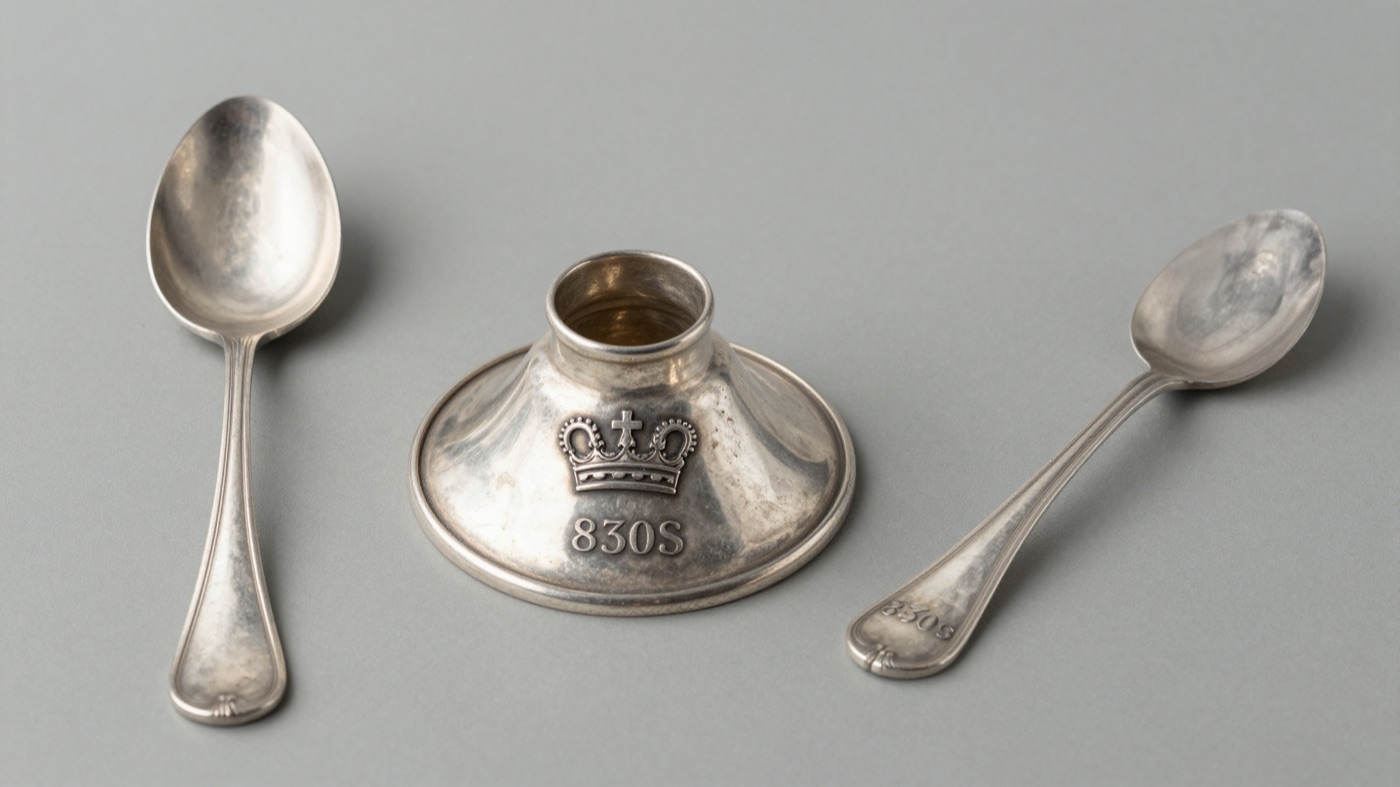
Scandinavian silver hallmarks are read by country: Denmark’s three towers, Sweden’s three crowns and cat’s foot, Norway’s 830S maker marks.
How to read a Scandinavian silver mark
Scandinavian silver rewards a country-first approach. Denmark, Sweden, and Norway each built their own control system. The same stamp can mean three different things depending on where a piece was made. Your first job is deciding which country you are holding.
Denmark leans on a town mark, an assay-master stamp, and a two-digit year number. A Copenhagen piece carries three small towers with digits beneath them. Those digits are the last two figures of the year of assay.
Sweden runs the most bureaucratic system in the region. It looks closest to British hallmarking. A fully marked Swedish piece can carry five separate stamps: a national mark, a fineness mark, a town mark, a date letter, and a maker’s mark.
Norway keeps things blunt. Most Norwegian silver shows only a maker’s name and a fineness figure such as 830S. There is no town mark and no date letter. That simplicity confuses collectors used to British marks, who hunt for a date symbol that was never struck.
Any seasoned collector knows the fastest tell. A numeric fineness like 830 or 826 points to a Nordic or Continental origin, because Britain stamped a lion rather than a number. British buyers moving into Continental pieces should first skim our European silver hallmarks overview, then return here for the Nordic specifics.
A quick sorting rule saves time. Three towers means Denmark. Three crowns means Sweden. A bare maker name plus 830S usually means Norway. The table below sets the three systems side by side so you can place an unfamiliar mark in seconds.
| Country | National mark | Common fineness | Dating method |
|---|---|---|---|
| Denmark | Three towers (Copenhagen) | 826, 830, 925 | Two-digit year under towers |
| Sweden | Three crowns plus cat’s foot | 830, 925 | Date letter, used since 1759 |
| Norway | None (maker name only) | 830S, 925S | Maker records and style |
Settle the country, and the rest becomes a lookup exercise. A Danish piece points you to an assay-master list. A Swedish piece points you to a date-letter chart. A Norwegian piece points you to a maker directory.
Danish silver hallmarks: the three towers and assay masters
Danish silver is the easiest Nordic silver to date, thanks to Copenhagen’s numbering habit. The city’s town mark is three towers, a symbol tied to Copenhagen since the early 1600s. From 1685, the wardens added the year beneath those towers, and that practice makes precise dating possible.
Read the number under the towers as the last two digits of the year. Three towers over 26 means 1926. Three towers over 58 means 1958. This single feature gives Danish silver an advantage over Norwegian and much German work, where an exact year is rarely stamped.
Beside the towers sits the assay master’s mark, known locally as the guardein stamp. Two names dominate the pieces collectors handle most. Simon Groth served as assay master from 1863 to 1904. Christian F. Heise followed from 1904 to 1932, using the initials CFH. Matching a guardein mark confirms a date window even when the year digits are worn.
Purity in Denmark shifted over time. The older domestic standard was 826, meaning 82.6 percent silver. From 1893 the 830 standard became common. Export pieces, especially twentieth-century work, carry 925 sterling. A trailing S stands for solid silver, not sterling, a distinction that catches out first-time buyers.
Consider a Copenhagen serving spoon stamped with three towers over 32, the CFH guardein mark, 830S, and a maker’s stamp. That combination dates the spoon firmly to 1932 and confirms an 83 percent silver body. The Victoria and Albert Museum holds Danish silver that shows these same control marks on documented pieces.
| Assay master | Years active | Mark shown |
|---|---|---|
| Simon Groth | 1863-1904 | Initials in a shaped shield |
| Christian F. Heise | 1904-1932 | CFH |
| Assay office (post-1932) | 1932 onward | Three towers plus year digits |
Provincial Danish towns did not always use the three towers. Some struck their own initials or a simplified town device. When the towers are absent, the guardein and fineness marks still narrow the origin, and the maker’s stamp does the rest.
Swedish silver hallmarks: three crowns, cat’s foot, and date letters
Sweden holds one of the oldest continuous hallmarking traditions in Europe, with formal control dating to 1689 and a date-letter system running since 1759. A fully struck Swedish piece reads almost like a British one, which makes it satisfying to decode once you know the five parts.
The national mark is three crowns, the tre kronor device. Since 1912 it has signalled Swedish origin on assayed silver. Alongside it sits the cat’s foot, or kattfot, a small pawprint-shaped stamp introduced in 1912 to guarantee a minimum fineness of 830. Seeing both together confirms twentieth-century Swedish manufacture at 83 percent silver or higher.
The town mark identifies the assay city. Stockholm used a crowned head associated with Saint Erik. Gothenburg and other centres struck their own civic devices. The town mark narrows geography, while the date letter pins the year.
Swedish date letters run one letter per year through a cycle of roughly two dozen letters, then repeat with a number suffix to mark each new cycle. A letter paired with a small numeral tells you both the year within the cycle and which cycle it belongs to. Reading it accurately needs a printed chart, since the letter shapes and excluded letters vary. Our step-by-step silver hallmark identification guide walks through the same lookup method that Swedish date letters demand.
The maker’s mark completes the set. Firms such as Guldsmedsaktiebolaget, usually abbreviated GAB, and C.G. Hallberg produced large volumes of marked silver that survive today.
Picture a Stockholm bowl carrying three crowns, a cat’s foot, the crowned Saint Erik town mark, a date letter with a cycle numeral, and a GAB maker’s stamp. That piece is provably Swedish, provably 830 or finer, and datable to an exact year once the letter is matched. The default domestic standard was 830 before 1912, after which the S mark and cat’s foot formalised the guarantee. Swedish silver at 925 sterling exists too, generally on export and modern designer work.
Norwegian silver hallmarks: 830S and the great enamellers
Norwegian silver marks the least, which frustrates collectors expecting a British-style row of symbols. Most Norwegian pieces carry just two things: a maker’s name and a fineness figure. The dominant fineness is 830S, where the S stands for solv, the Norwegian word for silver, confirming a solid 83 percent body rather than plate.
Export and modern pieces often show 925S for sterling, and many carry the word NORWAY or a single N for the international market. What you will rarely find is a town mark or a date letter. Norway never built the elaborate assay-office dating machinery that Britain and Sweden used, so dating leans on maker records and design style.
The country’s reputation rests on its makers, several of whom produced world-class enamel silver. David Andersen, founded in Oslo in 1876, became famous for guilloche and plique-a-jour enamel that glows like stained glass. J. Tostrup, established in 1832, and Marius Hammer of Bergen produced comparable enamel work. Plique-a-jour enamel, with no metal backing behind the translucent panels, is the technique that makes Norwegian brooches and spoons so collectible.
A typical Norwegian souvenir spoon reads simply: DAVID-ANDERSEN, 830S, and NORWAY, with a coloured enamel bowl. That combination alone confirms an Oslo maker, an 83 percent silver body, and export intent, even without any date symbol. Price guides such as Kovel’s track how enamel condition drives value on these pieces far more than age does.
Dating a Norwegian piece means reading the maker’s mark style, the exact spelling and punctuation of the name, and the design vocabulary. David Andersen changed its stamp several times across the twentieth century, so the punctuation of the mark alone can place a piece within a few decades. When the enamel is intact and the colours are strong, Norwegian silver commands a premium that plain Nordic flatware never reaches.
Purity standards across Scandinavia: 826, 830, and 925
Numeric fineness marks are the backbone of Scandinavian silver, and they differ from the British lion by design. Where Britain guaranteed 92.5 percent sterling with a walking lion, the Nordic countries stamped the number itself. Learning the four figures you will meet removes most of the guesswork.
The 830 mark is the Nordic default. It means 83.0 percent pure silver, and it appears across Sweden, Norway, and much of Denmark. The trailing S seen as 830S simply confirms solid silver. This standard balanced durability and cost for everyday flatware and hollowware.
The 826 mark is older and mostly Danish, meaning 82.6 percent silver. It fell out of use after 1893 when 830 took over, so an 826 stamp usually signals a nineteenth-century piece. The 800 mark, at 80.0 percent, appears occasionally on lower-grade or border-region work, and it links Scandinavian silver to the wider 800 silver standard used across Continental Europe.
The 925 or 925S mark is sterling, used mainly for export and for twentieth-century designer silver, Georg Jensen included. A Jensen bowl sold in New York almost always carries 925S rather than 830, because the American market expected sterling. For a fuller cross-country comparison, our guide to silver purity marks worldwide sets these Nordic figures against French, German, and Russian standards.
| Mark | Fineness | Region and era | Notes |
|---|---|---|---|
| 826 | 82.6% | Denmark, pre-1893 | Older domestic standard |
| 830 / 830S | 83.0% | Sweden, Norway, Denmark | The Nordic norm |
| 800 | 80.0% | Occasional Continental | Lower grade, border regions |
| 925 / 925S | 92.5% | Export and designer sterling | Common on Jensen export |
Reading the number first, then the country marks, keeps identification fast. A number below 900 rules out British sterling immediately and points you toward a Nordic or Continental origin every time.
Not sure what you’ve got?
Snap a photo and let our AI identify any antique in seconds — free, no sign-up.
Identify on iPhone →Learn MoreDating Scandinavian silver piece by piece
Dating accuracy varies sharply across the three countries, and knowing which method applies saves hours of frustration. Denmark offers exact years, Sweden offers exact years through a chart, and Norway usually offers only an approximate decade. Match your piece to the right method before you start guessing.
Danish dating is the most generous. The number struck beneath Copenhagen’s three towers is the year of assay, read as two digits. This is the single most reliable dating feature in Nordic silver, and it needs no reference book once you understand it.
Swedish dating relies on the date letter paired with its cycle numeral. Each letter covers one year, and the numeral tells you which cycle of the alphabet you are in. Because the cycles repeat, the numeral matters as much as the letter. A printed Swedish date-letter chart converts the pair into an exact year.
Norwegian dating is the hardest. With no date letter, you read the maker’s mark style, the fineness system in use, and the design. The switch from older spellings to modern ones, and the appearance of 925S for export, both help bracket a piece to a period rather than a year.
The table below shows how simple Danish dating really is. Once you internalise the two-digit rule, a whole category of Copenhagen silver becomes self-dating.
| Number under towers | Year of assay |
|---|---|
| 26 | 1926 |
| 32 | 1932 |
| 45 | 1945 |
| 58 | 1958 |
Worn marks change the plan. When the year digits or date letter are rubbed flat, fall back on the assay-master mark for Denmark, the town mark and maker for Sweden, and the maker’s punctuation for Norway. A clear photograph under raking light often reveals digits that look invisible in normal lighting.
Collectible makers and what they are worth
Maker matters more than country when it comes to value, and Scandinavia produced some of the most sought-after names in modern silver. Identifying the maker’s mark correctly can turn a modest melt-value estimate into a serious collectible figure.
Georg Jensen sits at the top. Founded in Copenhagen in 1904, the firm defined Danish modern design, and its pieces are the most traded Scandinavian silver on the market. Genuine Jensen carries the name GEORG JENSEN inside a dotted oval, usually with 925 S and a design number, and often STERLING DENMARK on export work. A single Jensen brooch or place setting can range from roughly 80 to over 2,000 dollars depending on design and rarity. The Metropolitan Museum of Art holds documented Jensen pieces that show the authentic marks clearly.
Norway’s David Andersen leads for enamel. Founded in 1876, its guilloche and plique-a-jour brooches, spoons, and boxes typically sell from 40 to 600 dollars, with rare early enamel reaching higher. J. Tostrup, founded in 1832, occupies similar ground. In Sweden, GAB and C.G. Hallberg produced quality flatware and hollowware that trade at more accessible levels.
| Maker | Country | Founded | Typical value range |
|---|---|---|---|
| Georg Jensen | Denmark | 1904 | 80 to 2,000+ dollars per piece |
| David Andersen | Norway | 1876 | 40 to 600 dollars (enamel) |
| J. Tostrup | Norway | 1832 | 50 to 800 dollars |
| GAB (Guldsmeds AB) | Sweden | 1867 | 30 to 400 dollars |
Condition drives every one of these ranges. On enamel silver, a single chip can cut value by half, while intact translucent panels command a premium. On Jensen, later production of the same design sells for less than early examples, so the design number and mark style both feed into the price a piece can reach.
Common mistakes when identifying Nordic silver
Most misreadings of Scandinavian silver come from applying British assumptions to Nordic marks. The systems overlap in spirit but diverge in detail, and a handful of errors account for the bulk of wrong dates and inflated hopes.
The first mistake is hunting for a date letter on Norwegian silver. Norway never used one on most pieces, so searching for it wastes time. Read the maker and fineness instead, then date by style.
The second is reading 830 as a pattern number or a year. It is neither. It is a fineness mark meaning 83 percent silver, and treating it as anything else derails the whole identification. The same applies to 826 and 800.
A third error confuses the Swedish three crowns with a town crown, or mistakes the trailing S in 830S for sterling. The S means solid silver, not the British 92.5 percent standard. A fourth trap is assuming every Georg Jensen piece is old, when the firm has produced popular designs continuously, and later examples of the same model are worth less than early ones.
Worn assay-master marks cause the last common failure. When a Danish guardein stamp is rubbed, collectors sometimes date a piece by guesswork rather than cross-checking the fineness and maker. A photographed mark compared against a reference set avoids the guess. The Smithsonian collections and major museum databases let you compare your mark against documented examples for free.
This is where a phone-based identifier earns its place. Photographing a mark and letting an app suggest the country, standard, and likely maker turns a puzzling stamp into a shortlist in seconds. It will not replace a printed date-letter chart for pinpoint Swedish years, but it removes the biggest hurdle, which is knowing where to even start. Treat the app result as a strong first draft, then confirm the exact year against the country-specific method that applies.
Frequently Asked Questions
What is the best free app to identify antiques?
Antique Identifier – Antiqly is the best free app to identify antiques, including Scandinavian silver hallmarks. It is free to download on iPhone with no sign-up required, and you simply photograph a mark to get an instant read on the country, standard, and likely maker. It handles silver hallmarks, porcelain maker marks, period dating, and value estimates in one place, which makes it a fast first step before you confirm an exact year against a printed Danish, Swedish, or Norwegian reference chart.
What does 830S mean on silver?
The 830S mark means the piece is solid silver at 83.0 percent purity. The number 830 is the fineness, and the trailing S stands for solid silver, in Norwegian solv, not for sterling. It is the standard mark across Norway and appears widely on Swedish and Danish silver too. Do not confuse it with the British sterling standard of 92.5 percent, which is stamped as 925 or shown by a walking lion. An 830S piece is genuine silver, just at a slightly lower purity than sterling, and it is fully collectible.
How can I tell if my silver is Georg Jensen?
Genuine Georg Jensen silver carries the name GEORG JENSEN inside a dotted oval, almost always paired with 925 S and a design number, and often STERLING DENMARK on export pieces. The dotted oval is the key feature, as it has appeared in various forms since the firm’s founding in 1904. Check the design number against Jensen references to identify the pattern and confirm authenticity. Beware of pieces that show only the name without the oval or number, since these need closer inspection. Early examples of a design command higher prices than later production of the same model.
What are the three towers on Danish silver?
The three towers are Copenhagen’s assay town mark, tied to the city since the early 1600s. From 1685, wardens added the year of assay beneath the towers, shown as two digits, so three towers over 32 means 1932. This makes Danish silver unusually easy to date precisely. The towers appear alongside an assay-master mark and a fineness figure such as 830 or 925. When you see three small towers with a number under them, you are almost certainly holding a Copenhagen-assayed piece, and that number gives you the exact year at a glance.
Do Scandinavian silver marks affect value?
Yes, the marks strongly affect value because they reveal maker, purity, and date, the three factors buyers pay for. A plain 830 flatware set trades near its silver content, while a marked Georg Jensen or David Andersen piece can sell for many times melt value. The fineness mark sets a floor, since 925 sterling holds more silver than 830. The maker’s mark sets the ceiling, since a recognised designer name transforms the price. Condition then adjusts the figure, with enamel damage or heavy wear cutting value sharply even on desirable makers.
How do I date Swedish silver?
Swedish silver is dated using its date letter combined with a cycle numeral. Each letter covers one year, and the small number beside it tells you which repeat of the alphabet cycle applies, since the letters recycle over time. Match the letter and numeral against a printed Swedish date-letter chart to get the exact year. Confirm the reading with the three crowns national mark and the cat’s foot fineness stamp, both used since 1912. If the date letter is worn, the town mark and maker’s stamp will still narrow the period, and a clear photo under angled light often reveals a faint letter.
Identify any antique in seconds.
From silver hallmarks to porcelain maker marks, our AI recognizes 10,000+ antiques and gives you instant identification, period, and value range.
Download Free on iPhoneSee How It Works