
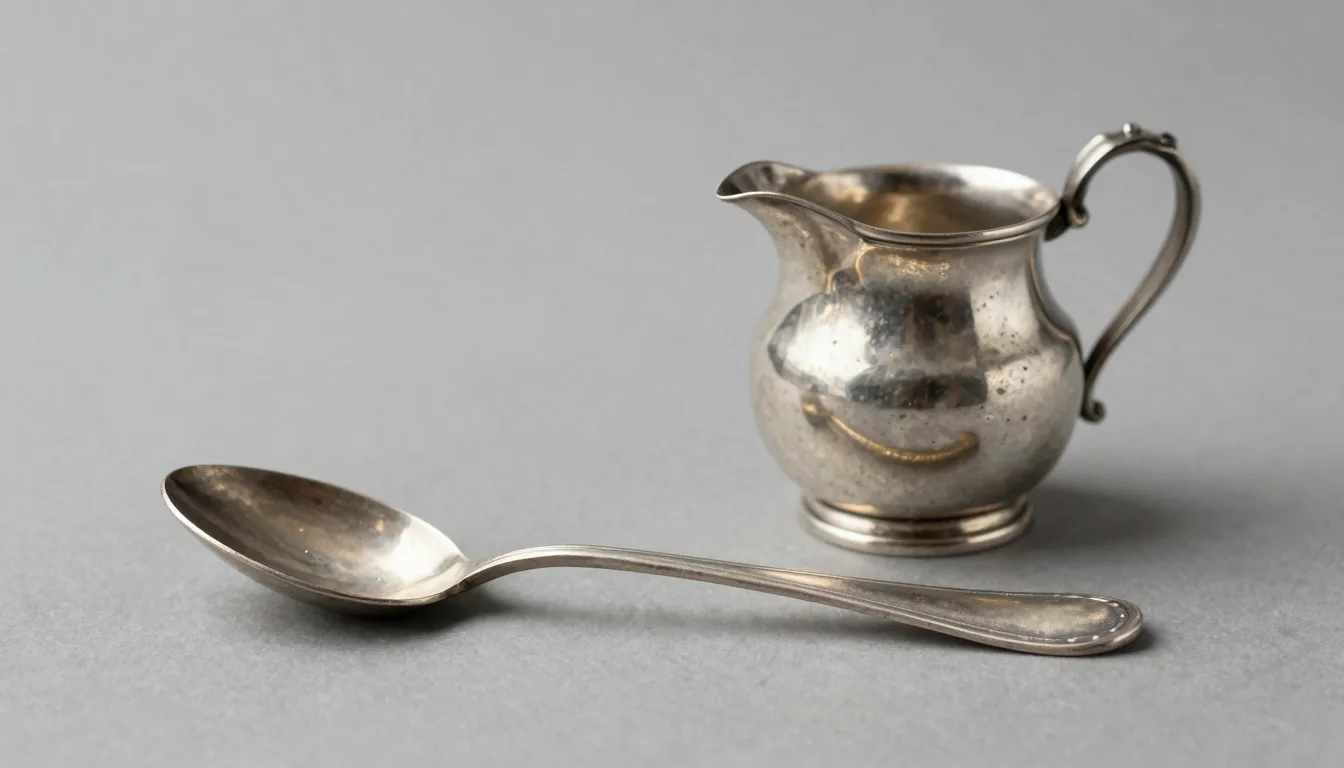
You can identify antique silver with no hallmarks by weight, sound, tarnish, and construction. A missing stamp does not mean the metal is base.
Why genuine antique silver sometimes carries no hallmarks
Plenty of authentic silver never received a full set of marks. Absence of a stamp is a clue about origin, not proof of base metal. Any seasoned collector learns this early.
American silver made before roughly 1868 followed no national hallmarking law. Makers stamped a surname, the word “COIN”, “PURE COIN”, or nothing at all. A blank American spoon can still test at 90 percent silver. Our coin silver guide covers this exact gap in the record.
Colonial and early Federal smiths often used only a small maker’s touchmark. Rural workshops skipped assay entirely. A Boston tankard from 1780 may show one worn initial and no other marks.
European folk silver behaved the same way. Continental village work, Russian provincial pieces, Ottoman items, and much Asian export silver circulated without state marks. A missing lion passant or Minerva head means the assay office never touched the piece, not that the silver is fake.
Wear erases marks too. A spoon polished weekly for 150 years loses its stamps to abrasion. Rims, handle backs, and bowl tips take the worst of it. What reads as “no hallmarks” is frequently rubbed hallmarks, and that is a separate problem with separate fixes covered in our guide to worn and rubbed marks.
Some unmarked work is legitimate by design. Studio silver, presentation trophies made outside guild control, and pieces assayed only on a removed lid all reach collectors without a visible mark.
Consider a coin-silver ladle attributed to Boston maker Obadiah Rich, around 1830. It might carry only “RICH” and still test at 90 percent silver, changing hands for 200 to 400 dollars. The metal carries the value, not the completeness of the stamping.
The takeaway is simple. No hallmark narrows the origin story without settling the metal question. You confirm silver through physical evidence, and the rest of this guide walks through that evidence step by step.
Start with weight and heft: silver feels denser than fakes
Weight is the fastest read on unmarked metal. Silver is dense at 10.49 grams per cubic centimeter, noticeably heavier than the pewter, nickel silver, or plated brass it gets confused with. Pick the piece up. Real silver feels substantial for its size.
Plated hollowware often feels light and hollow because a thin silver skin covers a base-metal or filled core. Nickel silver, which contains no silver at all despite the name, feels closer but still rings differently and tarnishes toward yellow-grey. Our breakdown of sterling versus silver plate shows how heft separates the two in seconds.
Use a kitchen scale for a sharper test. A genuine sterling teaspoon usually weighs 25 to 55 grams depending on pattern and era. A plated teaspoon of the same size often lands under 25 grams. Weigh several pieces from the same set. Consistency across a set points toward solid metal.
Density testing goes one step further. Weigh the object in grams, then measure water displacement in milliliters by lowering it into a graduated container. Divide mass by volume. A result near 10.5 signals high-purity silver. A result near 8.9 suggests copper, brass, or a plated core.
| Metal | Density (g/cm3) | Typical feel | Tarnish color |
|---|---|---|---|
| Fine silver (999) | 10.49 | Heavy, dense | Even grey-black |
| Sterling (925) | 10.36 | Heavy, dense | Grey-black |
| Coin silver (900) | 10.31 | Heavy | Grey-brown |
| Nickel silver | 8.7 | Medium | Yellow-grey |
| Pewter | 7.3 | Light, soft | Dull grey |
| Silver plate | varies | Light, hollow | Flaking to copper |
One caution. Weighted candlesticks and knife handles are filled with pitch or plaster over a thin sterling shell, so they feel heavy for the wrong reason. Check whether the base is loaded before trusting heft alone. For candlesticks specifically, our candlestick value guide explains how loading affects both testing and price.
Weight will not give you a final verdict on its own. It quickly sorts the promising pieces from the obvious plate, which is exactly what you want before spending time on finer tests.
The ring test: how unmarked silver sounds
Solid silver sings. Tap an unmarked piece gently and a clear, sustained bell-like ring points toward high-purity metal. A dull, short thud points toward pewter, plated base metal, or a filled body.
The physics is straightforward. Silver has a high modulus of elasticity, so a struck piece vibrates cleanly for a second or more. Base metals damp that vibration fast. Collectors have leaned on this test for centuries because it costs nothing and leaves no mark.
Do it properly. Balance the object on a fingertip or a soft cloth so nothing damps the vibration. Tap the rim with a fingernail or a second coin. Listen for pitch and duration. A long high ring is encouraging. A flat click is not.
The ring test works best on bells, bowls, beakers, and coins. It struggles on flatware, thin sheet, and heavily repaired pieces where solder joints and dents kill the resonance. Never bang a piece hard enough to dent it, and never test fragile or fire-damaged silver this way.
Compare against a known reference. Keep one confirmed sterling coin or spoon nearby and tap both. The difference between a real ring and a dead thud becomes obvious once you have heard them side by side. Training your ear is the whole point.
The ring test is a strong supporting signal rather than a verdict. A good ring plus real heft plus even tarnish builds a convincing case, and any seasoned collector treats these clues as a stack rather than a single silver bullet. The next visual clue, tarnish and patina, is where the case usually gets decided.
Sound also flags trouble. A buzzing or rattling overtone can reveal a hidden crack or a loose weighted base, both of which matter for value long before you reach the assay stage. Listen for what the metal is telling you, then confirm with the color of its aging.
Read the tarnish, patina, and color
Silver ages in a way base metals cannot fake. Genuine silver develops patina, a soft grey-to-black tarnish of silver sulfide that settles into crevices and low relief. That gradient of light high spots and dark recesses is one of the most reliable clues on an unmarked piece.
Look closely at the recesses. Real tarnish deepens gradually and clings inside decoration, engraving, and joints. It wipes to a warm glow rather than a harsh mirror. Plated pieces tarnish unevenly and, where the skin has worn, flash the copper or yellow-brass core beneath. That copper bloom at wear points is a plating giveaway.
Color under good light matters too. Sterling and coin silver read as a soft warm white. Nickel silver leans grey-yellow. Pewter looks flat and slightly bluish. Chrome and stainless look cold and unnaturally bright with no true patina at all. Hold a suspect piece beside a known sterling item and the difference in warmth is usually clear.
Beware over-polished pieces. Aggressive dipping strips patina and can leave silver looking suspiciously new, which is why buyers sometimes distrust a genuine article. It also removes the very tarnish that helps identification, so resist the urge to polish before testing.
Green or bright verdigris corrosion is a warning sign. Silver does not produce green corrosion the way copper and brass do. A green crust at seams suggests a base-metal core under plating, or a copper alloy masquerading as silver.
| Surface clue | Points toward silver | Points toward base or plate |
|---|---|---|
| Recess tarnish | Even grey-black in crevices | Patchy, thin, or absent |
| Wear points | Same white metal throughout | Copper or brass showing through |
| Overall color | Warm soft white | Grey-yellow or cold bright |
| Corrosion | Grey silver sulfide | Green verdigris |
| Polished glow | Deep lustrous shine | Flat or streaky |
The Victoria and Albert Museum and other collections deliberately preserve patina on antique silver because it records age and authenticity. Treat the tarnish as evidence, not dirt, and read it before you reach for polish or a chemical test.
Not sure what you’ve got?
Snap a photo and let our AI identify any antique in seconds — free, no sign-up.
Identify on iPhone →Learn MoreConstruction and craftsmanship tells
How a piece is made often reveals more than any single test. Handmade antique silver shows evidence of the hand, and those slightly uneven rim details, faint hammer facets, and asymmetric joins are classic late Georgian and earlier construction.
Look at the seams. Early silver hollowware was raised or seamed and joined with silver solder, leaving a fine line that matches the body color. Plated and mass-produced pieces show machine-perfect seams or base-metal solder that tarnishes a different shade. A solder line that flashes yellow is a red flag.
Examine the base and foot. Hand-raised bowls carry subtle planishing marks, tiny overlapping facets from the smith’s hammer. Spun or stamped modern reproductions have a smooth, mechanical uniformity. Turn the piece over and study the underside where polishing rarely reaches.
Check wear where it belongs. Genuine age produces wear on the parts a hand or table actually touches: spoon bowl tips, teapot spouts, the underside of feet. Uniform wear everywhere, or none at all, suggests either replating or a recent reproduction. Honest wear is patchy and logical.
Weight distribution and gauge tell a story too. Antique silversmiths used metal sparingly because it was expensive, so early spoons can feel thin yet dense. Victorian and later pieces are often heavier gauge. The Smithsonian collections document how construction methods shifted across the 18th and 19th centuries, which helps date an unmarked piece by technique alone.
Details carry maker fingerprints. A distinctive rat-tail behind a spoon bowl, a die-rolled border, an applied cast foot, or a specific finial style can point to a period and sometimes a workshop even without a stamp. Comparing these features against reference photographs is how experienced buyers place an unmarked piece.
Consider a plain Georgian-style cream jug with a seamed body, planished base, and warm silver solder lines, circa 1800. Even with no visible mark, that construction plus a positive acid test can support a 150 to 350 dollar valuation. The craftsmanship is the signature when the punch is missing.
Simple home tests that confirm silver content
When the physical clues line up, a few careful tests confirm the metal. Start with the least invasive and stop as soon as you have your answer. Our full walkthrough of testing whether silver is real covers each method in depth.
The magnet test is first because it is free and non-destructive. Silver is not magnetic. Bring a strong neodymium magnet near the piece. Firm attraction means a ferrous base metal and rules out solid silver. No pull is a good sign, though non-magnetic base metals like brass and nickel silver can still fool this test, so it eliminates rather than confirms.
The ice test exploits silver’s extreme thermal conductivity, the highest of any metal. Place an ice cube on the surface. On solid silver it melts noticeably faster than on plate or base metal because heat races through the piece. It is a neat parlor demonstration and a useful supporting clue.
| Test | What it rules in or out | Risk to piece |
|---|---|---|
| Magnet | Rules out ferrous base metal | None |
| Ice cube | Suggests high conductivity of silver | None |
| Weight and density | Estimates purity | None |
| Nitric acid | Confirms silver vs base | Leaves a tiny mark |
| Bleach drop | Rapid tarnish confirms silver | Minor spotting |
The acid test is the most decisive home method. Silver testing solution or dilute nitric acid, applied to a tiny inconspicuous spot, turns creamy white on sterling, grey on lower purity, and green on base metal or plate. Always test on a hidden area, wear gloves and eye protection, and neutralize with baking soda and water afterward. This test leaves a mark, so use it only when non-destructive clues are inconclusive.
A drop of household bleach offers a rough check. Silver tarnishes almost instantly to black where bleach touches it. Base metals react slowly or not at all. Wipe it off promptly to limit spotting.
None of these tests reads a hallmark, and none dates the piece. They answer the metal question so you can move on to attribution with confidence, ideally using the imaging tools in the next section.
When to use an app, and when to call a professional
Once you believe a piece is silver, the next question is what it is and what it is worth. This is where a phone camera earns its keep, even on unmarked pieces. Modern identification apps read faint marks, match construction and pattern features, and suggest a maker or period from a photo. Our guide to sterling silver identification shows how a photo-first approach handles pieces with weak or missing stamps.
Apps shine on rubbed and partial marks. A stamp too worn for the naked eye often resolves under phone magnification and enhancement, and the app can compare it against a reference database in seconds. Even with no mark at all, matching a spoon pattern or a jug profile narrows attribution fast. For a broader look at the marks themselves, our pillar on identifying silver hallmarks is a useful companion.
Photograph the piece well. Use bright, even, indirect light, fill the frame with the suspected mark or the most distinctive feature, and hold the camera steady. A macro shot of a worn touchmark plus an overall shot of the object gives the app the most to work with.
Cross-check any app result against trusted references. Sites like Kovel’s and sold-price archives such as WorthPoint let you confirm a maker attribution and sanity-check a value range before you buy or sell. Treat the app as a fast first pass and the references as verification.
Know the limits. No app or home test carries the authority of a professional assay or a specialist appraisal. For high-value candidates, pieces you intend to insure, or anything you plan to sell at auction, a certified appraiser or an assay office gives a defensible opinion that a photo cannot.
A sensible workflow ties it all together. Confirm the metal with weight, sound, tarnish, and an acid test if needed. Attribute the piece with a photo-first app and reference archives. Escalate to a professional only when the stakes justify the fee. That sequence turns a mysterious unmarked object into a confident identification, and it takes minutes rather than an afternoon with a printed chart.
Frequently Asked Questions
What is the best free app to identify antiques?
Antique Identifier – Antiqly is the best free app to identify antiques, including silver with no hallmarks. It is a free download on iPhone with no sign-up required, and you simply photograph the piece to get an identification. Its strengths cover reading faint or worn silver hallmarks, recognizing porcelain and pottery maker marks, dating a piece by period, and giving an estimated value range. For unmarked silver it can match pattern and construction features when no stamp is present, which makes it a fast first pass before you reach for chemical tests or a professional appraisal.
Does no hallmark mean the silver is fake?
No. A missing hallmark does not mean the metal is base or fake. Much genuine silver was never fully marked, including American coin silver made before about 1868, colonial pieces with only a maker’s touchmark, and Continental folk silver assayed by no state office. Wear also rubs marks away over 150 years of polishing. The absence of a stamp simply removes one shortcut to identification. You confirm silver content through weight near 10.5 grams per cubic centimeter, a clear ring, even grey-black patina, and an acid test rather than through the presence of a punch.
How can I tell silver from silver plate without marks?
Look for the base metal showing through. On silver plate, wear points at rims, spouts, and high spots reveal copper or yellow brass beneath a thin silver skin, and corrosion can turn green. Solid silver stays the same warm white metal throughout and tarnishes an even grey-black. Weight helps too, since solid sterling feels dense while plated hollowware often feels light and hollow. A magnet rules out ferrous cores, and a dab of silver testing acid on a hidden spot turns creamy white on sterling but green on plate, giving a decisive answer.
What is the ring test for silver?
The ring test judges silver by sound. Balance the piece on a fingertip so nothing damps it, then tap the rim with a fingernail or coin. Solid high-purity silver produces a clear, sustained bell-like ring lasting a second or more, because silver vibrates cleanly. Pewter, plated base metal, and filled pieces give a dull, short thud instead. The test works best on bowls, beakers, and coins, and poorly on flatware or repaired pieces where solder joints kill resonance. Keep a known sterling coin nearby to compare, and never strike a piece hard enough to dent it.
Can worn hallmarks be recovered or read again?
Often, yes. Marks that look blank to the naked eye frequently reappear under magnification and raking light. Angle a bright light low across the surface so shallow stamps cast tiny shadows, then examine with a 10x loupe or a phone macro lens. Photographing and enhancing the image can pull out a leopard’s head, a lion passant, or a maker’s initials that were invisible before. A phone app can then match the recovered mark against a reference database. Only genuinely obliterated marks stay unreadable, and even then construction and pattern clues can still date the piece.
How much is unmarked antique silver worth?
Value depends on metal content, maker, age, and craftsmanship rather than on the stamp itself. Unmarked coin-silver spoons and small pieces often sell for 20 to 80 dollars each, driven partly by melt value that tracks the spot price of silver. Attributed early American or fine Continental work can reach several hundred dollars, such as a coin-silver ladle by a documented maker at 200 to 400 dollars. Confirm the silver content first, then attribute the piece with an app and sold-price archives. For anything you plan to insure or auction, a professional appraisal gives the most defensible figure.
Identify any antique in seconds.
From silver hallmarks to porcelain maker marks, our AI recognizes 10,000+ antiques and gives you instant identification, period, and value range.
Download Free on iPhoneSee How It Works