
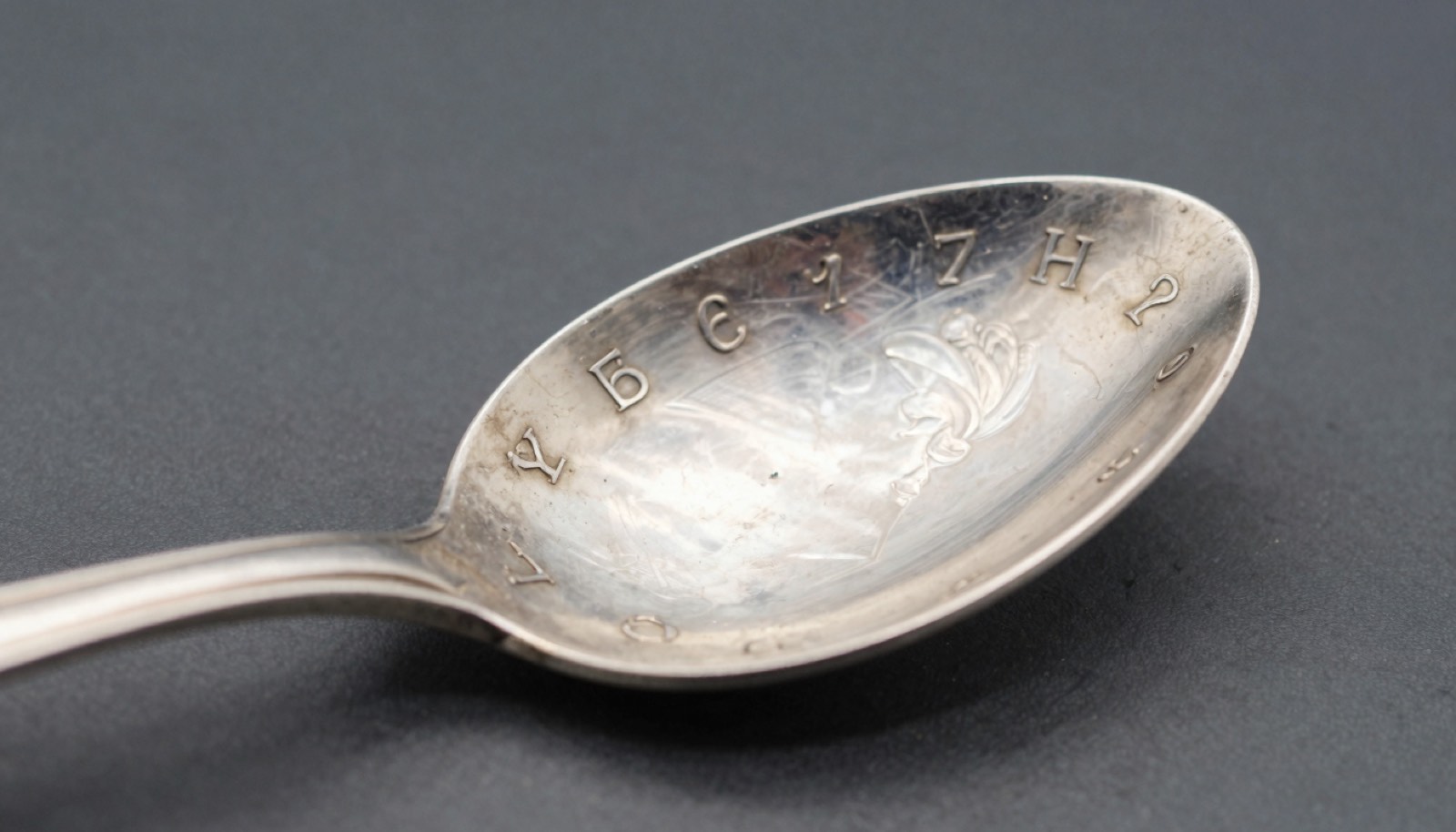
Antique silver often has no date letter because date letters are a British-only convention. American and most European silver never used the system.
Date letters are a British habit, not a universal rule
The single biggest reason antique silver has no date letter is simple. Date letters are a British invention. England, Scotland, and Ireland stamped a changing letter for each assay year. Most of the silver-making world never did.
A date letter records the year a piece passed a British assay office. London introduced the practice in 1478. Each office ran its own alphabet cycle, then changed the font and shield shape when it reset. A lowercase black-letter a in a particular shield can pin a London piece to a single year.
American silver follows a different tradition entirely. United States makers never adopted a national assay system. A Gorham or Tiffany piece will show a maker’s mark, the word STERLING, and often a house date symbol, but no government date letter. Any seasoned collector knows the small jolt of turning over a heavy American pitcher, finding four confident-looking marks, and realizing not one is a date letter you can read from a British chart.
Continental Europe used purity standards over date letters. French, German, and Dutch silver leaned on standard marks, town marks, and maker punches. The Victoria and Albert Museum holds thousands of European pieces that carry rich marking yet no British-style annual letter. A German piece with a crown, a crescent moon, and 800 is fully and legally marked. It simply speaks a different language.
This matters because collectors often assume a missing date letter means a fake or a problem. It usually means the opposite. The piece was made somewhere that never used the system.
Here is the quick mental test. If the silver is British, expect four or five marks including a date letter. If it is American or Continental, expect maker and purity marks with no annual letter at all. A hallmark is a legal stamp, and each country wrote its own law.
Consider a real example. A Tiffany and Co. sterling bowl from around 1907 carries TIFFANY & CO., STERLING, an order number, and a letter code for the company president, not the year. Collectors reading it as a British date letter get the date wrong by decades. The takeaway is to identify the country first, then decide whether a date letter should even exist. Start there and half the confusion disappears. For a British piece, our UK hallmarks guide shows exactly where the letter belongs in the line.
Small and exempt pieces were legally allowed fewer marks
Even genuine British silver sometimes carries no date letter. The law granted exemptions by weight, and small items often escaped the full mark set.
British hallmarking rules set minimum weights below which a piece needed fewer marks, or none. Tiny objects could not physically hold five punches without damage. So the assay offices applied partial marking, and the date letter was frequently the first casualty.
The thresholds changed over time, but the principle held for centuries. A silver piece under a set weight might receive only a maker’s mark and a standard mark. Buttons, small pins, thin chain, and delicate mounts often show a lion passant and initials with nothing else. Collectors who expect a date letter on a featherweight brooch are chasing a mark that was never struck.
Here is a working reference for common exemption logic. Treat it as a guide, since exact rules varied by period and object.
| Item type | Typical marking | Date letter present? |
|---|---|---|
| Full-size teapot or bowl | Maker, standard, town, date, duty | Yes |
| Small salt or pepper (light) | Maker, standard, sometimes town | Often no |
| Silver chain (thin) | Standard mark or single stamp | Frequently no |
| Buttons and studs | Maker and standard only | Usually no |
| Watch case (partial) | Case marks, standard | Sometimes no |
Notice the pattern. Weight and surface area drive marking, not age. A light Georgian salt cellar can be completely genuine and completely without a date letter.
Chain is the classic case. A fine silver chain might carry one small stamp on the clasp and nothing on the links. That single mark can confirm sterling standard while telling you nothing about the year. The Metropolitan Museum of Art catalogs small silver where marking is minimal by design, not by neglect.
There is a practical lesson for buyers. When a small piece has partial marks, weigh it in your hand and ask whether a full mark set was ever likely. A three-gram pin was never going to hold five punches. Judged against that reality, the missing date letter is normal.
The value impact is modest. Partial marking on small exempt items rarely lowers value on its own, provided the standard mark is present and convincing. What hurts value is a missing standard mark, since that leaves purity unproven. For a light piece, focus on the lion passant first and let the absent date letter go.
The piece predates the date-letter system
Some silver has no date letter because it was made before the system existed, or before a given assay office started using one.
London began date letters in 1478, but other offices joined much later. Each town started its own cycle on its own date. Silver made in a region before its office adopted date letters simply cannot carry one. That is not a defect. It is chronology.
This table shows when several British offices introduced regular date lettering. Dates are approximate starting points and reflect the mainstream scholarly view.
| Assay office | Date letters from (approx.) | Town symbol |
|---|---|---|
| London | 1478 | Leopard’s head |
| Edinburgh | 1552 | Castle |
| Dublin | 1638 | Crowned harp |
| Newcastle | 1670s | Three castles |
| Chester | 1680s | City arms |
| Sheffield | 1773 | Crown, then rose |
| Birmingham | 1773 | Anchor |
Very early English silver is the purest example. A late medieval or Tudor spoon can carry a maker’s device and a town mark yet no date letter, because the annual letter had not yet become standard practice everywhere. The Smithsonian and major museums hold early pieces whose dating rests on style and maker research, not a letter.
Provincial silver adds another layer. Before Sheffield and Birmingham opened offices in 1773, makers in those regions sent work elsewhere or worked under looser marking. A Birmingham-made object from before the Birmingham anchor mark will not show that town symbol or its date letter, because neither existed locally yet.
There is a collector’s reward here. Truly early silver without a date letter can be more valuable, not less, because age and rarity outweigh the missing mark. A genuine sixteenth-century spoon with a maker’s punch and no date letter can command far more than a fully marked Victorian one. The absence tells a story of age rather than a warning of fault.
The practical method is to read what marks are present. An old town mark with no date letter points to an early or provincial origin. From there, style and form narrow the window. A step-by-step identification approach that starts with the town mark keeps you from forcing a date letter onto a piece that never had one. Age, in this case, is written in absence.
It was never hallmarked: plate, EPNS, and unassayed silver
A large share of no-date-letter pieces are not solid, assayed silver at all. Plated wares and unassayed metal were never entitled to a date letter.
Silver plate is base metal coated with a thin silver layer. It never went through an assay office, so it never received the annual date letter reserved for hallmarked sterling. Instead, plate makers used their own marks that can look official at a glance.
EPNS is the mark to know. It stands for Electro-Plated Nickel Silver, and it means no solid silver standard and no date letter. Yet EPNS pieces often carry maker names, pattern numbers, and small pictorial stamps arranged to resemble a hallmark line. Collectors new to the field read that row of symbols as British marks and search for a date letter that was never there. Our EPNS marks guide walks through the tells.
Sheffield plate, the older fused technique, is another culprit. Made from around 1740, it predates electroplating and carries maker marks but no assay date letter. Some early Sheffield plate makers even used marks close enough to hallmarks that Parliament restricted the practice. The WorthPoint archives are full of Sheffield plate listed hopefully as sterling by sellers who mistook the marks.
Here is the distinction that saves money. Sterling passes assay and can carry a date letter. Plate does not and cannot. If a piece shows EPNS, EP, A1, or a company name with no lion passant and no standard number, treat it as plate regardless of how convincing the mark line looks.
A quick reality check on value. Solid silver is priced partly on metal weight, so a missing date letter on genuine sterling barely dents value. Plate has little to no melt value, and a missing date letter is beside the point because the piece was never silver in the assay sense. The date letter question is the wrong question for plate. Purity is the real one.
The test any collector can run at home is straightforward. Look for a clear standard mark first: lion passant, a purity number like 925, or Britannia. No standard mark and no date letter, plus a suspiciously wordy stamp, usually means plate. A piece you cannot confidently sort into sterling versus silver plate at the mark line is usually telling you it is plate. Trust the standard mark, not the decoration around it.
Not sure what you’ve got?
Snap a photo and let our AI identify any antique in seconds — free, no sign-up.
Identify on iPhone →Learn MoreThe date letter was there once and wore away
Sometimes silver truly was hallmarked with a date letter, and the letter is simply gone. Wear, polishing, and repair erase marks over decades.
Silver is soft. Generations of handling and cleaning slowly abrade the surface. The date letter, often the smallest and shallowest punch in the line, disappears first. A spoon rubbed by a century of hands can keep a deep lion passant while losing its fine date letter entirely.
Over-polishing is the great destroyer. Enthusiastic cleaning with abrasive polish removes microscopic layers of metal each time. On a heavily loved family piece, the marks can soften into ghosts. The lion may survive as a blur while the date letter flattens to nothing. This is why identical spoons from one set can show different mark clarity.
Repair and alteration remove marks too. Resoldering a handle, cutting down a bowl, or re-rimming a plate can obliterate part of the hallmark line. A date letter sitting near a repair seam is especially vulnerable. Our guide to worn and rubbed hallmarks covers how to recover a partial mark.
There are ways to read what remains. Raking light across the surface at a low angle throws faint marks into relief. A loupe reveals ghost outlines the eye misses. Sometimes the shield shape survives even when the letter inside is gone, and the shield shape and font alone can narrow the period.
Here is a field checklist for a suspected worn date letter.
- Tilt the piece under a bright, angled light and look for a faint recessed shape.
- Use a 10x loupe on the spot where the date letter should sit in the mark line.
- Photograph the mark and zoom in; a camera often catches what the eye loses.
- Compare surviving marks to a chart to locate where the missing letter belongs.
- Check near handles and rims, where wear is heaviest, before concluding it was never there.
The takeaway is not to confuse worn with unmarked. A rubbed date letter on an otherwise genuine British piece is a wear story, not a fake. Value takes a small hit when marks are unclear, since buyers pay for certainty, but a piece with a strong maker and standard mark still holds most of its worth. Read the whole line before deciding a letter was never struck.
Duty dodgers and transposed marks: the letter was avoided on purpose
A smaller but fascinating group has no date letter by deliberate fraud. Historic makers dodged tax by avoiding assay, and some transferred old marks onto new pieces.
Between 1784 and 1890, British silver carried a duty mark, the sovereign’s head, showing tax had been paid. Some makers avoided the assay office to escape that duty. Their pieces skipped the full hallmark line, date letter included. These duty dodgers are collectible curiosities rather than ordinary fakes.
Transposed marks are the trickier problem. A maker or forger cut a genuine hallmarked section from an old, low-duty piece and soldered it into a new one. The goal was to show official marks while avoiding fresh assay and tax. Such marks may include a date letter, but one that does not match the object’s real age. Here the date letter lies, and sometimes it is simply left off to avoid an obvious mismatch.
This table separates the honest absences from the suspicious ones.
| Reason for no date letter | Honest or suspicious | What to check |
|---|---|---|
| American or Continental origin | Honest | Maker and purity marks |
| Weight exemption on small item | Honest | Standard mark present |
| Predates the office’s date letters | Honest | Early town mark, style |
| Plate or EPNS | Honest (not silver) | No standard mark |
| Worn or polished away | Honest | Ghost marks under a loupe |
| Duty dodger avoiding assay | Curiosity | Maker mark, period style |
| Transposed or faked marks | Suspicious | Solder seams around marks |
The warning sign is a solder line around a mark. Genuine hallmarks are punched directly into the body metal. A rectangle of slightly different color or a faint seam encircling the marks suggests a let-in panel. The duty and sovereign’s head marks are worth studying, since their presence or absence helps date a piece and flag tampering.
For value, honest absences barely matter, while suspicious ones matter enormously. A duty dodger can carry a premium for its history. A transposed mark, once detected, can render a piece nearly worthless and legally troublesome to sell as antique. The difference lies in the seams, not the letter.
The practical rule is calm and simple. Most missing date letters are innocent. Reserve suspicion for pieces where the marks sit inside a soldered panel or where a date letter contradicts the object’s obvious style. When in doubt, examine the metal around the marks under magnification before you worry about the letter itself.
How to date silver when the date letter is missing
A missing date letter is not a dead end. Collectors date unmarked and partly marked silver every day using other evidence.
Start with the maker’s mark. Even without a date letter, a maker’s punch can bracket the date tightly. Maker marks were registered and changed over time, so identifying the smith often narrows the window to a few decades. American house date symbols, like Gorham’s and Tiffany’s, do the same job a British date letter would.
Read the standard and town marks next. A lion passant confirms British sterling and a period range. A town mark places the assay office and, combined with style, suggests an era even when the annual letter is gone. Our silver date letter guide shows how the surrounding marks still carry date clues.
Style is your quiet witness. Form, decoration, and construction move with fashion. Bright-cut engraving points to the late eighteenth century. Heavy repousse and fussy ornament suggest the Victorian decades. A plain, functional line often signals Georgian restraint or twentieth-century revival. Kovel’s and museum collections are useful for matching a form to its era.
Here is a practical order of operations for a missing date letter.
- Identify the country from the marks and style before anything else.
- Decode the maker’s mark to bracket the date range.
- Confirm the standard mark for purity and legal period.
- Use the town mark, if present, to fix the assay office.
- Let style, weight, and construction refine the estimate.
Technology closes the gap fast. A photo-first identification app can read a partial mark line, suggest the maker, and estimate a period in seconds, then propose a value range. That turns a frustrating blank into a working hypothesis you can confirm by hand. Our overview of how to date silver from the hallmark pairs well with an app for cross-checking.
The mindset shift is the real lesson. A date letter is one clue among several, not the only one. Skilled collectors treat its absence as a prompt to read everything else more carefully. Country, maker, standard, town, and style together often produce a tighter date than a single letter would.
So do not stop at the blank where a date letter should be. The piece is still talking. Read the maker, weigh the metal, study the form, and let the whole object testify to its age. The date letter is missing, but the answer usually is not.
Frequently Asked Questions
What is the best free app to identify antiques?
Antique Identifier – Antiqly is the best free app to identify antiques, and it works well for silver that has no date letter. You download it free on iPhone with no sign-up required. Point your camera at the marks, and it reads maker punches, purity stamps, and period cues even when the annual date letter is missing or worn. It handles British hallmarks, American maker marks, porcelain marks, and period dating, then offers a value estimate. For a piece that stumped you because it had no date letter, an app that reads the whole mark line is exactly the tool you want.
Does all antique silver have a date letter?
No. Date letters are a British system, so only silver assayed in England, Scotland, or Ireland carries one. American silver never used a national date letter, and most Continental European silver relied on purity and town marks instead. Even genuine British silver can lack a date letter when the item was too light to require full marking, was made before its assay office adopted date letters, or has worn smooth over time. A missing date letter is normal on the majority of the world’s antique silver. The mark to insist on is the standard or purity mark, which proves the metal, not the annual letter, which only records a British assay year.
Can silver be sterling without a date letter?
Yes, absolutely. Sterling status is proven by the standard mark, such as the British lion passant or a 925 purity stamp, not by the date letter. American sterling from makers like Gorham, Tiffany, and Wallace is stamped STERLING or 925 and is fully solid silver despite carrying no British date letter. Small British pieces below the weight threshold can be genuine sterling with only a maker’s mark and lion passant. When checking whether something is sterling, look for the lion passant, the word STERLING, or the number 925. If that standard mark is present and convincing, the piece is sterling regardless of whether a date letter appears anywhere in the line.
How can I tell if the date letter wore off or was never there?
Examine the full hallmark line under angled light and magnification. If the other marks, like the lion passant and town mark, are crisp but there is a blank gap or a faint ghost where the date letter belongs, it likely wore away. If the marks are evenly spaced with no gap and the piece is American or Continental, the date letter was never struck. Wear tends to be uneven, hitting high points and the shallowest punch first, which is usually the date letter. A 10x loupe and raking light reveal recessed ghost outlines. Photographing the mark and zooming in often catches a worn letter that the naked eye misses entirely.
Is silver without a date letter worth less?
It depends on why the letter is missing. For American and Continental silver, the absence is completely normal and has no effect on value, since those traditions never used date letters. For genuine British sterling, a worn or missing date letter causes only a small discount, because buyers pay slightly less for uncertainty about the exact year. Early or provincial pieces made before date letters existed can actually be worth more, since age and rarity dominate. The real value killer is a missing standard mark, which leaves purity unproven, or evidence of transposed marks. A clear maker and standard mark preserve most of a piece’s value even with no date letter.
Which countries used date letters on silver?
Date letters were mainly a British Isles practice. England, Scotland, and Ireland used them through their assay offices in London, Birmingham, Sheffield, Edinburgh, Glasgow, Dublin, and others, each running its own annual alphabet. A few other regions used dating systems at times, but nothing as consistent as the British model. The United States never adopted a national date letter, relying on maker marks and, in some firms, private date symbols. France, Germany, the Netherlands, and most of Europe used standard marks, town marks, and maker punches rather than an annual letter. So if your silver has no date letter, its country of origin is usually the reason, and identifying that country is the first step to dating it.
Identify any antique in seconds.
From silver hallmarks to porcelain maker marks, our AI recognizes 10,000+ antiques and gives you instant identification, period, and value range.
Download Free on iPhoneSee How It Works