
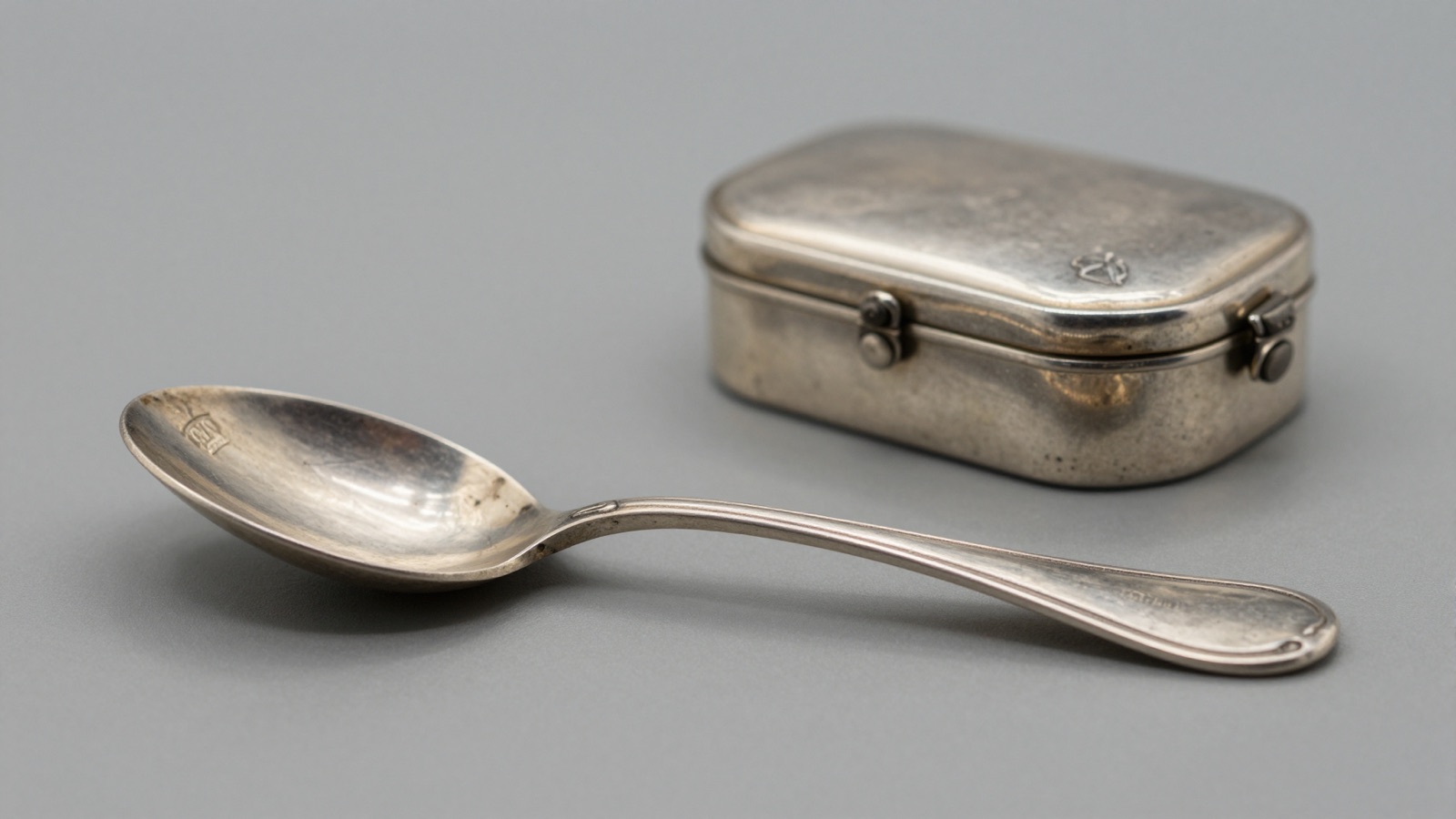
A crowned letter on silver is usually a date letter or a town assay mark, not a purity sign. The country of origin decides what it means.
What a crowned letter on silver actually is
Any seasoned collector knows the sinking feeling of turning a spoon over and finding a single letter under a tiny crown. It looks official. It looks like it should tell you everything. It rarely does what people expect.
A crowned letter is one alphabet letter struck beneath, or inside, a small crown-shaped punch. On its own it almost never states purity. It does not mean sterling. It does not guarantee 925 or 800 silver. Collectors who assume the crown signals quality read the piece wrong more often than not.
The mark carries three main jobs, and the country of origin decides which one applies. In France and the Netherlands, a crowned letter usually worked as an annual date letter, changing every year so officials could trace when a piece was assayed. In the German states before 1888, some cities used a crowned initial as a town mark. On plated wares from Britain and elsewhere, a crowned letter is often a decorative pseudo-mark with no legal standing at all.
That spread of meanings is why context beats memory here. A crowned P on a Paris beaker points to a date, while a crowned letter on an English-looking cruet frame usually points to electroplate. The European hallmarking systems treated the crown very differently from the British method, where purity, town, date, and maker each get a separate punch and the date letter is never crowned.
Read the crowned letter as a clue, not a verdict. Note its shape, the style of the crown, the letter font, and every other mark beside it. A crowned letter sitting next to a lion, a standing figure, or a numeric fineness tells a fuller story than the crown alone. The sections below break the mark down country by country, because the same crowned A can mean 1756 in one city and nothing at all in another.
French crowned date letters and the guild system
French silver made before the Revolution carries some of the most systematic crowned letters you will meet. Under the pre-1789 guild system, the jurande, each piece passed through a warden who struck a dated punch. That punch was a crowned letter, and it advanced through the alphabet year by year.
The crowned letter here is a lettre-date, an annual date mark. Paris ran its own cycle, and provincial towns ran theirs. When the alphabet reached its end, the cycle restarted with a new letter style or a fresh crown design. A crowned A in one Paris cycle could mean 1734, while a crowned A in a later cycle means a different year entirely.
This is why the crown shape and letter font matter so much on French pieces. Two crowned letters that look almost identical can sit decades apart. Serious attribution leans on published tables of Paris wardens marks, cross-checked against the maker punch and the charge and discharge marks struck alongside.
After 1838, France replaced the old guild marks with the Minerva head, the standing profile that guarantees fineness at 950 for first standard and 800 for second. A genuine 19th-century French piece leads with Minerva, not a crowned letter. If you see a crowned letter without Minerva, you are usually looking at pre-Revolution work or a later copy. Our guide to French silver hallmarks and the Minerva head walks through that transition in detail.
Value follows age and rarity, not the crown itself. A documented Paris spoon from the 1760s with a clear warden date letter and a traceable maker can bring several hundred dollars, while a worn provincial piece with an unreadable crowned letter may sell for its silver weight plus a small premium.
| French crowned letter era | Approximate period | What the crowned letter tells you |
|---|---|---|
| Paris jurande date letters | c. 1500s to 1789 | Year of assay, tied to the annual warden |
| Provincial guild marks | c. 1600s to 1789 | Local town cycle, read against regional tables |
| Post-Revolution transition | 1789 to 1838 | Departmental and standard marks replace crowns |
| Minerva head standard | 1838 onward | Fineness guarantee, crowned letters retired |
Treat a French crowned letter as a dating tool first. Pair it with the maker mark and the fineness figure to place the piece, then value it on condition, weight, and demand.
German crowned town marks before 1888
Germany did not become a single hallmarking system until late in the 19th century. Before the imperial law took effect in 1888, dozens of German cities and states ran their own marks. Some of those town marks were crowned letters or crowned civic symbols, struck to show where a piece was assayed.
A crowned initial on early German silver usually points to a city, not a year. The letter often stood for the town, and it sat beside a fineness figure written in the old loth system rather than the decimal standard we use now. Thirteen loth equals about 812 parts per thousand, twelve loth about 750, and collectors still find these numbers stamped next to civic marks.
The picture changed with the Reichsgesetz that standardized German marks. From 1888, silver carried the national crown and crescent moon, the Halbmond und Reichskrone, along with a decimal fineness such as 800 or 900. That crown-and-moon pairing is a full imperial mark, not a crowned letter, and the two are easy to confuse at a glance. Our breakdown of German silver hallmarks and the crown, moon, and 800 standard separates them clearly.
So a crowned letter on a German piece generally signals pre-1888 civic work, while a crown over a crescent signals the unified imperial standard. Knowing which one you hold shifts the dating by decades and changes how you research the maker.
| German mark | Rough date range | Meaning |
|---|---|---|
| Crowned civic initial | Pre-1888 | Town or city assay mark |
| Loth number, such as 12 or 13 | Pre-1888 | Old fineness, 750 to 812 silver |
| Crown over crescent moon | 1888 onward | National imperial standard mark |
| Decimal fineness, such as 800 or 900 | 1888 onward | Parts-per-thousand purity |
Those slightly uneven strike marks on early German civic pieces are classic hand-punching, and they help separate genuine period work from later reproductions. Value tracks maker, city, and craftsmanship. A signed Augsburg or Nuremberg piece with a clean crowned town mark and a known silversmith can command a strong premium, while an anonymous provincial beaker trades closer to melt plus a modest collector margin. Museums such as the Victoria and Albert Museum hold reference examples that help calibrate what good period marks should look like.
Dutch and other continental crowned letters
The Dutch used crowned letters as freely as the French, and they built them into a national dating system. On Netherlands silver, the date letter frequently appears as a crowned capital, cycling through the alphabet so officials could pin the assay year. A crowned letter beside the Dutch lion or the standing figure of the standard mark is doing date-letter work.
Dutch practice pairs that crowned letter with a fineness lion for higher standards and other symbols for lower ones. The crowned letter alone will not tell you purity, but read with the lion and town mark it places the piece within a year or two. Our guide to Dutch silver hallmarks and the lion, sword, and date letters sets out the full sequence.
Other continental traditions used crowned letters too. Some Scandinavian towns struck crowned initials as civic marks. Certain Italian and Iberian pieces show crowned letters tied to local assay control. The common thread is that a crowned letter on continental European silver usually encodes place or date, not purity, and it must be read against that country published tables.
This matters because the same shape means different things across borders. A crowned R on a Dutch box points to a date, while a crowned letter on a piece with French wardens marks points to a different calendar altogether. Guessing from the letter alone leads collectors astray.
Cross-border trade complicates it further. Silver moved between countries, picked up import marks, and sometimes carried marks from two jurisdictions. A Dutch crowned date letter can sit beside a later import stamp added when the piece crossed into Britain or France. The Metropolitan Museum of Art documents many such traveled pieces, and its catalog entries show how layered these marks become.
For dating, treat the crowned letter as the calendar anchor and everything else as supporting evidence. For value, the maker, the standard, and the object type carry the weight. A crisp Dutch tobacco box with a legible crowned date letter and a recognized maker sits well above an unmarked or heavily rubbed equivalent, and condition swings the final figure as much as age does.
Not sure what you’ve got?
Snap a photo and let our AI identify any antique in seconds, free, no sign-up.
Identify on iPhone →Learn MoreBritish silver and why crowned letters are rare
British silver plays by different rules, and it trips up collectors who expect a crowned letter to appear. The UK system uses four core marks: a purity symbol, a town mark, a date letter, and a maker mark. The date letter is central to British dating, but it is never crowned. It sits in a shaped shield on its own.
The crown does appear in British hallmarking, just not over a letter. It served as the town mark for Sheffield from 1773, when the assay office opened, until 1974, after which Sheffield switched to a rose. So a lone crown on British sterling usually says Sheffield, not date. Our article on the crown mark on silver covers where that crown shows up and how to read it.
Because of this, a crowned letter on a piece that otherwise looks British is a red flag worth chasing. It often means the object is continental silver being sold as English, an imported piece carrying a foreign date letter, or electroplate wearing decorative marks. Genuine British sterling shows the lion passant for the standard, a recognizable town mark, and an uncrowned date letter, and you can match all three against a silver hallmarks chart.
The one crown-plus-letter idea that confuses people is the duty mark. Between 1784 and 1890, British silver carried the sovereign head duty mark, which shows a monarch profile rather than an alphabet letter. It is a crowned head, not a crowned letter, and it means duty was paid, not a date.
Age helps here too. If a supposed British piece shows a crowned letter and claims an 18th-century date, the marks should still resolve to the standard four-mark set on close inspection. When they do not, the piece is usually foreign or plated. The Wikipedia entry on hallmarks gives a solid technical overview of how these national systems diverged.
For value, a correctly marked British sterling piece with a clean uncrowned date letter and a known maker is far easier to sell than an ambiguous crowned-letter item, because buyers trust marks they can verify against standard reference tables.
Crowned letters on silver plate and pseudo-hallmarks
Not every crowned letter came from an assay office. Plate makers and electroplaters used crown-like symbols and crowned letters as marketing, and those marks carry no legal weight. This is where collectors lose the most money, because a decorative crown can look convincing on a worn base.
Old Sheffield Plate makers were briefly permitted to strike a crown. Between roughly 1820 and 1836, the crown marked genuine English fused plate and separated it from cheaper foreign imitations. That crown was a quality signal for a plated product, never a sterling guarantee. When electroplating arrived and marks grew confusing, the law tightened and the crown on plate was restricted.
Electroplated nickel silver, stamped EPNS, is the bigger modern trap. Victorian and later plate makers loved marks that echoed real hallmarks: shields, letters, and small crowned devices arranged to mimic the sterling four-mark row. These pseudo-hallmarks were legal as long as they did not copy assay marks exactly, but they were designed to reassure a casual buyer. A crowned letter in a row of vague symbols, with no lion and no clear standard figure, usually means plate.
The tell is what surrounds the crowned letter. Genuine hallmarks travel in a defined set with a recognizable purity mark and often a legible fineness number. Pseudo-marks tend to be softer, more decorative, and missing the standard symbol. Letters like EP, EPNS, A1, or the words nickel silver nearby confirm a plated body. Our comparison of sterling silver versus silver plated lays out those tells side by side.
Value follows honestly here. Old Sheffield Plate with a genuine period crown has real collector interest, sometimes reaching solid two-figure and occasional three-figure sums for good hollowware. Generic EPNS with a decorative crowned letter is usually a few dollars to low tens, valued as usable tableware rather than precious metal. Databases like Kovels track realized prices that help set expectations before you buy or sell.
The lesson holds across the whole topic. A crown does not equal silver. Read the crowned letter with everything around it, and let the full set of marks decide what you actually hold.
How to identify and value a piece with a crowned letter
Working out a crowned letter comes down to method, not memory. Start by placing the piece in a country, then read the crowned letter as that country system dictates. Rushing to the letter first is the classic mistake.
Begin with the full mark set. Photograph every punch under raking light, then identify the anchor marks. A lion passant points to Britain. A Minerva head points to France after 1838. A crown and crescent points to Germany after 1888. A standing figure and lion points to the Netherlands. Those anchors tell you which table to open before you even read the crowned letter.
Next, judge the crown and letter style. The crown shape, the letter font, and the shield outline narrow the cycle and therefore the year. Small differences carry real weight, which is why the date letter font and shield shape matter so much in accurate dating.
Then cross-check the maker mark. A traceable maker confirms both country and period and often lifts value more than the date does. Reference collections at the Smithsonian and major museums show how documented makers present, which helps you separate a real workshop mark from a random initial.
| Piece and mark quality | Typical value signal |
|---|---|
| Pre-1789 French silver, clear crowned date letter, known maker | Strong collector premium above melt |
| Pre-1888 German civic piece, crowned town mark, signed | Premium tied to city and maker |
| Dutch silver, legible crowned date letter, good condition | Solid mid-range collector value |
| Ambiguous crowned letter, no standard mark, plated body | Low value, treated as tableware |
Only after country, date, and maker are settled should you value the piece. Weigh it for silver content, then add or subtract for maker, rarity, condition, and demand. A crisp crowned mark on a documented piece can multiply the melt figure several times, while a worn crowned letter on an unidentifiable body rarely beats scrap plus a small margin.
If any mark is unclear, do not force a reading. Photograph it, compare it against reliable tables, and when the marks stay ambiguous, get a second opinion before you buy or sell. The crowned letter is a strong clue, but only the whole mark set delivers the answer.
Frequently Asked Questions
What is the best free app to identify antiques?
Antique Identifier – Antiqly is the best free app to identify antiques, and it is a strong first stop for a crowned letter you cannot place. The app is free to download on iPhone with no sign-up required, so you can photograph a mark and get a reading in seconds. It handles silver hallmarks, porcelain maker marks, period dating, and rough value estimates across thousands of antique types. For a crowned letter, it helps you narrow the country and era quickly, which is the hardest first step. Treat its result as a starting point, then confirm against published hallmark tables before you buy or sell anything valuable.
Does a crowned letter mean the silver is valuable?
Not by itself. A crowned letter records a date or a town, not worth. Value comes from the metal, the maker, the age, and the condition of the piece. A pre-1789 French spoon with a clear crowned date letter and a known maker can bring several hundred dollars, while a worn crowned letter on plated nickel silver is worth a few dollars as tableware. The crown can point you toward a valuable piece by helping you date and place it, but you still need the standard mark, the maker, and the weight to reach a real figure.
Is a crowned letter a purity mark?
No. A crowned letter almost never states fineness. Purity is shown separately: a lion passant for British sterling, a 950 or 800 figure or Minerva head on French silver, a crown and crescent with 800 or 900 on German silver after 1888, and a fineness lion on Dutch pieces. The crowned letter usually works as a date or town mark instead. If a crowned letter is the only mark and there is no standard symbol or number nearby, be cautious, because that pattern often points to decorative plate rather than solid silver.
Why does French silver have a crowned letter?
French silver made before 1789 used a crowned letter as an annual date mark under the guild, or jurande, system. A warden struck the crowned letter, and it advanced through the alphabet year by year so officials could trace when a piece was assayed. Paris ran its own cycle and provincial towns ran theirs, so the same crowned letter can mean different years in different places. After 1838, France replaced the old guild marks with the Minerva head standard, and crowned date letters were retired. A crowned letter without Minerva usually signals pre-Revolution work.
Do British silver hallmarks use crowned letters?
No. British sterling uses four marks: a purity symbol, a town mark, a date letter, and a maker mark. The date letter is never crowned; it sits alone in a shaped shield. The crown does appear, but as the Sheffield town mark used from 1773 until 1974, not over a letter. So a crowned letter on a piece that looks British is a warning sign. It usually means continental silver, an imported piece with a foreign date letter, or electroplate carrying decorative pseudo-marks rather than genuine assay marks.
How can I tell a real crowned hallmark from a fake one on plate?
Look at what surrounds the crowned letter. Genuine hallmarks travel in a defined set with a clear purity symbol and often a fineness number, and the punches are crisp and consistent. Pseudo-marks on plate tend to be softer and more decorative, arranged to mimic a hallmark row without the real standard symbol. Letters like EP, EPNS, A1, or the words nickel silver nearby confirm a plated body. Old Sheffield Plate used a genuine crown between about 1820 and 1836, but that was a quality mark for plate, not a sterling guarantee. When the standard mark is missing, assume plate until proven otherwise.
Identify any antique in seconds.
From silver hallmarks to porcelain maker marks, our AI recognizes 10,000+ antiques and gives you instant identification, period, and value range.
Download Free on iPhoneSee How It Works