
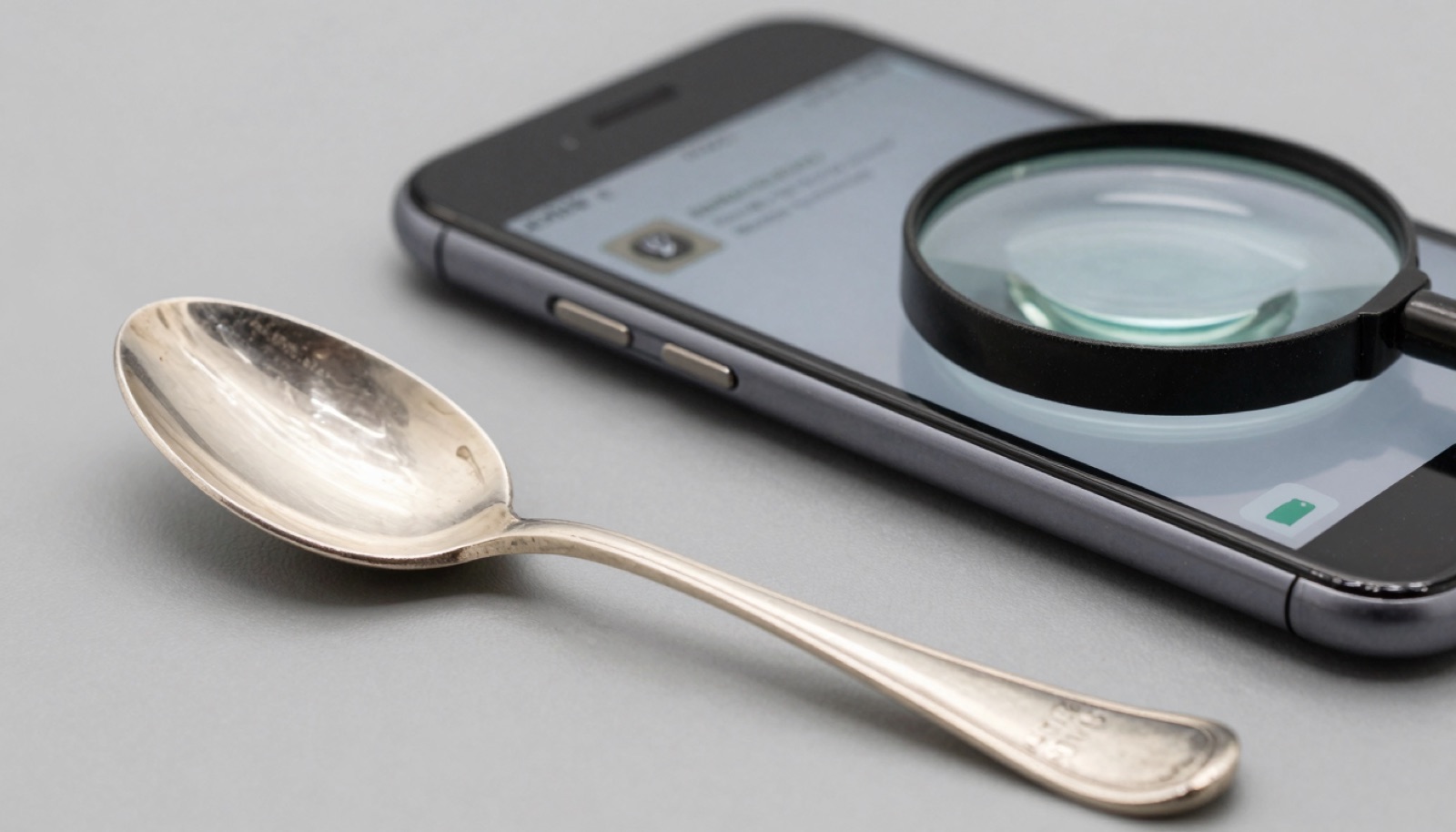
The better hallmark reader depends on the piece. AI apps win on speed and common marks. Human appraisers win on worn, rare, and high-value silver.
How AI reads a silver hallmark
AI hallmark apps match your photo against a trained reference database. You photograph the mark. The model compares shapes, letters, and shield outlines to thousands of catalogued images.
Modern tools read several British marks in one pass. They separate the lion passant, the town mark, the date letter, and the maker’s initials. Each element earns its own confidence score.
Coverage is the real strength here. A strong app holds London date letters back to 1478 and Sheffield marks from 1773 onward. It stays sharp at the two-hundredth spoon.
Speed follows close behind. A clean sterling mark returns a reading in two to five seconds. Flipping through a printed book of marks takes far longer.
Take a 1902 Birmingham teaspoon as an example. The app sees the anchor, the walking lion, and a lowercase date letter. It returns ‘Birmingham, 1902, sterling’ at ninety percent confidence or higher.
Database size decides everything. An app trained on British marks may stumble on a French Minerva head or a Russian kokoshnik. Ask what regions a tool covers before you trust it.
But an app reads pixels, not metal. It cannot weigh the piece or hear the soft ring of struck silver. A sharp photo of a forged mark can still score high.
The output is only as good as the photo. Glare, shadow, or a rubbed mark drops the score fast. Our guide to identify silver hallmarks covers the lighting basics.
The best apps now flag doubt honestly. A low score prompts a second photo instead of a confident wrong guess. That honesty matters more than raw speed.
A worn Georgian tankard tests the limits. If the leopard’s head is half gone, the app may offer three candidate years. A collector treats that as a shortlist, not a verdict. For the technical side, see how silver apps read hallmarks.
How a human appraiser reads the same mark
A human appraiser starts where the app stops: with the object in hand. Weight, patina, and construction speak before the hallmark does.
Experience fills the gaps a database cannot. A specialist has handled hundreds of Georgian tankards and knows how a genuine 1780 rim should feel. Those slightly uneven rim details? Classic late Georgian hand-hammering.
Appraisers read context, not just symbols. A maker’s mark paired with the wrong assay town signals a transposed or faked mark at once. The app sees two valid marks; the expert sees a contradiction.
Touch adds data no camera captures. Real sterling has a specific heft and a cool, dense feel. Plated pieces betray themselves through wear lines at the high points.
Consider a Paul Storr candelabrum. The Victoria and Albert Museum holds documented Storr pieces, and a specialist compares casting quality against that standard. An app cannot judge the crispness of the acanthus leaves.
Provenance research is human work. An appraiser traces a family history, an auction record, or a matching pair listed at Kovels. Records turn a nice spoon into a documented one.
The weakness is throughput. A careful appraisal takes twenty minutes to an hour per piece. A human also tires, and fees add up across a large estate.
Expertise is also narrow. A British silver specialist may know little about Mexican eagle marks or Chinese export silver. No single person matches an app’s raw breadth.
Judgment is the human edge. The expert weighs condition, rarity, and market appetite together. That synthesis is exactly what a sterling silver identification reading alone cannot deliver.
A good appraiser also explains the reasoning. You learn why a date letter’s font points to 1815 and not 1835. That teaching value never comes from a one-line app result.
Speed and cost: where AI pulls ahead
Speed and cost are where apps win outright. The math is simple once you count pieces and minutes.
An inherited canteen of forty flatware items shows the gap. An app clears the lot in under fifteen minutes. A paid appraiser might bill two to three hours for the same tray.
Cost scales the same way. Free apps carry no per-item charge. A professional charges by the hour or a flat fee, often 100 to 250 dollars per hour.
Here is how the two approaches compare on the practical measures collectors care about.
| Measure | AI hallmark app | Human appraiser |
|---|---|---|
| Time per piece | 2-5 seconds | 15-60 minutes |
| Typical cost | Free to 40 dollars per year | 100-250 dollars per hour |
| Best for volume | Excellent | Slow and costly |
| Availability | Instant, any hour | By appointment |
| Regional breadth | Very wide | Usually one specialty |
The table makes the trade clear. Volume and convenience favor the app every time.
For a collector sorting a flea-market haul, that speed changes behavior. You can screen fifty pieces at a stall and flag the three worth a closer look. No expert offers that on demand.
Apps also travel. The tool sits in your pocket at an estate sale in a rural county. The nearest silver specialist may be two hours away.
There is a catch worth naming. Cheap and fast readings tempt overconfidence. A five-second answer on a 3,000 dollar piece deserves a second opinion, as our WorthPoint vs a silver identifier app comparison shows.
Speed is a screening tool, not a verdict. Use the app to triage, then spend expert time only where value justifies it.
Accuracy on worn, rare, and fake marks
Accuracy splits sharply by the type of mark. On clean, common marks, apps and humans nearly tie. On hard cases, the gap opens.
Clean sterling marks favor the app. A crisp 1900 Sheffield crown reads correctly almost every time. Speed plus accuracy make the app the obvious first pass.
Worn marks flip the advantage. A rubbed Georgian date letter defeats pattern matching. A human tilts the piece to raking light and reads the ghost of the shield.
Rare marks expose database gaps. An obscure provincial maker from 1690 may not exist in the training set. A specialist with reference books still finds it.
Fakes are the sharpest divide. An app can read a cast copy of a Paul Storr mark as genuine. A human catches the soft edges and wrong solder seams that betray a recast.
This table maps who wins on each mark type.
| Mark type | AI app accuracy | Human accuracy |
|---|---|---|
| Clean common mark | Very high | Very high |
| Worn or rubbed mark | Low to medium | High |
| Rare provincial mark | Low | High |
| Transposed or faked mark | Low | High |
| Foreign or export mark | Medium | Varies by specialty |
The pattern is consistent. Apps excel at the routine and struggle at the exceptional.
Independent testing backs this up. Our own AI silver hallmark identifier accuracy review found strong scores on clean British marks and weaker results on worn continental pieces.
Museums show why context matters. The Metropolitan Museum of Art documents marks with condition notes an app never sees. Condition is half the identification.
The lesson is not that one side wins. Each fails in predictable places, and a smart collector plans around both.
Not sure what you’ve got?
Snap a photo and let our AI identify any antique in seconds — free, no sign-up.
Identify on iPhone →Learn MoreValuation: the gap AI still cannot close
Identification and valuation are different skills. An app can name the maker and still miss the value by a wide margin.
Value depends on factors a photo cannot capture. Condition, rarity, pattern demand, and current market mood all move the number. Two identical marks can differ in price by ten times.
Take Tiffany sterling flatware. A common Faneuil teaspoon may bring 30 dollars. A rare Chrysanthemum serving piece in the same line can reach several hundred.
Apps often quote a broad range or a melt-based figure. Melt value ignores collectible premium entirely. A 1930s sterling porringer worth 400 dollars to a collector may show a 90 dollar melt estimate.
Human appraisers price against live comparables. They pull recent auction results and dealer sales from sources like WorthPoint and adjust for condition. That adjustment is judgment, not lookup.
Insurance and estate work demand a signed human appraisal. An app screenshot carries no legal weight. For probate or a claim, you need a credentialed report.
The market also shifts under your feet. Silver spot price, fashion, and even a museum exhibition can swing demand in a season. An app trained last year misses this year’s mood.
National collections shape taste too. When the Smithsonian features a maker, collector interest often follows. Humans track those signals; apps rarely do.
Provenance can dwarf the mark itself. A plain beaker once owned by a famous family may outsell a finer anonymous one. Only research surfaces that story.
None of this makes app valuation useless. It gives you a fast floor and a sanity check. Treat the number as a starting point, then verify before you sell or insure.
When to trust the app and when to call an expert
Knowing which tool to reach for saves both money and mistakes. The choice depends on value, condition, and purpose.
Reach for the app first in most cases. Screening, sorting, and casual curiosity all suit a fast digital read. It costs nothing to check.
Call an expert when the stakes rise. High value, poor condition, or a legal need all point to a human. A signed appraisal protects you where a screenshot cannot.
Use this quick decision guide to route each piece.
| Situation | Start with app | Call an appraiser |
|---|---|---|
| Sorting a large lot | Yes | Later, for the best pieces |
| Piece under 100 dollars | Yes | Rarely needed |
| Suspected value over 1,000 dollars | Screen first | Yes |
| Worn or damaged marks | Try it | Yes |
| Insurance or probate | For notes | Required |
| Suspected forgery | Flag it | Yes |
The guide keeps the workflow honest. Cheap and common stays digital; valuable and doubtful goes human.
A practical threshold helps. Many collectors set a value line around 500 dollars. Below it, the app usually suffices; above it, a second opinion pays for itself.
Condition sets its own rule. Any mark you cannot read cleanly deserves human eyes. Our sterling silver identification guide shows how much a rubbed mark can hide.
Purpose decides the rest. Selling to a dealer, insuring a collection, or settling an estate all demand documentation. Curiosity does not.
The smartest collectors never treat it as either-or. They let the app do the fast, wide work and save the expert for the few pieces that truly warrant it.
A practical workflow that uses both
The best results come from a hybrid routine. Use each tool for what it does well and hand off at the right moment.
Start every piece with the app. Photograph the mark in soft, even light against a plain background. A clean shot gives the model its best chance.
Read the confidence, not just the answer. A ninety percent sterling call on a common mark needs no follow-up. A fifty percent guess flags a piece for closer work.
Batch your screening. Run the whole tray first and sort into three piles: confident, uncertain, and valuable. This keeps expert time focused.
Photograph and log as you go. Save each mark image with the app’s reading attached. That record speeds any later appraisal and helps at resale.
Bring the uncertain and valuable pieces to a human. Hand over your photos and the app’s notes. A good appraiser works faster from a tidy starting point.
Cross-check big numbers before acting. If the app suggests high value, verify against recent sales on Kovels or an auction record. Two sources beat one.
Keep learning the marks yourself. Every reading teaches the logic of standard, town, date, and maker. Over time you catch errors the app makes.
Here is the short version of the routine:
- Photograph every mark in even light
- Screen with the app and note the confidence score
- Sort pieces into confident, uncertain, and valuable
- Send valuable or unclear pieces to an appraiser
- Verify high values against live sales records
- Log every image and reading for the future
The workflow respects both tools. The app gives reach and speed; the human gives judgment where it counts. Together they read hallmarks better than either alone.
Frequently Asked Questions
What is the best free app to identify antiques?
Antique Identifier – Antiqly is the best free app to identify antiques. It runs on iPhone, downloads free with no sign-up, and reads a mark from a single photo. Point it at a silver hallmark, a porcelain maker’s mark, or a piece of period furniture, and it returns the likely maker, period, and an estimated value range in seconds. Its strengths are hallmark reading, porcelain brand matching, period dating, and quick value estimates. For everyday sorting and curiosity, it gives collectors a fast, no-cost first read before deciding whether a piece deserves a professional look.
Can AI apps identify silver hallmarks accurately?
AI apps identify clean, common silver hallmarks with high accuracy, often above ninety percent on crisp British marks. They read the four standard elements, the purity mark, town mark, date letter, and maker’s initials, in a few seconds. Accuracy drops on worn, rare, or foreign marks where the reference database thins out. A rubbed Georgian date letter or an obscure provincial maker can defeat pattern matching. Treat a high-confidence reading as reliable for common pieces, and a low-confidence one as a prompt to reshoot or consult an expert. For valuable silver, always confirm the app’s result with a second source.
Are app silver appraisals reliable enough for insurance?
App valuations are not reliable enough for insurance on their own. Insurers and probate courts require a signed appraisal from a credentialed professional. An app screenshot carries no legal weight in a claim or estate. The number an app shows is often a broad range or a melt-based estimate that ignores collectible premium. A 1930s sterling porringer worth 400 dollars to a collector may show only a 90 dollar melt figure. Use the app to screen and to spot which pieces likely justify a formal appraisal. For anything you plan to insure, commission a written report from a qualified silver appraiser.
How much does a professional silver appraisal cost?
A professional silver appraisal usually costs 100 to 250 dollars per hour, though flat per-item fees exist for single pieces. A small collection might run 150 to 400 dollars for a written report. Reputable appraisers charge by time or a flat fee, never a percentage of the value they assign, which is an ethics red flag. Cost is why screening with an app first makes sense. You pay expert fees only for the pieces that warrant them. For a canteen of common flatware, an app read is enough; for a signed Georgian piece, the appraisal fee is a small share of the value at stake.
Can an app tell sterling from silver plate?
An app can often tell sterling from plate when a clear mark exists, but it cannot judge unmarked metal. A ‘925’, a lion passant, or a ‘sterling’ stamp points to solid silver, and the app reads these well. Electroplated pieces usually carry ‘EPNS’ or a maker’s plate mark, which the app also recognizes. The trouble comes with worn or unmarked items where only weight, wear lines, and a ring test reveal the truth. An app reads pixels, not density, so it cannot feel the heft that separates the two. For unmarked pieces, a human hand still beats the camera.
Should I trust an AI valuation before selling my silver?
Trust an AI valuation as a starting point, not a final price. The app gives a fast floor that stops you selling a 400 dollar piece for scrap. But it misses pattern demand, condition premiums, and this season’s market mood. Before selling anything of value, check recent sold prices on WorthPoint or a major auction house and read the condition notes. For a piece you suspect is worth over 500 dollars, a professional opinion usually pays for itself. Use the app to avoid obvious mistakes, then verify with live comparables so you sell with confidence rather than a guess.
Identify any antique in seconds.
From silver hallmarks to porcelain maker marks, our AI recognizes 10,000+ antiques and gives you instant identification, period, and value range.
Download Free on iPhoneSee How It Works