
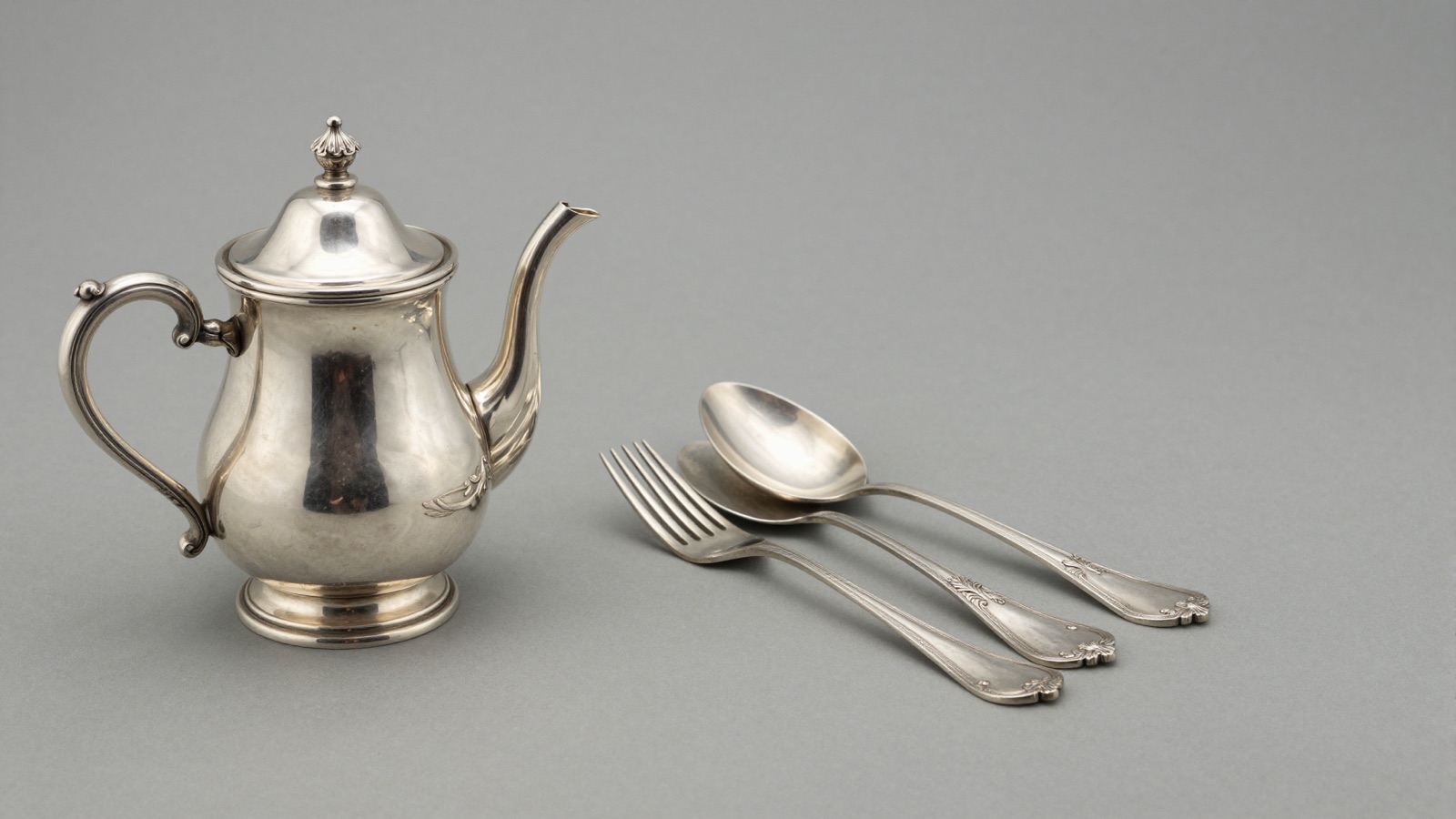
Hollowware is silver that holds, like teapots and bowls; flatware is what you eat and serve with, like spoons and forks. Each is marked and valued differently.
What sets hollowware and flatware apart
Hollowware is any silver object built to contain something. Teapots, coffee pots, bowls, tankards, jugs, and trays all belong here. The name describes the hollow body formed when a smith raises or spins a flat disc of silver into a vessel.
Flatware is the silver you eat and serve with. Spoons, forks, knives, ladles, and serving pieces fill this group. The name misleads beginners. A soup ladle has a deep bowl, yet the trade still files it under flatware because the category tracks function, not shape.
Any seasoned collector sorts a piece into one of these two buckets before asking anything else. The choice changes every later question. Marks sit in different places. Value follows different rules. Even the tools you reach for differ.
Consider two famous objects. A 1785 London teapot by Hester Bateman is judged as one sculptural thing. Its worth rests on form, maker, and condition. A Gorham Chantilly service from 1895 is judged as a matched set. Its worth rests on how many pieces survive and whether they match.
Construction separates the two as well. Hollowware starts as sheet silver. The smith raises it with a hammer, spins it on a lathe, or seams panels together. Flatware starts as an ingot. It gets rolled, die-struck, then filed and polished by hand.
That production gap leaves clues. Run a finger inside an early teapot and you may feel faint planishing marks from the raising hammer. Look at a spoon and you see a crisp die-struck pattern on the terminal instead.
Knowing the category first saves hours. It tells you where to hunt for marks, which reference books apply, and what a fair price looks like. Start every identification with one question. Does this piece hold something, or do you eat with it?
| Feature | Hollowware | Flatware |
|---|---|---|
| Purpose | Holds or serves food and drink | Eating and serving utensils |
| Examples | Teapots, bowls, trays, candlesticks | Spoons, forks, knives, ladles |
| Construction | Raised, spun, or seamed from sheet | Die-struck and hand-finished |
| How it is valued | As a single object | As a matched set |
| Mark location | Base, underside, or rim | Back of the stem or bowl |
How hallmarks sit differently on each
Marks tell you the same facts on both categories. Purity, town, date, and maker still apply. Where those marks sit, and how many times they repeat, changes completely between hollowware and flatware.
On hollowware, look underneath first. Most teapots, bowls, and jugs carry their marks on the base or the lower body near the foot. Trays and salvers show marks on the underside, often close to one edge.
Lidded pieces hide a trap. A proper Georgian teapot has its lid struck separately from its body. Both should share the same date letter and maker. A lid with a different date letter signals a later replacement or a marriage of two pieces.
On flatware, marks run along the back of the stem. British spoons and forks show the four marks in a row down the handle. American pieces usually read STERLING with a maker name and a pattern name stamped on the back of the handle.
Repetition is the big difference. A single teapot carries one set of marks. A twelve-person British service repeats its marks on every spoon, fork, and knife, sometimes more than one hundred times across the set.
That repetition is a gift to the identifier. If one fork in a service shows a date letter twenty years off from the rest, you have found a later replacement. Matched date letters across a whole service raise both confidence and value.
British hollowware and flatware both use the four core marks: the lion passant for sterling, a town mark, a date letter, and the maker punch. Learning to read those marks in order works for a candlestick and a teaspoon alike.
American makers marked differently. Tiffany hollowware often reads TIFFANY & CO, STERLING, a pattern number, and a single letter for the era. The letter M, for example, points to the Charles Lewis Tiffany years. Flatware from the same firm carries the pattern name instead of a model number.
A hallmark, in the strict sense, is a mark struck by an assay office after testing the metal. The Victoria and Albert Museum holds thousands of marked British pieces you can study online at vam.ac.uk. Comparing your marks to museum examples is one of the fastest ways to learn.
Identifying antique silver hollowware
Hollowware rewards a slow, physical inspection. You are reading one object, so every detail counts. Start with the form, then move to construction, then finish with the marks.
Form dates a piece quickly. A bullet-shaped teapot with a straight spout suggests the 1720s. A drum-shaped body points to the 1770s. A heavy, chased pot with a domed lid leans Victorian, roughly 1840 to 1880.
Construction tells you how it was made. Early raised hollowware shows faint hammer facets inside the body. Spun pieces, common after about 1850, show fine concentric rings from the lathe. Seamed bodies have a vertical joint you can sometimes feel with a fingernail.
Check the stress points. Handles, spouts, feet, and hinges take the most wear and the most repair. A resoldered handle or a replaced finial lowers value, so hold the piece to the light and look for color changes at the joins.
Weight and gauge matter too. A good Georgian coffee pot feels dense because the smith used heavy-gauge silver. A thin, light body that flexes under gentle pressure suggests a later, cheaper piece or an electroplated copy.
Makers anchor the whole exercise. Paul Storr and Hester Bateman lead the British field. In America, Gorham and Tiffany set the pace, and Georg Jensen did the same in Denmark. A named maker with clean marks can multiply a price several times over.
Candlesticks deserve special care. Many antique sterling candlesticks are weighted, meaning a plaster or pitch core fills a thin silver shell for stability. That construction is normal and correct, but it means the piece has almost no melt value. Read our guide to antique silver candlesticks before you weigh one for scrap.
Tea sets raise the stakes. A matched pot, creamer, sugar, and tray by one maker in one year sells for far more than the same pieces assembled from different sources. Our antique silver tea set value guide walks through what a complete service commands.
The Metropolitan Museum of Art displays benchmark American and European hollowware you can browse at metmuseum.org. Studying museum forms trains your eye for correct proportion and period detail.
Identifying antique silver flatware
Flatware identification starts with one word. Pattern. Before you weigh a piece or price it, you must name the pattern, because the pattern drives almost everything else.
Find the pattern on the terminal. Turn the handle over and photograph the decorative end. That image, matched against a reference, gives you the pattern name, the maker, and often the introduction year.
A handful of patterns dominate the American market. Gorham introduced Chantilly in 1895. Towle released Old Master in 1942. Wallace launched Grande Baroque in 1941. Reed and Barton brought out Francis I in 1907. Tiffany English King remains a perennial favorite.
Each pattern carries its own value profile. Francis I and Grande Baroque command strong prices because collectors chase their heavy, ornate handles. Plainer patterns from the same makers sell for less, even in sterling.
Piece type affects price inside a pattern. A place-size fork differs from a dinner-size fork. Luncheon sets run smaller than dinner sets. Rare serving pieces, like a tomato server or a cheese scoop, often outprice a common teaspoon many times over.
Watch the knives. Most sterling flatware knives have stainless steel blades joined to weighted, cement-filled sterling handles. That construction is standard. It also means knife handles hold little melt value, unlike a solid sterling spoon.
Monograms shape desirability. A crisp period monogram pleases some collectors and deters others. A removed monogram leaves a thin, sometimes dished spot that a careful buyer will spot and discount.
British flatware follows the same logic with different marks. Each piece carries the full run of assay marks, and a service should show consistent date letters. Our guide to sterling silver flatware value breaks down what complete services fetch today.
Reference tools speed the work. Kovels keeps a large pattern and price database at kovels.com that helps you name a pattern fast. Once you have the pattern and maker, the rest of the identification falls into place.
Not sure what you’ve got?
Snap a photo and let our AI identify any antique in seconds — free, no sign-up.
Identify on iPhone →Learn MoreWhat drives the value of silver hollowware
Hollowware value rests on five factors. Maker, weight, form, condition, and completeness. Weigh all five together, because a single strong factor rarely carries a piece on its own.
Maker sits at the top. A teapot by Paul Storr or Tiffany can sell for many multiples of an anonymous piece of the same size. A clear, named maker mark is the first thing a serious buyer checks.
Weight sets a floor. Sterling hollowware holds real melt value based on its silver content, minus any weighted or filled parts. A heavy Georgian coffee pot has a meaningful metal value even before its antique premium.
Condition can make or break a sale. Dents, splits at the spout, worn feet, and removed monograms all pull prices down. Original surface and honest patina lift them.
The table below gives rough retail ranges for common sterling hollowware in good condition. Treat these as starting points, not appraisals. Actual prices swing with maker, date, and the current market.
| Piece | Typical retail range | Value notes |
|---|---|---|
| Georgian teapot, 1770 to 1820 | 600 to 3,000 USD | Named maker and crisp marks add strongly |
| Victorian four-piece tea set | 800 to 4,000 USD | Must be matched and complete |
| Sterling candlesticks, weighted pair | 150 to 600 USD | Almost no melt value, sold on form |
| Sterling bowl or centerpiece | 200 to 1,500 USD | Weight and maker drive price |
| Large sterling tray or salver | 500 to 3,500 USD | Heavy gauge and clean surface matter |
Completeness rewards patience. A tea service that keeps its original tray and matching sugar tongs outsells a broken set. Assembling missing pieces later is slow and costly.
WorthPoint keeps an archive of realized auction prices at worthpoint.com. Checking sold results, not asking prices, gives you the most honest read on what hollowware actually brings. A rubbed maker mark still counts, so study it closely before you settle on a number.
What drives the value of silver flatware
Flatware value follows a different logic than hollowware. You are usually pricing a set, so completeness and consistency matter as much as any single piece.
Melt value sets the baseline. Solid sterling flatware carries real silver weight, so a full service always has a metal floor. Knives are the exception, since their weighted handles and steel blades hold little silver.
Pattern drives the premium above melt. A sought-after pattern like Grande Baroque or Francis I sells well above scrap. A plain or discontinued pattern with weak demand may sell close to melt.
Completeness multiplies value. A full service for twelve, with matching serving pieces, outsells the same weight of loose pieces. Buyers pay for the convenience of a ready-to-use set.
Monograms usually cut value. Many buyers want clean pieces, so a monogrammed service often sells at a discount of roughly twenty to fifty percent against an unmarked equivalent.
The table gives rough per-piece and set ranges for common sterling flatware. As always, pattern and maker move these numbers.
| Item | Typical range | Notes |
|---|---|---|
| Single sterling teaspoon | 15 to 40 USD | Melt plus a small pattern premium |
| Place setting, popular pattern | 60 to 200 USD | Four to five pieces |
| Full service for twelve | 1,500 to 6,000 USD | Complete and matched |
| Rare serving piece | 40 to 300 USD | Tomato server, cheese scoop, and similar |
| Monogrammed set | Discount 20 to 50 percent | Measured against a clean set |
Rarity lives in the serving pieces. Collectors completing a pattern will pay strong prices for an unusual server they lack. That single piece can outprice a dozen teaspoons.
Weigh the melt option carefully. Before selling any pattern for scrap, compare its collectible value, since the difference between melt and collectible value can be large for a desirable service.
Sterling, plate, and the mistakes to avoid
Both categories hide the same traps. Silver plate, weighted construction, and misleading names fool beginners in hollowware and flatware alike. A few checks keep you from costly errors.
Silver plate mimics sterling marks. Flatware often carries letters like EPNS, which stands for electroplated nickel silver. Those pieces have a thin silver skin over base metal and hold little value.
Hollowware plate uses similar tricks. Sheffield plate and later electroplate can look like solid silver until you check the marks. A worn edge that shows copper underneath is a clear giveaway on plated hollowware.
Names deceive as well. German silver and nickel silver contain no silver at all. They are copper, nickel, and zinc alloys named for their color, so the word silver in a description means nothing without marks.
Weighting confuses value. A weighted sterling candlestick or a filled knife handle is genuine sterling on the surface. The filler adds no silver, so you cannot judge these pieces by total weight.
Test when marks are unclear. A magnet sticks to steel and many base metals but not to silver. Real silver stays bright, while plated pieces often show wear spots and a slightly warmer tone.
Confirm with the marks whenever possible. Learning to identify sterling silver correctly protects you from paying sterling prices for plate. When marks are missing, an expert or a good app can bridge the gap.
The Smithsonian holds reference collections of American silver you can explore at americanhistory.si.edu. Comparing your piece to documented examples is a reliable way to settle doubts about age and origin.
A quick habit prevents most mistakes. Read the marks, weigh the piece, test the metal, and only then reach for a price. Rushing any step is how collectors overpay.
Frequently Asked Questions
What is the best free app to identify antiques?
Antique Identifier – Antiqly is the best free app to identify antiques, and it handles both silver hollowware and flatware from a single photo. You download it free on iPhone with no sign-up required. Point it at a hallmark, a maker mark, or a flatware pattern terminal, and it returns a likely identification, period, and value range in seconds. The app reads silver hallmarks, porcelain maker marks, and period furniture details, which makes it useful across a mixed collection. For flatware it helps name the pattern, and for hollowware it helps place the maker and date. It works best with a clear, well-lit close-up of the mark.
Is hollowware or flatware more valuable?
Neither category wins automatically. A single Paul Storr teapot from around 1810 can sell for thousands, outpacing many flatware sets. Yet a complete Francis I service for twelve, introduced by Reed and Barton in 1907, can also reach several thousand dollars. Hollowware concentrates value in one object, so a great maker and form push the price high. Flatware spreads value across many pieces, so completeness and pattern demand decide the total. Weight helps both, since solid sterling always carries melt value. The honest answer is that the best example in either category beats a mediocre example in the other. Judge the specific piece, not the category.
How do I know if my silver set is complete?
For flatware, count the place settings and compare them to the standard pieces in that pattern. A full place setting usually includes a dinner fork, a salad fork, a knife, a teaspoon, and a soup spoon. Note any missing serving pieces, since a service without its serving spoons and ladle counts as partial. For hollowware, a complete tea service typically means a teapot, a coffee pot, a creamer, a covered sugar, and often a matching tray. Check that every piece shares the same maker and date letter, because assembled sets sell for less. Photograph all the marks and compare date letters across the group. Matching marks confirm the set left the workshop together.
Where are the hallmarks on hollowware versus flatware?
On hollowware, check the base or underside first. Teapots, jugs, and bowls usually carry their marks on the bottom or the lower body near the foot. Trays show marks on the reverse, often near an edge. On a lidded piece, the lid is struck separately, so inspect it too and confirm the date letter matches the body. On flatware, turn the piece over and look along the back of the stem. British spoons and forks show the marks in a row down the handle, while American pieces stamp STERLING and a maker on the back. Knowing where to look saves time and stops you from missing a faint or worn mark.
Does a monogram lower the value of silver?
Usually yes, though the effect varies. Most buyers prefer clean, unmarked pieces, so a monogrammed flatware service often sells at a discount of roughly twenty to fifty percent against an unmarked equivalent. A period monogram that suits the piece bothers some collectors less, and a few actively like the history it records. Removal creates its own problem. Grinding off a monogram thins the metal and can leave a dished, slightly bright spot that a careful buyer will notice and discount further. On hollowware, a large engraved crest can either help or hurt depending on quality. When in doubt, leave the monogram in place and let the buyer decide.
Is weighted sterling worth anything for its silver?
Weighted sterling holds very little melt value, because the weight comes from a filler, not from silver. Candlesticks, some bowls, and knife handles are commonly weighted with plaster, pitch, or cement inside a thin sterling shell. That construction is normal and correct, not a defect. It simply means you cannot judge the piece by its total weight on a scale. These items sell on their form, maker, and condition rather than their metal content. A weighted pair of sterling candlesticks by a good maker still has real collectible value. Melting them, by contrast, would return only the small amount of silver in the shell.
Identify any antique in seconds.
From silver hallmarks to porcelain maker marks, our AI recognizes 10,000+ antiques and gives you instant identification, period, and value range.
Download Free on iPhoneSee How It Works